스밍 (seuming) — The Heart of Putting In Your Earphones at Midnight
At 11:50 p.m. on comeback night, a Korean fandom’s group chat suddenly goes quiet. Everyone has their earphones in, waiting for midnight. 스밍 (seuming) is a shortening of the English word “streaming,” and it means playing a favorite artist’s songs over and over on a music service. It has a different texture from simply listening to music. 스밍 (seuming) has a purpose — you hit play knowing that your one press becomes a number on the chart, and that the number turns into a ranking on a music show.
That’s why 스밍 (seuming) is a word closer to “taking part” than to “taste.” In Korean fandoms it’s used as another name for cheering someone on. Even if you can’t make it to the concert and can’t afford to buy ten copies of the album, anyone can do 스밍 (seuming). Leaving a playlist running all night is a way of saying, “I’m here.”
스밍 (seuming)
In form it’s a noun, but in real conversation it behaves almost like a verb. 스밍하다 (seuminghada) is the base form, but in everyday life people say 스밍 돌리다 (seuming dollida) far more often. 돌리다 (dollida) means to keep a washing machine or any machine running, so the image of a playlist rolling nonstop comes through intact. The moment you say you’re “rolling” 스밍 (seuming) rather than starting it, it stops being about appreciating one song and becomes a job measured in hours.
There’s a whole family of related terms. 스밍 리스트 (seuming riseuteu) is the playlist a fandom agrees on and shares, and 스밍 총공 (seuming chonggong) refers to everyone streaming together at a set time. 총공 (chonggong) is short for 총공격 (chonggonggyeok), “all-out attack,” so the word carries a temperature close to battle.
The nuance is light and giddy. Because it’s both new slang and fandom insider language, one word says everything among people who know it — but outside that circle, it often doesn’t land at all. These two qualities — being casual, and being an inside word — are what create the “awkward situations” we’ll look at below.
A Real Conversation
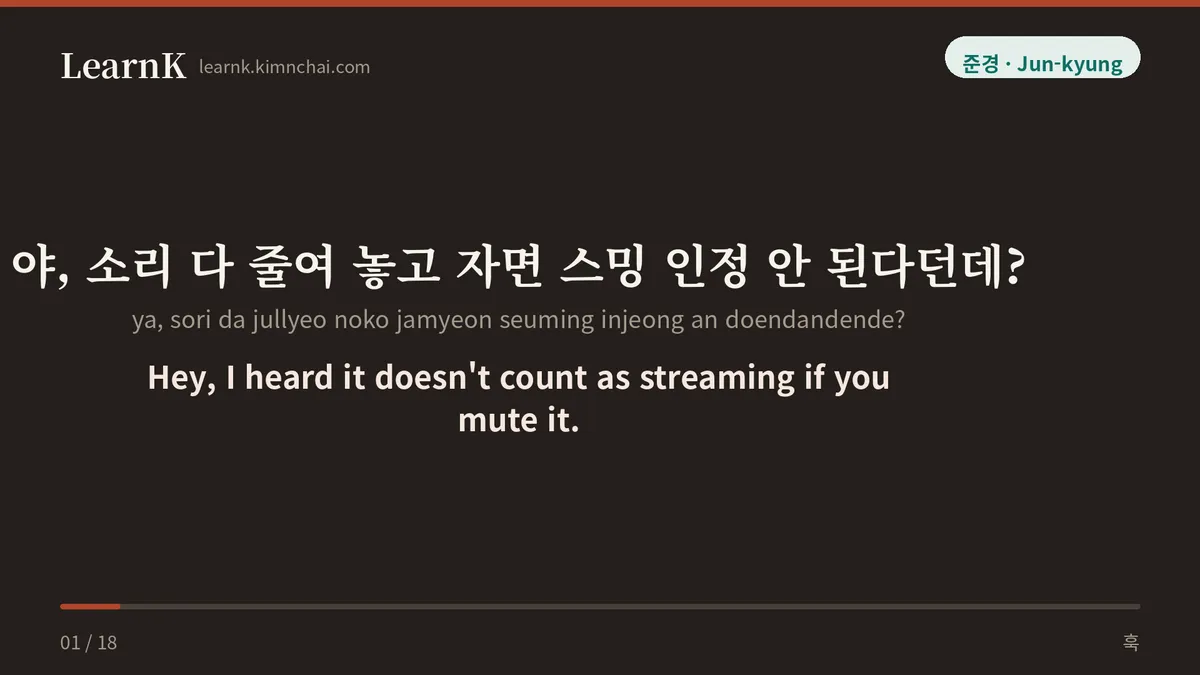
Scene: Friday night, 11:55 p.m., at a table outside a convenience store. Their favorite group’s new album drops at midnight.
Jun-kyung: 오 분 남았다. 너 이어폰 챙겼어? Five minutes left. Did you bring your earphones?
Emily: 당연하지. 나 오늘 밤새 스밍 돌릴 거야. Of course. I’m going to stream all night.
Jun-kyung: 밤새? 너 내일 출근 안 해? All night? Don’t you have work tomorrow?
Emily: 하지. 근데 첫날이 제일 중요하잖아. 자면서라도 틀어 놔야지. I do. But the first day matters most. I’ll leave it playing even while I sleep.
Jun-kyung: 야, 소리 다 줄여 놓고 자면 스밍 인정 안 된다던데? Hey, I heard it doesn’t count as streaming if you mute it while you sleep.
Emily: 뭐? 그럼 나 삼 년째 헛수고한 거야? What? So I’ve been wasting my time for three years?
When It Sounds Off
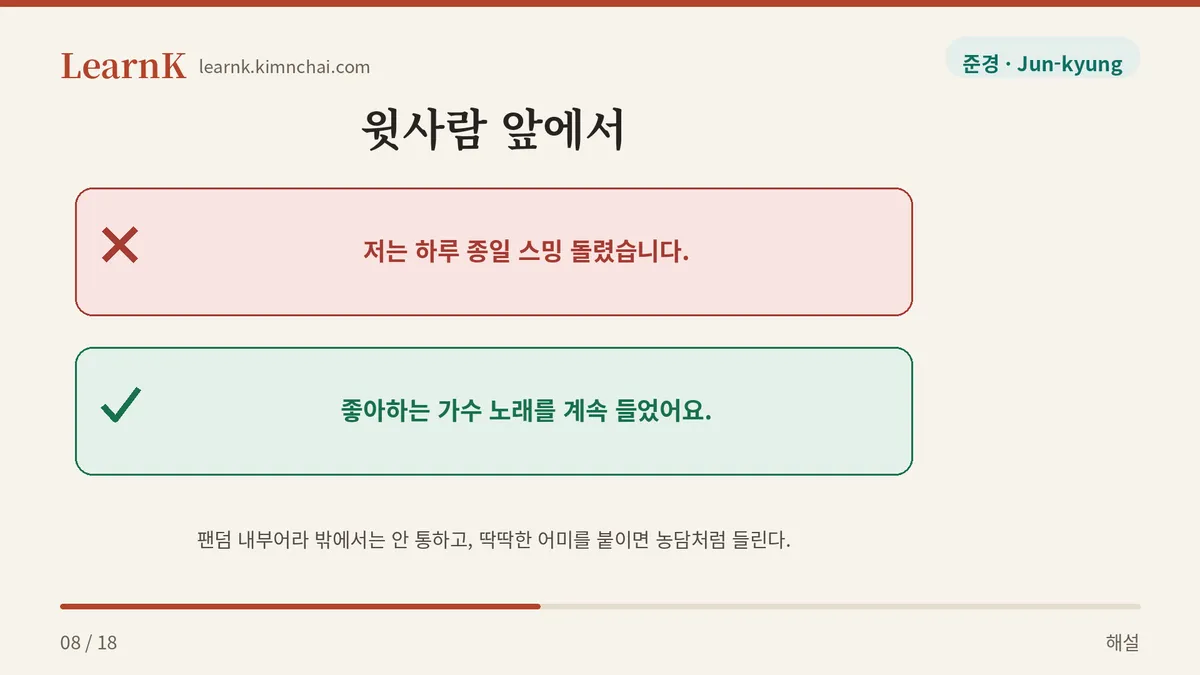
✗ (to your team leader) 팀장님, 주말에 뭐 하셨어요? 저는 하루 종일 스밍 돌렸습니다. (Sir, what did you do over the weekend? I rolled 스밍 all day long.) ✓ (to a coworker your own age) 나 주말에 하루 종일 스밍 돌렸잖아. (I spent the whole weekend rolling 스밍, you know.) → It’s a fandom abbreviation, so outside that circle the meaning doesn’t come across — and even when it does, it sounds like a bit of light wordplay. With someone senior to you, ‘좋아하는 가수 노래를 계속 들었어요 (joahaneun gasu norereul gyesok deureosseoyo)’ — “I kept listening to my favorite singer’s songs” — is the safer choice.
✗ 어제 넷플릭스로 드라마 세 편 스밍했어. (I 스밍’d three dramas on Netflix yesterday.) ✓ 어제 넷플릭스로 드라마 세 편 정주행했어. (I binge-watched three dramas on Netflix yesterday.) → English “streaming” covers video too, but Korean 스밍 (seuming) has hardened into meaning only the repeat-playing of songs on a music service. For binge-watching a drama, use 정주행 (jeongjuhaeng).
Example Sentences by Situation
1. Telling a friend about a comeback. Releases are often at midnight, so people talk about it like making plans.
오늘 자정에 신곡 나와. 같이 스밍 돌리자. (oneul jajeonge singok nawa. gachi seuming dollija.) The new song drops at midnight. Let’s stream it together.
2. Posting a playlist to a fan community. Here people use polite speech, and the sentences get short, like an announcement.
스밍 리스트 공유합니다. 순서 바꾸지 말고 그대로 틀어 주세요. (seuming riseuteu gongyuhamnida. sunseo bakkuji malgo geudaero teureo juseyo.) Sharing the streaming playlist. Please play it in this exact order.
3. When you’ve been too busy to keep up. The tone turns apologetic, because within a fandom 스밍 (seuming) is treated as something you’re supposed to do.
나 요즘 시험 때문에 스밍도 못 했어. 미안해서 앨범이라도 샀어. (na yojeum siheom ttaemune seumingdo mot haesseo. mianhaeseo aelbeomirado sasseo.) I haven’t even been able to stream lately because of exams. I felt bad, so I at least bought the album.
Casual vs. Polite Speech, and Similar Expressions
In casual speech, ‘스밍했어 (seuminghaesseo)’ / ‘스밍 돌렸어 (seuming dollyeosseo)’ sound natural; in polite speech, ‘스밍했어요 (seuminghaesseoyo)’ / ‘스밍 돌렸어요 (seuming dollyeosseoyo)’. Formal endings like ‘스밍하였습니다 (seuminghayeotseumnida)’, however, are almost never used. It isn’t a word you’d bring out in a formal setting to begin with, so attaching a stiff ending makes it sound like a joke.
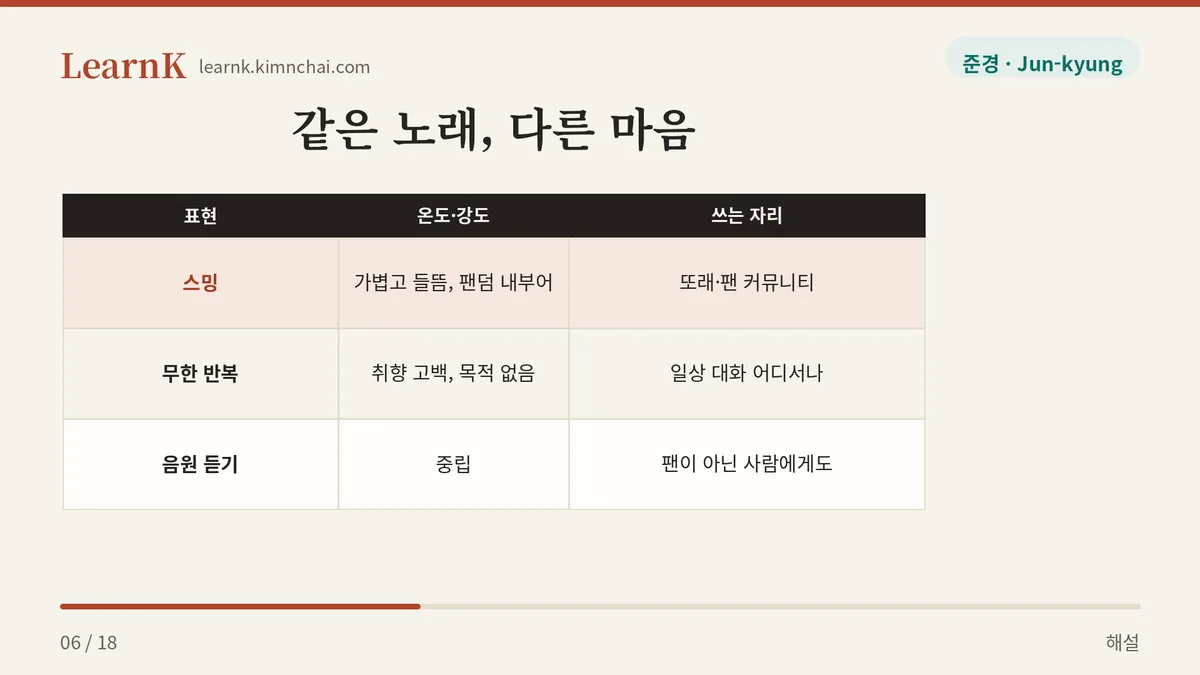
| Expression | Tone & intensity | Where it’s used |
|---|---|---|
| 스밍 (seuming) | Light and giddy, fandom insider word | Among peers, fan communities, social media |
| 총공 (chonggong) | Determined, organized | Fandom announcements, group chats |
| 음원 듣기 (eumwon deutgi) | Neutral | Anywhere, including with non-fans |
| 무한 반복 (muhan banbok) | A confession of taste, no agenda | Anywhere in everyday conversation |
The difference between 무한 반복 (muhan banbok) and 스밍 (seuming) matters especially. Both describe listening to the same song again and again, but 무한 반복 (muhan banbok) is being unable to turn it off because you love it, while 스밍 (seuming) is leaving it on for the numbers. That’s why ‘이 노래 무한 반복 중 (i norae muhan banbok jung)’ — “this song’s on infinite repeat” — is talking to yourself, while ‘스밍 돌리는 중 (seuming dollineun jung)’ — “currently rolling 스밍” — is a signal to join in.
Cultural Background — The Midnight Numbers Game
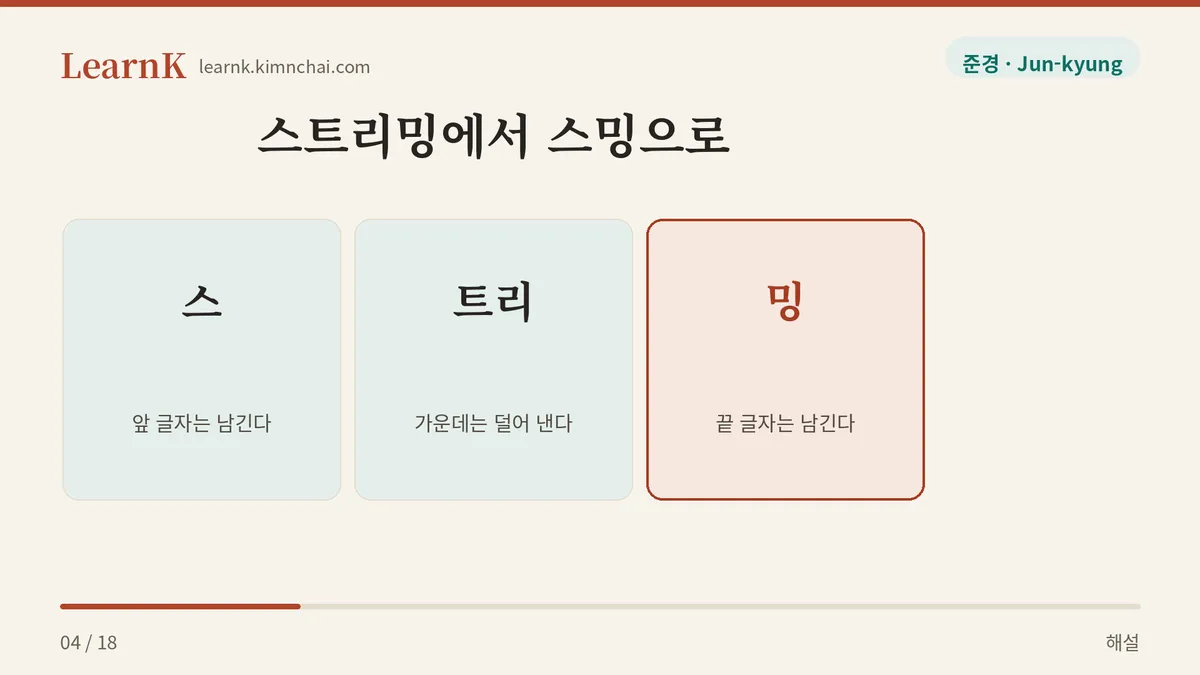
The word-formation is simple. Take the four-syllable 스트리밍 (seuteuriming), scoop out the middle, and keep the front and back: 스밍 (seuming). Korean abbreviations often work this way, keeping only the skeleton of the original word, so if you know the source word you can usually work your way back to it.
Behind the word’s rise are the Korean music charts. For a long time, domestic music services displayed real-time rankings, and streaming numbers carried heavy weight in how music shows calculated their weekly No. 1. That made the first few hours after release the decisive battleground, and fandoms built a culture of all hitting play together at midnight. It’s also why detailed rules get passed around among fans — the order of the playlist, keeping the volume above a certain level, not repeating just one song. Jun-kyung’s line about how it “doesn’t count if you mute it” is one of those rules.
That culture is shifting little by little, though. When Korea’s largest music service scrapped its real-time chart in 2021, people say the old scene of refreshing the rankings all night largely faded. Still, the word 스밍 (seuming) stayed. These days its meaning is broadening away from chart competition and toward a warm declaration: “I’m still listening to this song.” It’s also a word that shows up almost without fail whenever an idol-fan character appears in a drama or variety show.
What makes this word fun for Korean learners is that it isn’t in the dictionary, yet anyone who likes K-pop runs into it several times a day. The moment you know what it means, half the posts in a fan community suddenly become readable.
Today’s Quiz
Which of the following sentences uses ‘스밍 (seuming)’ naturally?
① 어제 넷플릭스로 영화 두 편 스밍했어. (I 스밍’d two movies on Netflix yesterday.) ② 새 앨범 나왔대. 오늘부터 같이 스밍 돌리자. (I heard the new album is out. Let’s roll 스밍 together starting today.) ③ 팀장님, 요청하신 자료 스밍해서 보내 드렸습니다. (Sir, I 스밍’d the documents you requested and sent them over.)
The answer is ②. ① is about video, so 정주행 (jeongjuhaeng) is the right word, and ③ has nothing to do with 스밍 (seuming) at all — on top of being something you’d never say to a superior. 스밍 (seuming) sounds natural when three things line up: it’s about music, among peers, and said lightly.