시차적응 (sichajeogeung) — When Your Body Is Still Back in the Other Country
시차적응
시차적응 (sichajeogeung) means the process of resetting your body’s rhythm to a new day-and-night cycle after traveling to a place in a different time zone. The moment the plane touches down, your watch flips to the new time right away — but your body doesn’t follow nearly that fast. You step out of the arrivals hall at Incheon Airport, the board says three in the afternoon, and your body is still living at three in the morning. Those few out-of-sync days are what Korean calls 시차적응.
If you’re a Korean-culture fan coming to Korea, you’re bound to run into this word. Those first few days when you land with a concert ticket in hand, your eyes close at eight in the evening, and at four in the morning you’re wide awake staring at the ceiling. When a Korean friend asks you “어제 잘 잤어?” (“Did you sleep well last night?”), this is the single most accurate answer you can give.
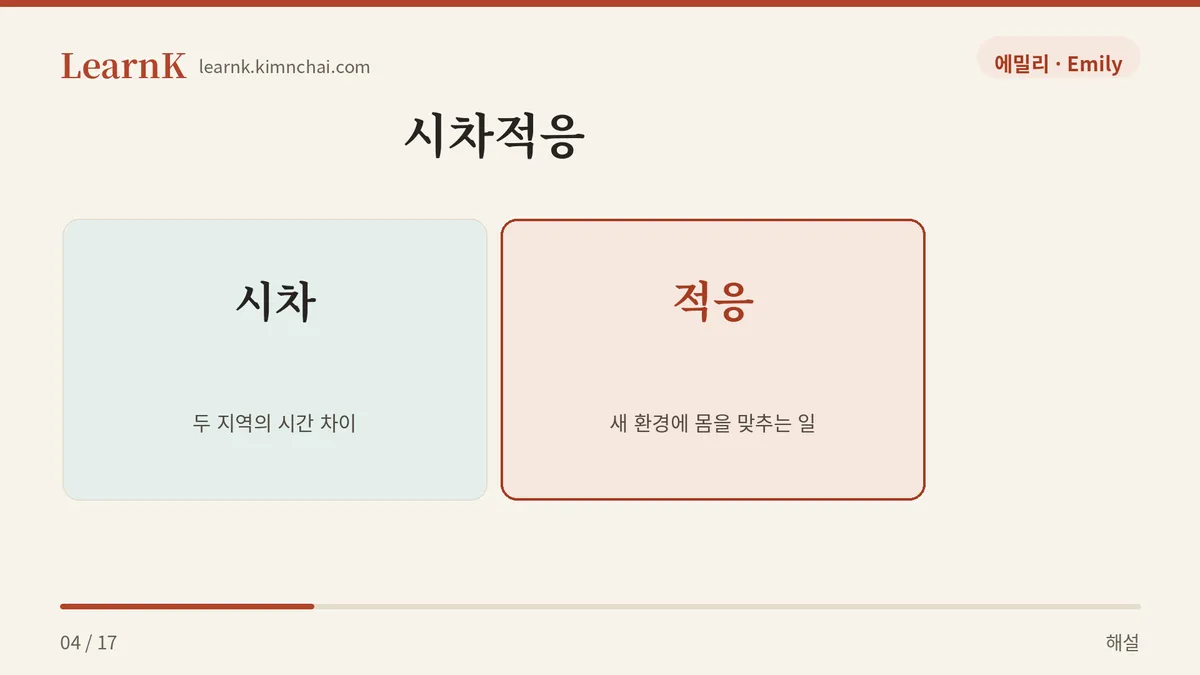
The structure of the word is simple. 시차 (sicha, 時差) is the time difference between two regions, and 적응 (jeogeung, 適應) is adapting your body or mind to a new environment. Put them together and you get “fitting yourself to a time difference.” So the word points to a process, not a symptom. It doesn’t mean you’re sick — it means you’re still in the middle of adjusting. Because of that distinction, Koreans almost always use this word together with 되다 / 안 되다 (“to be done” / “to not be done”).
- 시차적응이 안 됐어 (sichajeogeung-i an dwaesseo) — I haven’t adjusted yet
- 시차적응 중이야 (sichajeogeung jung-iya) — I’m in the middle of adjusting
- 시차적응 다 됐어 (sichajeogeung da dwaesseo) — I’m all adjusted now
- 시차적응하느라 힘들었어 (sichajeogeunghaneura himdeureosseo) — Getting through that adjustment was rough
One note on spelling. By the book, it should be written as two words — 시차 적응 — with a space. But in actual conversation and online writing, people write it as a single word far more often. Learners are better off getting used to the spaced-out-free version, since that’s what makes real Korean easier to read and to search for.
See It in a Real Conversation
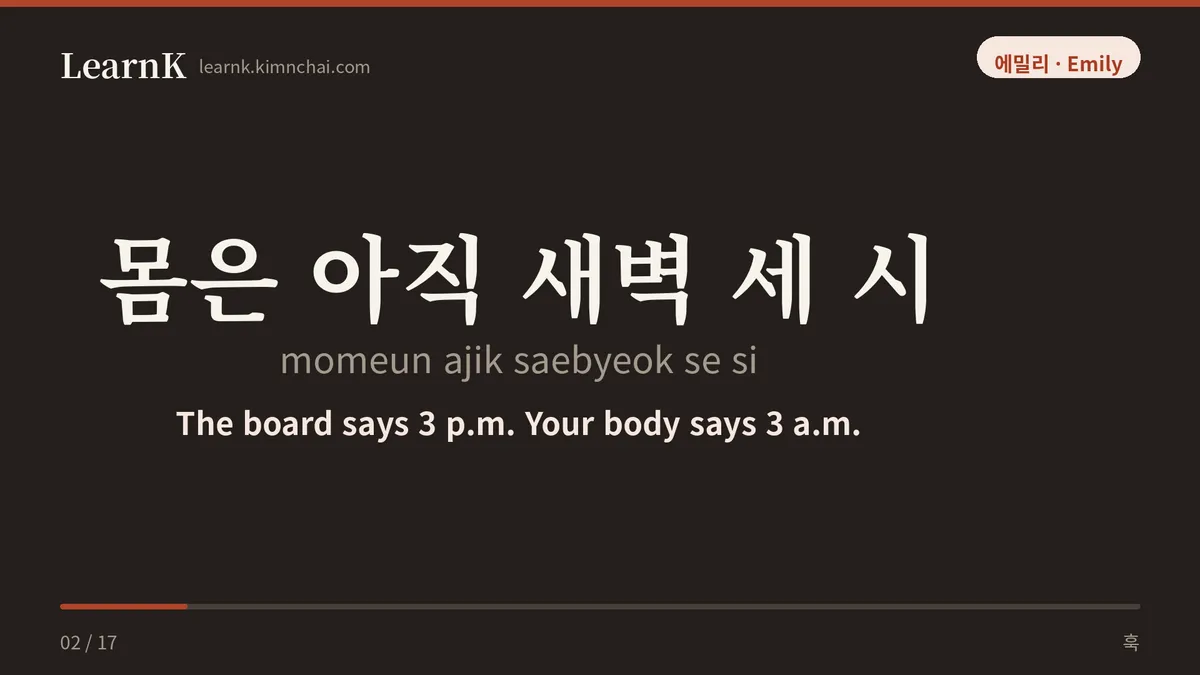
The scene: six in the morning, in front of the neighborhood convenience store. Jun-kyung is on his way back from a morning workout, and Emily, awake since four, has finally given up and come outside.
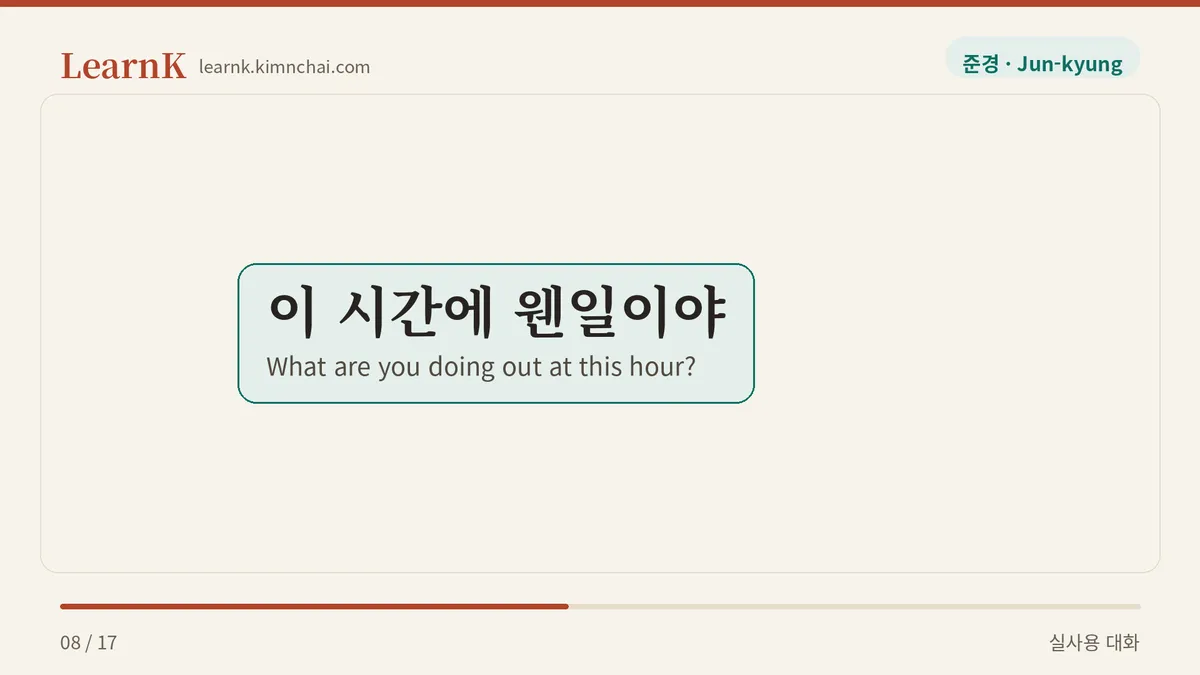
준경: 어? 에밀리 아니야? 이 시간에 웬일이야. Huh? Emily? What are you doing out at this hour?
에밀리: 나 새벽 네 시부터 깨 있었어. 시차적응이 아직 안 됐나 봐. I’ve been up since four. I guess I still haven’t adjusted to the time difference.
준경: 캐나다 갔다 온 지 며칠 됐지? How many days has it been since you got back from Canada?
에밀리: 오늘로 나흘째. 밤엔 말똥말똥하고 낮엔 죽겠어. Today makes four. Wide awake at night, dying during the day.
준경: 하루에 한 시간씩 맞춰진대. 낮에 절대 자지 마, 그게 제일 중요해. They say you shift about an hour a day. Just don’t nap — that’s the main thing.
에밀리: 알지… 근데 오후 두 시만 되면 기절해. 이번엔 진짜 시차적응 제대로 해 볼게. I know… but I black out every day at two. This time I’ll really do the adjustment properly.
This Would Sound Off
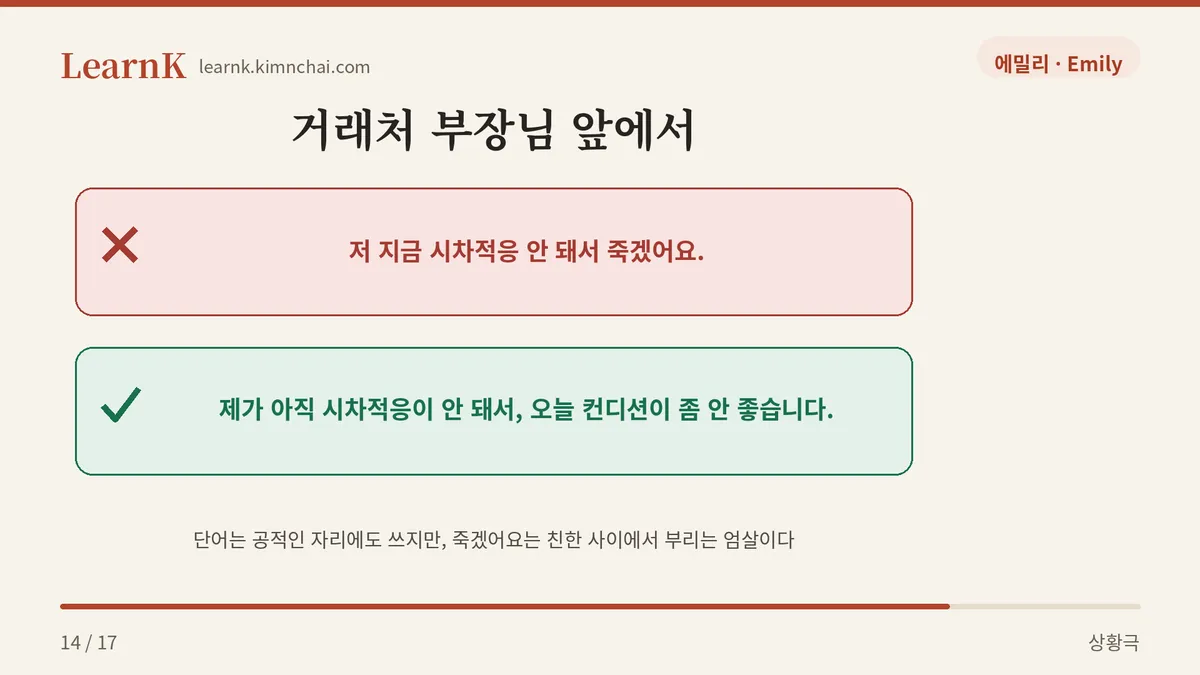
✗ (to a manager at a client company) 부장님, 저 지금 시차적응 안 돼서 죽겠어요. ✓ (to a manager at a client company) 제가 아직 시차적응이 안 돼서, 오늘 컨디션이 좀 안 좋습니다. → 죽겠어요 (“I’m dying”) is the kind of playful complaining you do with people you’re close to. The word itself is perfectly fine in formal settings — it’s the temperature of the words around it that sets the tone. In front of a superior or a client, just state your condition plainly.
✗ (back from a business trip from Seoul to Busan, said with a straight face) 부산 갔다 왔더니 시차적응이 안 되네요. ✓ (same situation) 부산 갔다 왔더니 아직 피로가 안 풀리네요. → All of Korea is on a single time zone, so there’s no time difference for domestic travel. Say this seriously and the other person will pause for a beat. On the other hand, if you’re deliberately going for a laugh, it lands beautifully.
Example Sentences by Situation
1. The morning after getting back to Korea, giving your coworkers a heads-up in the team group chat
아직 시차적응이 안 돼서 오전에는 반응이 좀 느릴 수 있습니다. (ajik sichajeogeung-i an dwaeseo ojeon-eneun baneung-i jom neuril su itsseumnida.) I haven’t adjusted to the time difference yet, so I may be a bit slow to respond this morning.
The reason this doesn’t come across as an excuse is that the word points to a physical state, not laziness — it’s neutral. It’s a sentence people returning from overseas business trips genuinely use all the time at Korean companies.
2. A fan who came to Korea for a concert, talking to the friend who came to meet them
시차적응하느라 첫날은 숙소에서 그냥 잤어요. (sichajeogeunghaneura cheotnareun sukso-eseo geunyang jasseoyo.) I just slept at the guesthouse the first day, dealing with the jet lag.
Adding -하느라 (-haneura) means “I spent my time and energy on that, so I couldn’t do anything else.” It also carries a hint of regret at having spent a precious first day asleep.
3. Planning a trip, talking to a friend
시차적응할 시간까지 계산해서 이틀 먼저 들어갈 거야. (sichajeogeunghal sigan-kkaji gyesanhaeseo itheul meonjeo deureogal geoya.) I’m going in two days early, counting the time I’ll need to adjust.
Here the word isn’t something you suffer through — it’s a line item in a plan. This is how people who travel for work often talk.
Polite vs. Casual, and Related Expressions
The same situation splits like this depending on who you’re talking to.
- Casual: 시차적응 아직 안 됐어. (sichajeogeung ajik an dwaesseo.)
- Polite: 아직 시차적응이 안 됐습니다. (ajik sichajeogeung-i an dwaetsseumnida.)
In the casual version the particle 이 (i) drops out entirely; in the polite version it comes back. Keeping the particle makes the sentence half a step tidier.
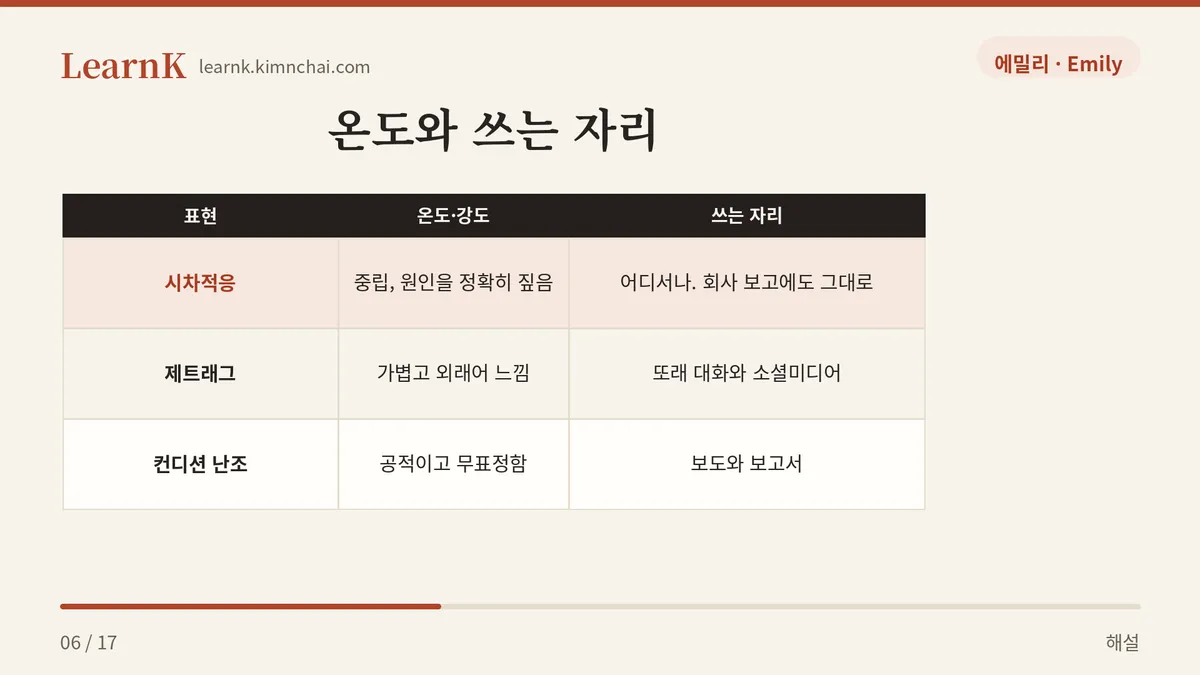
| Expression | Temperature / intensity | Where it’s used |
|---|---|---|
| 시차적응 | Neutral. Names the cause precisely | Anywhere. Works as-is in work reports and official notices |
| 시차 (as in 시차 때문에) | Neutral but shorter and more colloquial | Everyday conversation. “시차 때문에 못 잤어” |
| 제트래그 (jet lag) | Light, with a loanword feel | Peers and social media. Almost never in official documents |
| 생체리듬이 깨졌다 (my biorhythm is broken) | Somewhat stiff and explanatory | Articles and health content. The cause doesn’t have to be travel |
| 컨디션 난조 (off condition) | Formal and expressionless | News reports and business documents. When you’d rather not name the cause |
Scan the table top to bottom and a pattern appears: the further down you go, the further you get from the cause, and the more the expression loses its face. 시차적응 sits in the one spot where you can name the cause precisely without losing the warmth of everyday speech. That’s why its range of use is the widest.
Cultural Background — The Three Days That Begin at Incheon Airport
There’s nothing hidden in how this word was built. Take 시차, the Sino-Korean word for a difference in time, and 적응, meaning adapting to a new environment, and stick them together. No metaphor, no imagery — an honest compound. Korean does this constantly: two Sino-Korean words joined to make a single concept. So learners who are comfortable with Sino-Korean vocabulary can guess half the meaning on first sight.
What’s interesting is the social place this word occupies. Korea uses a single time zone for the entire country. You can ride the KTX two and a half hours from Seoul to Busan and the clock won’t move a single minute. So 시차적응 always travels together with “outside the border.” The moment you bring the word up, the other person automatically asks, “어디 갔다 왔어?” (“Where did you go?”). A single word carries the scent of someone who has been somewhere far away.
There’s a reason Korean-culture fans know this word so well. An idol group comes home from a world tour, goes on a broadcast or a livestream, and says “아직 시차적응 중이라 정신이 없다” (“I’m still adjusting to the time difference, so I’m all over the place”) — a scene that repeats almost like a fixed ritual. And fans who deliberately flip their days and nights to watch an overseas concert stream airing at dawn are, broadly speaking, telling the same story. Loving something shakes your body’s clock.
These days the word gets used without any airplane involved. On the Monday morning after a long holiday, people joke around the office that they’re “아직 연휴 시차적응 중” (“still adjusting to holiday jet lag”). After a week of all-nighters, someone will say “낮밤 바뀌어서 시차적응해야 돼” (“my days and nights are flipped, I need to readjust”). The actual time zone hasn’t changed at all — they’re just borrowing the word for the work of restoring a collapsed daily rhythm. It’s worth remembering that this extension only works in the space of a joke. That’s exactly why the Busan example above sounded off — it was said seriously, with none of the signals that a joke was coming.
Today’s Quiz
Which of the following uses 시차적응 most naturally?
- 서울에서 부산까지 KTX를 탔더니 시차적응이 안 돼서 힘들다.
- 밴쿠버에서 돌아온 지 사흘째인데 아직 시차적응이 안 됐다.
- 어제 야식을 너무 많이 먹어서 시차적응이 안 된다.
Show the answer
Answer: 2
시차적응 is used after moving between places in different time zones. Vancouver and Seoul are far apart in time, and the sentence even includes 사흘째 (“the third day”), an in-progress stretch of time — so the word lands in exactly the right spot.
Number 1 is domestic travel, so there’s no time difference at all. It works as a joke, but not as a serious sentence. In number 3 the cause is food, so 속이 안 좋다 (“my stomach is off”) or 더부룩하다 (“I feel bloated”) is the right fit. Remember: this word doesn’t cover tiredness in general — it’s used only when the cause is crossing time zones.
Definitions and example sentences are from the National Institute of Korean Language’s Basic Korean Dictionary (krdict.korean.go.kr); that portion of this post, including our translations, is licensed under CC BY-SA 2.0 KR.