"실화냐? (silhwanya?)" — The One-Liner That Bursts Out When You Can't Believe It
Intro: When What’s in Front of You Just Won’t Sink In
Your favorite idol suddenly replied to your comment. Your test score came back a whole 20 points higher than you expected. Or, the other way around, the file you worked so hard on wouldn’t even save and vanished completely. In moments like these — when something is so shocking or so absurd that it doesn’t feel real — Korean people these days blurt out a short little phrase.
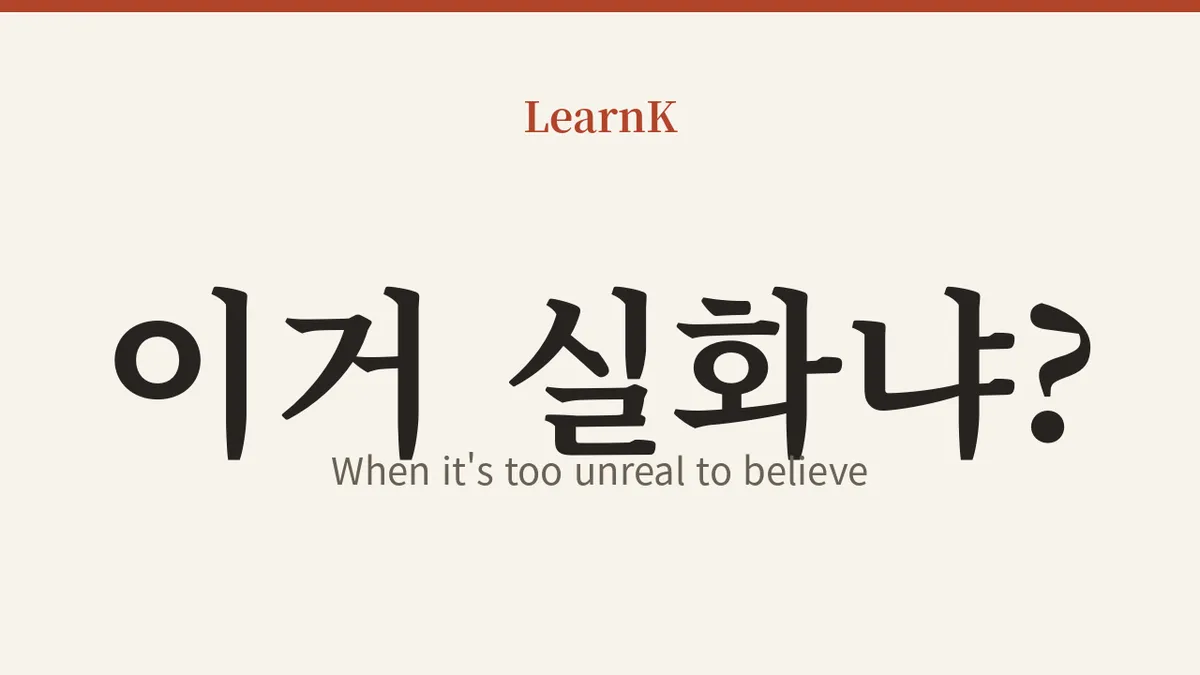
“이거 실화냐? (igeo silhwanya?)”
Today’s expression is exactly that — 실화냐 (silhwanya). It’s a signature piece of new slang that pops up constantly in drama subtitles, YouTube comments, and variety-show captions.
실화냐 (silhwanya)
실화냐 (silhwanya) is quick to understand once you break the word apart.
- 실화 (silhwa): a story that actually happened — in other words, ‘something real.’
- -냐 (-nya): a casual (반말, banmal) question ending.
So, literally, it means “Is this a real story?” or “For real?” It originally comes from the phrase “실화 바탕 (silhwa badang, based on a true story)” that used to appear on movie posters, but its meaning has broadened, and now it’s closer to an exclamation that bursts out when you’re faced with something hard to believe.
The key thing is the nuance. 실화냐 (silhwanya) isn’t really a question meant to confirm whether something is true — it’s a way of expressing surprise, amazement, or disbelief, like “Oh my gosh,” “No way,” or “Whoa.” You use it for good things and for jaw-dropping things alike.
For example, if you say “이 가격 실화냐? (i gagyeok silhwanya?)”, it carries the amazement of “Is this price for real? That’s ridiculously cheap/expensive.”
Example Sentences by Situation
Situation 1 — Amazingly good news
오늘 콘서트 티켓 당첨됐어. 이거 실화냐? (oneul konseoteu tiket dangcheomdwaesseo. igeo silhwanya?) — I won the concert ticket lottery today. Is this actually real?
It’s an expression that holds both joy and disbelief at the same time.
Situation 2 — Something absurd and ridiculous
세 시간 기다렸는데 문 닫았대. 실화냐 진짜? (se sigan gidaryeonneunde mun dadatdae. silhwanya jinjja?) — I waited three whole hours and they say it’s closed. Are you kidding me?
Adding 진짜 (jinjja) at the end emphasizes the absurdity even more.
Situation 3 — Marveling at someone’s skill or a result
이걸 하루 만에 다 외웠다고? 실화냐. (igeol haru mane da oewatdago? silhwanya.) — You memorized all of this in a single day? That’s incredible.
It’s also used as a compliment mixed with amazement and envy.
Casual vs. Polite Speech, and Similar Expressions
Since 실화냐 (silhwanya) ends in -냐 (-nya), it’s casual speech (반말, banmal), so you use it with friends, people younger than you, or when talking to yourself. With someone senior to you, you’ll want to soften it a bit.
- Casual: 실화냐? (silhwanya?)
- A little gentler: 실화야? (silhwaya?)
- With a polite feel: 이거 실화예요? (igeo silhwayeyo?) — but since it’s still a casual piece of slang, in formal settings “정말이에요? (jeongmarieyo?)” or “진짜예요? (jinjjayeyo?)” is safer.
Some similar exclamations include 말도 안 돼 (maldo an dwae, “that makes no sense”), 헐 (heol, an exclamation of surprise), and 대박 (daebak, “awesome/incredible”). Among these, 실화냐 (silhwanya) carries the strongest nuance of “I can’t believe it.”
Cultural Background: A Buzzword Raised by Subtitles
실화냐 (silhwanya) spread explosively especially through variety-show captions and online communities. On TV, when a cast member is dumbfounded, a big “실화냐? (silhwanya?)” caption flashes across the screen, pinpointing the emotion exactly for the viewer. In dramas, too, you’ll often see a scene where a character faces a shocking truth and, instead of a line of dialogue, this single phrase sums up the whole moment. So if you know this expression while watching Korean content, you’ll be able to follow the characters’ emotions much more vividly.
One tip — because 실화냐 (silhwanya) is a casual buzzword, it feels natural to use it among close friends or online. Save it for later in formal settings or in front of an adult you’re meeting for the first time.
Wrap-Up Quiz
A friend brags, “나 로또 5등 됐어! (na lotto o-deung dwaesseo!, I won 5th place in the lottery!)” If you want to toss back a one-liner in casual speech, packed with surprise and envy, which of the following is the most natural?
- 실화냐? (silhwanya?)
- 감사합니다 (gamsahamnida)
- 안녕히 가세요 (annyeonghi gaseyo)
The answer is number 1, 실화냐? (silhwanya?). In those surprising, unbelievable moments, try shouting it out naturally starting today. “이거 실화냐? (igeo silhwanya?)”