신나다 (sinnada) — The Word for When Joy Leaks Out of Your Body
신나다
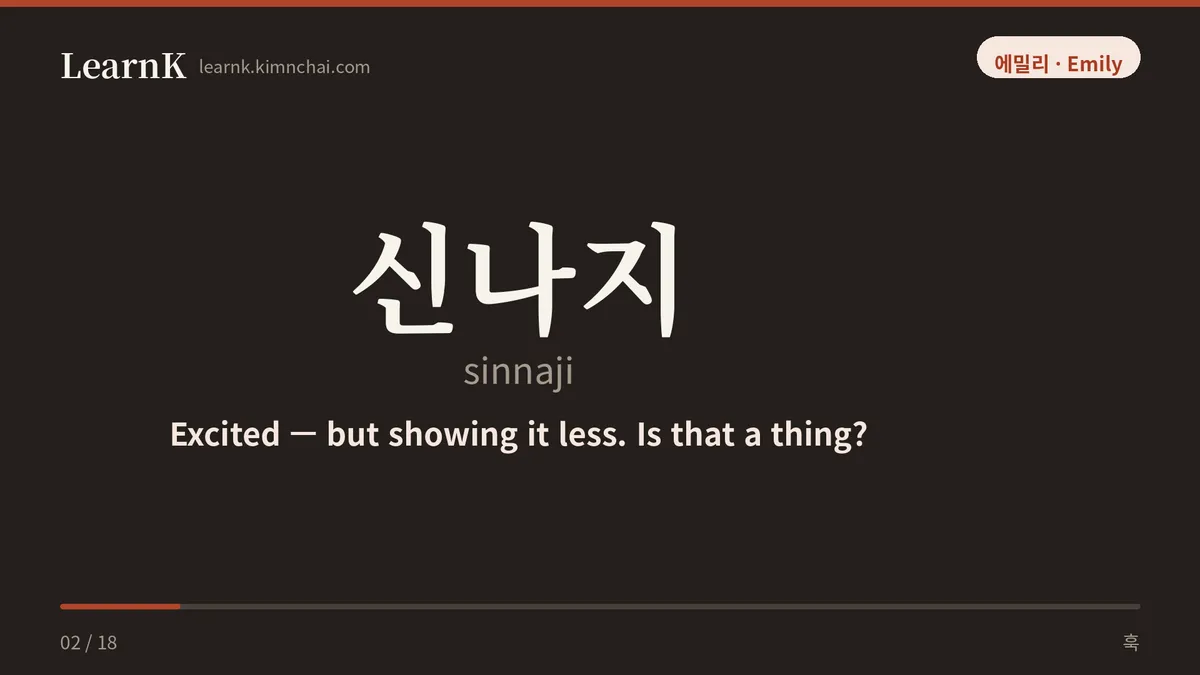
Saturday morning: your eyes open without an alarm, and the sky outside the window is clear. It’s the outing you’ve been looking forward to for ages. Under the blanket your toes start wiggling first, and halfway through washing your face a hum slips out. Korean has a single word for this state. 신나다 (sinnada) means to get excited and come to feel very good. It’s the word for the moment when something good happens, your heart floats up, and that lift leaks out into your shoulders and your voice.
Korean has several words for joy, but 신나다 (sinnada) occupies a pretty clear spot. If 기쁘다 (gippeuda) is an emotion that pools on the inside, 신나다 is that emotion popping out of the body. You can usually tell when someone is 신난 (sinnan) — they talk faster, take bigger steps, and reel off plans nobody asked about. So in places where you’re supposed to be quiet, where you’re supposed to keep your head down, this word doesn’t sit well.
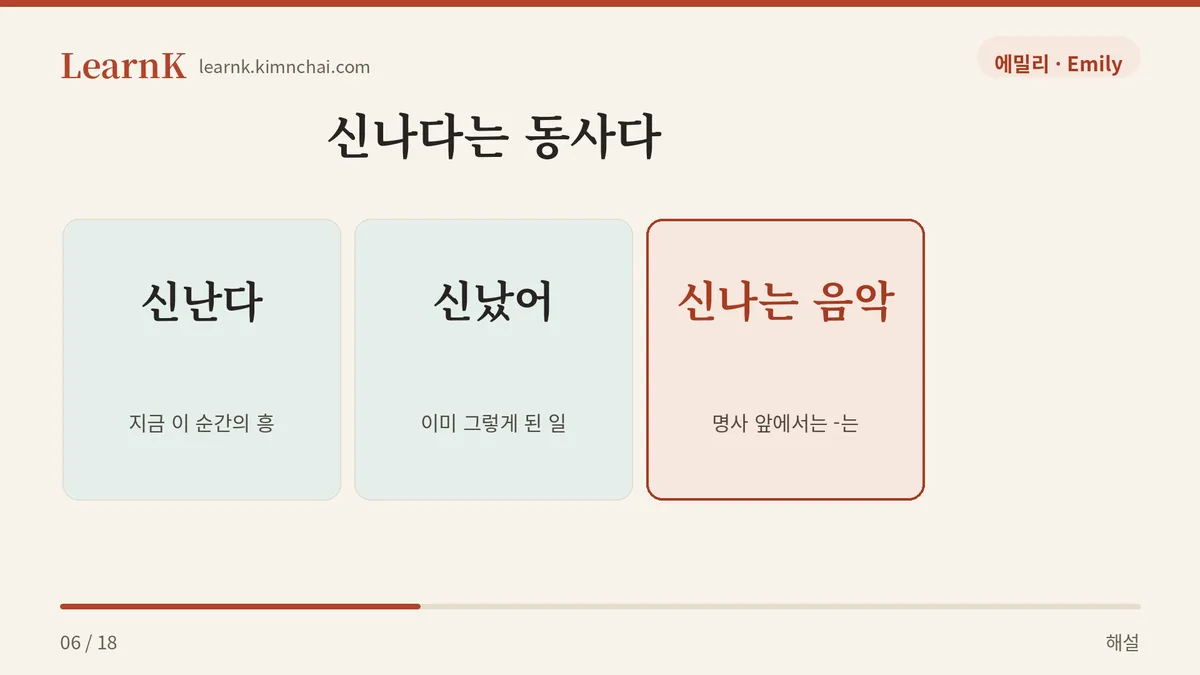
The part of speech is worth knowing too. 신나다 (sinnada) is not an adjective but a verb. It doesn’t point at the state of feeling good; it points at the change — your feelings moving in the direction of good. So when you’re talking about this very moment, it isn’t 신나다 but 신난다 (sinnanda), or in casual speech 신나 (sinna); for something that has already happened, it’s 신났어 (sinnasseo). When a noun follows, use the modifier form -는, as in 신나는 음악 (sinnaneun eumak).
Checking with the National Institute of Korean Language dictionary
신나다 (sinnada) 「verb」 흥이 나고 기분이 아주 좋아지다. (To get excited and come to feel very good.) [English] become happy; become delighted; become elated — To get excited and come to feel very good. [Japanese] よろこぶ【喜ぶ】 — 楽しくて、気分が非常に良くなる。 [Spanish] estar entusiasmado — Sentir regocijo y alegría. [Chinese] 兴高采烈,兴奋 — 来了兴致,心情变得非常好。 — National Institute of Korean Language, Basic Korean Dictionary (krdict.korean.go.kr)
The tail end of the English definition — come to feel very good — is the key to this word. Not feel good, but come to feel good. The translation preserved exactly the point that this is not a good state but a change into one. The Chinese 兴高采烈 paints the same picture — spirits rising high, the face flushed with them — so it points in the same direction.
A Portuguese definition isn’t included in this dictionary. If we had to render it, ficar animado or ficar empolgado would come close — but note that this Portuguese translation is our own, not the dictionary’s.
The dictionary’s actual usage examples are these two.
사뭇 신나다. (samut sinnada.) — National Institute of Korean Language, Basic Korean Dictionary (krdict.korean.go.kr)
사뭇 (samut) is an adverb close to very or greatly. The fact that a degree word can sit in front of 신나다 (sinnada) means this feeling isn’t a matter of present-or-absent — it has strength and weakness. There are mildly 신나는 (sinnaneun) days and 사뭇 신나는 (samut sinnaneun) days.
참으로 신나다. (chameuro sinnada.) — National Institute of Korean Language, Basic Korean Dictionary (krdict.korean.go.kr)
참으로 (chameuro) is also an intensifying adverb, a little more literary and dignified than 사뭇 (samut). In real conversation, what goes in that slot is 진짜 (jinjja), 완전 (wanjeon), or 너무 (neomu) — as in 진짜 신난다 (jinjja sinnanda). Since those two are the only dictionary examples, every sentence below is one we wrote ourselves.
A look at real conversation
Scene: the third-base cheering section at Jamsil Baseball Stadium. Thirty minutes before the game, the cheer leader is tapping the mic and getting the crowd in sync.
Emily: 나 야구장 처음이야. 근데 벌써부터 신난다. This is my first time at a baseball stadium. But I’m already excited.
Jun-kyung: 시작도 안 했는데? 이따 응원가 나오면 진짜 난리 나. The game hasn’t even started. Wait till the cheer songs start — it goes wild.
Emily: 응원가 나 다 외웠어. 지난주에 유튜브로 연습했잖아. I memorized all the cheer songs. I practiced on YouTube last week, remember?
Jun-kyung: 어쩐지 아까부터 어깨가 들썩들썩하더라. No wonder your shoulders have been bouncing this whole time.
Emily: 어, 선수들 나온다! 야, 너는 안 신나? Oh, the players are coming out! Hey, aren’t you excited?
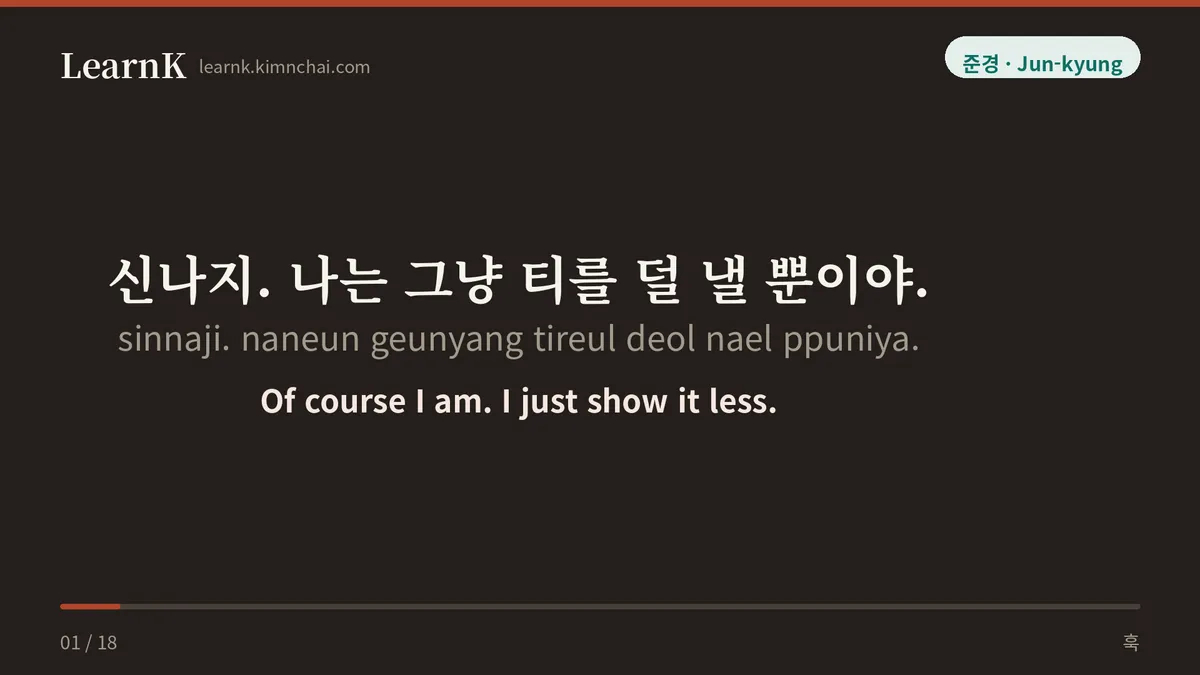
Jun-kyung: 신나지. 나는 그냥 티를 덜 낼 뿐이야. Of course I am. I just show it less.
Take a close look at that last line. Jun-kyung answers briefly with 신나지 (sinnaji), then adds that he simply shows it less. It’s proof that Korean speakers know by instinct that 신나다 (sinnada) is tied less to the feeling itself than to how visibly that feeling comes out.
Where this would sound off
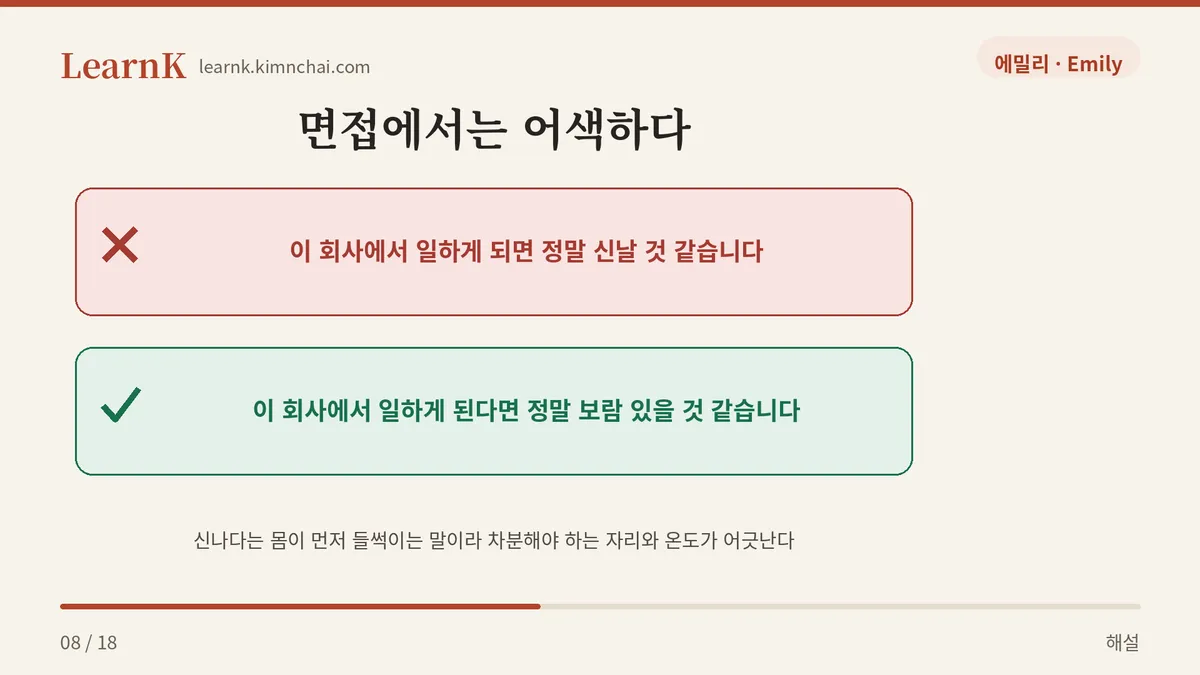
✗ (In an executive job interview) 이 회사에서 일하게 되면 정말 신날 것 같습니다. (i hoesaeseo ilhage doemyeon jeongmal sinnal geot gatseumnida.) — I think working at this company would be so exciting. ✓ (In an executive job interview) 이 회사에서 일하게 된다면 정말 보람 있을 것 같습니다. (i hoesaeseo ilhage doendamyeon jeongmal boram isseul geot gatseumnida.) — I think working at this company would be truly rewarding. → The grammar is perfectly fine. But 신나다 (sinnada) is a word where the body starts bouncing first, so in a formal setting it makes you sound not like a prepared candidate but like an over-excited one. In interviews, reports, and presentations, 기대가 큽니다 (gidaega keumnida) or 보람 있을 것 같습니다 (boram isseul geot gatseumnida) is the safe choice.
✗ (In front of a colleague who was passed over for promotion) 나 이번에 승진했어. 아, 완전 신나! (na ibeone seungjinhaesseo. a, wanjeon sinna!) — I got promoted this time. Ah, I’m so excited! ✓ (In front of a colleague who was passed over for promotion) 나 이번에 됐다더라. 너도 곧 될 거야. (na ibeone dwaetdadeora. neodo got doel geoya.) — I heard mine went through this round. Yours will come soon too. → This isn’t a grammar problem either; it’s a temperature problem. 신나다 (sinnada) is a word that hides nothing, so using it when the other person is deflated turns joy into bragging. In Korean, moments like this are usually handled by toning the words down a notch.
Example sentences by situation
1. The night before a trip, bags packed, lying in bed 내일 갈 생각에 벌써 신나서 잠이 안 와. (naeil gal saenggage beolsseo sinnaseo jami an wa.) Just thinking about tomorrow, I’m already too excited to sleep. Attaching -아서/-어서 to 신나다 (sinnada) turns it into a cause. Use it when the excitement pushed out some action, as in 신나서 잠이 안 온다 (sinnaseo jami an onda) or 신나서 소리를 질렀다 (sinnaseo sorireul jilleotda).
2. At a dinner with old classmates you haven’t seen in ages, speaking to an older senior 다들 이렇게 모이니까 신나네요. (dadeul ireoke moinikka sinnaneyo.) It’s exciting to have everyone together like this. 신나다 (sinnada) becomes polite with -요 too. Still, it fits a relaxed gathering like this better than a truly formal occasion. Adding -네요 gives it the flavor of putting a feeling you just noticed straight out into the open.
3. Watching a kid sprint toward the slide at the playground 애가 아주 신났네. (aega aju sinnanne.) The kid is having a blast. When you’re talking about a third person, the past form 신났다 (sinnatda) is often used — because you’re seeing from the outside a state where the excitement has already risen. It comes up especially often when describing kids, puppies, or a party atmosphere.
Polite and casual forms, and similar expressions
Casual is 신나 (sinna) / 신난다 (sinnanda) / 신났어 (sinnasseo); polite is 신나요 (sinnayo) / 신났어요 (sinnasseoyo); the formal style is 신납니다 (sinnamnida). If you remember only one thing: excitement in this very moment is 신난다 (sinnanda), and excitement about something past is 신났어 (sinnasseo).
One more thing. Because 신나다 (sinnada) is already a verb, you don’t need to tack on -어 하다 the way people sometimes do in 신나 한다 (sinna handa). The habit carries over from adjective-type words like 좋아하다 (joahada) and 신기해하다 (singihaehada), but 신난다 (sinnanda) on its own is plenty.
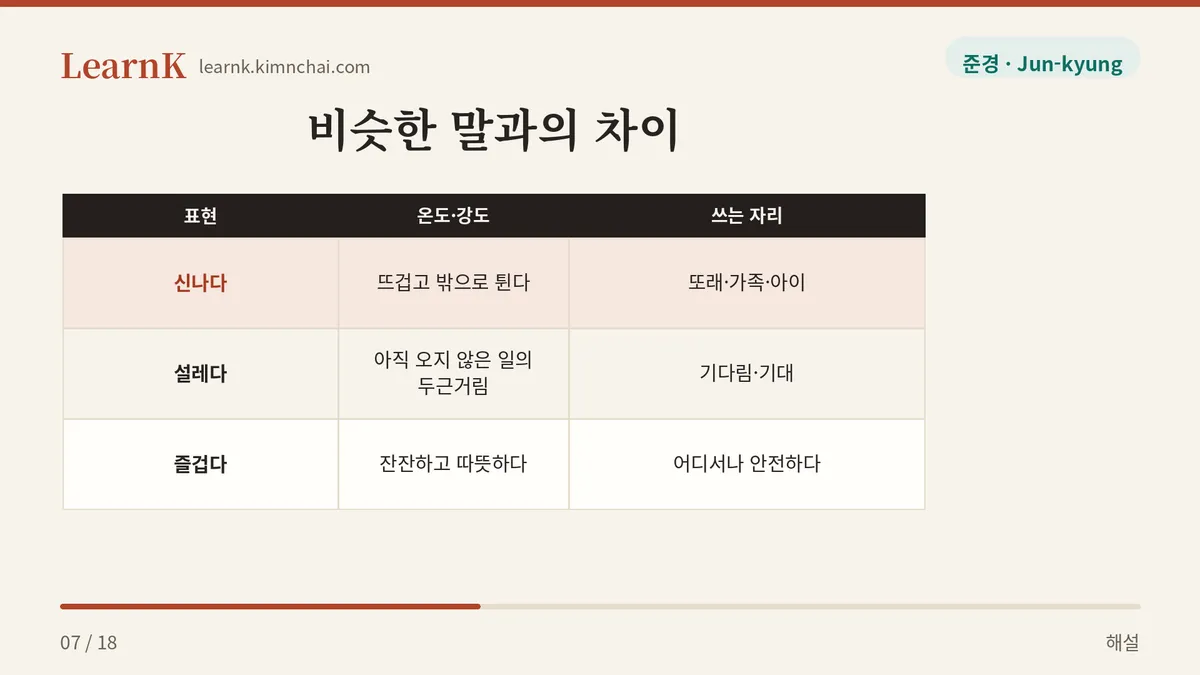
| Expression | Temperature / intensity | Where it’s used |
|---|---|---|
| 신나다 (sinnada) | Hot, and it bursts outward | With peers, family, kids. Occasions where the body starts bouncing |
| 즐겁다 (jeulgeopda) | Calm and warm | Anywhere. Safe even in formal settings |
| 설레다 (seolleda) | A flutter about something not here yet | Waiting, anticipation, romance |
| 들뜨다 (deultteuda) | Floating up and having lost your composure | Sometimes carries a mildly scolding nuance |
| 흥겹다 (heunggyeopda) | Enjoyment with melody and rhythm in it | Parties, holidays, anywhere there’s music |
The same day takes on a different color depending on the word. The night before a trip is 설레고 (seolleogo), the bus ride there is 신나고 (sinnago), and the night you come home and flip through the photos is 즐겁다 (jeulgeopda).
Cultural background — a word born from 신
신나다 (sinnada) splits into 신 + 나다 (sin + nada). Here 신 (sin) refers to a lively, good feeling — 신명 (sinmyeong) — and 나다 (nada) means for something that wasn’t there to come into being. It’s the same construction as 화나다 (hwanada), 겁나다 (geomnada), and 짜증나다 (jjajeungnada). Korean’s old habit of treating emotions as things that arise on their own rather than things you possess is preserved right here in this word. So 신 (sin) is not something you produce but something that arises, and 신바람 (sinbaram), which comes from the same root, blows in all by itself like the wind.
Where this word is most alive is the moment people gather and match their voices. The cheering section at a baseball stadium, the last song at the noraebang, the 윷놀이 (yunnori) board after a holiday meal. The scenes where 신난다 (sinnanda) turns up as a line in Korean dramas are pretty much set, too — the school-trip bus, the day of a first paycheck, a kid’s room the night before a picnic as they pack their bag. It doesn’t attach well to a scene of someone smiling quietly alone.
If you’re a fan of Korean culture, you’ve probably already seen this word plenty of times in song titles and variety-show subtitles. Picture the moment 신난다 (sinnanda) flashes across the screen in big letters and you’ll spot the common thread: somebody is springing to their feet, waving their arms, or talking half a step higher than usual. That picture is the meaning of the word.
Today’s quiz
Which of the following is the most awkward place to use 신나다 (sinnada)?
① Watching a child run ahead at the entrance to an amusement park ② Calling a friend right after booking concert tickets ③ Explaining why you applied, in an executive job interview ④ Talking to your roommate while packing for a trip
The answer is ③. Not because the grammar is wrong, but because the temperature of the occasion is off. 신나다 (sinnada) points to a feeling that has surfaced on the outside of the body, so in an official setting where you need to look composed, it’s more natural to switch to 기대가 큽니다 (gidaega keumnida) or 보람 있을 것 같습니다 (boram isseul geot gatseumnida). The other three are all shoulder-bouncing occasions, so go ahead and 마음껏 신나 해도 좋습니다 — no, wait: 마음껏 신나도 좋습니다 (maeumkkeot sinnado jotseumnida).
Definitions and example sentences are from the National Institute of Korean Language’s Basic Korean Dictionary (krdict.korean.go.kr); that portion of this post, including our translations, is licensed under CC BY-SA 2.0 KR.