시성비 (siseongbi) — the modern word for measuring how well you spent your time
시성비 (siseongbi)
시성비 (siseongbi) means weighing how much you get out of something against the time you put into it — in other words, “time-to-value efficiency.” Sneak a glance at the screen next to you on the subway home from work and six or seven out of ten are playing at double speed. People polish off a 16-episode drama with a 20-minute recap video, pick lunch by whichever line is shorter rather than whichever tastes better, and open an online lecture’s table of contents first so they can listen to only the chapters they actually need. 시성비 is the word that pops out at the exact moment you’re doing the math in your head: “Is this worth this much of my time?”
What matters is that the yardstick is time, not money. If a 10,000-won bowl of gukbap is filling and delicious, that’s a judgment about price — but if that gukbap place comes with a one-hour wait, it’s a different story. Money leaves your wallet, but time can never be topped back up. As that feeling spread, people started setting a second clock beside the price tag and choosing their purchases, their content, and their plans by both. 시성비 is the name on that second calculator.
The shapes it takes are more or less fixed. It shows up with a predicate attached — 시성비가 좋다 (siseongbiga jota), “the time-efficiency is good”; 시성비가 떨어지다 (siseongbiga tteoreojida), “the time-efficiency drops”; 시성비가 안 나오다 (siseongbiga an naoda), “it doesn’t pay off for the time”; 시성비를 따지다 (siseongbireul ttajida), “to weigh time-efficiency” — and when you’re really satisfied, you say 시성비 갑 (siseongbi gap), “peak time-efficiency.” The tone is light and practical. It works as praise, but it also sits comfortably in a mildly cynical take on the world, as in 요즘은 사람 만나는 것도 시성비 따진다 (“these days people even weigh the time-efficiency of meeting up with someone”).
See It in a Real Conversation
Situation: Friday evening on the subway home. Both are standing, holding onto the straps and looking at their phones.
Jun-kyung: 야, 너 그거 봤어? 요즘 다들 얘기하는 그 드라마. Hey, did you watch that drama everyone’s talking about?
Emily: 봤지. 근데 나 2배속으로 봤어. 솔직히 시성비 생각하면 그게 맞아. I did. But I watched it at 2x. Honestly, if you think about time-efficiency, that’s the way.
Jun-kyung: 그렇게 보면 무슨 재미냐. 대사 다 놓치잖아. What’s fun about watching it like that? You miss all the lines.
Emily: 1화만 정속으로 보고 나머지는 배속. 이게 진짜 시성비 갑이야. Episode one at normal speed, the rest sped up. That is peak time-efficiency.
Jun-kyung: 됐고. 난 주말에 이불 덮고 천천히 볼래. Nah. I’m going to watch it slowly under a blanket this weekend.
Emily: 그것도 시성비 좋은 거지, 뭐. 쉬는 시간 제대로 쓴 거니까. That’s good time-value too, actually. You’re using your rest time properly.
When It Sounds Off
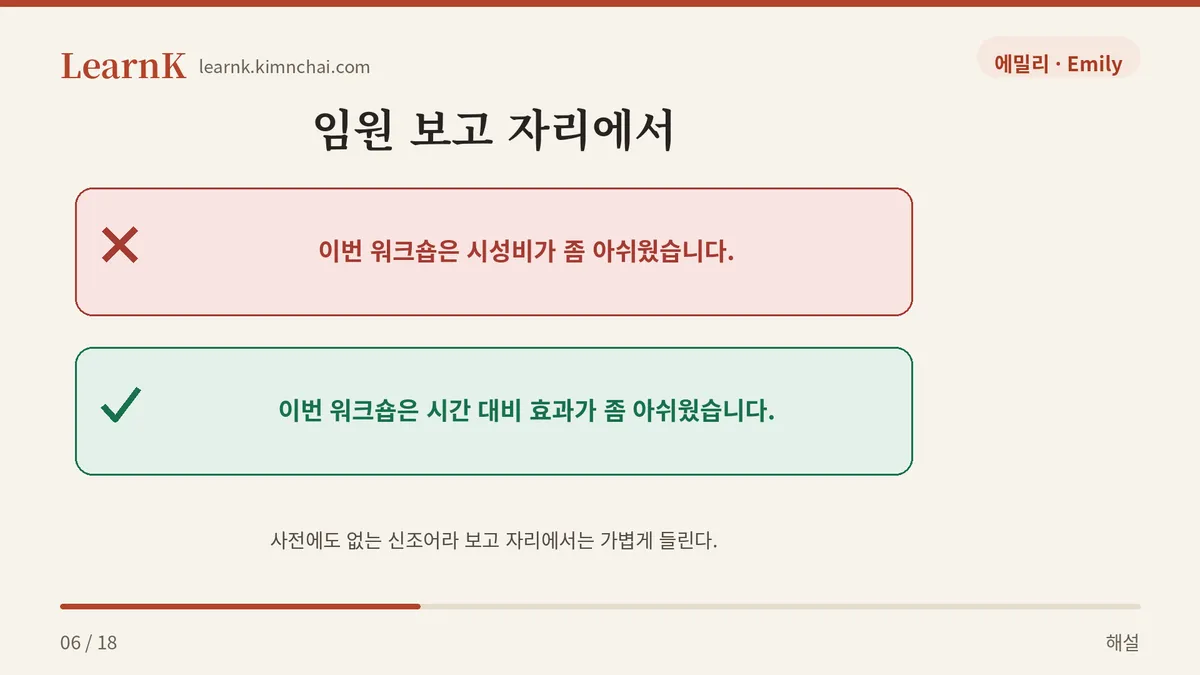
✗ (In a briefing to executives) 이번 워크숍은 시성비가 좀 아쉬웠습니다. — “This workshop’s siseongbi was a bit disappointing.” ✓ (In a briefing to executives) 이번 워크숍은 시간 대비 효과가 좀 아쉬웠습니다. — “The return on the time we spent on this workshop was a bit disappointing.” → It’s a new coinage that hasn’t even made it into the dictionary yet, so slipping it into an official report or document sounds flippant. In front of someone senior, 시간 대비 효율 (sigan daebi hyoyul) is the safer choice.
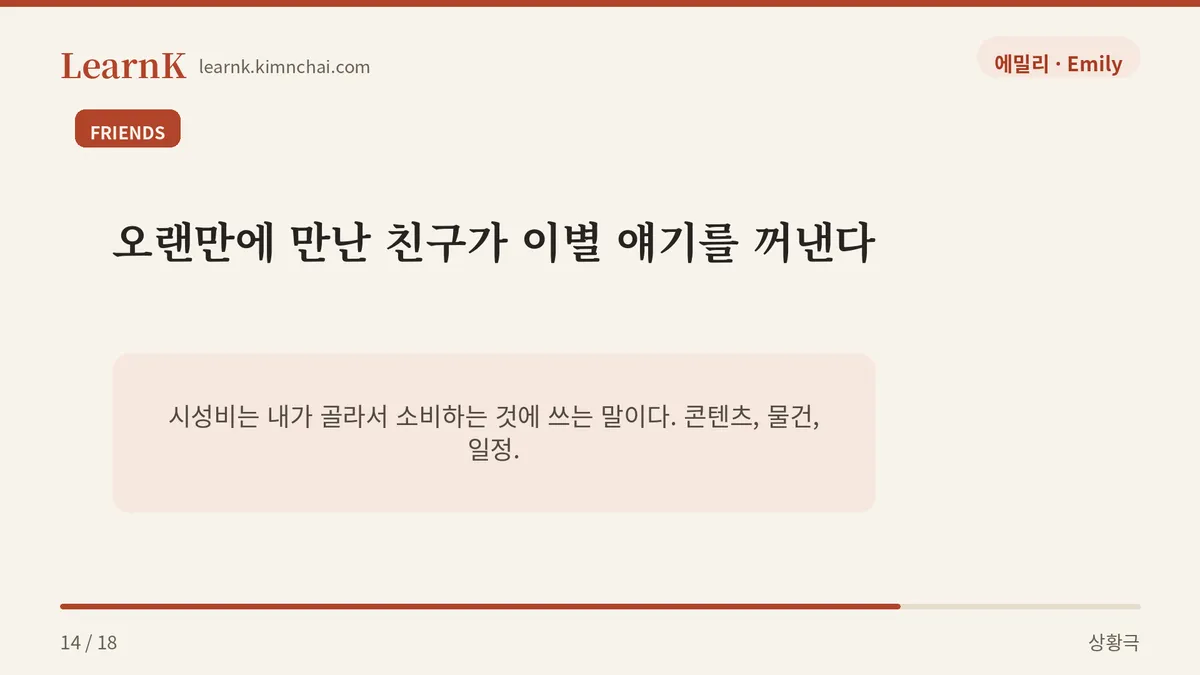
✗ (When a friend you haven’t seen in ages starts telling you about a breakup) 그 얘기 길어? 시성비 떨어지는데. — “Is that story long? The time-efficiency isn’t great.” ✓ (When a friend you haven’t seen in ages starts telling you about a breakup) 천천히 얘기해. 나 시간 많아. — “Take your time. I’ve got plenty of it.” → 시성비 is for things you pick and consume — content, products, schedules. Aim it at someone’s feelings or at a relationship and it turns into treating that person as a waste of your time.
Example Sentences by Situation
1. To a friend who’s picking an online course
Your friend is torn between two courses, and you’re recommending the short, dense one.
이 강의 시성비 진짜 좋아. 두 시간 만에 핵심만 딱 짚어 줘. (i gangui siseongbi jinjja joa. du sigan mane haeksimman ttak jipeo jwo.) This class is really time-efficient. It nails just the key points in two hours.
2. While planning a weekend trip
You’re talking someone out of a day trip where the round trip alone takes eight hours. Here it’s used in the negative.
당일치기로 부산 갔다 오는 건 시성비가 너무 떨어져. 그냥 1박 하자. (dangilchigiro Busan gatda oneun geon siseongbiga neomu tteoreojyeo. geunyang ilbak haja.) A same-day round trip to Busan is a terrible use of time. Let’s just stay a night.
3. Looking at the line outside a famous restaurant
The queue stretches to the end of the alley. The food is admittedly good, but the time doesn’t add up.
두 시간 웨이팅? 아무리 맛있어도 시성비 안 나온다. (du sigan weiting? amuri masisseodo siseongbi an naonda.) A two-hour wait? No matter how good it is, that doesn’t pay for the time.
Polite and Casual Forms, and Similar Expressions
In casual speech you use it exactly as in the examples above — 시성비 좋아 (siseongbi joa) — and in polite speech you soften it to something like 시성비가 좋더라고요 (siseongbiga jotdeoragoyo). But switching to polite speech doesn’t turn it into a word you can use anywhere. This isn’t a question of honorifics, it’s a question of formality: it sounds perfectly natural in polite form with a senior colleague you’re close to, yet even in polite form it has no place in official meeting minutes.
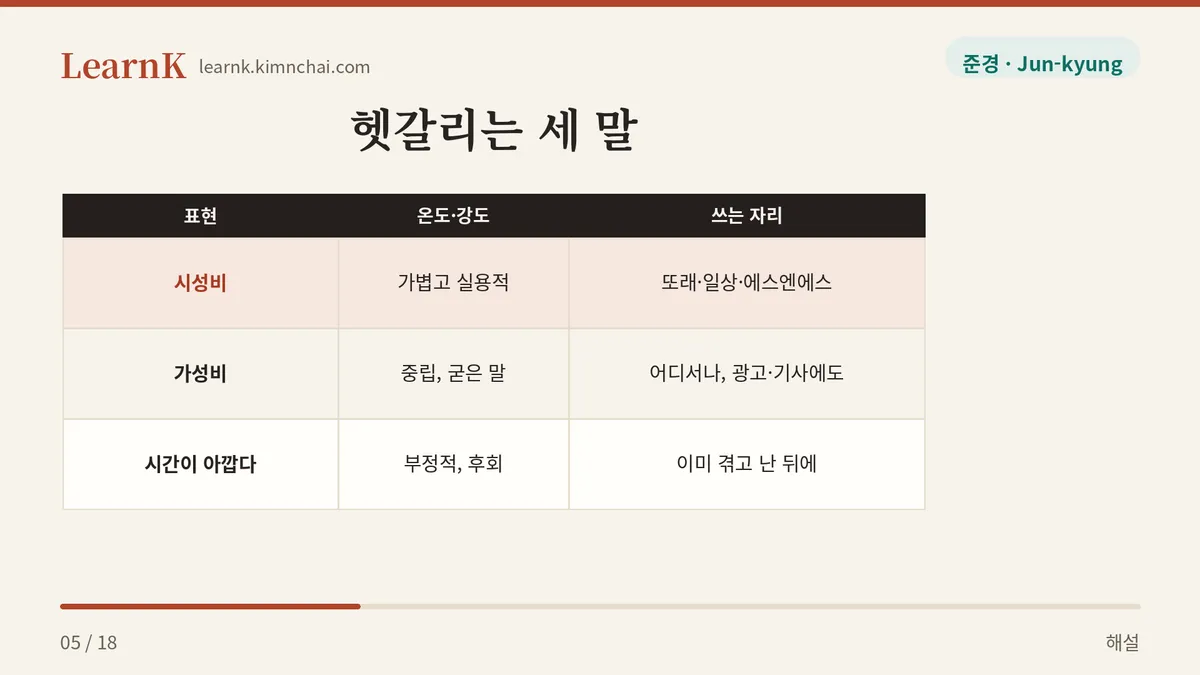
| Expression | Tone & strength | Where it’s used |
|---|---|---|
| 시성비 (siseongbi) | Light and practical; current slang | With peers, on social media, in everyday talk. Not in official documents |
| 가성비 (gaseongbi) | Neutral; already an established word | Anywhere. Shows up in ads and news articles too |
| 시간 대비 효율 (sigan daebi hyoyul) | Stiff and neutral | Reports, meetings, in front of seniors |
| 시간이 아깝다 (sigani akkapda) | Negative; regret or irritation | After the fact, once you’ve already been through it |
The difference between those last two is especially worth pinning down. 시성비 is a measuring stick you pull out before or while you’re choosing; 시간이 아깝다 is a belated verdict that comes only after the time is already gone. What you say walking out of the movie theater is 시간 아까웠다 (“that was a waste of time”), not 시성비 떨어졌다.
Cultural Background — A Word the Speed Button Made
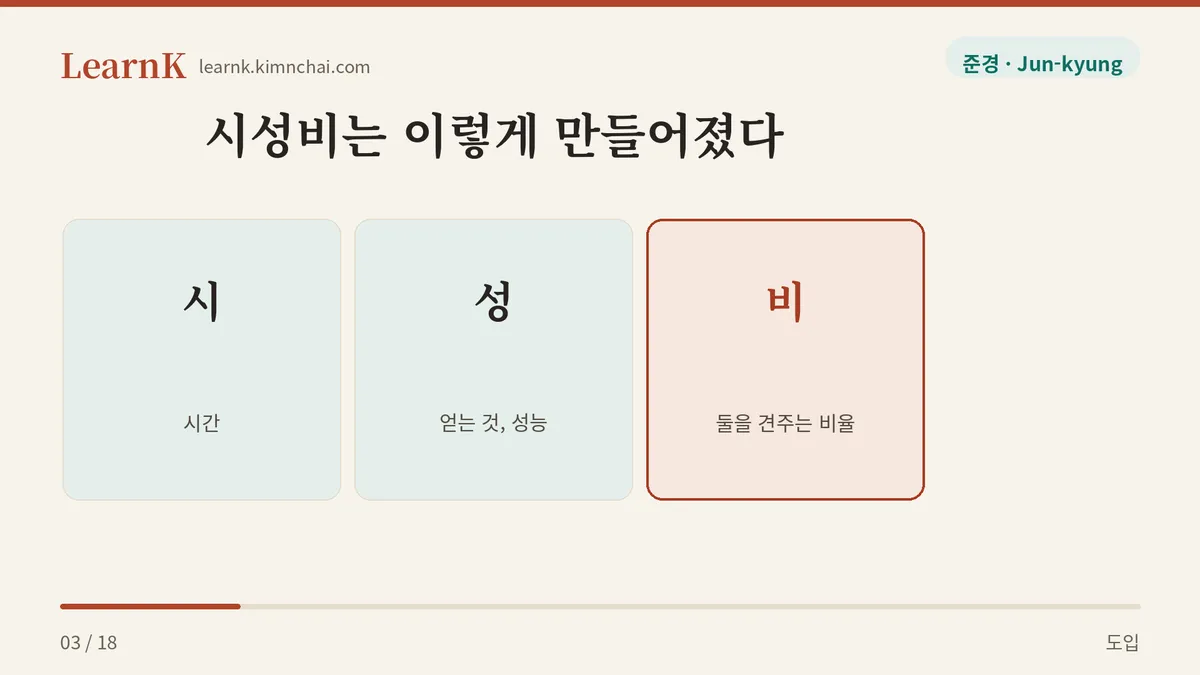
The way it’s built is simple and obvious. 가성비 (gaseongbi), in use for a long time now, is a shortening of “price-to-performance ratio”; swap “time” into that “price” slot and you get 시성비. Changing a single syllable shifts the entire standard, so anyone hearing it for the first time grasps it right away as long as they know 가성비. That’s also the classic way Korean coinages catch on — borrow a frame people already know and swap out just one part.
Behind the word’s rise are the playback-speed button, short-form video, and summary content. More and more people search for the ending before they watch, digest a drama as a 30-minute edit, or cross restaurants with long waits off the list entirely — and as they do, how you budget your time has started to be talked about the way a taste in consumption is. It travels alongside talk of 갓생 (gatsaeng), the relentlessly self-improving life.
Lately, though, you can see the backlash too. Weighing the 시성비 of everything means even rest gets graded on efficiency, which people say is exhausting, and so a counter-current has grown of deliberately setting aside time to watch slowly and walk slowly. In the conversation above, the moment where Jun-kyung says he’ll watch it slowly under a blanket and Emily grants that this is good time-value too is exactly that point. In the end, this word isn’t an order to economize on time — it’s closer to a declaration that you’ll decide for yourself where your time goes.
Today’s Quiz
Which of the following uses 시성비 (siseongbi) most naturally?
① 이 국밥집 만 원에 이 정도면 시성비 최고다. — “This gukbap place, all this for 10,000 won? Top siseongbi.” ② 요약본으로 보니까 30분 만에 다 이해했어. 시성비 진짜 좋다. — “I watched the summary version and got the whole thing in 30 minutes. Really good time-efficiency.” ③ 상무님, 이번 프로젝트는 시성비가 매우 우수하였습니다. — “Director, this project’s siseongbi was excellent.”
Answer: ② ① measures against a price — 10,000 won — so it needs 가성비 (gaseongbi). ③ makes sense, but laying a slang term onto a formal report sounds off; here 시간 대비 효율이 높았습니다 is the right call. Only ② uses time as the yardstick, among people on casual terms, in its proper place.
The definitions and example sentences in this post are all original work written by us. Where any part of it quotes material from the National Institute of Korean Language’s Basic Korean Dictionary (krdict.korean.go.kr), that portion — including our translation of it — is used and distributed under the CC BY-SA 2.0 KR license.