Cutting Your Losses? — A Complete Guide to '손절 (sonjeol),' Essential Slang for Korea's MZ Generation
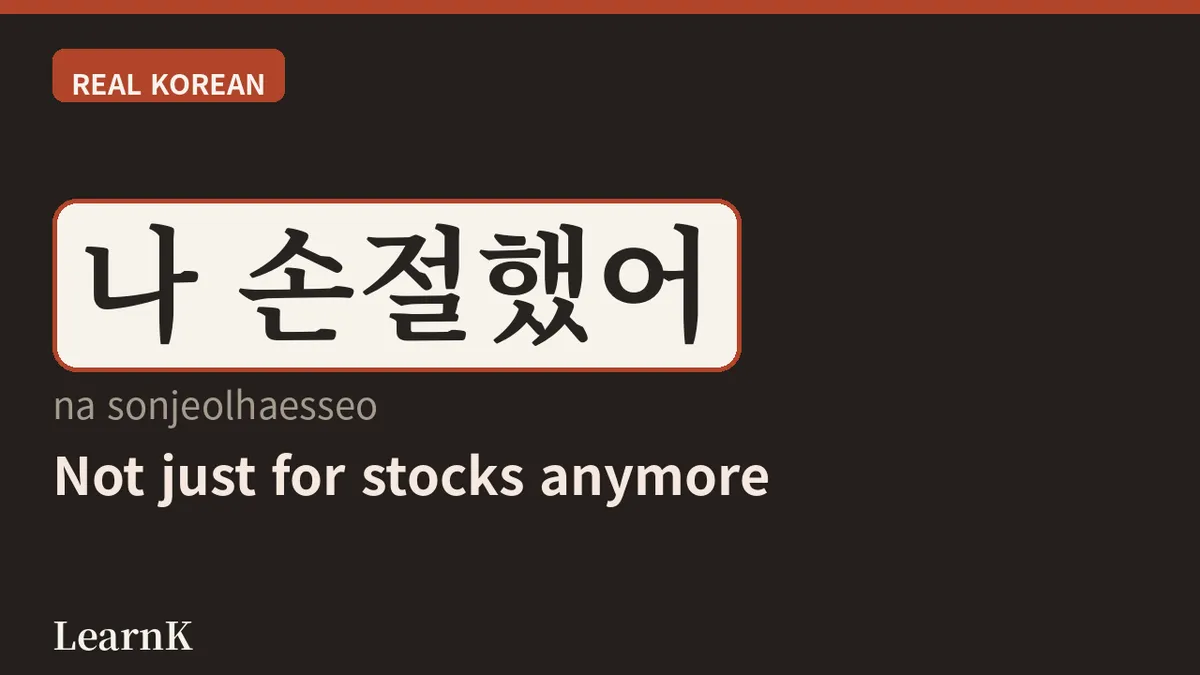
A word that started with a friend who plays the stock market is now used even for romance and friendship. When a friend keeps breaking promises and won’t pay back money they borrowed, Koreans say something like this: “I’m done with that person — I 손절 (sonjeol) them.” The face stays calm, but inside it holds a firm resolve: “I won’t take any more losses.” Today, let’s dig into this expression that’s deeply lodged in the conversations of Korea’s younger generation.
손절
손절 (sonjeol) is originally a shortened form of the stock-market term 손절매 (sonjeolmae). In Chinese characters it’s 損切 — meaning to “cut (切) your losses (損).” It refers to boldly selling off a stock while you’re still in the red, in order to prevent an even bigger loss when the price keeps falling.
These days the word has crossed over into human relationships. When you reluctantly but decisively cut off a person or a relationship that only brings you 손해 (sonhae) — loss — you say you’re “손절-ing” them. There are three core nuances. First, it’s a rational judgment, not an emotional one. Second, there’s a sense of resignation: “It’s a shame, but there’s nothing to be done.” Third, there’s the calculation: “If I cut it off now, I won’t get hurt even worse later.” So 손절 has a different feel from getting angry and fighting. It’s closer to quietly and calmly settling the matter in your own heart.
The meaning in one line
손절 (sonjeol): Boldly cutting off a relationship, an investment, or a task — even at the cost of taking a loss — in order to prevent a bigger loss.
Example Sentences by Situation
① Original meaning — stocks and investing
이 주식 3개월째 내려가는데, 그냥 손절할까 (sonjeolhalkka) 봐. (This stock has been dropping for three months now — I think I might just cut my losses and sell.)
This is the situation of holding onto a stock that keeps falling and, worried about an even bigger loss, wondering whether to sell it off even now. It’s the most basic usage — the “root” of 손절.
② Extended meaning — human relationships
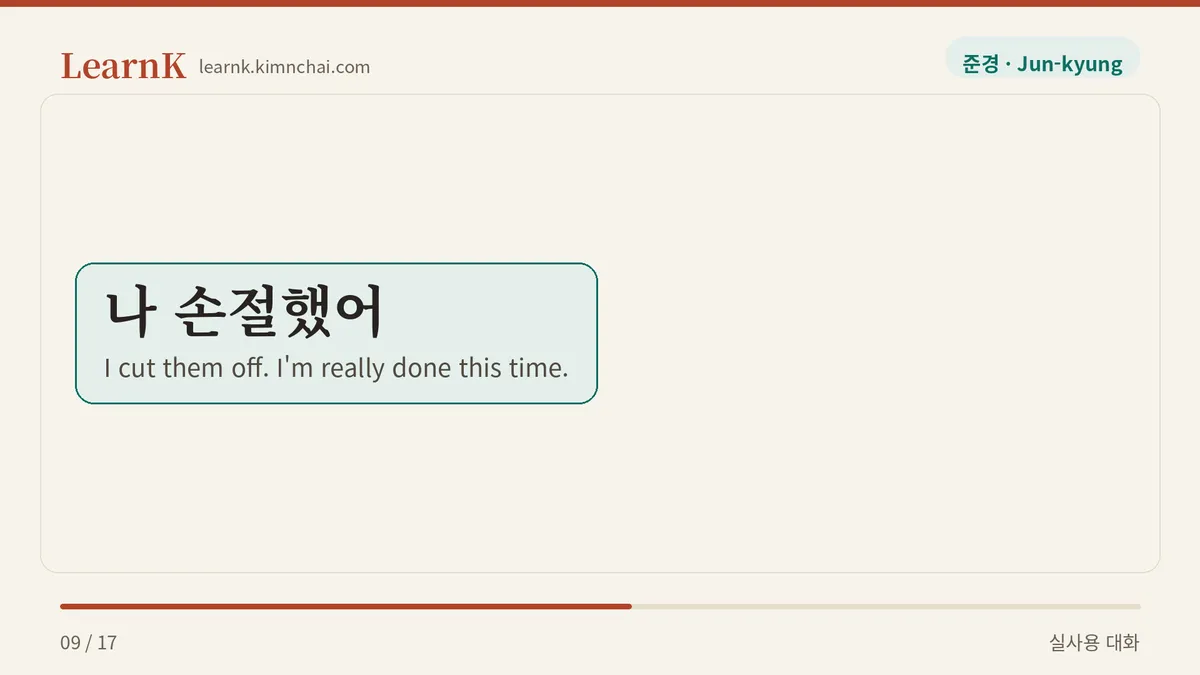
걔한테 몇 번을 참았는데 또 그러더라. 나 손절했어 (sonjeolhaesseo). (I put up with them so many times, and they did it again. I’m done — I cut them off.)
This means that although you gave the other person several chances, they didn’t change, so you’ve now settled the relationship. The strong nuance is that you quietly closed the door in your heart — not that you had a fierce fight like a dramatic “breakup.”
③ Hobbies and spending
이 게임 과금만 계속 시키길래 손절하고 (sonjeolhago) 지웠어. (This game just kept pushing me to spend money, so I cut my losses and deleted it.)
You also use it when you cut off, with no regrets, a game that only eats up your money and time — or a hobby you just don’t love anymore. When an idol fan stops liking the group they used to cheer for, they might say they’re “손절-ing” them too.
Formal vs. Casual Speech, and Similar Expressions
In casual speech you say “손절했어 (sonjeolhaesseo),” and in polite speech “손절했어요 (sonjeolhaesseoyo)” or “손절하기로 했습니다 (sonjeolhagiro haesseumnida).” That said, 손절 is slang, so you don’t really use it in formal settings or with people senior to you.
Shall we compare it with similar words? 절교 (jeolgyo) is the same in that it means “cutting off a relationship,” but it carries a strong feeling of an emotional, blowout fight and turning your back on someone. 손절, on the other hand, keeps the nuance of “a cool-headed decision made after weighing the gains and losses.” 정리 (jeongni) is a softer, more neutral expression. In other words, 손절 sits somewhere between the firmness of “절교” and the calm composure of “정리.”
Cultural Background
There’s a reason 손절 became an everyday word. Over the past few years, a 재테크 (jaeteku) — personal-finance and money-management — craze swept Korea, with stocks, crypto, and the like, so investing terms naturally rolled off the tongues of the younger generation. Combine that with today’s self-care culture of “keeping your distance from things that harm you,” and 손절 has settled in as a stylish word for describing human relationships.
The emotion of “손절” also shows up often in TV dramas — in scenes where a character resolves not to be swayed anymore by a friend who only ever used them, and quietly settles their feelings. That calm composure of deleting a contact instead of getting angry — that’s exactly the sentiment of Korean-style 손절.
Closing Quiz
A friend says, “어제 그 사람 손절했어 (I 손절-ed that person yesterday).” Which best matches this friend’s state of mind?
- They had a huge fight with that person and are still angry.
- They didn’t want to take any more losses, so — reluctantly but calmly — they decided to settle the relationship.
- They decided to lend that person money.
The answer is number 2. The heart of 손절 isn’t “anger” but “a cool-headed calculation of losses” — you’ll definitely remember that now, right?