스포 (seupo) — 'Don't Tell Me the Ending!' The First Rule of Korean Drama Fandom
스포 (seupo)
스포 (seupo) means giving away something important — the ending of a movie, the twist in a drama — to someone who hasn’t gotten there yet. It’s a two-syllable clipping of 스포일러 (seupoilleo), which came from the English word spoiler, and these days the short form is heard in Korea far more often than the original.
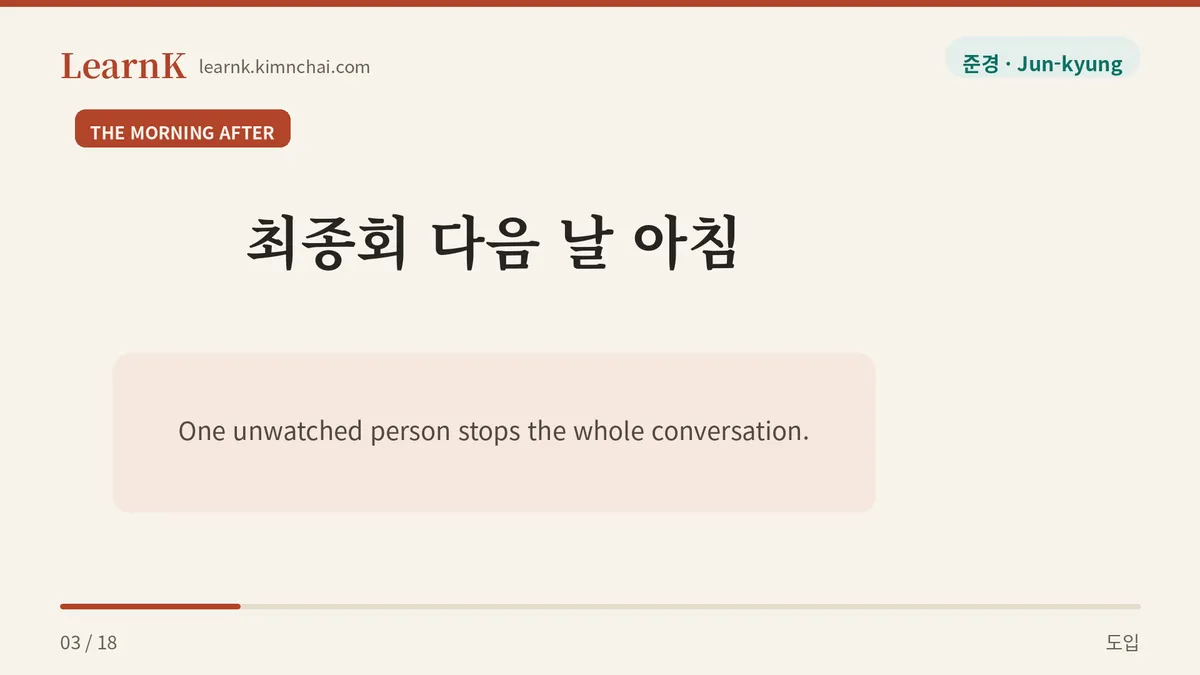
The morning after a drama’s finale airs, the same sentence travels through Korean offices, school hallways, and group chats: 「야, 스포 하지 마.」 (Ya, seupo haji ma. — Hey, don’t spoil it.) If even one person in the group hasn’t watched yet, a conversation that was racing along stops dead on the spot. If you started learning Korean because of K-dramas, 스포 (seupo) is probably the first piece of new slang you’ll learn — and the one you’ll end up using most.
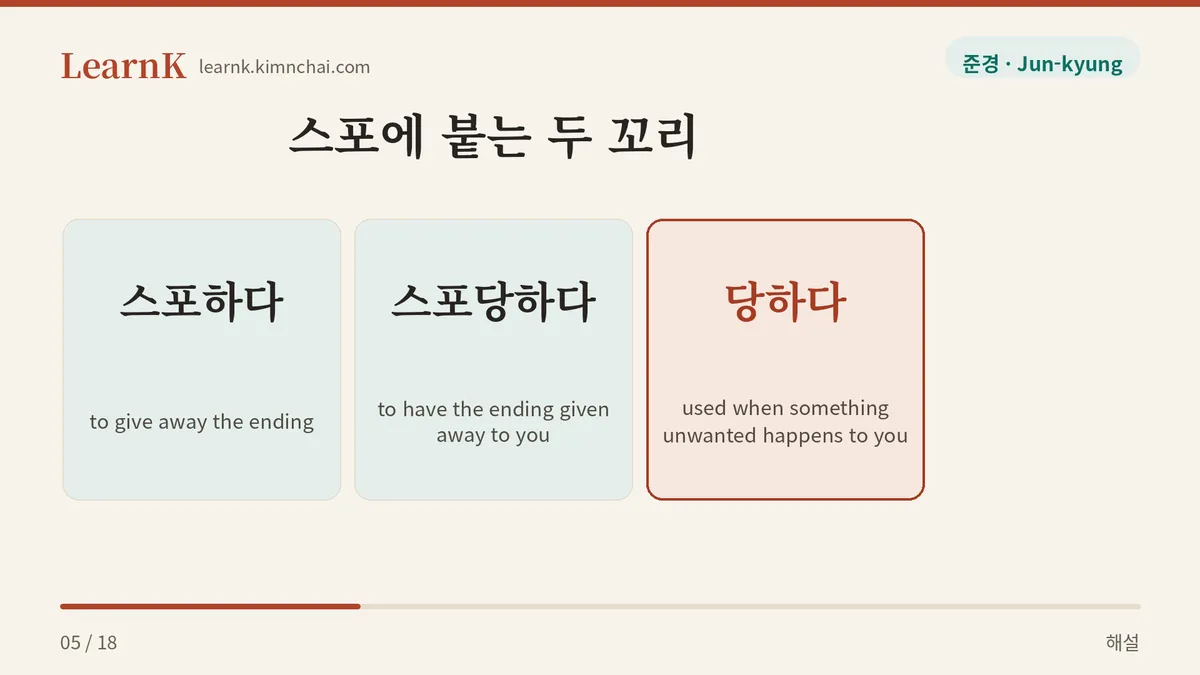
스포 (seupo) works freely as both a noun and a verb. Attach -하다 (-hada) and you get 스포하다 (seupohada) — to give away the ending. Attach -당하다 (-danghada) and you get 스포당하다 (seupodanghada) — to have the ending given away to you. What’s worth noticing here is that -당하다 attaches at all. In Korean, 당하다 (danghada) is used when something you didn’t want happens to you: 사기당하다 (sagidanghada, to get scammed), 무시당하다 (musidanghada, to be brushed off). In other words, 스포 is framed from the very start as an event with a victim.
So the temperature is light, but the direction is clearly negative. 「스포해 줄까?」 (Seupohae julkka? — Want me to spoil it for you?) is not an offer of kindness; it’s a mischievous tease. And 「스포당했어」 (Seupodanghaesseo — I got spoiled) is less anger than a mix of grievance and deflation. If someone is genuinely furious, a Korean speaker will actually drop the light little word 스포 and say flatly, 「왜 결말을 말해」 (Wae gyeolmareul malhae — Why would you tell me the ending?). The emotional size this word carries is exactly that much — a protest delivered with a light shove to the shoulder.
It’s worth memorizing the words that travel alongside it. 노스포 (noseupo) joins the English no to 스포 and means “no spoilers given”; you’ll see it in review titles like 「노스포 후기」 (noseupo hugi, spoiler-free review). 스포 주의 (seupo juui) is the warning label stuck onto post titles and video thumbnails. 스포 금지 (seupo geumji) is used as a rule in group chats and on community boards.
Seeing It in a Real Conversation
Situation: The subway home on a Friday evening. Jun-kyung still hasn’t watched the drama finale that aired last night.
Emily: 어, 너 그거 봤어? 어제 마지막 회. Oh, did you watch it? Last night’s finale.
Jun-kyung: 아직! 야, 스포 하지 마. 집 가서 볼 거야. Not yet! Hey, no spoilers. I’m watching it when I get home.
Emily: 알았어, 입 다물게. 근데 나 표정 관리가 안 되네. Okay, I’ll zip it. But I can’t keep a straight face.
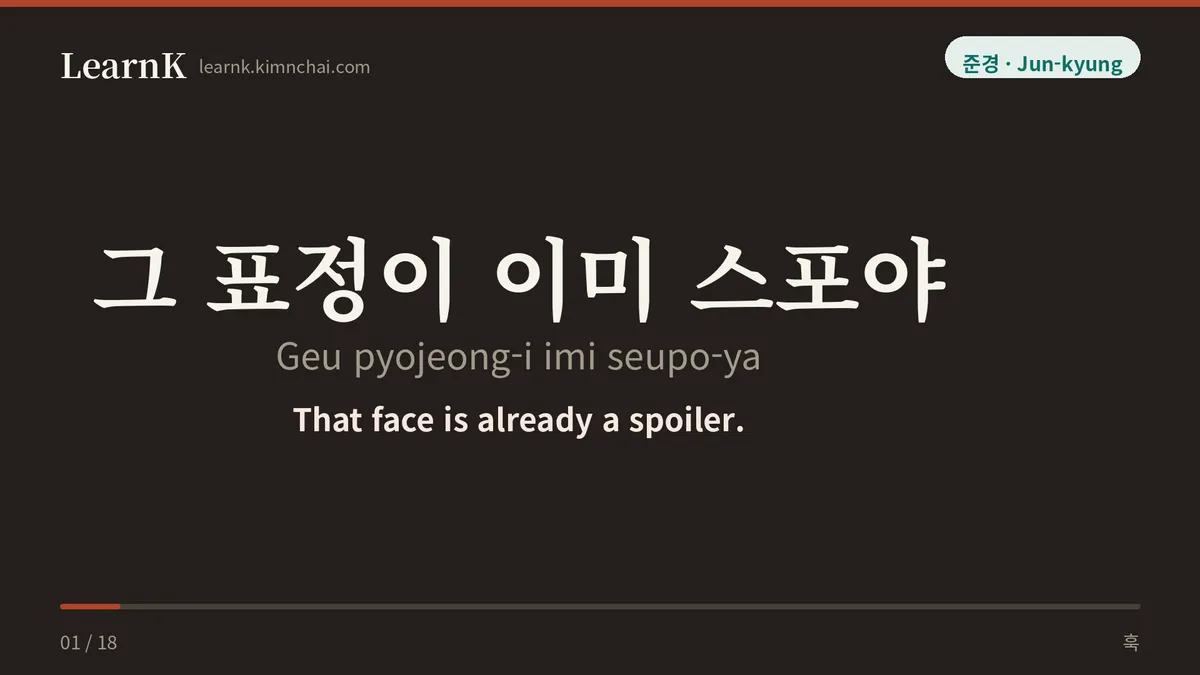
Jun-kyung: 그 표정이 이미 스포야. 저리 좀 가. That face is already a spoiler. Move over a bit.
Emily: 아 참, 아까 옆자리 아저씨가 통화로 다 말하던데. 못 들었지? Oh right, the guy next to us spilled the whole thing on the phone. You didn’t hear it, right?
Jun-kyung: …나 방금 너한테 스포당한 것 같은데. …I think I just got spoiled by you.
This Is Where It Sounds Off
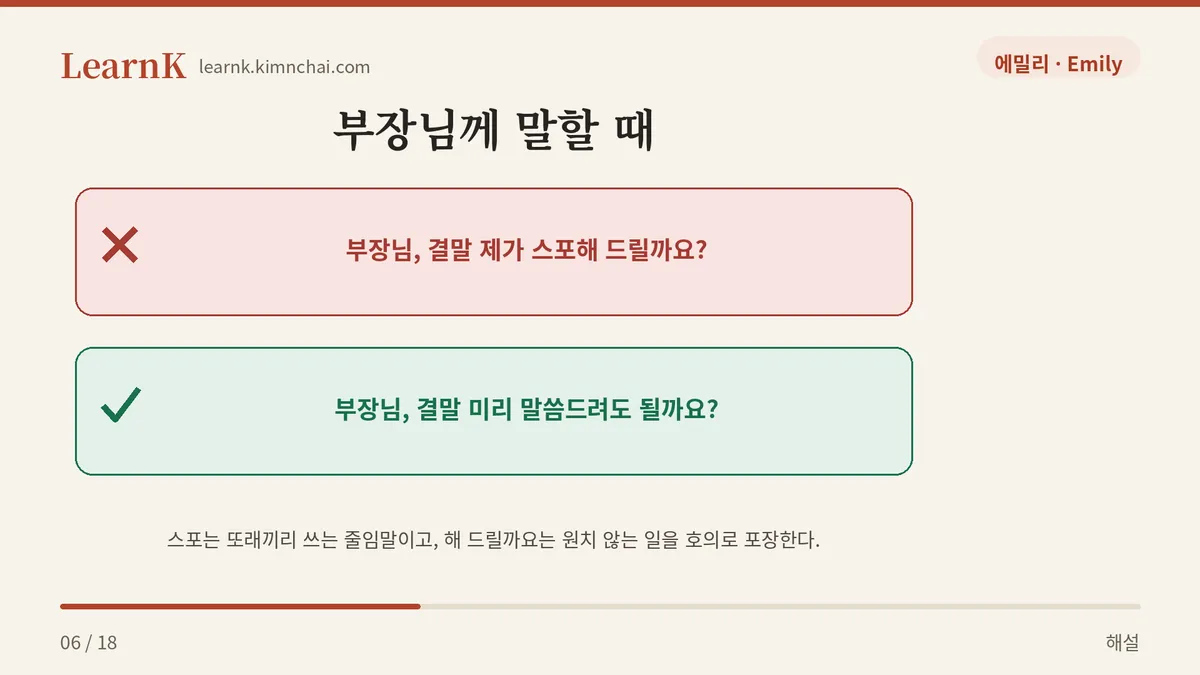
✗ (To your department head) 부장님, 어제 최종회 결말 제가 스포해 드릴까요? ✓ (To your department head) 부장님, 어제 최종회 결말 미리 말씀드려도 될까요? ✗ “Sir, shall I spoil last night’s finale for you?” / ✓ “Sir, would it be all right if I told you the ending of last night’s finale in advance?” → 스포 is a clipped bit of slang used between peers, so it lands as too casual in front of someone senior to you. On top of that, adding -해 드릴까요 (-hae deurilkkayo) dresses it up as a favor, when what you’re really announcing is that you’re about to do something the other person may not want. Unpack the abbreviation — and above all, ask first.
✗ Post title: 「○○ 마지막에 결국 헤어지네요」 / first line of the post: 스포 주의! ✓ Post title: 「○○ 최종회 후기 (스포 주의)」 / the ending mentioned inside the post ✗ Title: ”○○ — so they end up breaking up after all” / body: “Spoiler warning!” / ✓ Title: ”○○ finale review (spoiler warning)” → A warning only means anything if it comes before the exposure. If the title has already shown the whole ending, tacking 스포 주의 onto the body doesn’t read as a warning — it reads as an excuse. It’s also the single fastest way to get torn apart on a Korean community board.
Example Sentences by Situation
Situation 1. Staking out your position as you join a group chat late. Your friends have all seen it and you’re the only one who hasn’t. You need to get ahead of the conversation before it starts.
나 아직 못 봤어. 노스포로 부탁! Na ajik mot bwasseo. Noseupo-ro butak! I haven’t seen it yet. Keep it spoiler-free, please!
Situation 2. A friend has just blurted out the ending. This is said with a laugh — more disbelief than genuine anger.
야, 너 방금 완전 스포했잖아. 나 이제 뭘 보라고? Ya, neo banggeum wanjeon seupohaetjana. Na ije mwol borago? Hey, you just totally spoiled it. What am I supposed to watch now?
Situation 3. With someone much older than you, or in a formal setting. It’s safer to skip the abbreviation and spell it out.
저 그거 아직 안 봤어요. 결말은 말씀하지 말아 주세요. Jeo geugeo ajik an bwasseoyo. Gyeolmareun malsseumhaji marajuseyo. I haven’t seen it yet. Please don’t tell me the ending.
Polite vs. Casual Speech, and Related Expressions
스포 was born in 반말 (banmal, casual speech), but it attaches to 존댓말 (jondaenmal, polite speech) just fine. 「스포하지 마 (banmal)」 → 「스포하지 마세요 (jondaenmal)」, 「스포당했어」 → 「스포당했어요」 — you only change the ending. That said, raising the ending doesn’t lift the lightness out of the word itself. In a setting that calls for formality, the right move is to change the word, not the ending.
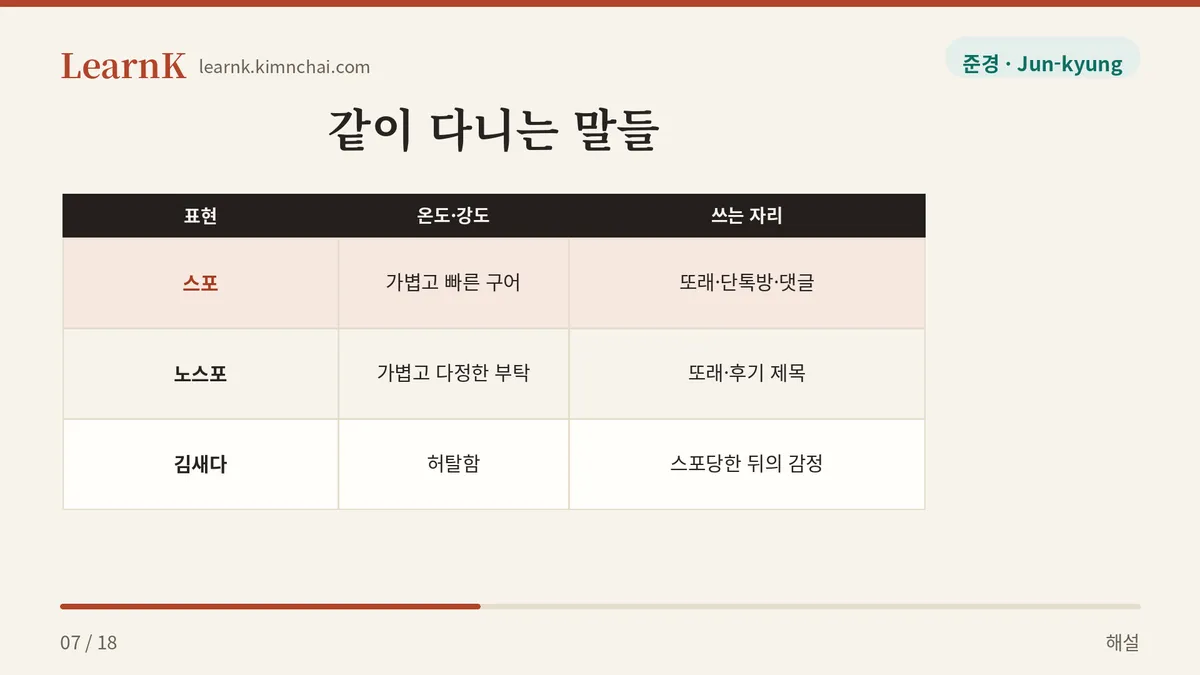
| Expression | Tone & intensity | Where it’s used |
|---|---|---|
| 스포 (seupo) | Light, fast, spoken | Peers, group chats, comment sections |
| 스포일러 (seupoilleo) | Neutral | Even in news articles and official notices |
| 노스포 (noseupo) | A light, warm request | Peers, review titles |
| 결말을 미리 말하다 (gyeolmareul miri malhada) | Completely neutral, explanatory | With elders, in formal settings |
| 김새다 (gimsaeda) | The feeling after being spoiled | Peers. Means the excitement has gone flat |
That last one, 김새다 (gimsaeda), travels with 스포 like a matched pair. If 스포 is the event, 김새다 is the aftermath. 「스포당해서 완전 김샜어 (seupodanghaeseo wanjeon gimsaesseo)」 means you found out the ending early and the desire to watch it simply drained away.
Cultural Background — 본방사수 (bonbangsasu) and the Morning After
The very shape of the word 스포 reveals a habit of the Korean language. Korean loves to lop off long loanwords and keep only the front. Just as 셀프카메라 (selpeukamera, self camera) became 셀카 (selka) and 아이스 아메리카노 (aiseu amerikano, iced americano) became 아아 (a-a), 스포일러 became 스포. When four syllables shrink to two, the word picks up speed — and once it has speed, it turns up in sentences far more often.
Behind this word’s unusual force is the culture of 본방사수 (bonbangsasu). It literally means “defending the original broadcast” — sitting down to watch at the exact hour a show first airs, rather than catching a rerun or streaming it later. In an era when you can watch anything whenever you like, there are two reasons people still guard the live broadcast. One is to enjoy the flood of real-time community reactions together. The other is that they don’t trust themselves to survive until the next morning without getting spoiled. For a Korean drama fan, the morning after an episode airs is a minefield. The office elevator, the next table over at the café, a social media timeline you opened without thinking — the ending can leap out from anywhere.
As more and more dramas are adapted from webtoons and web novels, one more variety of spoiler has appeared: someone who has already read the original telling a drama-only viewer what’s coming. That one has its own name — 원작 스포 (wonjak seupo), source-material spoilers. It’s also why community boards post 「원작 스포 금지」 (wonjak seupo geumji, no source-material spoilers) as a separate rule of its own.
In Korean dramas themselves, this word shows up more often as a situation than as a line of dialogue. A friend smiles meaningfully, as though they know what happens next; the other person claps their hands over their ears and flees. Without a single line spoken, viewers know exactly what’s going on. 스포 has become that kind of shared rule — one that needs no explaining.
Today’s Quiz
A friend is about to bring up a drama you haven’t watched yet. What’s the most natural one-liner to head them off?
- 스포당해 줘! (Seupodanghae jwo!)
- 노스포로 부탁해! (Noseupo-ro butakhae!)
- 스포 주의합니다. (Seupo juuihamnida.)
Answer: 2. Number 1 has 당하다 (danghada) attached, which flips it into the exact opposite meaning — “please spoil it for me.” The 스포 주의 in number 3 is a warning label you stick on a post or a video, so saying it out loud to a friend standing right in front of you sounds strange. In conversation, 「노스포로 부탁해」 or 「스포하지 마」 are the most natural choices.