숙소 (sukso): The Two Syllables That Decide Half Your Trip
숙소
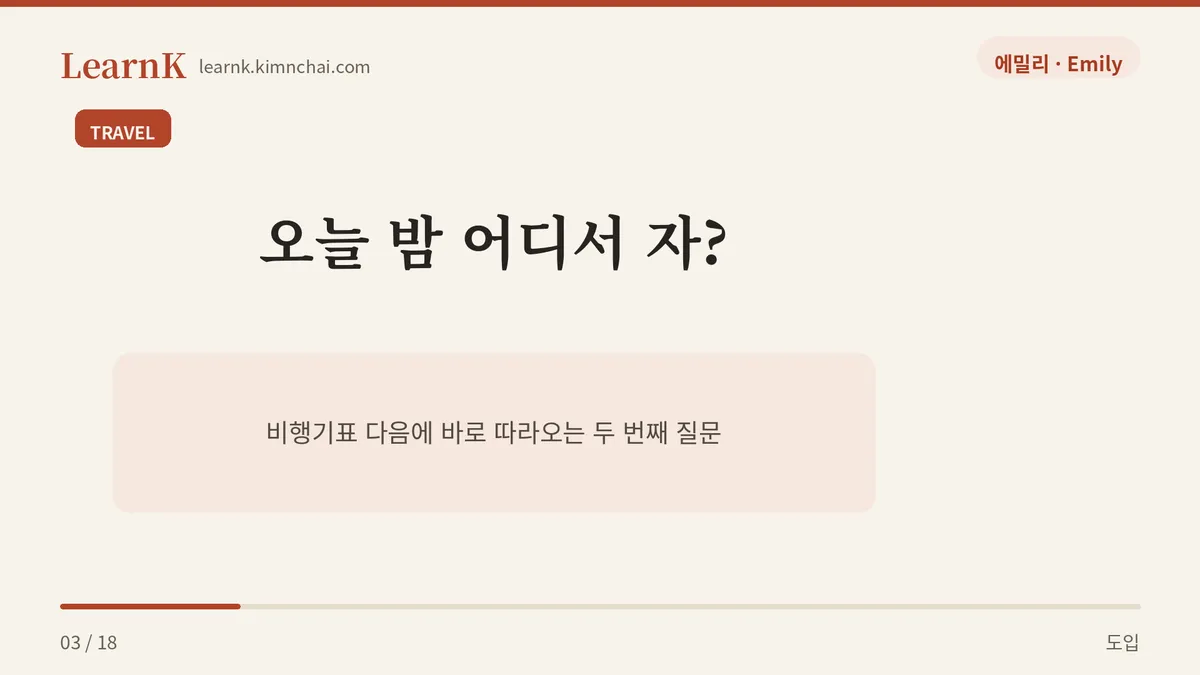
숙소 (sukso) means a place other than your own home where you stay temporarily. A hotel at your travel destination, a motel you check into on a business trip, a guesthouse where a backpacker crashes for a night — all of them are 숙소 (sukso). The second question that follows right after you book your plane ticket — so where are we sleeping tonight? — is something Korean wraps up in these two syllables.
Anyone who has ever planned a trip knows exactly where this word shows up. You decide when to go, you look into transportation, and then comes 숙소 (sukso). When Koreans talk about travel with each other, 「숙소 잡았어? (sukso jabasseo?)」 is effectively the same as asking “How far along are your trip preparations?” Having your 숙소 (sukso) settled is a signal that the trip has crossed over from a plan in your head into an actual itinerary.
The most important property of 숙소 (sukso) is that it’s an umbrella word. Hotels, motels, pensions, guesthouses, minbak, hanok stays, dormitories — whatever the type, if it’s a space you’ve borrowed briefly in order to sleep, it all gets bundled under 숙소 (sukso). So this word comes out when you haven’t decided where yet, or when there’s no particular need to specify the type. Conversely, once you’re in a situation where you can just say “our hotel,” you don’t bother reverting to 숙소 (sukso).
One more thing: 숙소 (sukso) always carries the condition of “not home.” No matter how small or how temporary the studio apartment you live in is, you don’t call your own place 숙소 (sukso). Is it your base for daily life, or a spot where you stay briefly and then leave? That single line is the whole of this word. Its temperature is neutral and slightly practical. It’s a word that carries information rather than emotion, so it appears as-is in stiff writing like booking confirmation texts, corporate travel policies, and travel agency notices.
Checking the National Institute of Korean Language Dictionary
The National Institute of Korean Language’s Basic Korean Dictionary defines the word this way.
숙소 「Noun」 A place that is not one’s house where one stays temporarily. [English] lodging; accommodations — A place that is not one’s house where one stays temporarily [Japanese] しゅくしょ【宿所】 — 家ではなく臨時に泊まるところ。 [Spanish] alojamiento, hospedaje, albergue — Lugar para la permanencia temporal, que no es casa. [Chinese] 住处,落脚点 — 临时停留住宿的地方。 — National Institute of Korean Language, Basic Korean Dictionary (krdict.korean.go.kr)
A Portuguese translation isn’t included in this dictionary. For reference only, it would be something like alojamento or hospedagem — but that line is our own translation, not dictionary content.
The two phrases worth noting in the definition are “not one’s house” and “temporarily.” Both conditions have to be met at once for something to be 숙소 (sukso). Looking at the dictionary’s actual usage examples shows how those conditions operate inside a sentence.
나는 지도와 가이드북을 살펴보며 깨끗하고 저렴한 숙소를 찾고 있다. — National Institute of Korean Language, Basic Korean Dictionary (krdict.korean.go.kr)
naneun jidowa gaideubugeul salpyeobomyeo kkaekkeutago jeoryeomhan suksoreul chatgo itda. — This is before setting off on a trip, at the stage where nothing has been decided yet. Notice how 「깨끗하고 저렴한 (kkaekkeutago jeoryeomhan)」— “clean and cheap” — sits in front of 숙소 (sukso). Because 숙소 (sukso) is something you choose by conditions rather than by type, it very often pairs up with adjectives like these.
숙소는 어디로 예약할까요? — National Institute of Korean Language, Basic Korean Dictionary (krdict.korean.go.kr)
suksoneun eodiro yeyakhalkkayo? — This is polite speech, two or more people preparing a trip together and asking the other person’s opinion. The ending 「-ㄹ까요? (-lkkayo?)」 creates the stance of not making the decision alone. It’s practical enough that you could copy this sentence straight into a group chat about a trip.
민준이는 제주도 여행을 하기 위해 숙소와 교통편을 알아보는 중이다. — National Institute of Korean Language, Basic Korean Dictionary (krdict.korean.go.kr)
Minjunineun Jejudo yeohaengeul hagi wihae suksowa gyotongpyeoneul araboneun jungida. — Here 숙소 (sukso) is placed side by side with 교통편 (gyotongpyeon), “transportation.” When Koreans talk about trip preparation, these two travel together almost as a set. 「숙소와 교통편 (suksowa gyotongpyeon)」 is a chunk worth memorizing whole.
나는 여러 사람이 함께 쓰는 숙소에 살면서 많은 불편을 감내해야 했다. — National Institute of Korean Language, Basic Korean Dictionary (krdict.korean.go.kr)
naneun yeoreo sarami hamkke sseuneun suksoe salmyeonseo maneun bulpyeoneul gamnaehaeya haetda. — Here 숙소 (sukso) isn’t a traveler’s one-night stay but a shared residence used by several people together. Dormitories, hostel dorm rooms, and training camp lodgings all fall on this side. Because it’s a neutral word that carries no implication of being a nice place, it fits into a sentence like this without any friction.
내가 도착한 지 얼마 되지 않아 곧 친구들도 숙소에 도착했다. — National Institute of Korean Language, Basic Korean Dictionary (krdict.korean.go.kr)
naega dochakhan ji eolma doeji ana got chingudeuldo suksoe dochakhaetda. — This sentence shows the role 숙소 (sukso) plays during a trip. In an unfamiliar city, it’s the reference point where people scatter and then gather again — in other words, the place you go back to.
A Real Conversation
The scene: 11 p.m., in front of the Gangneung intercity bus terminal in the rain. Two people who have just arrived are standing under the eaves.
Jun-kyung: 야, 비 온다. 우산 챙겼어? Hey, it’s raining. Did you bring an umbrella?
Emily: 아니, 하나도 없어. 숙소 여기서 멀어? No, not one. Is the place we’re staying far from here?
Jun-kyung: 걸어서 십 분쯤? 지도에선 바닷가 쪽이었는데. About ten minutes on foot? On the map it was over toward the beach.
Emily: 십 분이면 다 젖어. 그냥 택시 타자. Ten minutes and we’ll be soaked. Let’s just grab a taxi.
Jun-kyung: 아 맞다, 나 숙소 이름이 기억이 안 나. 예약 문자 너한테 갔지? Oh right, I can’t remember the name of the place. The booking text went to you, didn’t it?
Emily: 잠깐만… 아, 있다. ‘파도게스트하우스’. 숙소 가서 라면부터 끓여 먹자. Hold on… ah, found it. Pado Guesthouse. Let’s get there and make ramyeon first thing.
These Would Sound Off
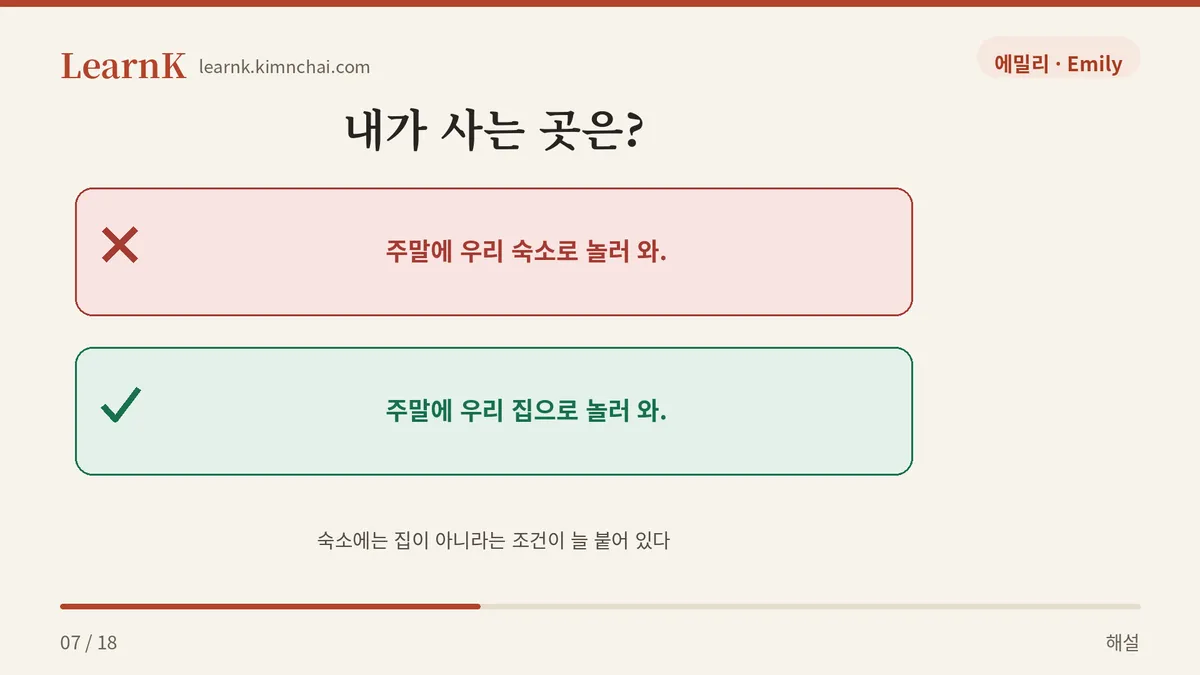
✗ (pointing at the house you’ve lived in for ten years) 주말에 우리 숙소로 놀러 와. jumare uri suksoro nolleo wa. ✓ 주말에 우리 집으로 놀러 와. jumare uri jibeuro nolleo wa. → 숙소 (sukso) comes with the condition of “not home” attached. If you call the place you live 숙소 (sukso), the listener will pause for a second and wonder, “Wait, is this person on some kind of posting right now?”
✗ (to a staff member at the hotel front desk) 제 숙소 열쇠 좀 주세요. je sukso yeolsoe jom juseyo. ✓ (to a staff member at the hotel front desk) 제 방 열쇠 좀 주세요. je bang yeolsoe jom juseyo. → 숙소 (sukso) is a big word referring to an entire building or place. When you’re already standing inside that building and want to refer to one room, you have to say 방 (bang), “room.” If you ask about your 숙소 (sukso) at the front desk, the staff will think you’re asking about some other lodging.
Example Sentences by Situation
1. To a coworker after returning from a business trip (polite speech)
이번 출장은 숙소가 회사 근처라 아침에 좀 여유가 있었어요.
ibeon chuljangeun suksoga hoesa geuncheora achime jom yeoyuga isseosseoyo. (“On this business trip the place I stayed was near the office, so I had a bit of breathing room in the mornings.”) In business trip stories, 숙소 (sukso) almost always comes up together with where it was. That’s because the location is what determines how exhausting the trip turns out to be.
2. To a friend asking about your travel plans (casual speech)
숙소는 아직 안 잡았어. 항공권부터 끊고 보려고.
suksoneun ajik an jabasseo. hanggongkwonbuteo kkeunko boryeogo. The verb that attaches to 숙소 (sukso) most often is 잡다 (jabda), literally “to grab.” It’s far more colloquial than 예약하다 (yeyakhada), “to book,” so among friends 「숙소 잡다 (sukso japda)」 is the default. 「숙소 알아보다 (sukso araboda)」 means you’re still looking, while 「숙소 잡다 (sukso japda)」 means you’ve decided and locked it in.
3. Writing a review after a trip
숙소 자체는 깨끗했는데 방음이 좀 아쉬웠어요.
sukso jachaeneun kkaekkeuthaenneunde bangeumi jom aswiwosseoyo. In a review, starting with 「숙소 자체는 (sukso jachaeneun)」— “the place itself” — is a signal that a complaint is coming next. It’s a very common structure in Korean reviews: acknowledge the good first, then lay the downside on gently.
Polite vs. Casual Speech, and Similar Expressions
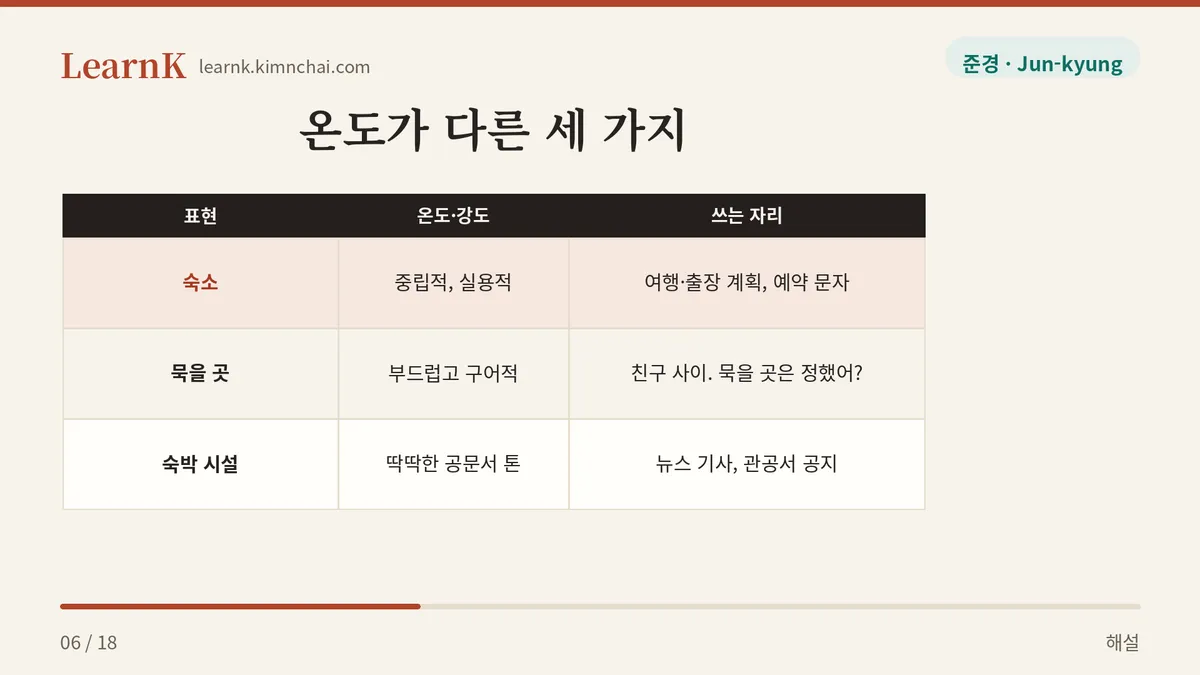
숙소 (sukso) is a noun, so the word itself has no politeness level. Polite and casual speech are decided at the end of the sentence. To a friend it’s 「숙소 어디야? (sukso eodiya?)」, and to someone you’ve just met it becomes 「숙소가 어디세요? (suksoga eodiseyo?)」. That said, when asking about someone else’s lodging, 「어디에 묵으세요? (eodie mugeuseyo?)」 is a little softer. Asking about their 숙소 (sukso) directly can come across as slightly too focused on pinning down the exact place.
| Expression | Temperature / Intensity | Where it’s used |
|---|---|---|
| 숙소 (sukso) | Neutral, slightly practical | Travel and business trip planning, booking texts. When you’re not specifying the type |
| 숙박 시설 (sukbak siseol) | Stiff, official-document tone | News articles, government notices, industry jargon |
| 묵을 곳 (mugeul got) | Soft and colloquial | Between friends. 「묵을 곳은 정했어? (mugeul goseun jeonghaesseo?)」 |
| 호텔·펜션·게스트하우스 (hotel · pension · guesthouse) | Type is specified | When you already know where you’re staying |
| 집 (jip) | Your base for daily life | Where you live. The opposite pole from 숙소 (sukso) |
Cultural Background — 잘 숙 (宿), 바 소 (所)
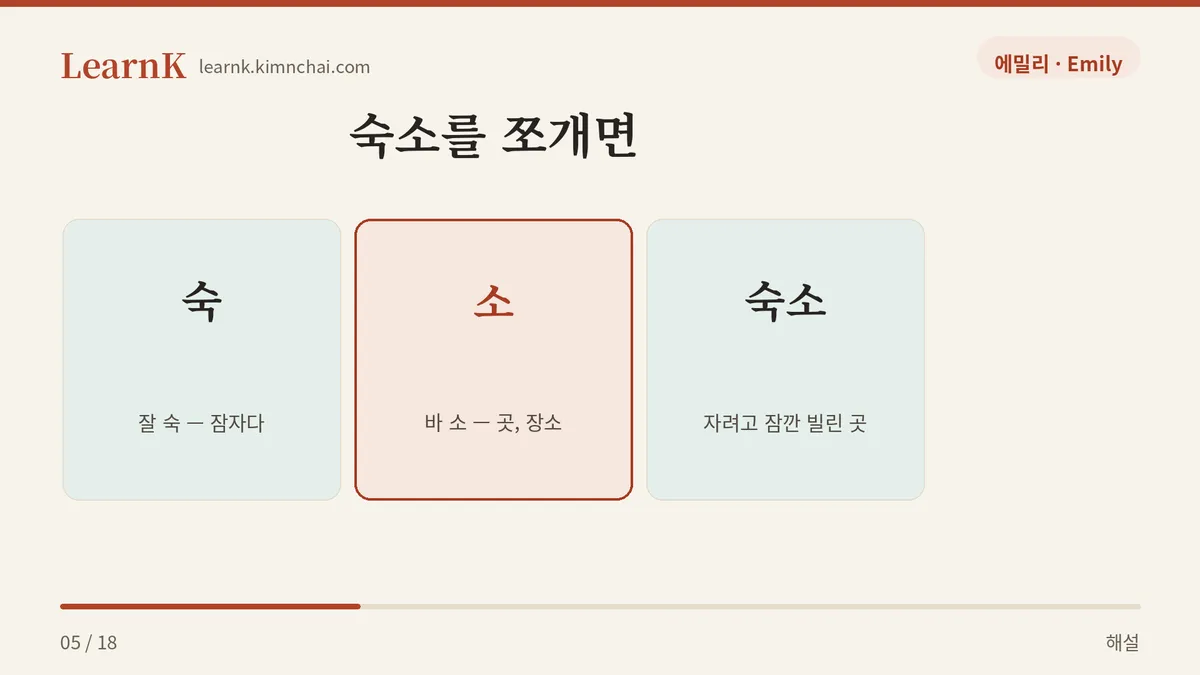
숙소 (sukso) is a Sino-Korean word: 宿 (suk), “to sleep,” plus 所 (so), “place” — in other words, “a place to sleep.” There’s a whole string of words that share that same 宿 character. 숙박 (宿泊, sukbak) is the act of staying overnight, 하숙 (下宿, hasuk) is renting a room in someone else’s house to live in, and 합숙 (合宿, hapsuk) is a group of people gathering to stay in one place together. Learn this family of words all at once and you develop a feel for it: if 宿 is in there, it’s a story about where someone sleeps.
In Korea, the range of what counts as 숙소 (sukso) is wider than you’d expect. Pensions by the sea, business hotels downtown, guesthouses where travelers mix, minbak in rural villages, temple stays where you spend a day at a monastery, and — when you’re desperate — even a 24-hour jjimjilbang. The tiers you can choose from, depending on budget and circumstances, are packed close together. That’s why the question 「숙소 어디로 잡았어? (sukso eodiro jabasseo?)」 carries both a price range and the character of the trip inside it.
If you’re a fan of Korean pop culture, you may have first heard this word in a slightly different context. The house where the members of an idol group live together around their debut is also called 숙소 (sukso) in Korean. That’s because each of them has their own family home elsewhere, and this is a temporary residence the company has set up for their activities. The dictionary definition’s conditions — “not one’s house” and “temporarily” — are being observed precisely here too.
These shared 숙소 (sukso) show up often in dramas as well. Reply 1994 (tvN, 2013), set in a boarding house in Seoul’s Sinchon neighborhood in 1994, is a story about college students who have come up from the provinces, sharing sleeping quarters under one roof and eventually becoming a family. In travel variety shows, too, the squabble over how to divide up the rooms on the first day is practically a fixed scene — and what those scenes tell us is one thing. 숙소 (sukso) isn’t just a place to sleep; it’s also where the relationships of that trip get decided.
Today’s Quiz
Which of the following uses 숙소 unnaturally?
- 여행 첫날은 숙소에 짐만 두고 바로 나왔어.
- (pointing at the house you’ve lived in for ten years) 우리 숙소에서 저녁 먹고 가.
- 이번 출장 숙소는 공항 근처예요.
The answer is number 2. 숙소 (sukso) refers to “a spot where you stay temporarily somewhere that isn’t home,” so you can’t use it for the house you actually live in. Here, 「우리 집에서 저녁 먹고 가 (uri jibeseo jeonyeok meokgo ga)」 is the correct form. Number 1 is a temporary place to stay during a trip and number 3 is a temporary place to stay on a business trip, so both are natural.
Definitions and example sentences are from the National Institute of Korean Language’s Basic Korean Dictionary (krdict.korean.go.kr); that portion of this post, including our translations, is licensed under CC BY-SA 2.0 KR.