수상소감 (susangsogam) — What Koreans Say During Their Three Minutes Holding the Trophy
수상소감
수상소감 (susangsogam) is the reflection and thanks an award winner shares on the spot — literally, “what you felt on receiving a prize, put into words.” It’s the Korean equivalent of the English acceptance speech. Turn on Korean television in late December and you’ll hear it several times a day. The host holds out the trophy, the stage lights gather on one person, the microphone changes hands. The four characters that come up in the subtitle right then are exactly this word.
If you’re a K-pop fan, there’s no getting around it. Once year-end awards season arrives, half the post titles in fan communities start with this word. A sentence like 어제 수상소감 봤어? (eoje susangsogam bwasseo?) — “Did you see the acceptance speech yesterday?” — is close to a greeting among Korean fans.
Let’s look at the nuances. First, it’s a noun. It doesn’t point to a single line said on stage; it bundles up the entire stretch of time that person held the microphone. That’s why you can judge the whole thing at once: 수상소감이 길었다 (susangsogami gireotda), “the acceptance speech was long,” or 수상소감이 좋았다 (susangsogami joatda), “the acceptance speech was good.”
Second, it’s a formal word. It appears as-is in newspaper articles and as-is in broadcast subtitles. It isn’t an abbreviation or a piece of slang, so there’s no problem at all using it in front of someone older than you.
Third, in Korea the word comes with a quiet set of conventions attached. Naming the people you want to thank, in order, is the basic skeleton — and that order gets read as a statement about the speaker. So 수상소감을 잘한다 (susangsogameul jalhanda) doesn’t mean someone is a smooth talker; it’s closer to saying they did a good job of remembering who, and in what order.
The phrases that commonly attach to it are worth memorizing too: 수상소감을 밝히다 (susangsogameul balkida), 수상소감을 전하다 (susangsogameul jeonhada), 수상소감 한 말씀 (susangsogam han malsseum) — the first two are journalese, and the last is what a host says when handing over the mic.
Seeing it in a real conversation
Scene: The night of December 31, in Jun-kyung’s living room. A year-end music awards show is airing live, moments before the Grand Prize is announced. The two of them are glued to the sofa, side by side.
준경: 야, 소리 좀 키워봐. 이제 대상 수상소감 한다. Hey, turn it up. The Grand Prize acceptance speech is about to start.
에밀리: 어? 리더 벌써 우는데? 아직 말도 안 꺼냈어. Huh? The leader’s already crying? He hasn’t even said anything yet.
준경: 원래 저래. 울다가 소속사 사장님부터 부르지, 아마. That’s how it always goes. He’ll cry, then start by thanking the CEO.
에밀리: 근데 나 저 팀 수상소감은 진짜 좋더라. 팬덤 이름 꼭 마지막에 부르잖아. But I really do like that team’s acceptance speeches. They always save the fandom name for last.
준경: 그치. 준비해 온 티 안 나게 말하는 게 제일 어려운 건데. Right. Sounding unrehearsed is the hardest part.
에밀리: 나 작년에 회사 워크숍에서 상 받았을 때 머리 하얘져서 “감사합니다”만 세 번 했잖아. Last year when I got an award at the company workshop, my mind went blank and I just said “thank you” three times.
준경: 그것도 훌륭한 수상소감이었어. 짧고 진심이었잖아. That was a perfectly good acceptance speech. Short and sincere.
These uses sound unnatural
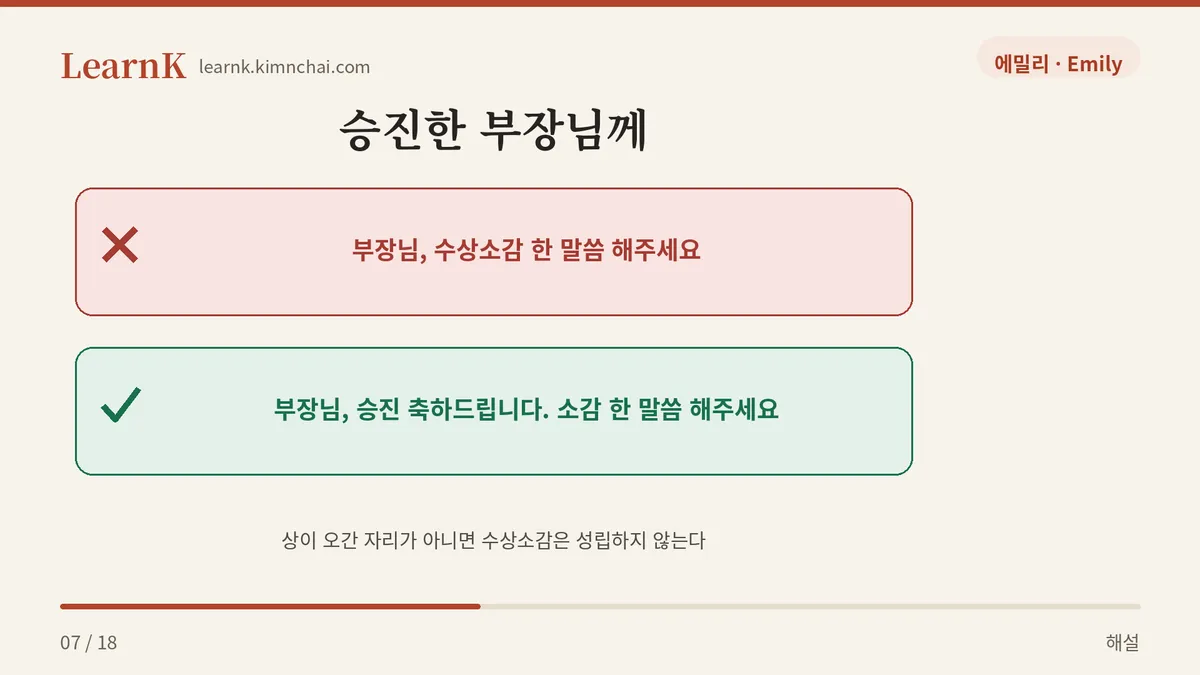
✗ (To a manager who’s just been promoted) 부장님, 승진하셨다면서요? 수상소감 한 말씀 해주세요. (bujangnim, seungjinhasyeotdamyeonseoyo? susangsogam han malsseum haejuseyo) “Sir, I hear you got promoted? Please give us your acceptance speech.”
✓ (To a manager who’s just been promoted) 부장님, 승진 축하드립니다. 소감 한 말씀 해주세요. (bujangnim, seungjin chukhadeurimnida. sogam han malsseum haejuseyo) “Sir, congratulations on your promotion. Please share a few words about how you feel.”
→ 수상소감 only holds up in a setting where an award (상, 賞) actually changed hands. For occasions with no award — a promotion, passing an exam, winning an election — you just use 소감 (sogam). Saying 수상소감 when there’s no award either lands as a joke or makes you look like someone who misread the room.
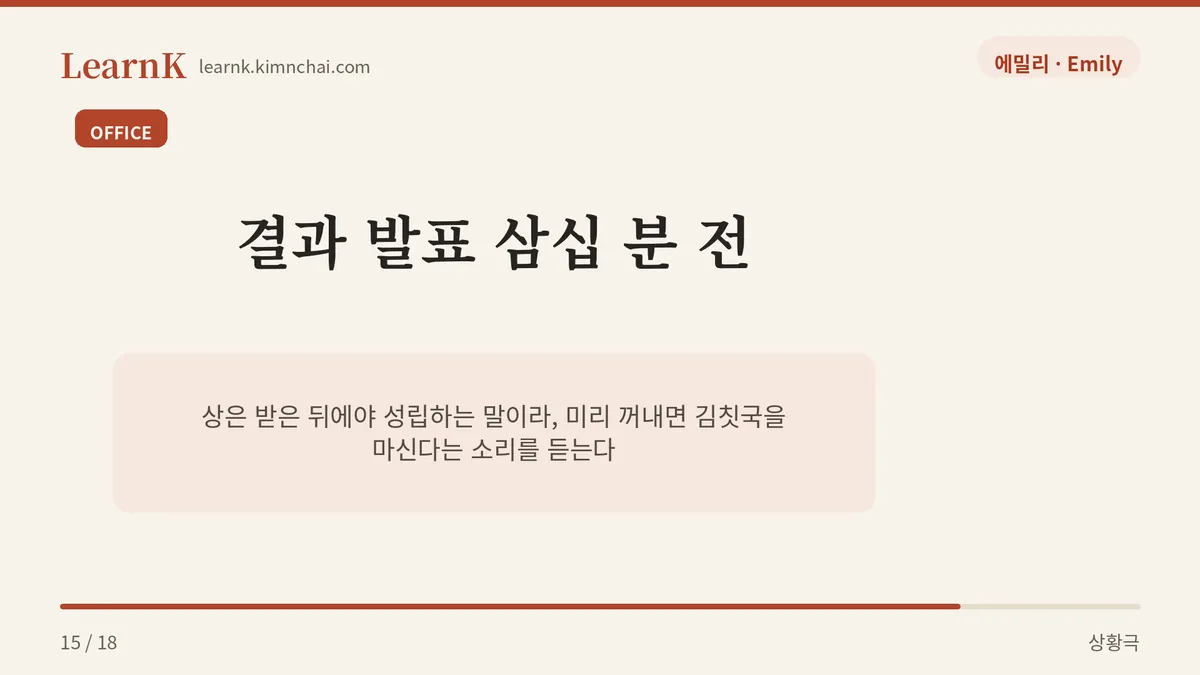
✗ (Before the results are announced, to colleagues) 저 오늘 수상소감 미리 써 왔어요. (jeo oneul susangsogam miri sseo wasseoyo) “I wrote my acceptance speech in advance today.”
✓ (Before the results are announced, to colleagues) 혹시 몰라서 한마디 정도는 생각해 뒀어요. (hoksi mollaseo hanmadi jeongdoneun saenggakhae dwosseoyo) “Just in case, I’ve thought of a few words to say.”
→ The grammar is perfectly fine, but the timing is off. The word only comes into existence after the award has been received, so pulling it out before the announcement gives the impression that you’re “treating it as already won.” In Korea this attitude is described as 김칫국을 마신다 (gimchitgugeul masinda) — “drinking the kimchi broth,” the Korean version of counting your chickens before they hatch. Even if you really did prepare, keeping that to yourself is the etiquette of the occasion.
Example sentences by situation
1. Live awards-show subtitle — previewing what comes next
잠시 후 대상 수상소감이 이어집니다. (jamsi hu daesang susangsogami ieojimnida) The Grand Prize acceptance speech will follow shortly.
This is written-style Korean used verbatim on air. 이어집니다 (ieojimnida) means the program is moving on to the next item without a break — a staple of news and broadcast subtitles.
2. Host at a company awards ceremony — handing over the mic
그럼 올해의 사원상 수상자께 수상소감 한 말씀 부탁드리겠습니다. (geureom orhaeui sawonsang susangjakke susangsogam han malsseum butakdeurigetseumnida) Then we’d like to ask this year’s Employee of the Year for a few words.
This works exactly the same way at company year-end events and school award ceremonies, not just on K-pop stages. 한 말씀 (han malsseum) elevates the other person’s words honorifically while gently sending the signal, “you don’t have to go long.”
3. Fan community comment — the morning after the broadcast
어제 수상소감 듣다가 나도 같이 울었어요. (eoje susangsogam deutdaga nado gachi ureosseoyo) I cried right along with them while listening to yesterday’s acceptance speech.
This is the most common use among fans. Both 보다 (boda, “to watch”) and 듣다 (deutda, “to listen”) work here: 듣다 if you were focused on what was said, 보다 if you’re picturing the whole scene on stage.
Polite and casual forms, and similar expressions
수상소감 itself is a noun, so it has no separate honorific or plain form. The politeness is created by the words around it. Among friends it becomes 수상소감 뭐라고 했어? (susangsogam mworago haesseo?), “What did they say in the acceptance speech?”; to an elder, 수상소감 어떠셨어요? (susangsogam eotteosyeosseoyo?), “How was it, giving your acceptance speech?”
Expressions that look similar are used in different settings.
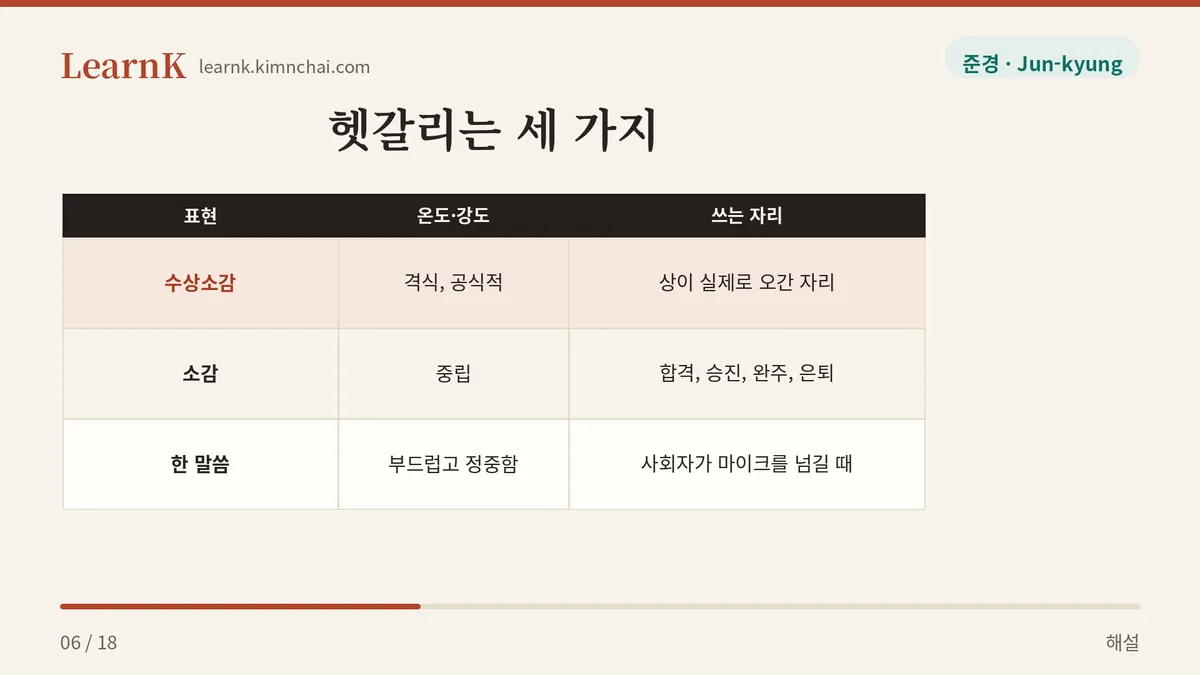
| Expression | Tone / intensity | Where it’s used |
|---|---|---|
| 수상소감 (susangsogam) | Formal, official | Only where an award actually changed hands |
| 소감 (sogam) | Neutral | Anywhere — passing an exam, a promotion, finishing a race, retiring |
| 한 말씀 (han malsseum) | Soft and polite | When a host hands over the microphone |
| 감사 인사 (gamsa insa) | Warm and personal | When the focus is purely on giving thanks |
The two most often confused are the first and second rows. 수상소감 is one kind of 소감, so you’ll never get it wrong as long as you check a single thing: was there an award on the line? If there was, 수상소감; if not, 소감.
Cultural background — three minutes holding the trophy
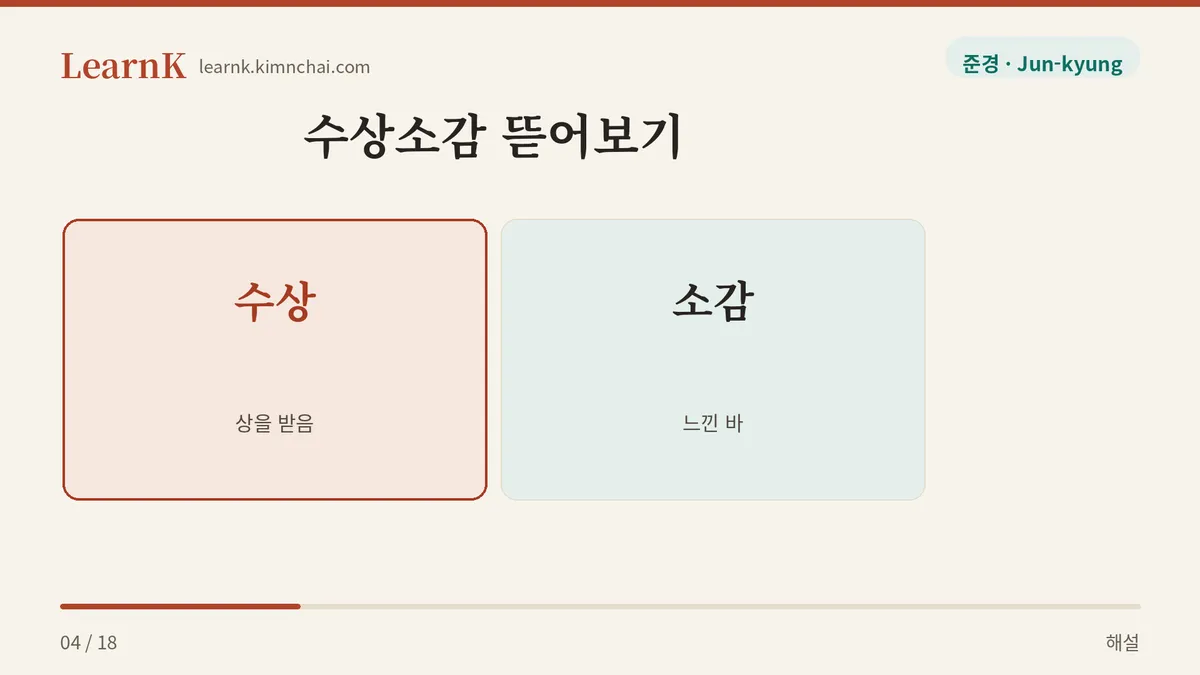
The word is built from two Sino-Korean pieces. 수상 (susang, 受賞) is “receiving an award,” and 소감 (sogam, 所感) is “what one felt.” Put them together and you get “what you felt upon receiving an award” — the meaning is right there on the surface. One thing to watch out for: 시상 (sisang, 施賞), which sounds nearly identical, points in the opposite direction. Receiving is 수상, giving is 시상. So the person handing over the award is the 시상자 (sisangja, presenter), and the person receiving it is the 수상자 (susangja, recipient).
Korea’s year-end is filled with awards shows. Once December arrives, music awards run one after another, and these broadcasts air live for hours at a time. Fans tune in to watch the performances, but the video that circulates most the next day is often not a performance at all — it’s the acceptance speech.
An acceptance speech has an invisible running order. Usually the agency’s CEO and staff come first, parents next, and the fandom’s name is placed dead last. That last slot is the heaviest one. If it’s a group, the convention is for the leader to speak on everyone’s behalf while the other members add a line each. That’s why fans clip out the few seconds when their own fandom name is called and pass it around. It’s common for those few seconds to be talked about longer than any single song.
When it’s time to wrap up, background music slowly fades in. That’s the signal for “please bring it to a close.” If the music starts while there are still people left to thank, the speech speeds up — and that rushed voice often reads as all the more sincere. The acceptance speeches remembered longest at Korean awards shows are generally not the polished ones, but the ones where the speaker cried and the words got tangled.
Dramas use this scene often, too. The classic versions: an unknown actor wins a first award, steps onto the stage, and finds the words won’t come; or someone saves the name of a person they long resented for the very last line. Because these scenes give silence more room than dialogue, they’re one of the rare stretches where a Korean learner can read the emotion even without subtitles.
Today’s quiz
A colleague has just won the Grand Prize at an in-house contest and stepped up on stage. As the host handing over the microphone, which is the most natural thing to say?
- 수상소감 미리 준비하셨죠? (susangsogam miri junbihasyeotjyo?) — “You prepared your acceptance speech in advance, right?”
- 수상소감 한 말씀 부탁드리겠습니다. (susangsogam han malsseum butakdeurigetseumnida) — “We’d like to ask you for a few words of acceptance.”
- 승진 소감 한 말씀 부탁드리겠습니다. (seungjin sogam han malsseum butakdeurigetseumnida) — “We’d like to ask you for a few words about your promotion.”
Answer: 2
An award has actually changed hands here, so 수상소감 is correct, and 한 말씀 부탁드리겠습니다 is the polite set phrase a host uses when passing the mic. Option 1 publicly points out that the person prepared, which puts them on the spot — even if they did prepare, covering for that is the etiquette of the occasion. Option 3 is out of place entirely, since this isn’t a promotion.
The definitions, example sentences, and dialogue in this post are all original writing.