Time Slip — I Fell Into a Well and Woke Up in Joseon
타임슬립
타임슬립 (taimseullip) means slipping across time and landing in another era, past or future. Watch Korean dramas long enough and you are guaranteed to meet this word at least once. The main character falls into a well, gets struck by lightning, or closes a hand around an old hairpin — the screen flashes white, and when they open their eyes, people in horsehair hats are looking down at them. Viewers describe that scene like this: 주인공이 조선 시대로 타임슬립했어. (juingong-i Joseon sidae-ro taimseullip-haesseo.) — “The main character time-slipped into the Joseon era.”
The heart of the word is the slipping. A 타임슬립 is not a planned trip you take by boarding a machine; it is closer to an accident, your foot dropping straight through a crack in time before you have any idea what happened. That is why a time-slipped hero almost always begins with a bewildered face. They don’t know how to get back, and they don’t know why they came. This accidental, disoriented quality is exactly what separates 타임슬립 from the more composed expression 시간 여행 (sigan yeohaeng), “time travel.”
There are two main ways it gets used. The first points to a genre. Add -물 (-mul), meaning “work” or “piece,” and you get an umbrella term for any story with that premise, as in 이 드라마 타임슬립물이야? (i deurama taimseullip-mul-iya?) — “Is this drama a time-slip show?” The second use is far more common: an everyday figure of speech. Stepping into an old market alley, spotting the same little stationery shop that still sits in front of an elementary school, sitting down in a restaurant playing 90s pop — Koreans will say lightly that they feel like they just time-slipped for a moment. Here it doesn’t mean they really crossed time. It’s a small exclamation that the scene in front of them has summoned some other era far too vividly.
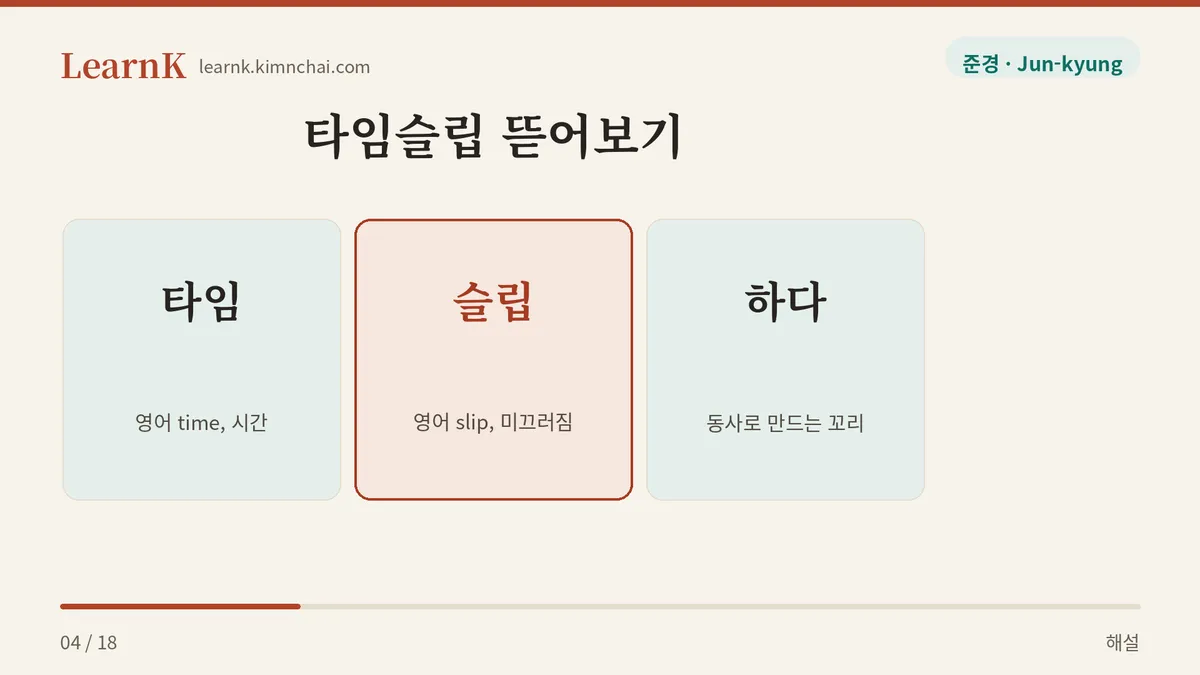
Grammatically it is a noun, and adding 하다 (hada) turns it into the verb 타임슬립하다 (taimseullip-hada). Casual speech gives you 타임슬립했어, polite speech 타임슬립했어요, and formal speech 타임슬립했습니다. As you’ll see below, though, this word does not sit comfortably in formal settings.
See It in a Real Conversation
Scene: An alley in Bukchon Hanok Village. They’ve just put on rented hanbok and turned into the narrow lane.
Jun-kyung: 와, 여기 들어오니까 소리가 확 줄어든다. Wow, the second we turn into this alley the noise just drops.
Emily: 그치? 나 방금 타임슬립한 줄 알았어. 저 기와 좀 봐. Right? I honestly thought I’d just slipped back in time. Look at those roof tiles.
Jun-kyung: 야, 그거 완전 드라마 대사 같다. 근데 인정, 진짜 그래. Hey, that sounds exactly like a drama line. But fair, it really does feel like that.
Emily: 나 요즘 타임슬립 드라마만 봐. 주인공이 우물에 빠지면 무조건 조선이잖아. I’ve been watching nothing but time-slip dramas lately. The lead falls into a well and it’s always Joseon.
Jun-kyung: 그래서 지금 우물 찾는 중이야? So is that what you’re doing right now, looking for a well?
Emily: 어. 근데 여기 우물은 없고 카페만 있네. Yeah. But there are no wells here, just cafés.
Jun-kyung: 하하, 조선 사람들이 보면 기절하겠다. 사진이나 찍자. Haha, people from Joseon would faint. Let’s just take a picture.
Emily: 좋아. 이 사진 나중에 보면 또 타임슬립하는 기분일 듯. Sure. I bet looking at this photo later will feel like slipping in time all over again.
This Sounds Off
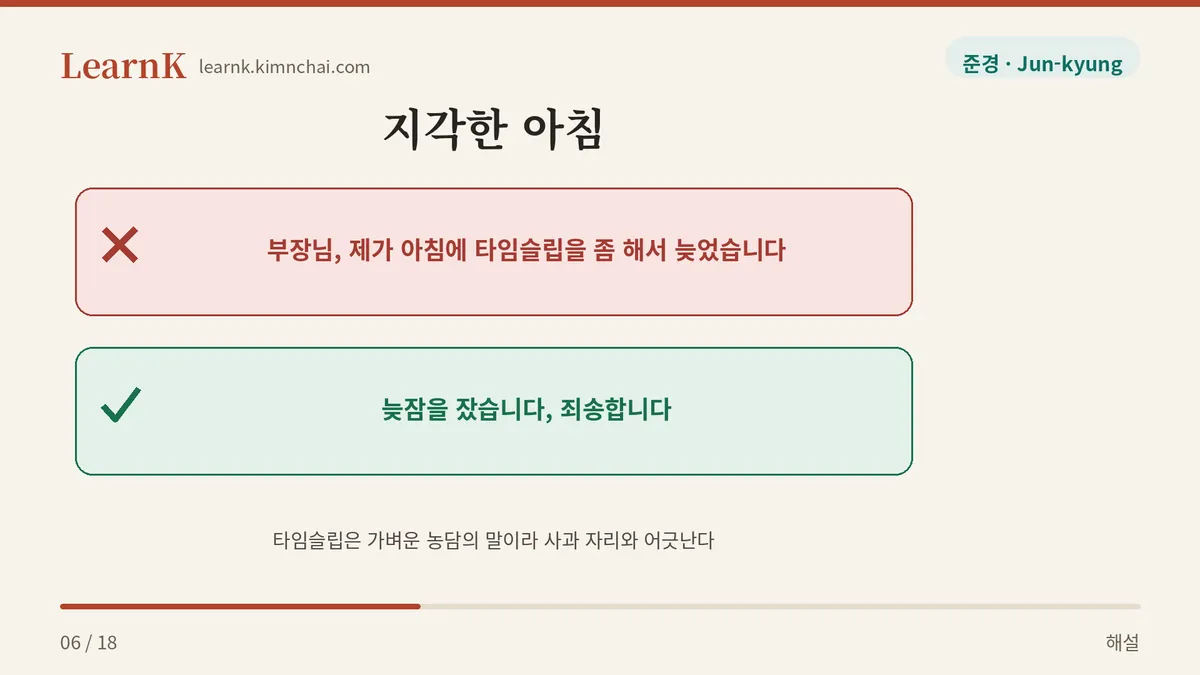
✗ (To your department head) 부장님, 제가 아침에 타임슬립을 좀 해서 늦었습니다. “Sir, I did a bit of time-slipping this morning, so I’m late.”
✓ (To a friend) 야, 나 아침에 타임슬립한 줄 알았어. 눈 떴는데 9시더라. “Dude, I thought I’d time-slipped this morning. I opened my eyes and it was already nine.”
→ It’s a joke, not something that actually happened. Used in a moment when you owe someone an apology, it makes you look like a person trying to laugh the situation off. With someone senior to you, 늦잠을 잤습니다, 죄송합니다 (neutjam-eul jatseumnida, joesonghamnida) — “I overslept, I’m sorry” — is the safe choice.
✗ 다음 주 회의를 다음 달로 타임슬립했어요. “I time-slipped next week’s meeting to next month.”
✓ 다음 주 회의를 다음 달로 미뤘어요. “I pushed next week’s meeting back to next month.”
→ This is a common misunderstanding. 타임슬립 is a person crossing into another era, not the act of moving a schedule or a date. If you think of the English words time and slip separately and guess your way to “push time around,” this is where you end up.
Example Sentences by Situation
1. Recommending a drama to a friend
Your friend is hunting for something to binge over the weekend, and you sum up the premise in one line. In Korea, people often skip the long plot description and just name the genre.
이거 타임슬립물인데, 주인공이 사고 나서 조선 시대에 떨어져. (igeo taimseullip-mul-inde, juingong-i sago naseo Joseon sidae-e tteoreojyeo.) It’s a time-slip show — the main character has an accident and drops into the Joseon era.
2. Walking through an old neighborhood
This is what comes out on a street that redevelopment never reached: faded signs, shops with prices written by hand and taped to the window. It’s close to an exclamation, so the ending gets drawn out a little.
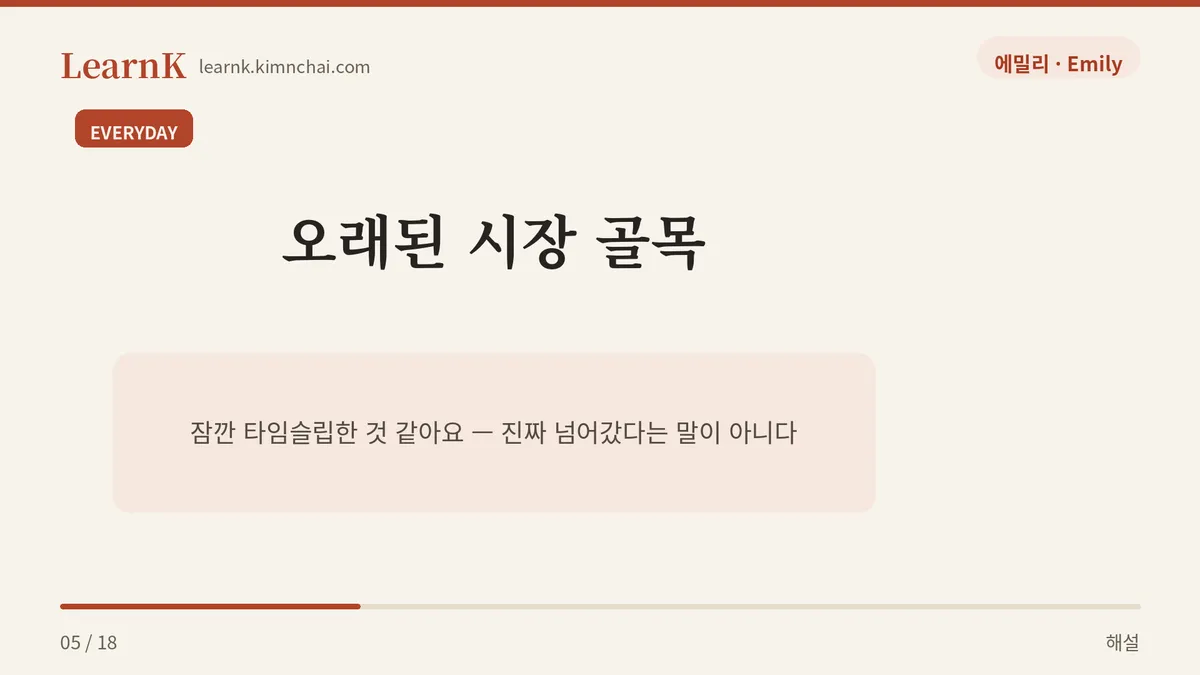
이 시장 골목 들어오니까 타임슬립한 것 같아요. (i sijang golmok deureoonikka taimseullip-han geot gatayo.) Coming into this market alley, I feel like I’ve slipped back in time.
3. Running into an old photo or song
Use it when you open an old album at your parents’ house, or when a song from a decade and a half ago comes on in a restaurant. With this usage, the forms -하는 기분이다 (-haneun gibun-ida) and -한 느낌이다 (-han neukkim-ida), “it feels like,” sound especially natural.
이 노래 들으니까 고등학교 때로 타임슬립하는 기분이야. (i norae deureunikka godeunghakgyo ttaero taimseullip-haneun gibun-iya.) Hearing this song, I feel like I’m slipping back to my high school days.
Politeness Levels and Similar Expressions
Change only the ending and the politeness follows. Casual speech is 타임슬립했어 (taimseullip-haesseo), general polite speech is 타임슬립했어요 (taimseullip-haesseoyo), and the formal style is 타임슬립했습니다 (taimseullip-haetseumnida). In practice, though, the formal style is almost never used. The word itself belongs to light exclamations and small talk, so dropping it into a report or an official announcement feels like clothes that don’t fit.
Several expressions look similar, but each has its own temperature and its own place.
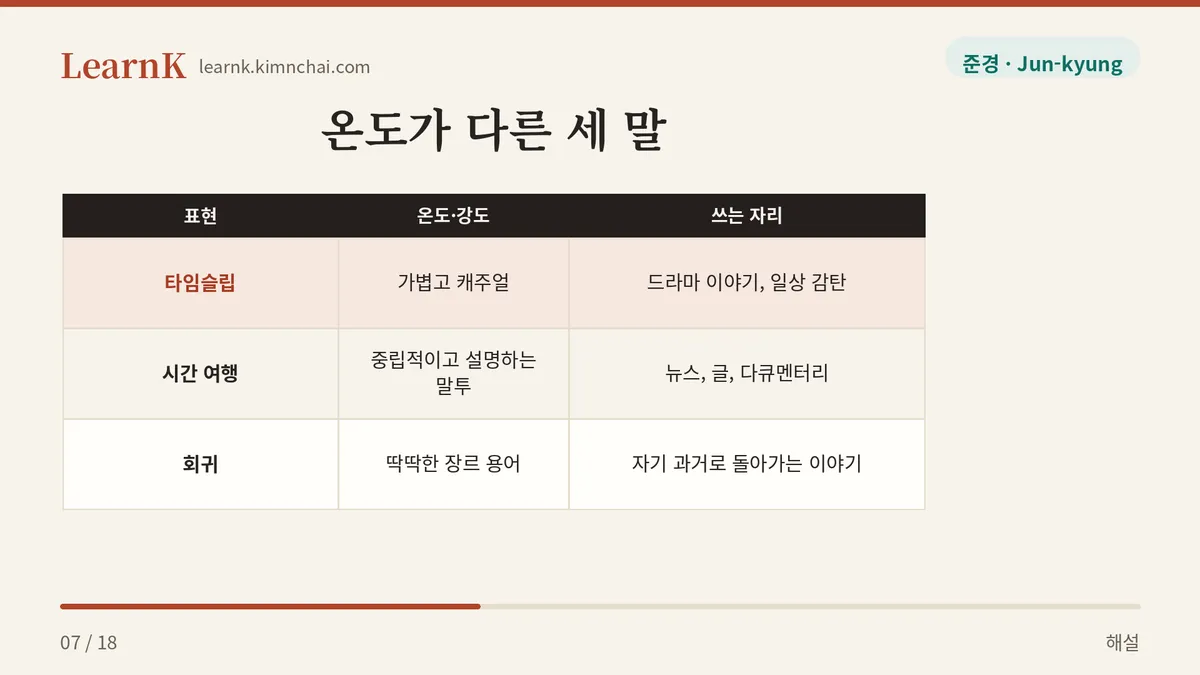
| Expression | Tone / Intensity | Where it’s used |
|---|---|---|
| 타임슬립 (taimseullip) | Light and casual. The feeling of slipping by accident | Drama talk, everyday exclamations. Not used in official documents |
| 시간 여행 (sigan yeohaeng) | Neutral, explanatory | News, writing, documentaries. Includes deliberate departures |
| 타임머신 (taimmeosin) | Device-centered, faintly sci-fi | When pointing to the means of crossing time |
| 회귀 (hoegwi) | A stiff genre term | Among web novel and drama fans. Returning to your own past, not someone else’s era |
Knowing the difference from 회귀 (hoegwi) in particular will help you follow Korean fan conversations much better. 타임슬립 is a story about being dropped into an unfamiliar era and becoming an outsider there; 회귀 is a story about a hero who has died or failed going back to some point in their own life and living it again. So if the pleasure of a time-slip story is culture shock, the pleasure of a 회귀 story is the satisfaction of someone who already knows all the answers.
Cultural Background — Wells, Lightning, and Joseon
타임슬립 was built by gluing together the English words time and slip. English speakers, however, don’t commonly use that combination with this meaning — in English it’s usually just “time travel,” and Japanese has the same construction in タイムスリップ. In other words, a learner who assumes the word was carried straight over from English will end up more confused, not less; this is a usage that took root in East Asia. It’s a loanword you have to learn again from inside Korean.
There’s a reason the word gets used so often in Korea specifically. Korean drama has a thick tradition of historical series, and most viewers already carry a picture of the Joseon era in their heads. Palaces, horsehair hats, hanbok, rigid class divisions — all of it lands without explanation. So all a writer has to do is drop one modern person into that world, and the story starts rolling on its own. Someone holding a smartphone stands before a king; a Joseon crown prince flounders in the middle of Seoul, unable to tap his card through a subway gate. That’s why the same setup keeps coming back with only the direction and method changed, as in 《옥탑방 왕세자》 (Rooftop Prince, SBS, 2012), 《나인: 아홉 번의 시간여행》 (Nine: Nine Time Travels, tvN, 2013), and 《철인왕후》 (Mr. Queen, tvN, 2020).
The means of crossing over has hardened into a set of images too. A well, a lightning strike, an old object, the sea below a cliff. Whichever it is, they share one thing: the hero didn’t choose it. That sense of “I somehow slipped” survives intact in the word’s nuance, which is why, in everyday speech, you don’t attach it to anything planned. Wandering by chance into an old alley, you say it feels like a 타임슬립 — but say it while buying a ticket into a folk village and something about it falls flat.
And Koreans use this word almost as an exclamation about time itself. Seoul is a city where a whole alley can change in the space of a few years. Inside that kind of speed, when you come across a spot where the old shape has survived, the shortest word that holds the surprise is 타임슬립. A word that arrived from dramas has moved over and taken a seat where everyday feelings get explained.
Today’s Quiz
Which of the following sentences uses 타임슬립 (taimseullip) naturally?
- 회의 시간을 3시에서 4시로 타임슬립했습니다.
- 이 골목에 들어오니까 타임슬립한 것 같아요.
- 어제 과음해서 기억이 타임슬립됐어요.
Show the answer
Answer: 2
타임슬립 is used for crossing into another era, or for a moment that makes an old time feel so vivid in front of you that it might as well be one. Sentence 1 is about moving a schedule, so 미뤘습니다 (mireotseumnida), “I pushed it back,” is the right word. Sentence 3 is about a memory cutting out, so 필름이 끊겼어요 (pilleum-i kkeunkyeosseoyo), literally “the film snapped,” is what sounds natural. Not everything involving time is a 타임슬립 — make sure that one sticks today.