Tangjinjaem — Feeling Rich on Ten Thousand Won, and the Joy of Blowing It All Today
탕진잼 (tangjinjaem)
탕진잼 (tangjinjaem) means the fun of spending a small, affordable amount of money all at once — blowing it in one satisfying go. It’s the week after payday, your bank account is already thin, and yet you stop by Daiso on the way home from work. You went in for one dish sponge, and somehow fifteen things end up in your basket. The register rings up eighteen thousand won. Not a lot of money — but you’re walking out with two bags. In that moment, laughing as you carry them out the door, Koreans say: “아, 오늘 제대로 탕진잼 (tangjinjaem) 했다.” (“Ah, I really went full tangjinjaem today.”)
What matters here isn’t the amount — it’s the temperature. 탕진잼 (tangjinjaem) isn’t a story about losing your fortune; it’s a story about spending you enjoyed while staying in control. The humor of the word lies in spending ten thousand won and then exaggerating, “I blew everything.” So 탕진잼 (tangjinjaem) always comes with three things attached: ① the amount is small (usually somewhere between 10,000 and 50,000 won), ② you chose it yourself, and ③ satisfaction outweighs regret, with a dash of self-deprecation mixed in. If even one of these three is missing, it isn’t 탕진잼 (tangjinjaem) — it’s just waste, or a disaster.
Grammatically it’s a noun, and in practice it shows up as 탕진잼이다 (tangjinjaem-ida), 탕진잼 하다 (tangjinjaem hada), and 탕진잼 하러 가다 (tangjinjaem hareo gada).
- 오늘 탕진잼 했어. (oneul tangjinjaem haesseo.) — I splurged to my heart’s content today (on a small scale).
- 이게 바로 탕진잼이지. (ige baro tangjinjaem-iji.) — This right here is what they call tangjinjaem.
- 주말에 탕진잼 하러 가자. (jumare tangjinjaem hareo gaja.) — Let’s go buy a whole bunch of stuff this weekend.
Seeing It in a Real Conversation
Situation: Saturday afternoon, in front of a Daiso. Emily, who said she’d “be out in ten minutes,” emerges forty minutes later with bags in both hands.
Jun-kyung: 야, 너 십 분 만에 나온다며. 그 봉투 다 뭐야? Hey, you said you’d be out in ten minutes. What’s all that in the bags?
Emily: 몰라. 정신 차려 보니까 계산대 앞이었어. 이게 바로 탕진잼이지. I don’t know. Next thing I knew I was at the register. This is exactly what they call tangjinjaem.
Jun-kyung: 얼마 썼는데? How much did you spend?
Emily: 만 팔천 원. 근데 스무 개 샀어. 개당 구백 원이야, 구백 원. Eighteen thousand won. But I got twenty things. That’s nine hundred won each. Nine hundred!
Jun-kyung: 아 진짜, 다이소는 탕진잼의 성지야. 나도 저번에 수세미만 여섯 개 사서 나왔잖아. Man, Daiso really is the holy land of tangjinjaem. Last time I walked out with six dish sponges.
Emily: 거봐, 너도 똑같으면서. 들어가자, 딱 한 번만 더 탕진잼 하게. See? You’re no different. Come on, let’s go back in for one more round.
When It Sounds Off
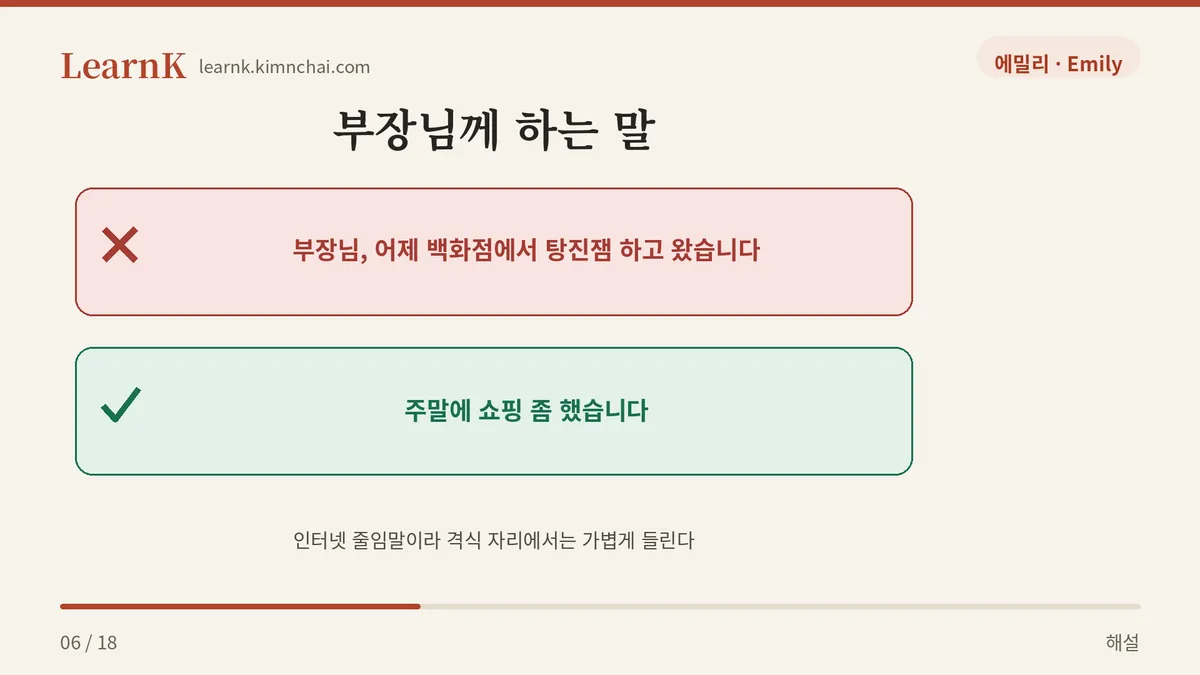
✗ (To your manager) 부장님, 저 어제 백화점에서 탕진잼 하고 왔습니다. (“Sir, I went and did some tangjinjaem at the department store yesterday.”) ✓ (To a friend) 야, 나 어제 다이소에서 탕진잼 하고 왔잖아. (“Dude, I totally went tangjinjaem at Daiso yesterday.”) → Because it’s an internet-born abbreviation, it sounds too casual in front of someone older or senior to you. On top of that, you’d essentially be announcing to your boss that you’re loose with money. With a senior, something like “주말에 쇼핑 좀 했습니다 (jumare syoping jom haetseumnida, I did a bit of shopping over the weekend)” is the safe choice.
✗ 나 사기당해서 전세금 다 날렸어. 완전 탕진잼이야. (“I got scammed and lost my entire jeonse deposit. Total tangjinjaem.”) ✓ 나 사기당해서 전세금 다 날렸어. 진짜 눈앞이 캄캄해. (“I got scammed and lost my entire jeonse deposit. Everything’s gone dark in front of me.”) → 탕진잼 (tangjinjaem) only attaches to “a small amount of money I spent myself, with a smile.” Use it for big money lost at someone else’s hands, or for gambling and investment losses, and it stops being a joke and becomes mockery. Once the amount is large and the choice wasn’t yours, this word turns rude immediately.
Example Sentences by Situation
① Walking out of a convenience store after sweeping up every new snack (texting a friend with a photo)
월급날도 아닌데 신상 과자만 만 원어치 샀어. 오늘 탕진잼 제대로 했다. (wolgeupnaldo anindae sinsang gwaja-man man woneochi sasseo. oneul tangjinjaem jedaero haetda.)
It’s not even payday and I bought ten thousand won worth of new snacks alone. I went full tangjinjaem today.
Korean convenience stores rotate in new snacks and drinks every two or three weeks. Each one runs around two thousand won, so once you start going “this one too, and that one,” you hit ten thousand won in no time. Saying “탕진잼 했다 (tangjinjaem haetda)” here instead of “낭비했다 (nangbihaetda, I wasted money)” makes the tone closer to bragging than to regret. Adding 제대로 (jedaero) gives it the emphasis of “properly, full-on.”
② The morning after checking out your shopping cart in the middle of the night
어젯밤에 장바구니 담아둔 거 다 결제했어. 새벽 탕진잼은 진짜 못 참겠더라. (eojetbame jangbaguni damadun geo da gyeoljehaesseo. saebyeok tangjinjaem-eun jinjja mot chamgetdeora.)
Last night I checked out everything sitting in my cart. Late-night tangjinjaem is just impossible to resist.
Letting things sit in a shopping app’s cart for days and then hitting the checkout button late at night is an extremely familiar scene. Combinations that attach a time or a place to the front — like 새벽 탕진잼 (saebyeok tangjinjaem, small-hours tangjinjaem) — sound perfectly natural too. For example: 다이소 탕진잼 (Daiso tangjinjaem), 편의점 탕진잼 (convenience-store tangjinjaem), 문구점 탕진잼 (stationery-shop tangjinjaem).
③ On the day exams end, dragging a friend out the door
시험 끝났으니까 오늘은 탕진잼 하러 가자. 딱 삼만 원까지만. (siheom kkeutnasseunikka oneureun tangjinjaem hareo gaja. ttak samman wonkkajiman.)
Exams are over, so let’s go on a spending spree today. Thirty thousand won max, though.
The part worth noticing here is 딱 삼만 원까지만 (ttak samman wonkkajiman, thirty thousand won max). 탕진잼 (tangjinjaem) very often comes with a ceiling you set for yourself like this. Setting a limit and then spending freely inside it — that safe sense of release is the heart of the word.
Politeness Levels and Similar Expressions
Since 탕진잼 (tangjinjaem) is a noun, you can attach polite endings to it: 탕진잼 했어요 (tangjinjaem haesseoyo), 탕진잼이었어요 (tangjinjaem-ieosseoyo). But raising the ending doesn’t raise the setting. The word’s very origin is internet slang, so in formal situations or in front of someone older, it sounds light no matter what ending you use. Its safe range is peers, friends, social media, and casual work messaging.
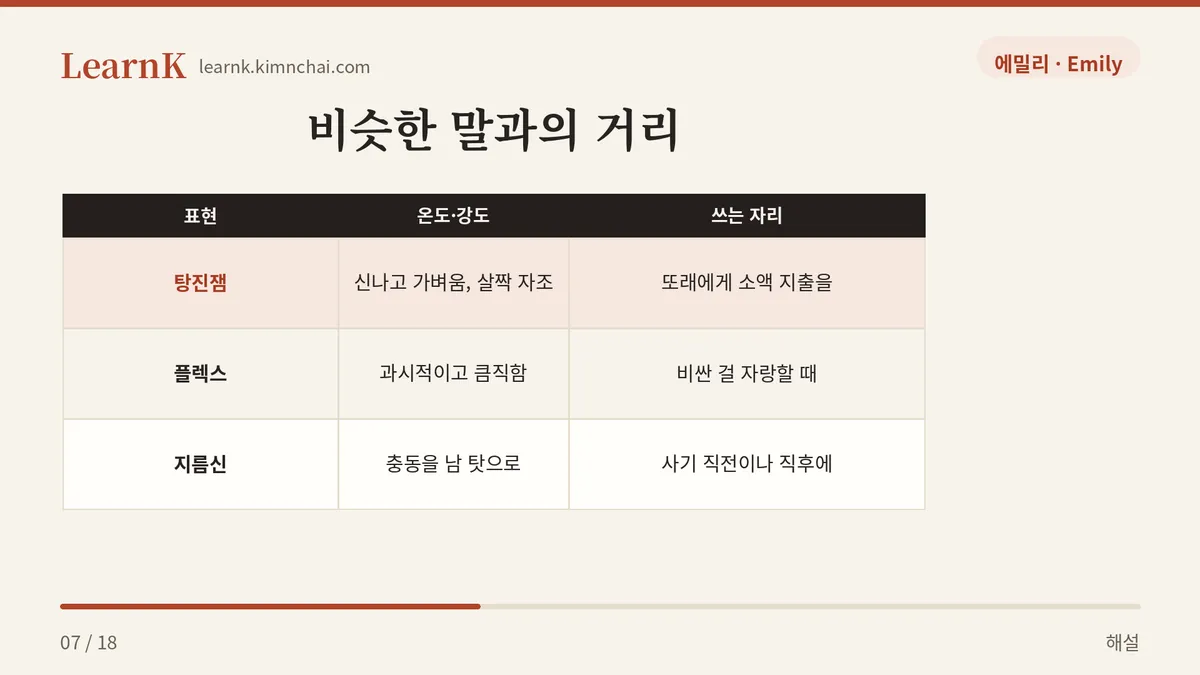
| Expression | Tone & intensity | Where to use |
|---|---|---|
| 탕진잼 (tangjinjaem) | Excited and light + a touch of self-mockery | Peers, social media. Small spending only |
| 플렉스 (peullekseu, flex) | Showy and big | Peers, social media. Showing off something expensive |
| 지름신 (jireumsin) | Blames the impulse on someone else (a “spending god”) | Peers. Right before or right after buying |
| 소확행 (sohwakhaeng) | Calm and warm | Anywhere. Even in writing and broadcasting |
| 낭비하다 (nangbihada) | Negative, reproachful | Anywhere. When criticizing or reflecting |
Here’s the difference in one line: 플렉스 (peullekseu) is buying one million-won item and showing it to other people; 탕진잼 (tangjinjaem) is buying twenty thousand-won items and quietly grinning to yourself. 지름신 (jireumsin) focuses on the impulse before the purchase; 탕진잼 (tangjinjaem) focuses on the satisfaction after it. And 낭비 (nangbi, waste) is what other people say to you, while 탕진잼 (tangjinjaem) is what you say to yourself. If someone else looks at your spending and says “탕진잼이네 (tangjinjaem-ine),” it can come off as teasing — so it’s good to remember this as a first-person word by default.
Cultural Background — Ten Thousand Won’s Worth of Freedom
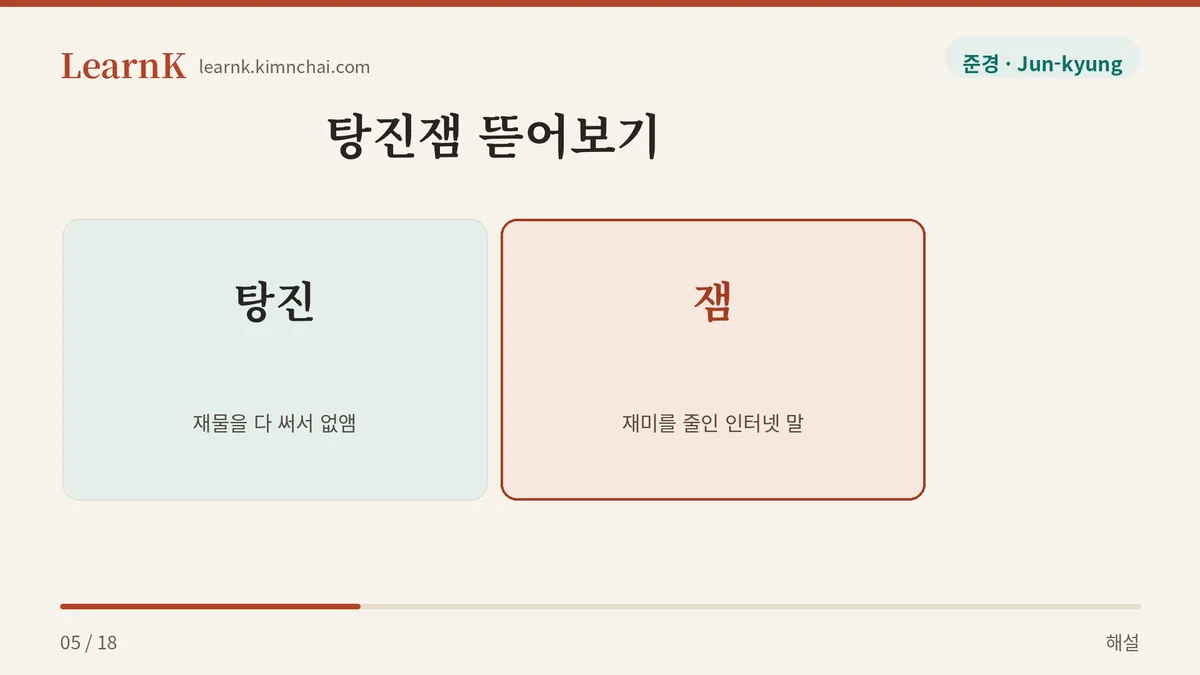
The word-building here is remarkably transparent. The first half, 탕진 (tangjin), is a weighty Sino-Korean word meaning to squander your wealth down to nothing; the second half, 잼 (jaem), is the internet’s one-syllable shortening of 재미 (jaemi, fun). That 잼 (jaem) already has a big family: 꿀잼 (kkuljaem, fun as sweet as honey), 노잼 (nojaem, no + fun), 핵잼 (haekjaem, nuclear-bomb-grade fun). Sticking a giggly internet abbreviation onto a heavy Sino-Korean word meaning “spending yourself into ruin” — that mismatch itself is the joke. Because you didn’t actually blow your entire fortune. You spent eighteen thousand won.
The expression spread through online communities and social media starting around 2016. No matter how much you save, housing prices and big lump sums stay out of reach — but spending in ten-thousand-won units is something you can control completely. That sense of securing joy through small things where the big ones have been given up — you can see it as coming from the same root as 소확행 (sohwakhaeng, small but certain happiness), which came into wide use around the same time. The difference is that where 소확행 (sohwakhaeng) leans quiet and lyrical, 탕진잼 (tangjinjaem) leans loud and playful.
That’s why the stage for 탕진잼 (tangjinjaem) isn’t the department store but 다이소 (Daiso), 올리브영 (Olive Young), convenience stores, stationery shops, and shopping apps in the small hours. Korean dramas and variety shows often have a scene where someone walks out with bags full and brags, “이게 얼마인 줄 알아? 만 원! (ige eolmain jul ara? man won!, Guess how much this was? Ten thousand won!)” — and the feeling in that scene is exactly 탕진잼 (tangjinjaem). If a Korean friend shows up grinning with an armload of bags, there’s a perfect line to hand them: 오, 오늘 탕진잼 했네? (o, oneul tangjinjaem haenne?, Oh, went tangjinjaem today, did you?)
Today’s Quiz
Which of the following uses 탕진잼 (tangjinjaem) most naturally?
- 부장님, 지난 주말에 백화점에서 명품 가방 사면서 탕진잼 했습니다. (“Sir, I did some tangjinjaem buying a luxury bag at the department store last weekend.”)
- 나 주식으로 전 재산 잃었어. 완전 탕진잼이야. (“I lost my whole fortune on stocks. Total tangjinjaem.”)
- 다이소 갔다가 삼천 원짜리 소품만 열 개 샀어. 오늘 탕진잼 제대로 했지. (“I went to Daiso and bought ten little three-thousand-won items. I went full tangjinjaem today.”)
Answer: 3
Number 1 goes wrong in two places: it uses internet slang with a superior, and a big purchase like a luxury bag isn’t 탕진잼 (tangjinjaem) — that’s 플렉스 (peullekseu) territory. Number 2 involves a large sum in a situation you can’t laugh about, so it lands as self-flagellation or mockery rather than a joke. Number 3 is a small amount, it was your own choice, and satisfaction outweighs regret — all three conditions of 탕진잼 (tangjinjaem) are met.
The definitions, example sentences, and dialogue in this post are all original writing by the author.