텐션 (tensyeon) — How Koreans Put a Number on a Mood
텐션 (tensyeon)
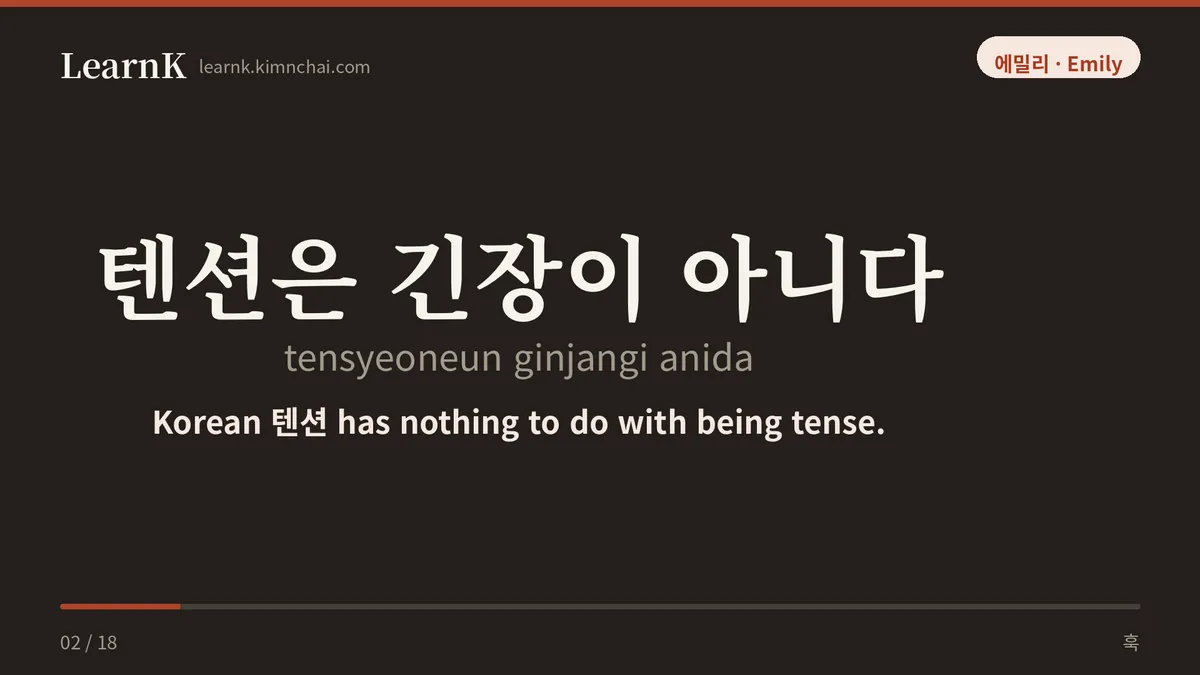
Eleven o’clock on a Friday night, in a noraebang (karaoke room). One person is standing on the couch shaking a tambourine; another is off in the corner drinking nothing but water. Koreans sum up the difference between these two people with a single word: 텐션 (tensyeon). 텐션 describes how amped up someone’s mood is right now — say that a person’s 텐션이 높다 (tensyeoni nopda) and you mean they’re excited and bursting with energy. It looks like the English word “tension” simply read out in Korean, but in Korean it has nothing to do with being tense. If anything, it means close to the opposite.
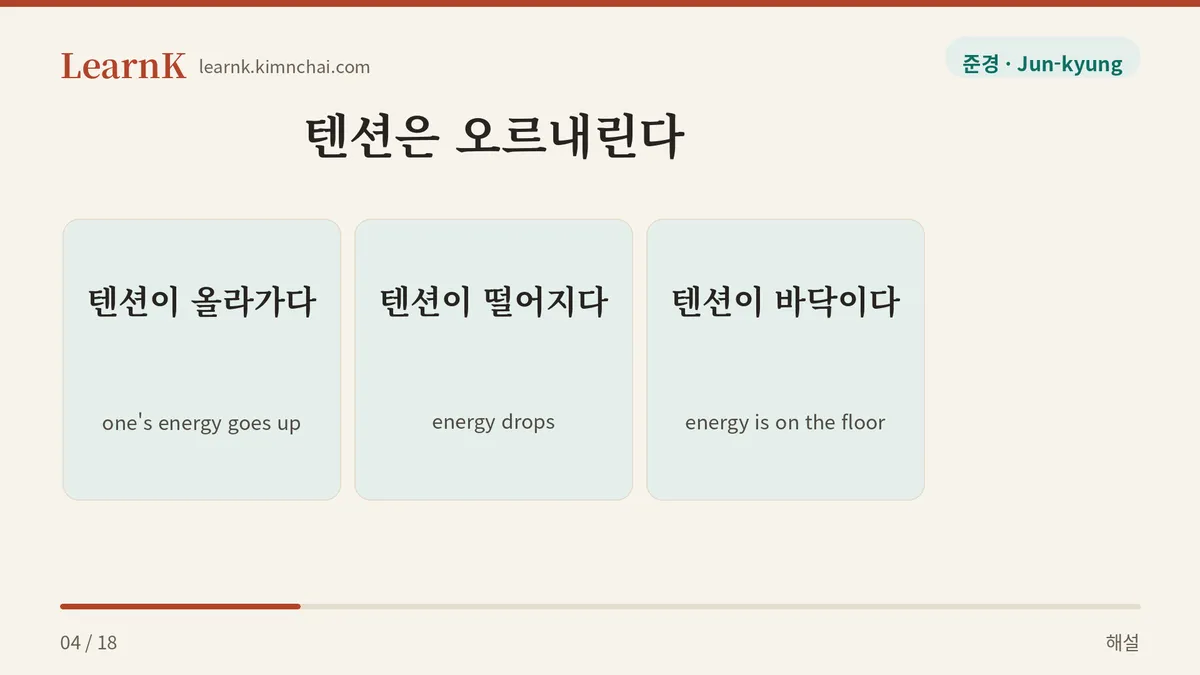
The heart of this word is that it points to the volume of a feeling, not the kind of feeling. Happy, sad, angry — those tell you which emotion. 텐션 tells you how loudly that emotion is currently turned up. So 텐션 gets treated like a gauge that rises and falls: 텐션이 올라가다 (tensyeoni ollagada) “one’s energy goes up,” 텐션이 떨어지다 (tensyeoni tteoreojida) “energy drops,” 텐션이 높다 (tensyeoni nopda) “energy is high,” 텐션이 바닥이다 (tensyeoni badagida) “energy is on the floor.” And if you want to crank it up, there’s 텐션 미쳤다 (tensyeon michyeotda) and 하이텐션 (haitensyeon). It doesn’t attach only to people, either — you can put it on a whole gathering or on a single song: 오늘 우리 팀 텐션 (oneul uri tim tensyeon) “our team’s energy today,” 이 곡 텐션 (i gok tensyeon) “this song’s energy.”
One thing to watch out for: low 텐션 doesn’t necessarily mean someone is depressed. Far more often it just means quiet, subdued, not saying much today. Remember that 텐션 is less a ruler for measuring good mood versus bad mood, and more a ruler for measuring volume — that alone will save you a lot of misunderstandings.
See It in a Real Conversation
Situation: A noraebang, the second stop of a company dinner. Eleven at night, and the tambourine is already in Emily’s hands.
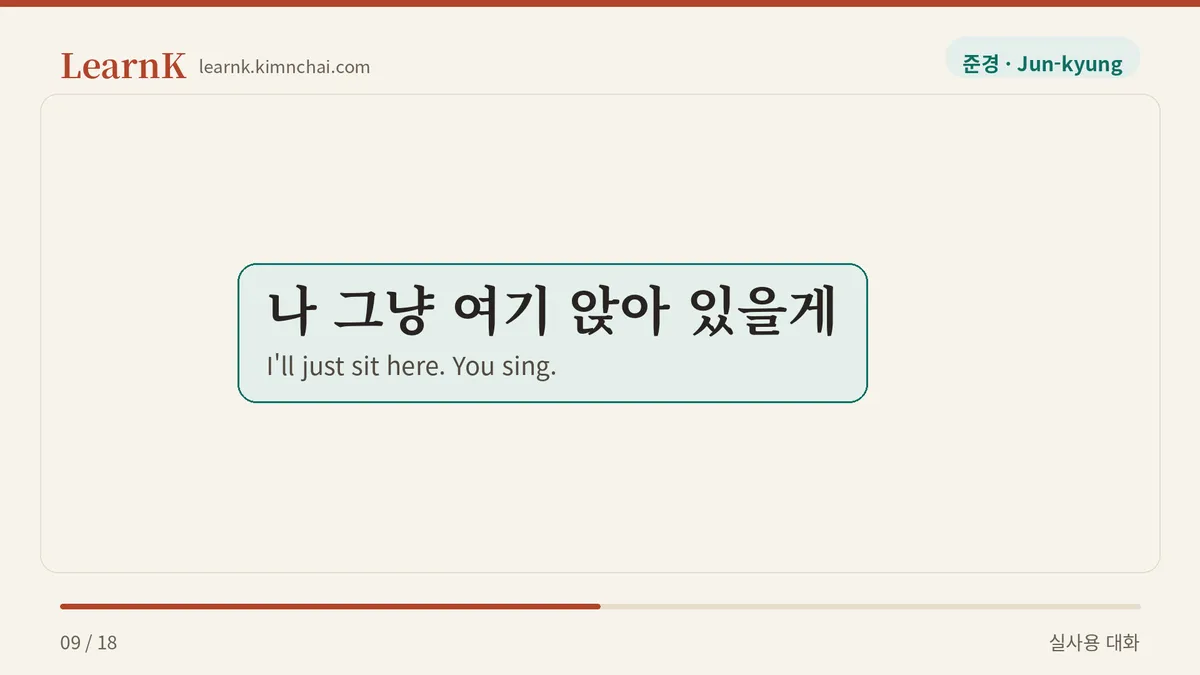
Jun-kyung: 나 그냥 여기 앉아 있을게. 너 불러. I’ll just sit here. You sing.
Emily: 왜 그래, 아까 삼겹살집에서는 제일 시끄러웠으면서. What’s up with you? You were the loudest one at the pork place.
Jun-kyung: 거기서 다 썼어. 텐션이 지금 바닥이야. Used it all up there. My energy’s on the floor right now.
Emily: 그럼 이거 봐. 나 아까 몰래 한 곡 예약했거든. Then look at this. I secretly queued up a song earlier.
Jun-kyung: …야, 이건 반칙이지. 이거 내 노래잖아. …Hey, that’s cheating. That’s my song.
Emily: 봐, 텐션 벌써 올라왔네. 탬버린 받아. See, you’re already fired up. Take the tambourine.
Where It Sounds Off
✗ (to your department head) 부장님, 오늘 텐션이 왜 이렇게 낮으세요? — Sir, why is your energy so low today? ✓ (to a coworker) 야, 너 오늘 텐션 왜 이렇게 낮아? — Hey, why’s your energy so low today? → This is a phrase that sizes up someone else’s mood like a reading on a dial, so it comes off as rude when aimed at someone senior to you. With a superior, you’re safer with 어디 편찮으세요? (eodi pyeonchaneuseyo?) “Are you feeling unwell?” or 오늘 피곤하신가 봐요 (oneul pigonhasinga bwayo) “You must be tired today.”
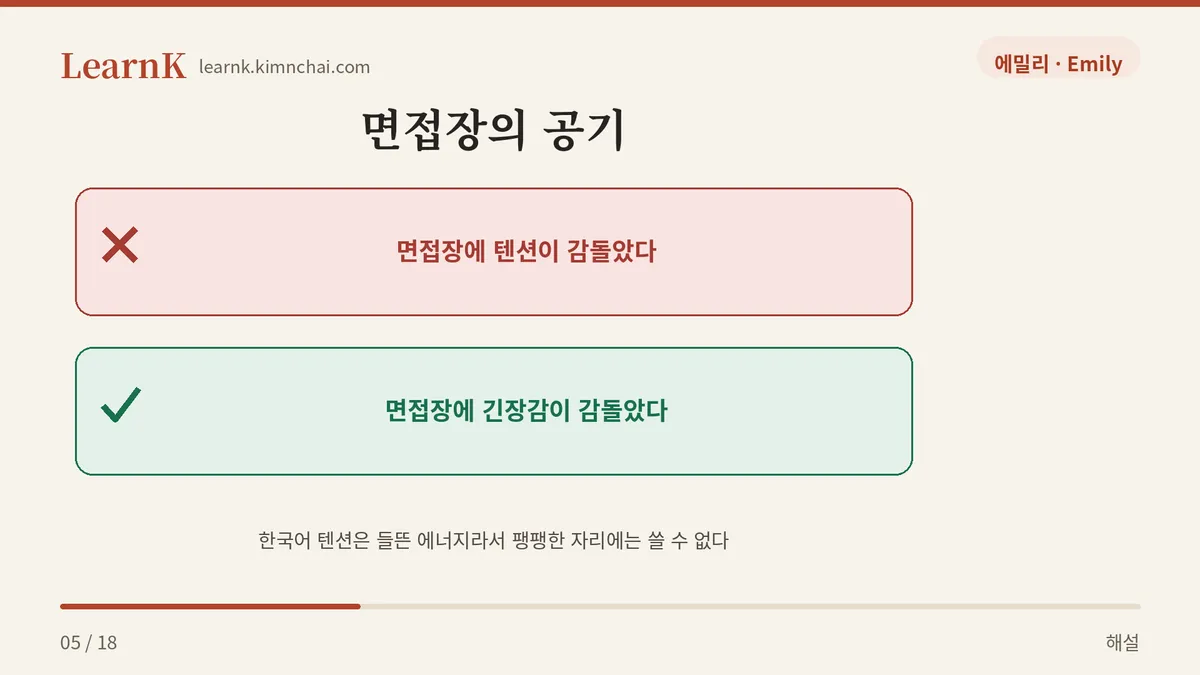
✗ 면접장에 들어서니 텐션이 감돌아서 아무도 말을 못 했다. ✓ 면접장에 들어서니 긴장감이 감돌아서 아무도 말을 못 했다. — Walking into the interview room, the air was so tense that nobody could speak. → This is the single biggest trap for learners. English “tension” means taut, nervous strain; Korean 텐션 means buzzing, excited energy. Saying 텐션이 감돌았다 (tensyeoni gamdoratda) here produces the bizarre claim that everyone in the interview room was pumped up and having a great time.
Example Sentences by Situation
1) The office on a Monday morning — when nobody’s talking
월요일이라 그런가 다들 텐션이 없네. (woryoirira geureonga dadeul tensyeoni eomne) Maybe it’s because it’s Monday — nobody’s got any energy.
텐션이 없다 (tensyeoni eopda) “to have no 텐션” feels even more drooping than 텐션이 낮다 (tensyeoni natda) “to have low 텐션.” It doesn’t mean people are angry or sad — just that nobody is opening their mouth. If someone passes around coffee at a moment like this and says 자, 텐션 좀 올리자 (ja, tensyeon jom ollija), they mean “come on, let’s perk up a bit.”
2) In line outside a concert venue — two hours before the show
아직 시작도 안 했는데 텐션 미쳤다. (ajik sijakdo an haenneunde tensyeon michyeotda) The show hasn’t even started and the energy is already insane.
미쳤다 (michyeotda) “crazy” carries no negative meaning here at all. It’s an exclamation: “this is ridiculously amazing.” It’s the form young people use most on social media and in messaging apps, and out loud you’ll also hear 텐션 미쳤어 (tensyeon michyeosseo) or 텐션 장난 아니야 (tensyeon jangnan aniya) “the energy is no joke.”
3) The day after an all-nighter — when a friend suggests drinks
미안, 오늘은 도저히 텐션이 안 올라와. 다음에 가자. (mian, oneureun dojeohi tensyeoni an ollawa. daeume gaja) Sorry, there’s no way my energy is coming up today. Let’s go next time.
Giving 텐션 as your reason for declining is extremely common. You’re not saying you’re sick or that your feelings are hurt — just “I don’t have the energy to go out right now” — so the other person takes it in stride without feeling brushed off. Memorize it whole as a soft way to say no; you’ll get a lot of use out of it.
Politeness Levels and Similar Expressions
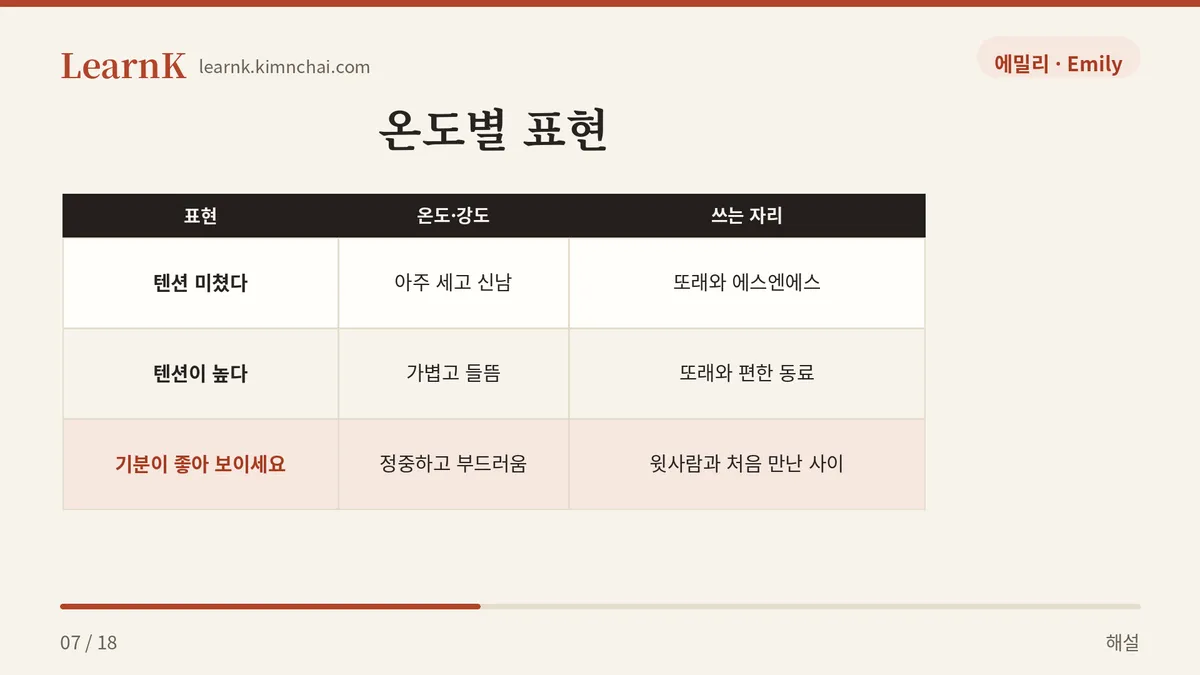
텐션 is recent slang, so dropping it into a polite sentence raises the register of your endings without raising the formality of the word itself. 텐션이 높으시네요 (tensyeoni nopeusineyo) is grammatically fine, but in front of a boss or an older person it still lands as casual. With someone senior, it’s safer to switch over to the expressions on the right side of the table below.
| Expression | Warmth / intensity | Where it’s used |
|---|---|---|
| 텐션 미쳤다 (tensyeon michyeotda) | Very strong, thrilled | Peers and social media. Never with someone senior |
| 텐션이 높다 (tensyeoni nopda) | Light, upbeat | Peers and coworkers you’re comfortable with |
| 신났다 (sinnatda) | Bright, but slightly childlike | Kids and close friends. Less used for adults |
| 들떠 있다 (deultteo itda) | Neutral, a touch literary | Anywhere. Works in writing too |
| 기분이 좋아 보이세요 (gibuni joa boiseyo) | Polite and gentle | Superiors, people you’ve just met |
It’s worth learning the other direction too. The more refined substitutes for 텐션이 떨어지다 (tensyeoni tteoreojida) are 기운이 없다 (giuni eopda) “to have no energy” and 가라앉다 (garaanda) “to be subdued,” and with someone senior, 오늘 좀 피곤해 보이세요 (oneul jom pigonhae boiseyo) “you look a little tired today” is the safe choice.
Cultural Background — A Society That Manages Its 텐션
텐션 borrowed its sound from English “tension,” but the meaning didn’t come along for the ride. The sense it carries in Korean today — the up-and-down of mood and drive — is almost identical to how Japanese uses テンション (tenshon), and in Korea it locked into that meaning as it spread through variety shows and the internet. That makes it one of those rare, nasty words where an English speaker who trusts the dictionary translation ends up saying the exact opposite of what they mean.
There’s a reason the word caught on so widely. In Korean variety television and idol culture, 텐션 is practically a job skill. On set, 텐션 올려 주세요 (tensyeon ollyeo juseyo) “please bring the energy up” is a real request that gets made out loud, and most groups have one member designated as the 하이텐션 (haitensyeon) one. The same goes for company dinners and noraebang nights: the person who lifts the room’s 텐션 is treated as the one saving the mood, and everyone is grateful for them.
Lately, though, the tone has shifted a little. As fatigue grows with a culture of forcing your energy upward, more people announce in advance, 저 원래 텐션 낮아요 (jeo wollae tensyeon najayo) “I’m just a low-energy person.” That’s less an apology than a declaration — it means “I’m a quiet person, so please don’t try to hype me up.” So when a Korean friend tells you 나 텐션 낮은 편이야 (na tensyeon najeun pyeoniya) “I tend to be low-energy,” it isn’t a moment for consolation. Just say “got it” and move on.
Today’s Quiz
Which of the three sentences below uses 텐션 incorrectly?
- 오늘 우리 팀 텐션 장난 아니다.
- 회의실에 텐션이 감돌아 아무도 먼저 입을 열지 못했다.
- 나 어제 한숨도 못 자서 텐션이 바닥이야.
Show the answer
The answer is number 2. It transplants the “nervous strain” sense of English tension straight into Korean, but since Korean 텐션 means buzzing, excited energy, the sentence ends up saying something absurd — that a cheerful, hyped-up mood was hanging over the meeting room. What you want here is 긴장감이 감돌았다 (ginjanggami gamdoratda) “tension hung in the air.” Numbers 1 and 3 are perfectly natural, meaning “the mood is fantastic” and “I’ve got zero energy left,” respectively.