티키타카 (tikitaka) — The One Word for When a Conversation Just Clicks
티키타카 (tikitaka)
티키타카 (tikitaka) describes two people trading short, quick lines without a break, the rhythm of the conversation falling perfectly into place — or that well-matched rhythm itself. One person tosses out a line, the other fires right back, and that reply pulls the next line out of them. There are no awkward silences in between, no pauses spent thinking “okay, what do I say now?” Koreans call that state “티키타카가 좋다” (the tikitaka is good) or “티키타카가 된다” (the tikitaka is working).
This is not a compliment about the content of a conversation. It doesn’t mean you had a deep talk or picked up useful information. What 티키타카 (tikitaka) measures is purely speed and rhythm. Even if all you exchanged were throwaway jokes, if the beat never broke, the 티키타카 (tikitaka) was good. And no matter how important the subject, if the talk kept stalling out, there was no 티키타카 (tikitaka).
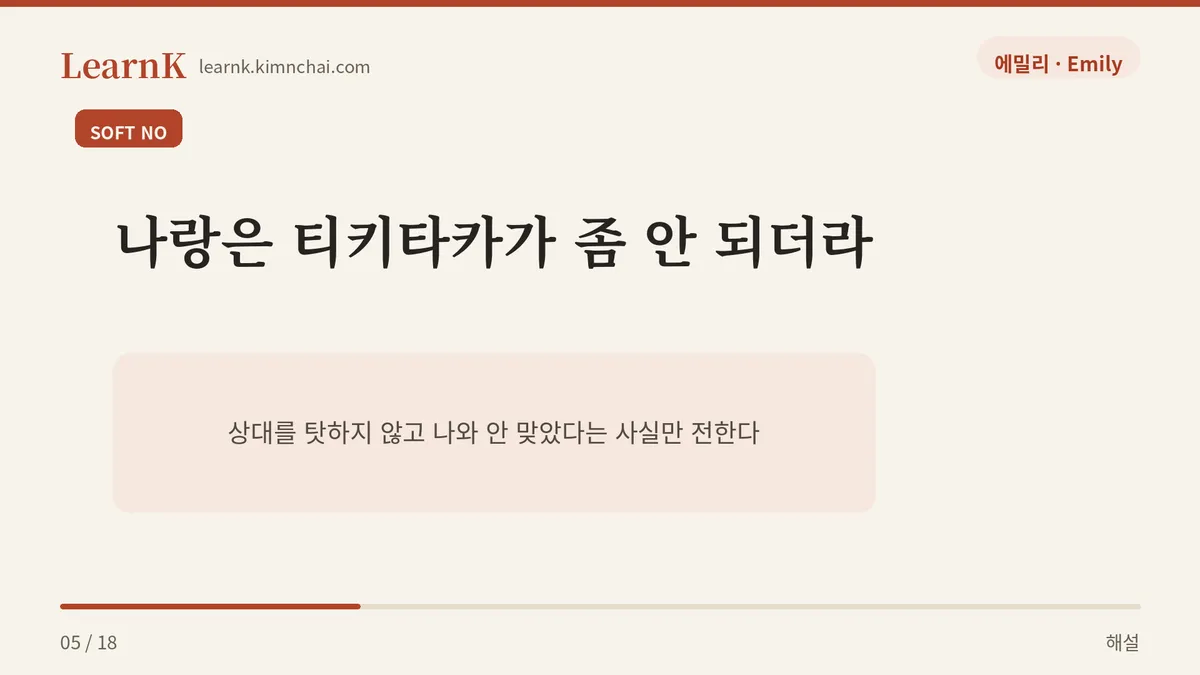
One more important point — 티키타카 (tikitaka) never works alone. Saying “나는 티키타카가 좋은 사람이야” (I’m a person with good tikitaka) sounds a little off. This word is always a scale that measures the space between two people, so change the other person and the result changes too. That’s why, instead of saying “저 사람이 말을 못해” (that person is bad at talking), Koreans will soften it into “나랑은 티키타카가 좀 안 되더라” (the tikitaka just didn’t quite work with me). It’s a rather handy expression: you get to say it didn’t click without putting any blame on the other person.
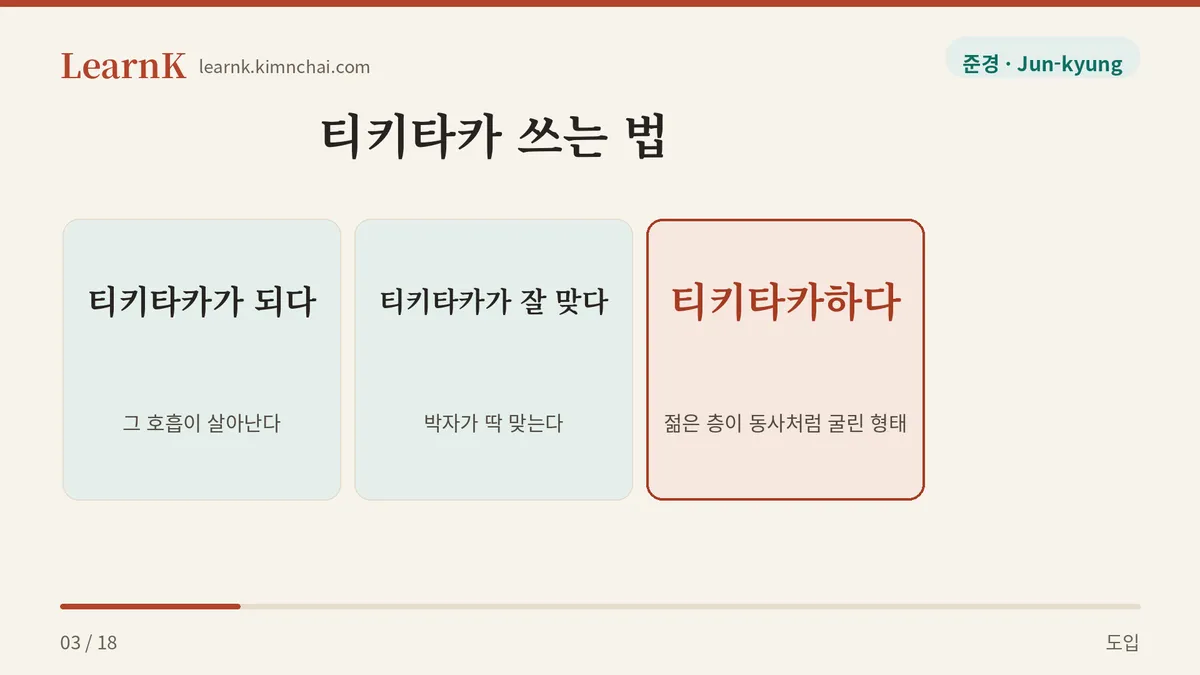
Grammatically it’s a noun, but in actual speech it shows up most often as 티키타카가 되다 / 티키타카가 잘 맞다 / 티키타카가 좋다, and younger speakers will even bend it into a verb: 티키타카하다. It isn’t a standard dictionary word so much as a piece of slang that hardened into place through broadcast and the internet from the 2010s onward.
See It in a Real Conversation
Scene: Saturday afternoon at the neighborhood badminton court. Emily went on a blind date yesterday. Jun-kyung fiddles with a shuttlecock and asks.
Jun-kyung: 야, 어제 소개팅 어땠어? 표정이 왜 그래. Hey, how’d the blind date go yesterday? Why that face?
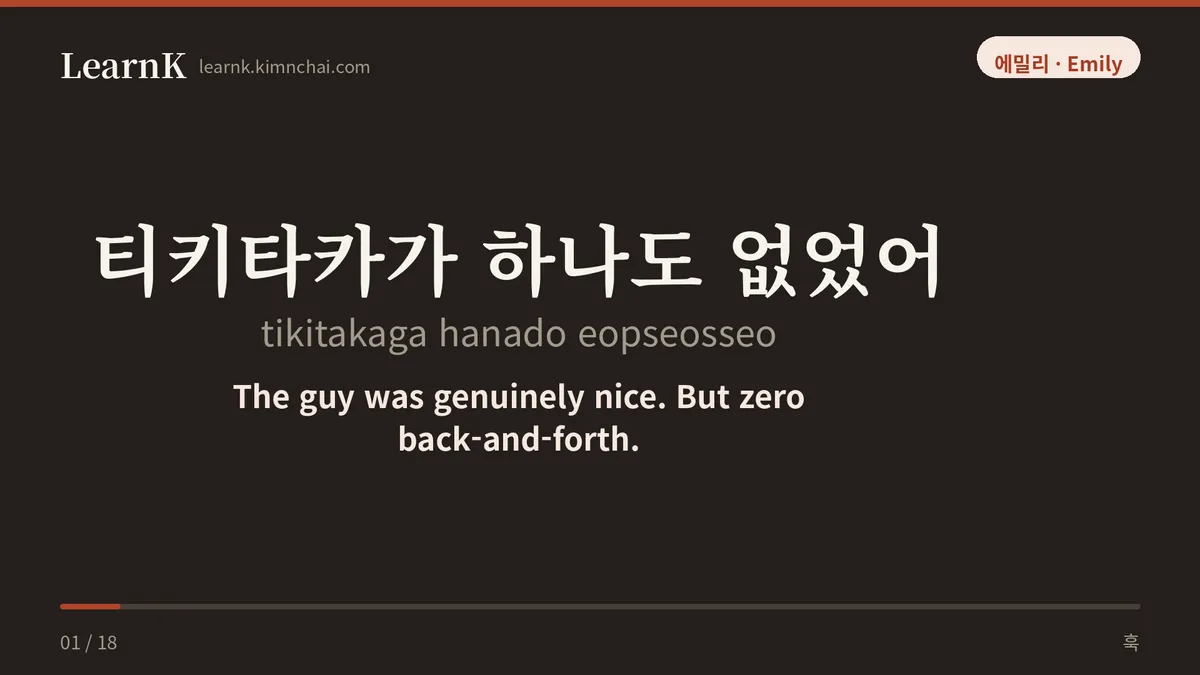
Emily: 사람은 진짜 괜찮았어. 근데 티키타카가 하나도 없었어. The guy was genuinely nice. But there was zero back-and-forth.
Jun-kyung: 아, 말이 자꾸 끊겼구나. Ah, so the conversation kept dying.
Emily: 응. 내가 하나 던지면 “네.” 끝. 두 시간 동안 나 혼자 벽에다 공 친 기분이야. Yeah. I’d throw something out, he’d go “yeah.” Done. Two hours of me hitting a ball against a wall.
Jun-kyung: 그럼 오늘 나랑 티키타카 좀 채우고 가. 자, 받아! Then top up your quota with me today. Here, take this!
Emily: 야, 그건 말이 아니라 공이잖아! Hey, that’s a shuttlecock, not a conversation!
When It Sounds Off
✗ (in a report to executives) 저희 팀은 타 부서와의 티키타카가 매우 원활합니다. Our team’s tikitaka with the other departments is very smooth. ✓ (in a report to executives) 저희 팀은 타 부서와의 소통이 매우 원활합니다. Our team’s communication with the other departments is very smooth. → Because it’s slang that took root in variety shows and on the internet, dropping it into a formal report or document makes the content itself look lightweight. In formal settings, it’s safer to swap in 소통 (sotong), “communication,” or 호흡 (hoheup), literally “breathing” — the sense of two people being in sync.
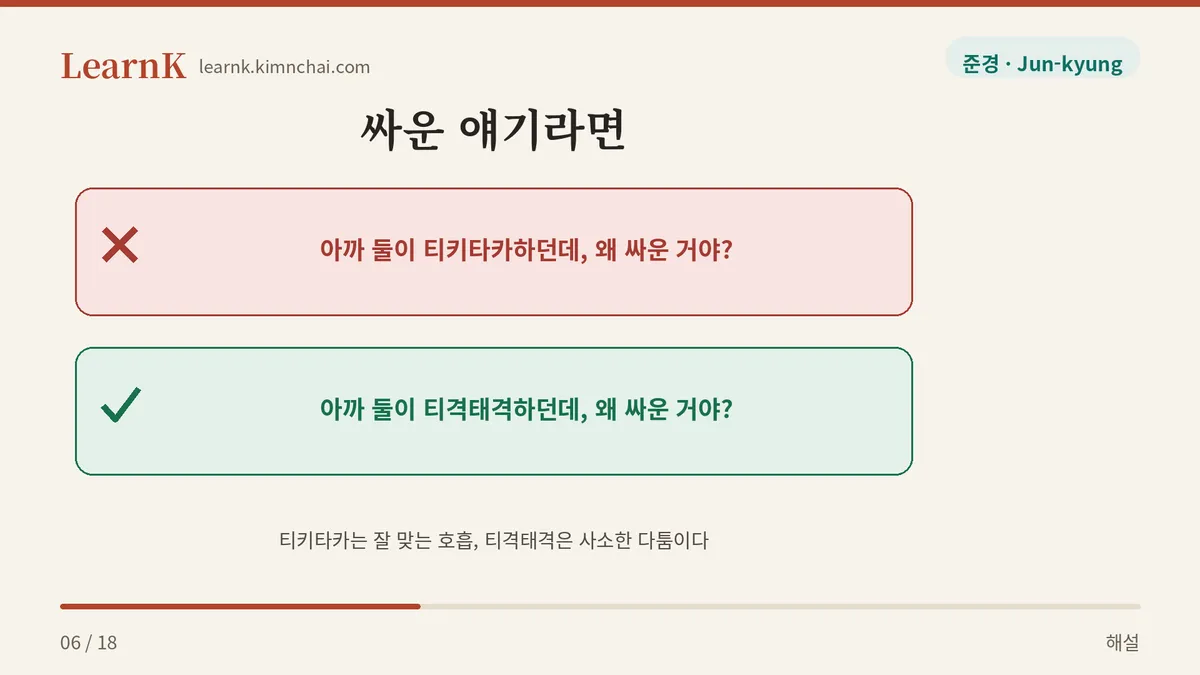
✗ 아까 둘이 티키타카하던데, 왜 싸운 거야? You two were doing tikitaka earlier — so why did you fight? ✓ 아까 둘이 티격태격하던데, 왜 싸운 거야? You two were bickering earlier — so why did you fight? → This is the pair that trips up Korean learners the most. They sound similar enough to feel related, but the meanings are close to opposite. 티키타카 (tikitaka) is being perfectly in sync; 티격태격 (tigyeoktaegyeok) is squabbling over trivial things. You do 티키타카 (tikitaka) because you get along, and 티격태격 (tigyeoktaegyeok) because you don’t.
Example Sentences by Situation
Situation 1 — Walking out after a first meeting with a new teammate
오늘 처음 봤는데 티키타카가 잘 맞아서 회의가 삼십 분 만에 끝났어. (oneul cheoeum bwanneunde tikitakaga jal majaseo hoeuiga samsip bun mane kkeutnasseo.) Meaning: we only met today, but we were so in sync that the meeting was over in thirty minutes.
You can hit 티키타카 (tikitaka) with someone you’ve just met. The fun quirk of this word is that knowing each other a long time doesn’t produce it automatically. You might not have it with a friend of ten years, and have it instantly with someone you met this morning.
Situation 2 — Watching a variety show on the weekend and texting a friend
저 두 사람 티키타카 진짜 미쳤다. 대본 없는 거 맞지? (jeo du saram tikitaka jinjja michyeotda. daebon eomneun geo matji?) Meaning: the back-and-forth between those two is incredible — that’s really unscripted, right?
“미쳤다 (michyeotda)” literally means “crazy” and started out negative, but in young people’s speech it’s become the highest praise, closer to “insane” in English. It’s a combination that turns up constantly alongside 티키타카 (tikitaka).
Situation 3 — To a friend asking how the blind date went
나쁜 사람은 아니었는데, 나랑은 티키타카가 좀 안 되더라. (nappeun sarameun anieonneunde, narangeun tikitakaga jom an doedeora.) Meaning: he wasn’t a bad guy, but he and I just weren’t in sync.
The key here is the particle 은/는 attached to “나랑은 (narangeun).” That one syllable leaves room for “it might click just fine with someone else.” It’s a great example of Korean-style indirectness: turning someone down without running them down.
Formality and Similar Expressions
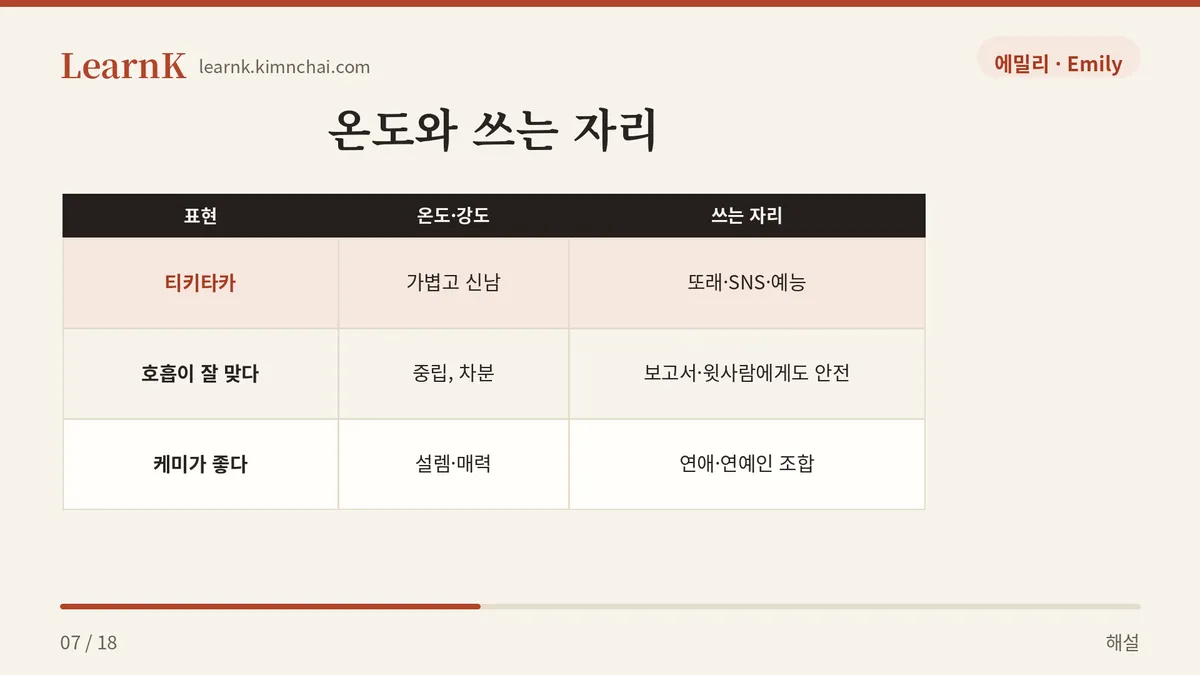
Since 티키타카 (tikitaka) is a noun, grammatically you can put it in polite speech — “두 분 티키타카가 정말 좋으시네요” (you two have really great tikitaka). In practice, though, it’s a word for peers and relaxed settings, so it’s best not to use it with an older person you’ve just met or with your boss. If you want to say the same thing to someone senior to you, “두 분 호흡이 정말 잘 맞으시네요” (you two are really in sync) is far more natural.
| Expression | Tone & intensity | Where it’s used |
|---|---|---|
| 티키타카 (tikitaka) | Light, excited, fast-moving | Peers, social media, talking about variety shows. Not for official documents |
| 호흡이 잘 맞다 (hoheubi jal matda) | Neutral, calm | Anywhere. Safe for reports and for people senior to you |
| 죽이 맞다 (jugi matda) | Warm, a bit old-fashioned | When a third party describes two people who get along |
| 케미가 좋다 (kemiga jota) | Leans toward attraction and spark | Romance, celebrity pairings. Less used for work |
| 티격태격하다 (tigyeoktaegyeokhada) | Negative, petty squabbling | Sounds similar, means the opposite |
The difference from the deceptively similar 케미 (kemi) is worth pinning down too. 케미 (kemi) comes from the English word “chemistry” and refers to the attraction or general fit flowing between two people. Two people can have great 케미 (kemi) without exchanging a single word — but if no words are exchanged, 티키타카 (tikitaka) simply doesn’t exist. 티키타카 (tikitaka) is, from start to finish, a verdict on the words being traded.
Cultural Background — From the Soccer Pitch to the Variety Studio
The root of this word isn’t Korean at all — it’s Spanish soccer. The Spanish tiki-taka refers to the tactic of keeping possession by trading short passes at speed, and it spread worldwide between 2008 and 2012, when the Spanish national team and FC Barcelona dominated the global game. The widely repeated explanation is that it comes from onomatopoeia imitating the sound of a ping-pong ball going back and forth; the finer points of the etymology differ from source to source, so let’s just file it under “a word copied from the sound of something short and fast going back and forth.”
It entered Korea first as soccer commentary vocabulary. It started with announcers saying “완벽한 티키타카였습니다” (that was perfect tikitaka). Then, in the mid-2010s, variety show producers and viewers began transplanting the word onto conversation between people. Scenes where two hosts latched onto the ends of each other’s sentences and spun them into laughs got captioned “환상의 티키타카” (fantastic tikitaka) — and from that point on, the word left the soccer pitch and started a completely new life.
Korean variety culture places unusual weight on how well words fit together. Shows built around several people sitting in a circle talking without a script have been popular for a long time, and in those settings the laugh comes not from one person’s wit but from the beat between two people. One person throws out a line, the other has to hit it back at exactly the right moment, and only then does the laugh land. There was an empty slot where a name for that moment should be, and 티키타카 (tikitaka) walked right into it.
So the word is now an essential term for dating shows as well. When two people who’ve just met sit down across from each other, the first thing viewers check is the 티키타카 (tikitaka). Ahead of looks or credentials, they want to know “do those two actually connect when they talk?” — and maybe that’s exactly why the expression spread so fast. What Koreans value most in a relationship is packed into this single word.
Today’s Quiz
Which of the following sentences uses 티키타카 (tikitaka) naturally?
① 어제 형이랑 티키타카해서 아직도 화가 안 풀렸어. I did tikitaka with my older brother yesterday, and I’m still not over it. ② 저희 부서는 협업 과정의 티키타카가 원활함을 보고드립니다. I report that the tikitaka in our department’s collaboration process is running smoothly. ③ 새로 온 아르바이트생이랑 티키타카가 잘 맞아서 요즘 일할 맛 나. The tikitaka with the new part-timer is great, so work has been fun lately.
Answer: ③
In ①, “화가 안 풀렸다” (still not over being angry) tells you this was a fight, so it should be 티격태격했다 (we bickered). 티키타카 (tikitaka) is for when things are going well between you. In ②, the meaning gets across, but laying slang onto a formal report makes it awkward — it should be 소통 (sotong) or 호흡 (hoheup). As in ③, the word is most natural when it means being in sync with someone you’re comfortable with.
Give it a try today. Telling a friend you click with “우리 티키타카 좋다” (our tikitaka is good) is more than enough.
Definitions and example sentences are from the National Institute of Korean Language’s Basic Korean Dictionary (krdict.korean.go.kr); that portion of this post, including our translations, is licensed under CC BY-SA 2.0 KR.