띵곡 (ttinggok) — Bending One Syllable of 명곡 Into a Word of Its Own
띵곡
띵곡 (ttinggok) is an internet coinage that takes 명곡 (myeonggok, 名曲, “a great song”) and swaps out the syllable 명 for 띵, which looks almost identical on a screen. It means a song so good you come back to it again and again. Scroll the comments under a Korean idol stage video and you’ll run into it about one time in ten. When a track released more than a decade ago rides the algorithm back up and its view count starts climbing again, the comments below fill up, line after line, with 띵곡 (ttinggok). And if someone cues up the first bars of a song at a noraebang at two in the morning and everyone else shouts “오!” at the same moment — that song is a 띵곡.
The meaning is the same as 명곡, but the temperature is completely different. 명곡 is dignified. A music-show announcer uses it, it goes into newspaper headlines, a teacher uses it with a student. 띵곡, on the other hand, is giddy and a little mischievous. It’s less an evaluation of the song than a way of throwing out the feeling “this song has me hyped right now.” So there’s always a trace of excitement in it, and it tends to pop out when you want to play a song for someone, not when you’re listening quietly on your own.
One more important point: this word was born as a word you read with your eyes. It started out as a letter joke you typed on a keyboard and saw on a screen, and only later moved into speech. That’s why it still shows up far more in writing than in conversation — and that fact is what determines the “awkward situations” coming up below.
A real conversation
Situation: Friday night at a noraebang. Jun-kyung has a grip on the mic, and Emily has been scrolling through the queue list with the remote for ages.
Jun-kyung: 야, 뭘 그렇게 오래 골라. 아무거나 눌러. Hey, what’s taking you so long? Just punch in anything.
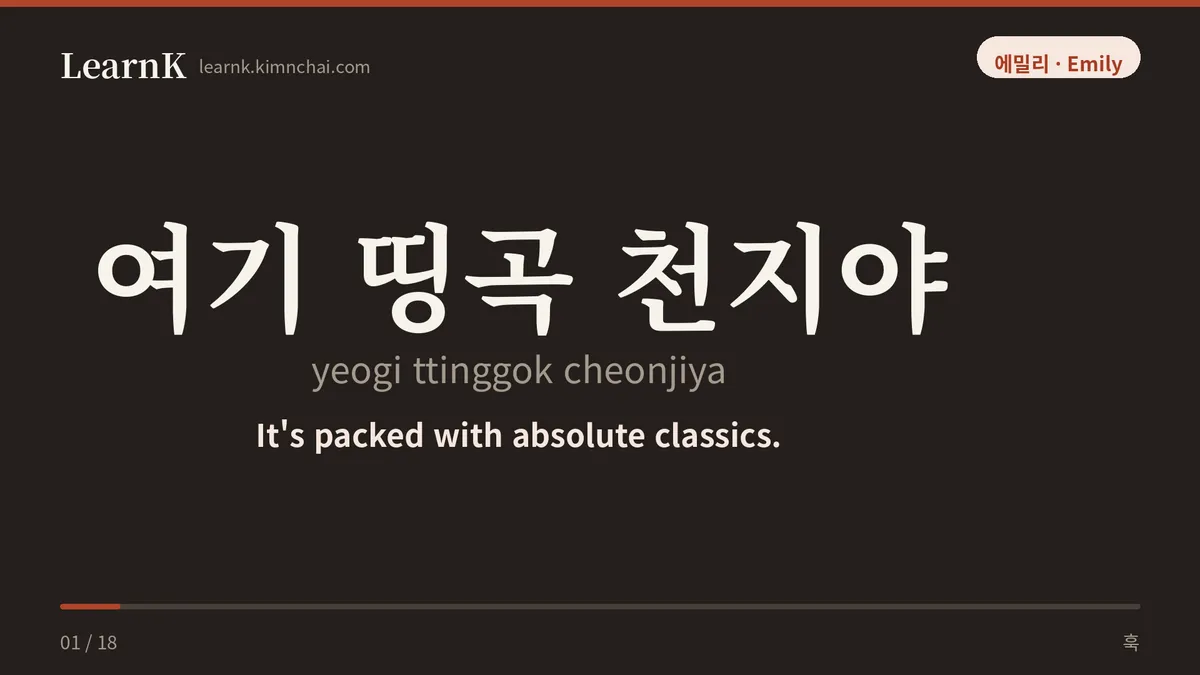
Emily: 잠깐만, 나 지금 2009년 목록 보고 있거든. 여기 띵곡 천지야. Hold on, I’m on the 2009 list. It’s packed with absolute classics.
Jun-kyung: 오, 그거 눌러 그거. 그 노래 나 고등학교 때 진짜 매일 들었는데. Oh, hit that one. I listened to that every single day in high school.
Emily: 그치? 이건 시간 지나도 안 늙는다니까. 이래서 띵곡은 못 버려. Right? This one just doesn’t age. That’s why you can never let go of a classic.
Jun-kyung: 근데 너 왜 자꾸 띵곡, 띵곡 해. 그냥 명곡이라고 하면 안 돼? But why do you keep saying ttinggok? Can’t you just say myeonggok?
Emily: 명곡이라고 하면 너무 점잖잖아. 이건 소리 지르면서 들어야 되는 노래야. Myeonggok sounds way too proper. This is a song you scream along to.
These uses sound off
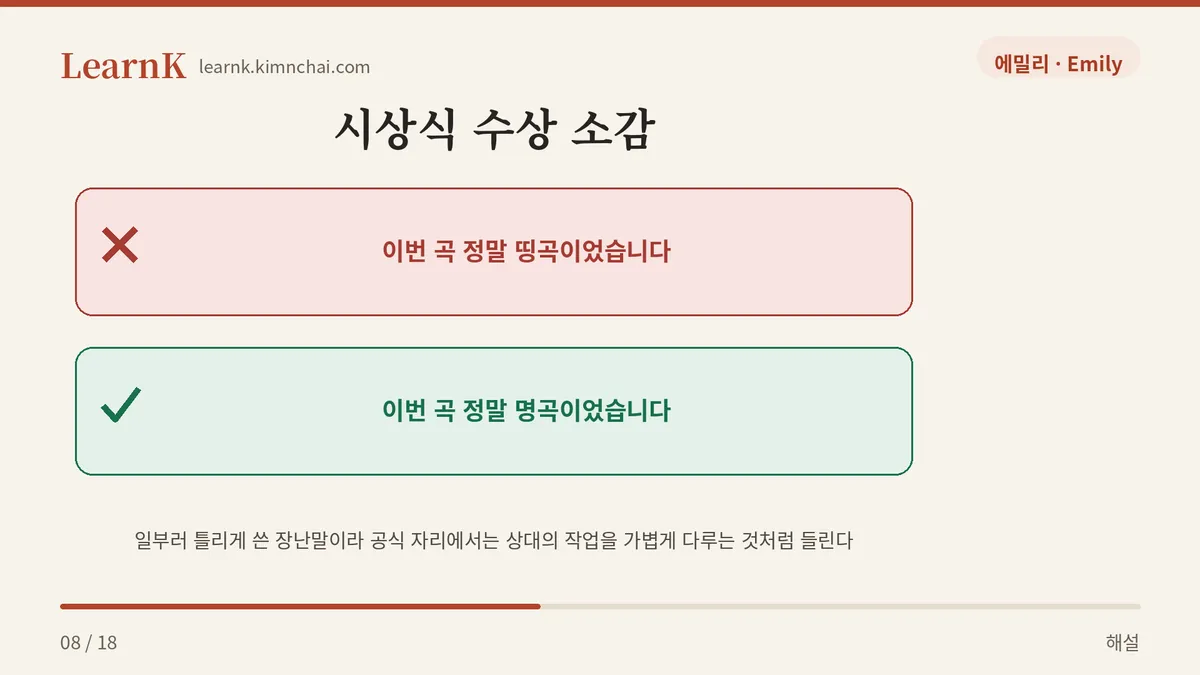
✗ (in an awards acceptance speech, to the composer) 선생님, 이번 곡 정말 띵곡이었습니다. ✓ (in an awards acceptance speech, to the composer) 선생님, 이번 곡 정말 명곡 (myeonggok) 이었습니다. → 띵곡 is a joke word built on a deliberate misspelling. Used in an official setting with cameras rolling, or in front of someone senior to you, it sounds like you’re treating their work lightly. Attaching the polite ending -이었습니다 doesn’t raise the temperature of the word itself.
✗ (a text to your mom) 엄마, 이 노래 진짜 띵곡이야. 한번 들어 봐. ✓ (a text to your mom) 엄마, 이 노래 진짜 명곡이야 (myeonggogiya). 한번 들어 봐. → This one isn’t awkward because it’s rude — it’s awkward because it doesn’t land. To a generation that doesn’t know the letter joke, it just looks like a typo. If the reply comes back as “띵곡이 뭐니?” (“What’s a ttinggok?”), the conversation about the song is gone and all that’s left is a conversation about spelling.
Example sentences by situation
1. When the algorithm drags up an old song (YouTube comment)
A stage video from ten years ago suddenly shows up in your recommendations, and the comments fill with “anyone watching in 2026?” Here’s the single most common line you’ll see.
알고리즘 고마워. 역시 띵곡은 다시 돌아온다. (algorijeum gomawo. yeoksi ttinggogeun dasi doraonda.) Thanks, algorithm. Sure enough, a 띵곡 always comes back around.
This word travels almost inseparably with 역주행 (yeokjuhaeng) — the phenomenon of an old song climbing back up the charts in reverse.
2. When you send a friend a playlist (messenger)
You know that if you just drop a link they won’t listen, so you single out one track and personally vouch for it.
딴 건 몰라도 3번 트랙은 꼭 들어. 이건 진짜 띵곡이야. (ttan geon mollado sambeon teuraegeuneun kkok deureo. igeon jinjja ttinggogiya.) Skip the rest if you have to, but you have to hear track 3. This one is a real 띵곡.
3. When you check the concert setlist (talking with a friend)
The list of songs for tonight has just gone up at the venue entrance, and the old song you were hoping for is on it.
1부 마지막에 띵곡 넣어 줬네. 나 오늘 울 것 같아. (ilbu majimage ttinggok neoeo jwonne. na oneul ul geot gata.) They put a 띵곡 at the end of the first set. I think I’m going to cry tonight.
Polite and casual speech, and similar expressions
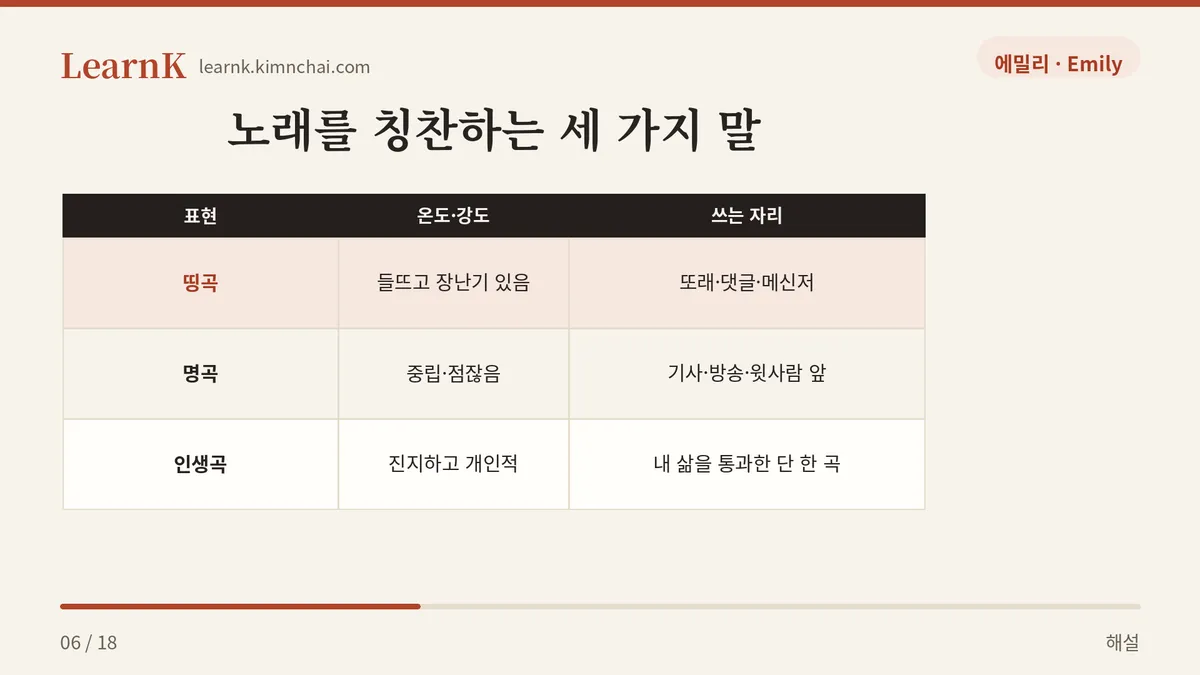
띵곡 is a noun, so in purely grammatical terms you can make it polite: 띵곡이에요. But the word itself is a joke shared between peers, so raising the ending doesn’t make it fit a formal setting. In front of someone senior to you, the fix isn’t the ending — it’s swapping the word out for 명곡.
| Expression | Temperature / intensity | Where it’s used |
|---|---|---|
| 띵곡 (ttinggok) | Giddy, playful | Peers, comment sections, messenger. Not for formal settings |
| 명곡 (myeonggok) | Neutral, dignified | Anywhere. Articles, broadcasts, in front of elders |
| 인생곡 (insaenggok) | Serious and personal | The one song that ran through your life. Not thrown around lightly |
| 개띵곡 (gaettinggok) | Strongest of all | Only with very close friends. Too much for anything public |
It’s worth knowing 띵작 (ttingjak), built the same way. It’s 명작 (myeongjak, 名作, “a masterpiece”) twisted by the same logic — so songs get 띵곡, and dramas or films get 띵작.
Cultural background — words that play with letter shapes
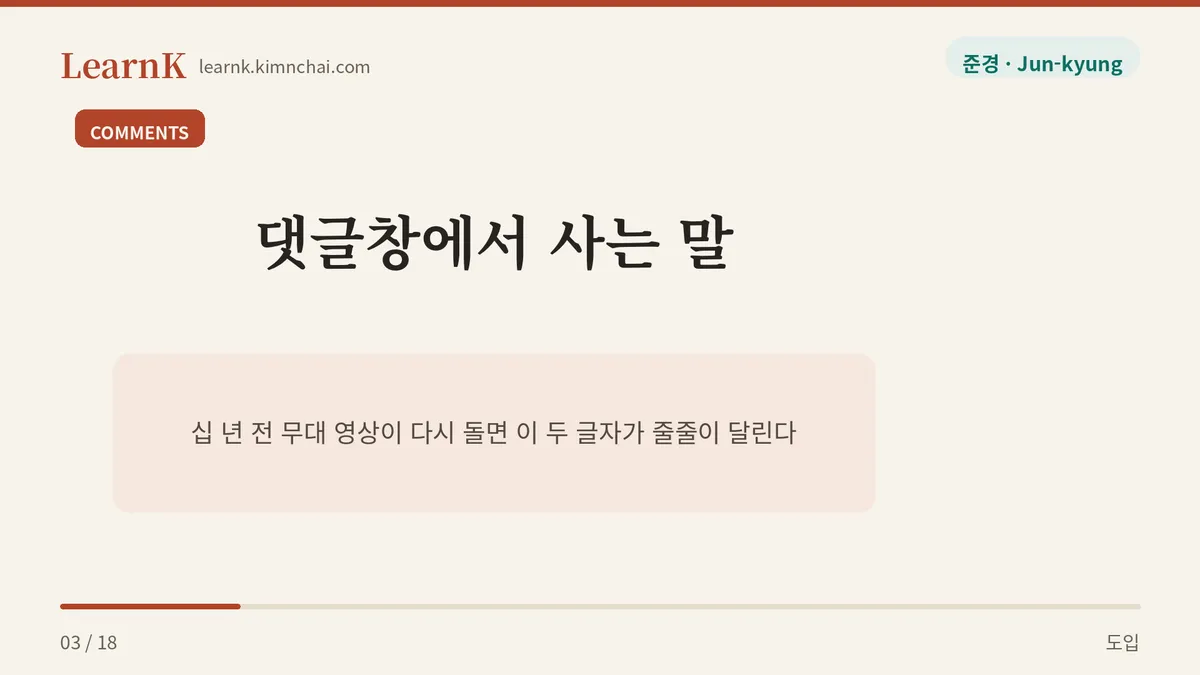
The origin of 띵곡 lies not in meaning but in shape. The Hangul syllable 명 is built from the initial ㅁ, the vowel ㅕ, and the final ㅇ — and when ㅁ and ㅕ sit side by side, on a screen they look like ㄸ with a ㅣ attached. So a joke was born of reading 명 as 띵, and the result is 띵곡. Nobody changed the meaning; they tricked the eye.
This kind of wordplay has a name: 야민정음 (yaminjeongeum). It’s a game that started spreading through Korean internet communities in the mid-2010s, and writing 멍멍이 (meongmeongi, “doggy”) as 댕댕이 (daengdaengi), 귀엽다 (gwiyeopda, “cute”) as 커엽다 (keoyeopda), and 대박 (daebak, “awesome”) as 머박 (meobak) all belong to the same family. They have one thing in common: they don’t imitate a sound, they pick out points where the shapes of the letters overlap. It’s a game made possible by the fact that Hangul stacks its letters inside a square block — which is also why it doesn’t transfer cleanly into other writing systems.
There’s a reason this word in particular ended up traveling with K-pop. In Korea, music is consumed on top of comment sections and short videos. Old stage videos come back around, and underneath them people seeing the performance for the first time leave a line each. What’s needed there isn’t precise critical vocabulary so much as a signal that says “I’m here too” — and 띵곡 was exactly the right size for that signal. People from different generations typing the same two syllables around a single song: that’s the place this expression lives right now.
That said, the word follows the lifespan of any slang. It isn’t standard Korean listed in the dictionary, and it doesn’t appear in official documents or subtitles. The order to recommend to learners is clear: understand it right now; use it only after you’ve picked your audience.
Today’s quiz
Which of the following is the most awkward place to use 띵곡 (ttinggok)?
- Sending a song link to a group chat with your friends
- As a comment under an old stage video by a group you love
- Thanking the composer from the stage at a music awards show
Answer: 3. In an official setting with the cameras rolling — and in front of the person who wrote the song, no less — the word is far too light. Here it’s safer to switch to 명곡 (myeonggok) and say “정말 명곡을 만들어 주셔서 감사합니다” (“Thank you for writing such a wonderful song”). Options 1 and 2 are exactly where this expression is most at home.
Definitions and example sentences are from the National Institute of Korean Language’s Basic Korean Dictionary (krdict.korean.go.kr); that portion of this post, including our translations, is licensed under CC BY-SA 2.0 KR.