우정출연 (ujeongchuryeon) — The Four Syllables That Show Up Quietly in the Credits
우정출연 (ujeongchuryeon)
우정출연 (ujeongchuryeon) means an actor showing up very briefly in a production — at the request of a director or a colleague they’re close to — for little or no fee. You know how it goes: you’re watching a drama and a famous face slips past in exactly one scene. Two lines of dialogue, thirty seconds on screen. Wait, why is that actor here? — and before you’ve finished being surprised, the scene is already over. Then the ending credits roll, and there’s small text next to that name: 우정출연.
If you’re a K-drama fan, you meet these four syllables in the credits all the time. In English subtitles, though, they usually get flattened into “cameo” or “special appearance.” And the moment they get flattened, one piece of information vanishes: why that actor showed up. That reason is baked right into the word.
Three conditions come attached to 우정출연. First, the screen time is short — one scene, two or three at most. Second, money isn’t the reason. Often the actor takes no fee at all, or just enough to cover transportation. Third — and this is the heart of it — the reason they appeared is a relationship. They’ve known the director for years, or they worked opposite the lead in a previous project, or someone gave them a hand back when they were a rookie. That’s why 우정 (友情), friendship, sits at the front of the word.
So 우정출연 isn’t a word about the size of a role. It’s the name of a relationship. From the viewer’s side, it feels like a story from outside the production has leaked onto the screen for a moment, and spotting those four syllables gives you a warm little glow. It’s one of the reasons Korean viewers sit through the ending credits to the very end.
See It in a Real Conversation
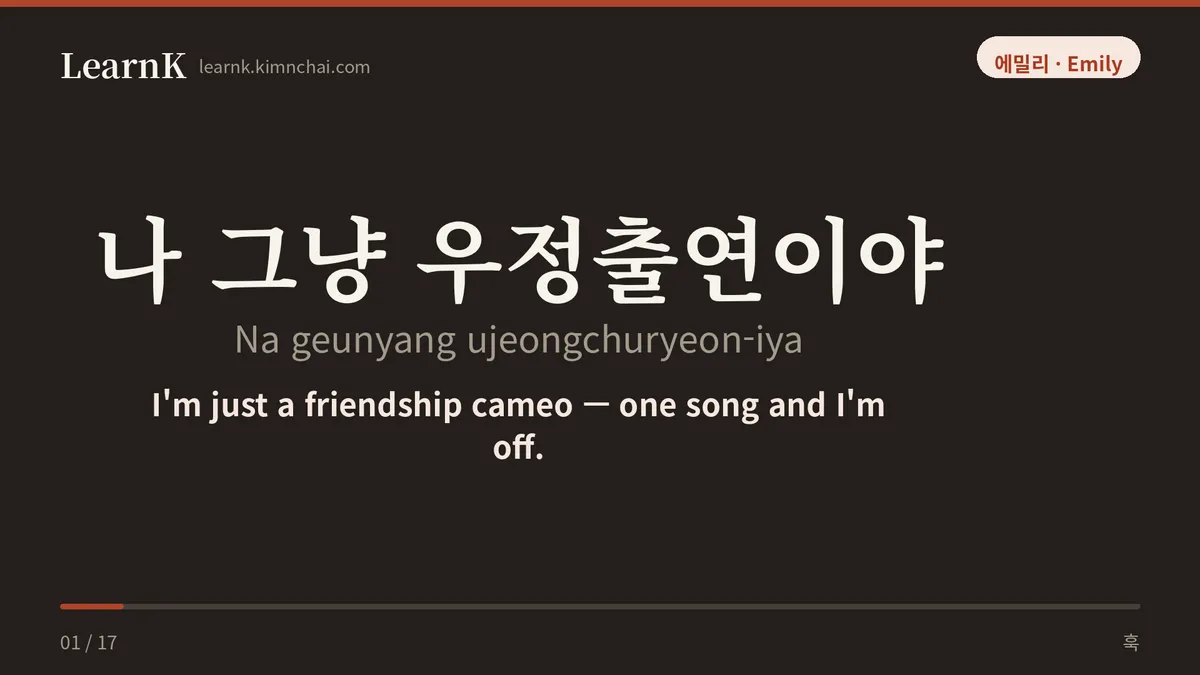
Situation: Saturday afternoon, backstage at a small theater near Hongdae. Emily has come to help out with a single song at a friend’s band show, and Jun-kyung has come to watch.
준경: 어? 너 오늘 밴드에서 노래해? 나 그런 얘기 못 들었는데. Huh? You’re singing with the band today? Nobody told me that.
에밀리: 아니야, 나 그냥 우정출연이야. 한 곡만 하고 바로 내려와. No, I’m just doing a friendship cameo. One song and I’m right back off the stage.
준경: 우정출연치고는 아까 리허설 엄청 열심히 하던데? You were rehearsing awfully hard back there for someone who’s “just a cameo.”
에밀리: 야, 무대는 무대지. 대충 하면 친구 얼굴에 먹칠하잖아. Hey, a stage is a stage. If I phone it in, I make my friend look bad.
준경: 그럼 앙코르 때도 또 나오는 거야? So are you coming back out for the encore too?
에밀리: 안 나와. 우정출연은 딱 한 번 나왔다 사라져야 멋있는 거야. Nope. A friendship cameo only looks cool if you show up once and disappear.
When It Sounds Off
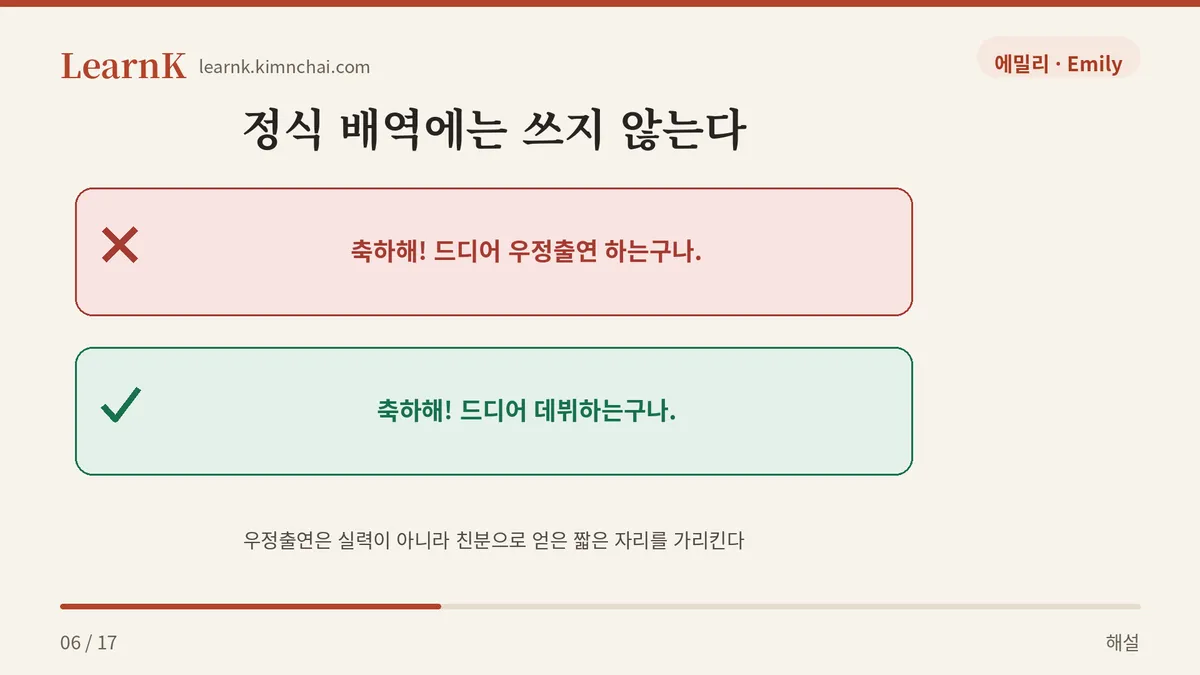
✗ (to a junior colleague who passed an audition and landed a proper role) 축하해! 드디어 우정출연 하는구나. Congrats! You’re finally doing a friendship cameo.
✓ (same situation) 축하해! 드디어 데뷔하는구나. Congrats! You’re finally making your debut.
→ 우정출연 points to a short slot someone got through personal connections, not through ability. Attach it to a real role and it lands as “ah, so you got in through your network” — which turns a congratulation into a put-down.
✗ (a director on the phone, casting an actor) 이번엔 8부 내내 나오는 역할인데, 우정출연으로 부탁드릴게요. This time it’s a role that runs through all eight episodes — I’d like to ask you to do it as a friendship cameo.
✓ (same situation) 이번엔 8부 내내 나오는 역할입니다. 출연료는 정식으로 준비하겠습니다. This time it’s a role that runs through all eight episodes. We’ll prepare a proper fee for you.
→ The word 우정출연 already contains “we can barely pay you.” Attach it to a substantial role and it sounds like using loyalty as an excuse to negotiate the fee down.
Example Sentences by Situation
① When a familiar face flashes by while you’re watching a drama with a friend
어, 저 배우 우정출연인가 봐. 1분도 안 나오네. (Eo, jeo baeu ujeongchuryeon-inga bwa. Ilbun-do an naone.) Oh, I think that actor’s doing a 우정출연. They’re not even on for a minute.
→ You haven’t checked the credits yet, so this is a guess, not a certainty — hence 「-인가 봐」. Once you’ve confirmed it in the credits, it becomes 「우정출연이래」 or 「우정출연이더라」.
② When you’re only dropping by an event a friend organized
나는 오늘 우정출연이니까 사진만 찍고 갈게. (Naneun oneul ujeongchuryeon-inikka sajin-man jjikgo galge.) I’m just a 우정출연 today, so I’ll take a photo and head out.
→ People use it in everyday life outside the entertainment world too. It jokingly layers on the meaning “you’re the star and I’m just here to help for a second,” which signals that you’re arriving without fuss and leaving without fuss.
③ When introducing a guest in a YouTube video
오늘은 제 친구가 우정출연 해 주셨습니다. (Oneureun je chinguga ujeongchuryeon hae jusyeotseumnida.) Today my friend was kind enough to make a 우정출연.
→ 우정출연 is a noun, but you attach 「하다」 to use it like a verb. Adding 「-아/어 주다」 to get 「해 주셨습니다」 folds in gratitude on top. It’s the polite way to publicly thank someone who came without being paid.
Formal vs. Casual Speech, and Similar Expressions
우정출연 is a noun, so there’s no honorific level in the word itself. The register is decided by the predicate that follows it. To a friend: 우정출연이야 (ujeongchuryeon-iya). To someone older than you, or in front of a camera: 우정출연입니다 (ujeongchuryeon-imnida). When you’re speaking respectfully about someone else’s appearance, add 「-아/어 주시다」, as in 우정출연 해 주셨어요 (ujeongchuryeon hae jusyeosseoyo).
Line up the look-alike expressions and the differences come into focus.
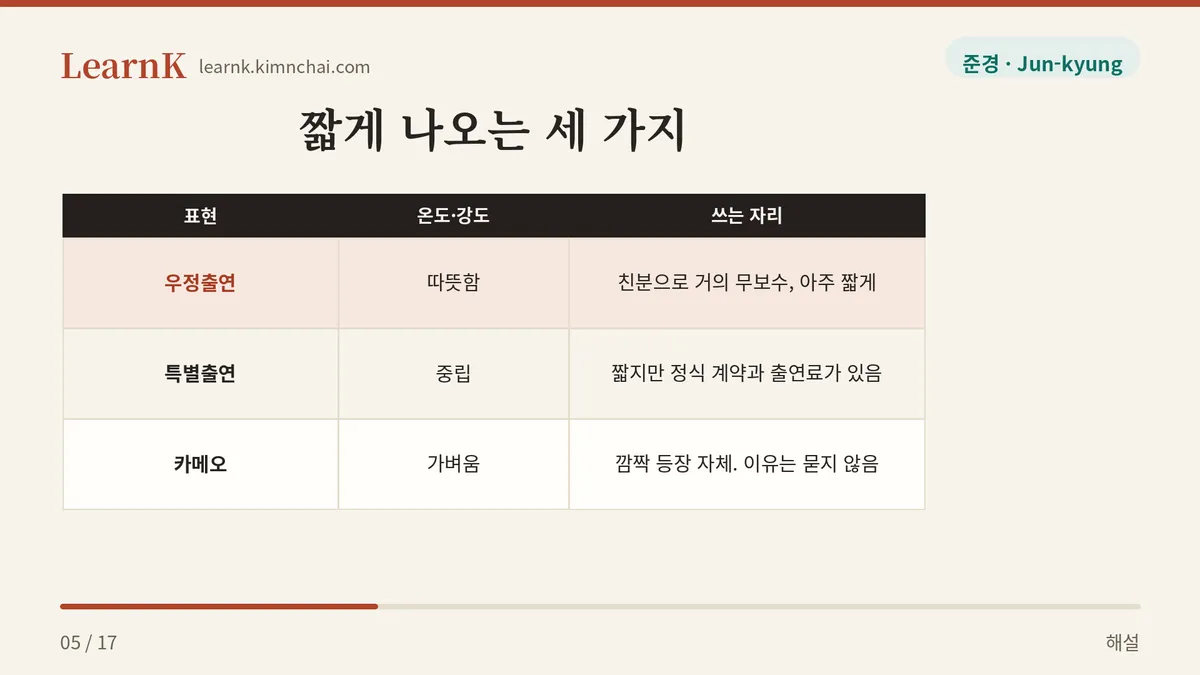
| Expression | Warmth / intensity | Where it’s used |
|---|---|---|
| 우정출연 (ujeongchuryeon) | Warm. Loyalty is the reason | A short appearance for a friend, at close to no pay. Credit captions, everyday jokes |
| 특별출연 (teukbyeolchuryeon) | Neutral. Carries weight | A short but meaningful role with a proper contract and a proper fee |
| 카메오 (kameo) | Light and playful | Points at the surprise appearance itself. Doesn’t ask why they showed up |
| 찬조출연 (chanjochuryeon) | Formal, a bit old-fashioned | Coming out to lend support at an event or performance. Rare in broadcast credits |
The key is the distance between 우정출연 and 특별출연. Both mean limited screen time, but 특별출연 is closer to “this role mattered, so we brought in someone special,” while 우정출연 is closer to “we’re close, so they came.” That’s why 특별출연 gets announced proudly in an agency’s press release, and 우정출연 just appears quietly in the credits.
Cultural Background — The Four Syllables That Show Up Quietly in the Credits
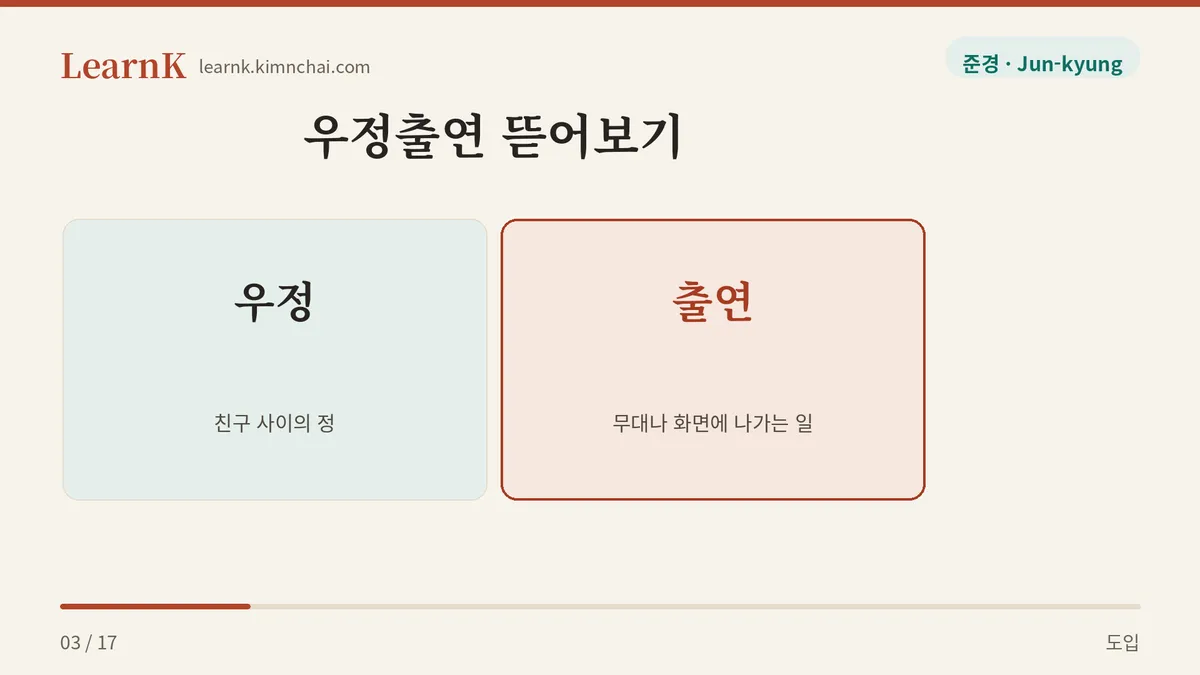
우정출연 is a Sino-Korean word. 우정 (友情) is the affection between friends; 출연 (出演) is going out onto a stage or a screen. Literally, then, it’s “going out for friendship’s sake” — so learners who know some Chinese characters can guess half of it. Just watch out for the pronunciation: it comes out as [우정추련], not the letter-by-letter [우정출연].
The reason this word gets so much use lies in the structure of Korean drama and film production. Actors spend months glued to the same set for a single project, and directors and actors carry relationships across many productions. The director who gave you your first chance, the senior actor who bought you meals when nobody knew your name — relationships stacked up that way come back years later as a one-day shoot. That’s the real reason viewers are so glad to see a 우정출연. What’s on screen is thirty seconds, but fans know there’s roughly a decade of story behind it.
These days the word has walked well beyond broadcasting. A wedding song for a friend, a club performance, a surprise guest on a YouTube channel, a talent show at a company workshop — anywhere you’re helping out briefly at someone’s request, you’ll hear 「나 오늘 우정출연이야」 (I’m just a friendship cameo today). It lowers you and, at the same time, slips in a little mischief — still, they called me because I’m somebody — which makes it a word with a warm temperature.
Today’s Quiz
Which of the following sentences uses 우정출연 awkwardly?
① 오늘 무대는 우정출연이라 한 곡만 부르고 내려갑니다. Today’s stage is a 우정출연, so I’ll sing one song and step down.
② 이번 작품은 우정출연이라서 16부 내내 주인공으로 나옵니다. This project is a 우정출연, so I appear as the lead through all sixteen episodes.
③ 엔딩 크레딧에 우정출연이라고 뜨길래 그 장면을 다시 돌려봤어. The ending credits said 우정출연, so I rewound and watched that scene again.
Answer: ②
우정출연 refers to an appearance that brushes past in an instant. Carrying a show as the lead for sixteen episodes is simply a starring role. Attach this word to a part with real screen time and weight, and the meaning flips to the exact opposite. ① fits the conditions perfectly — one song and off the stage — and ③ is natural, since it describes checking the credits.