완전체 (wanjeonche) — When Everyone Is There, Not a Single Member Missing

완전체
완전체 (wanjeonche) originally means a state in which every single member is present — not one person missing. In idol-group terms, it points to the moment when the exact lineup that stood on stage at debut is together in one place again.
There are certain occasions where this word burns hottest. When a member comes back from military service. When a member who had been resting for health reasons rejoins. When a group that had been dogged by disbandment rumors finally stands on the same stage after several years. Fans deliver that news in exactly one sentence — “이번 콘서트 완전체래!” (ibeon konseoteu wanjeoncherae!), “This concert is the full lineup!” The sentence is short, but the feeling packed inside it is not. The time spent waiting, the empty spot, the scene of that spot being filled again — it all fits into a single word.
The uses split into two main branches. The first is the “everyone assembled” sense we’ve been describing. You use it when something made up of many people — a group, a team, a regular gathering — comes together with no one absent. It’s often used with another word attached, as in 완전체로 컴백하다 (wanjeonchero keombaekhada), “to come back as the full lineup”; 완전체 무대 (wanjeonche mudae), “a full-lineup stage”; 완전체 회동 (wanjeonche hoedong), “a full-lineup get-together.”
The second is calling one single person a “완전체.” They can sing, they can dance, they’ve got the looks, and their personality is great too — it’s high praise meaning they have absolutely everything. Here you’d say something like 쟤 완전체야 (jyae wanjeonche-ya), “that kid is the complete package.” This use, though, is closer to an exclamation than a serious assessment, and it comes with a playful edge.
Let’s pin down the temperature. 완전체 is a noun, but in practice it works like an interjection. Drop it into a company notice where you’d normally write 전원 참석 (jeonwon chamseok), “full attendance,” and the sentence suddenly turns giddy. That giddy temperature is the heart of this word, and most of the misuses we’ll look at below come from getting the temperature wrong.
Seeing it in a real conversation
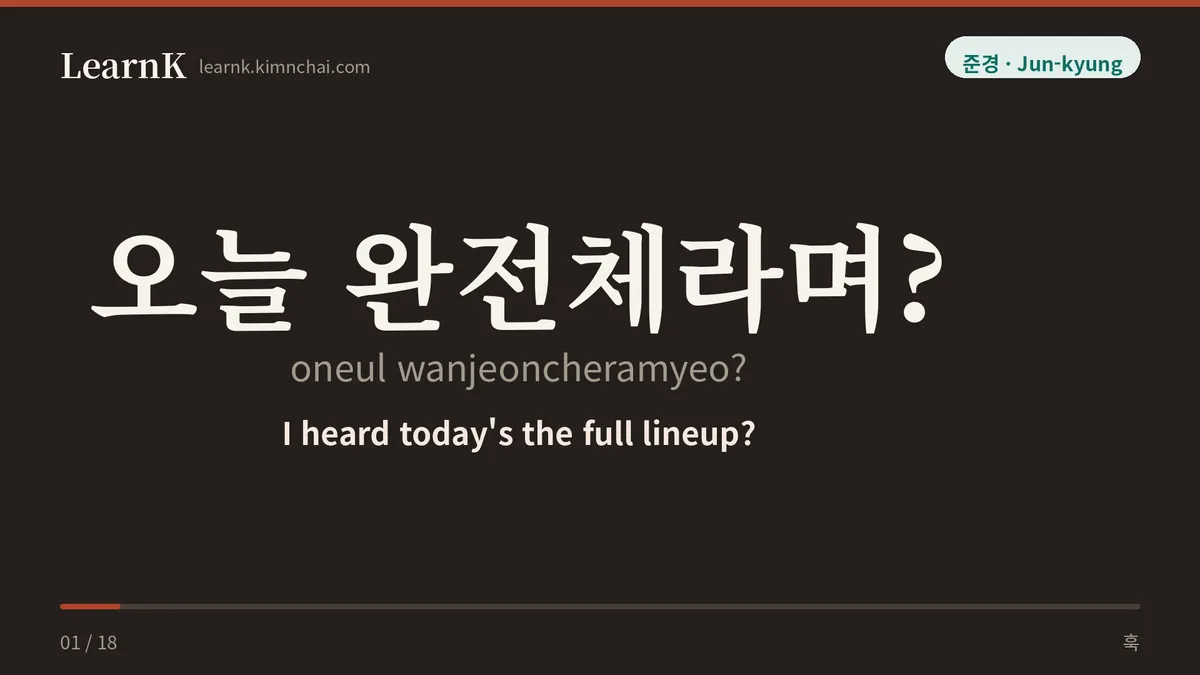
Scene: The merch line in front of Jamsil Stadium. It’s the day of the first concert since the youngest member was discharged from the military, so the line stretches about 200 meters.
Emily: 준경아, 이 줄 진짜 미쳤다. 나 벌써 세 시간째야. Jun-kyung, this line is insane. I’ve already been here three hours.
Jun-kyung: 그러게. 근데 오늘 완전체라며? 그럼 이 정도는 서야지. Right? But I heard today’s the full lineup. Then this much waiting is fair.
Emily: 어, 막내 전역하고 처음이야. 데뷔 때 다섯 명 그대로 다 나와. Yeah, it’s the first time since the youngest got discharged. All five from the debut lineup.
Jun-kyung: 와, 그럼 몇 년 만이야? Wow, so how many years has it been?
Emily: 3년! 나 완전체로 보는 거 진짜 오랜만이라 아까부터 손 떨려. Three years! It’s been so long since I’ve seen them all together, my hands have been shaking.
Jun-kyung: 야, 티켓팅 뚫은 것부터가 기적이야. 오늘 실컷 봐. Hey, just getting a ticket was already a miracle. Enjoy it to the fullest today.
Using it this way sounds off
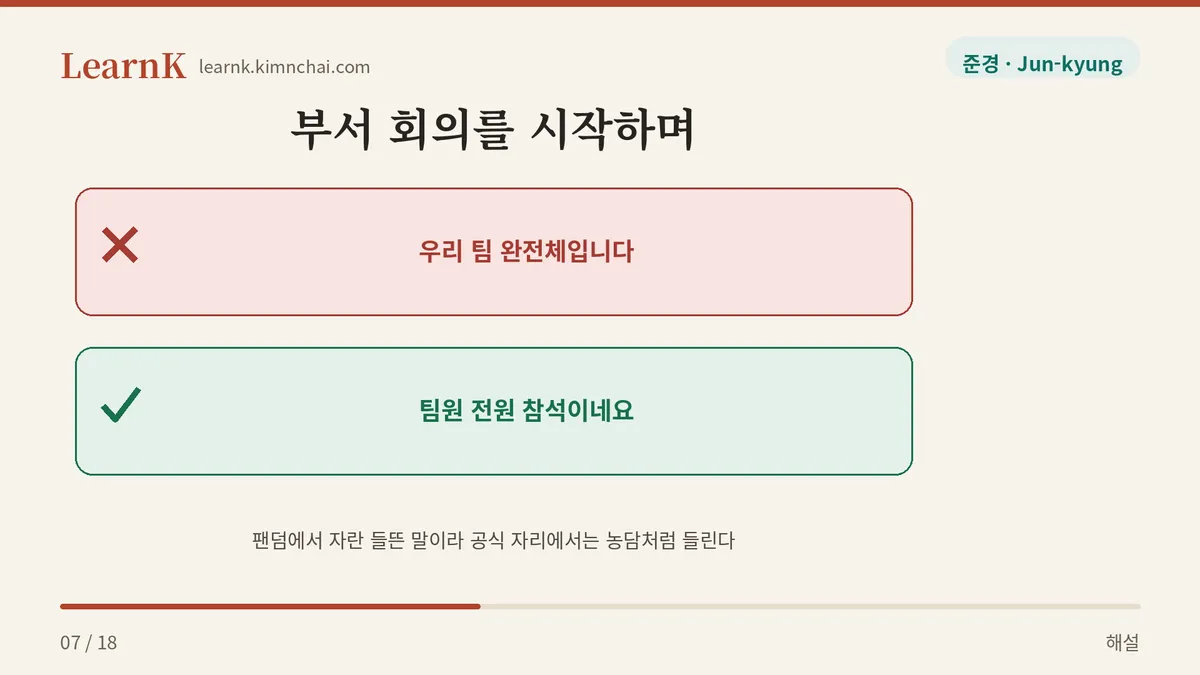
✗ (Opening a department meeting) 오늘은 팀원이 다 오셨네요, 우리 팀 완전체입니다. (oneureun timwoni da osyeonneyo, uri tim wanjeoncheimnida.) — “Everyone on the team made it today; our team is the full lineup.”
✓ (Opening a department meeting) 오늘은 팀원 전원 참석이네요. (oneureun timwon jeonwon chamseogineyo.) — “We have full attendance from the team today.”
→ 완전체 is a giddy word that grew up inside fandom, so in an official setting it lands like a joke. For reports and announcements, 전원 (jeonwon), “all members,” or 전원 참석 (jeonwon chamseok), “full attendance,” is the safer choice.
✗ (To a senior colleague) 선배님은 일도 잘하시고 성격도 좋으시고, 진짜 완전체세요. (seonbaenimeun ildo jalhasigo seonggyeokdo joeusigo, jinjja wanjeoncheseyo.) — “You’re great at your job, you have a great personality — you’re really the complete package.”
✓ (To a friend) 쟤는 노래도 춤도 얼굴도 다 되잖아. 진짜 완전체야. (jyaeneun noraedo chumdo eolguldo da doejana. jinjja wanjeoncheya.) — “She can sing, she can dance, she’s got the looks. She’s really the complete package.”
→ It is a compliment, but the structure grades a person condition by condition and declares the checklist full. Aimed at someone older or senior to you, it comes across as sizing them up a little too casually. For someone above you, “정말 배울 점이 많으십니다” (jeongmal baeul jeomi maneusimnida), “I really have so much to learn from you,” is the right call.
Example sentences by situation
1. Sharing comeback news
드디어 다음 달에 완전체로 컴백한대! (deudieo daeum dare wanjeonchero keombaekhandae!) “They’re finally coming back next month with the full lineup!”
This is the sentence that flies out the instant the agency’s announcement drops in the fan group chat. The -대 (-dae) in 컴백한대 is an ending for relaying news you’ve heard, so it keeps that feeling of carrying information you just learned. And 완전체로 here means “in a full-lineup state,” which is why the particle -로 (-ro) attaches.
2. About a gathering that finally came together
우리 동기 모임 완전체는 진짜 5년 만이다. (uri donggi moim wanjeoncheneun jinjja onyeon manida.) “It’s honestly been five years since our class-year group was all together.”
You use it outside idol talk too. It’s natural for any group with a fixed membership — university classmates, high school friends, cousins. It’s the line that comes out on the day a gathering that always had an empty seat, because someone was abroad or deep in childcare, is finally full again.
3. Praising someone to the skies
쟤는 노래, 춤, 예능감까지 완전체야. (jyaeneun norae, chum, yeneunggamkkaji wanjeonche-ya.) “Singing, dancing, and even variety-show instincts — he’s the complete package.”
This is the kind of exclamation that comes out while watching an audition show together. -까지 (-kkaji) adds the nuance of “and on top of all that, this too.” Keep it among friends; said straight to the person’s face, it can come off as teasing.
Formal and casual forms, and similar expressions
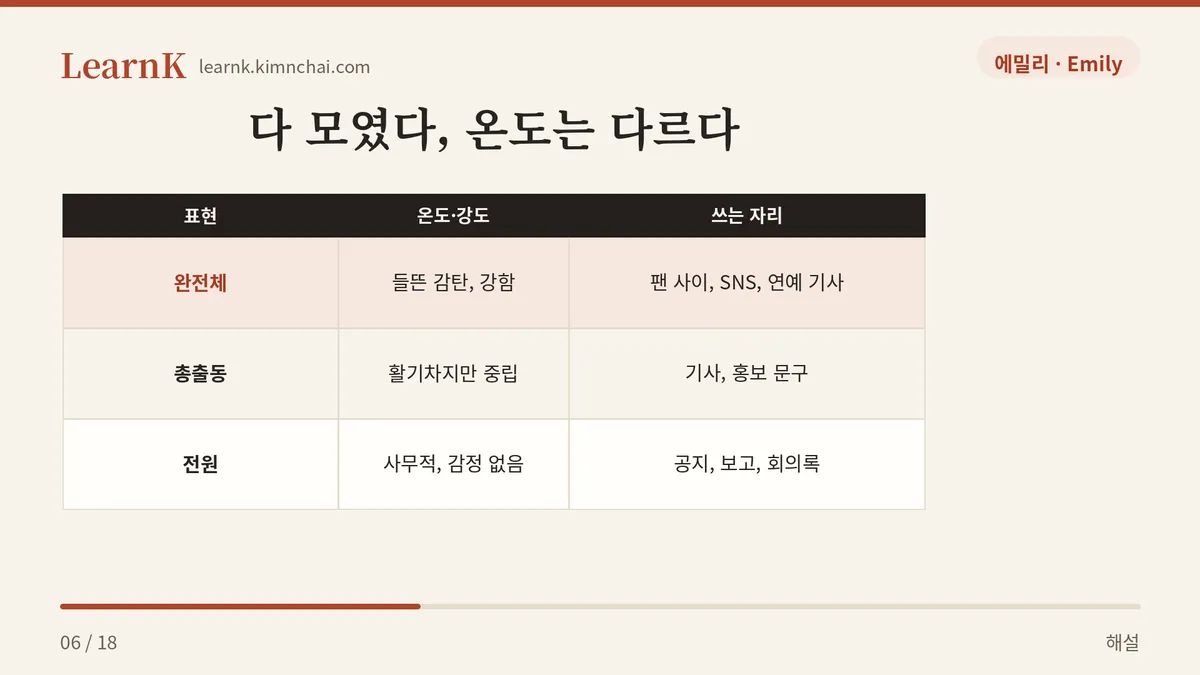
Since 완전체 is a noun, all you have to change is the predicate at the end of the sentence. Casual is 완전체야 (wanjeonche-ya), polite is 완전체예요 (wanjeoncheyeyo), and more formal still is 완전체입니다 (wanjeoncheimnida). As mentioned above, though, the formal form doesn’t sit well with the word’s light temperature, so in practice it’s almost always the casual form or the polite 해요체 (haeyoche) style.
| Expression | Temperature & intensity | Where it’s used |
|---|---|---|
| 완전체 (wanjeonche) | Giddy excitement, strong | Among fans, on social media, in entertainment headlines |
| 총출동 (chongchuldong) | Lively but neutral | News articles, promo copy. “인기 배우 총출동 (ingi baeu chongchuldong)” — “top actors all turn out” |
| 전원 (jeonwon) | Businesslike, no emotion | Announcements, reports, meeting minutes |
| 다 모이다 (da moida) | Plain, everyday wording | Anywhere. The safest option |
총출동 (chongchuldong) focuses on a lot of people turning out all at once, so it doesn’t care whether the original membership is complete. 완전체, by contrast, is all about “the empty spot got filled,” so it lands best between people who know how long that spot sat empty.
Cultural background — 군백기 (gunbaekgi) and 완전체
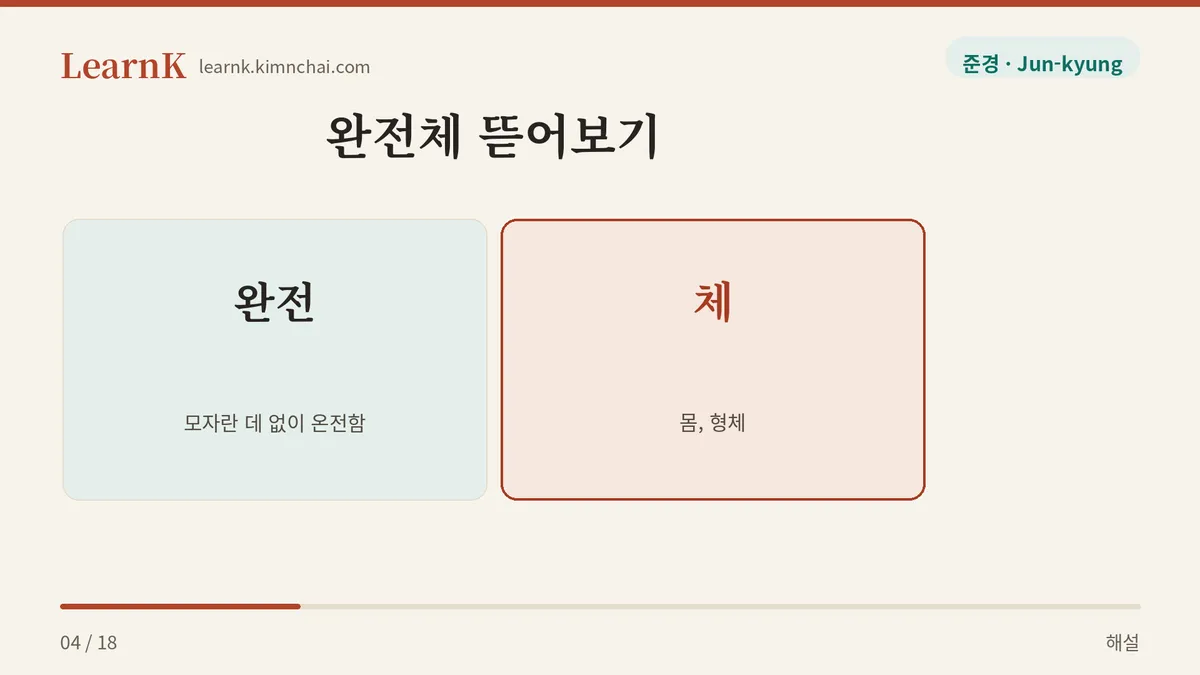
완전체 is built from the Sino-Korean 완전 (完全, wanjeon), “complete,” plus 체 (體, che), meaning “body” or “form.” Translated literally, it’s “a form fully equipped, with nothing lacking.” Internet communities and fandom speech habits had a lot to do with the word spreading as far as it has: it first settled in as an exclamatory noun for a “final form” or “completed state,” then crossed over into idol fandom.
There’s one particular reason this word carries such weight in Korean idol fandom. Korean men have a military service obligation, and boy groups inevitably pass through several years of members enlisting one after another. Fans call this stretch 군백기 (gunbaekgi) — a blend of 군대 (gundae, “the military”) and 공백기 (gongbaekgi, “hiatus”). During the 군백기, a group either promotes with the remaining members or stops entirely. Years go by with one spot on the stage standing empty. So the day the last member is discharged and the group is five, or seven, once more isn’t just another concert to a fan — it’s the day a long wait ends. That one word, “완전체,” stands in for the whole date.
These days the word has spread well beyond idols. When the cast of a beloved old variety show reunites after years, headlines carry 완전체 재회 (wanjeonche jaehoe), “full-lineup reunion.” When a family scattered all year gathers for a holiday, someone jokes, “올해는 완전체다” (olhaeneun wanjeoncheda), “this year we’re the full lineup.” In the end, there’s really only one condition for using this word: there has to be a fixed original lineup, and that spot has to have been empty for a while. 완전체 doesn’t stick well to a gathering where everyone has always shown up from the very beginning.
Today’s quiz
Which of the following uses 완전체 most naturally?
① 오늘 회의에 부장님 한 분만 오셔서 완전체였어요. (oneul hoeuie bujangnim han bunman osyeoseo wanjeoncheyeosseoyo.) — “Only the manager came to today’s meeting, so we were the full lineup.”
② 멤버 일곱 명이 3년 만에 다 모였어, 오늘 완전체 무대야! (membeo ilgop myeongi samnyeon mane da moyeosseo, oneul wanjeonche mudaeya!) — “All seven members are together for the first time in three years — today’s a full-lineup stage!”
③ 저 혼자 연습실에 남아서 완전체로 연습했어요. (jeo honja yeonseupsire namaseo wanjeonchero yeonseuphaesseoyo.) — “I stayed behind alone in the practice room and practiced as a full lineup.”
Answer: ②
완전체 is used when every spot on a multi-person team has been filled. In ①, only one person showed up, which is the exact opposite situation; in ③, the speaker is by themselves, so “everyone gathered” can’t apply at all. ② satisfies both conditions: there’s a fixed original lineup of seven, and after a three-year gap, every one of those spots is filled again.