완내스 (wannaeseu) — The Three Syllables That Pop Out When Something Is Exactly Your Taste
완내스 (wannaeseu)
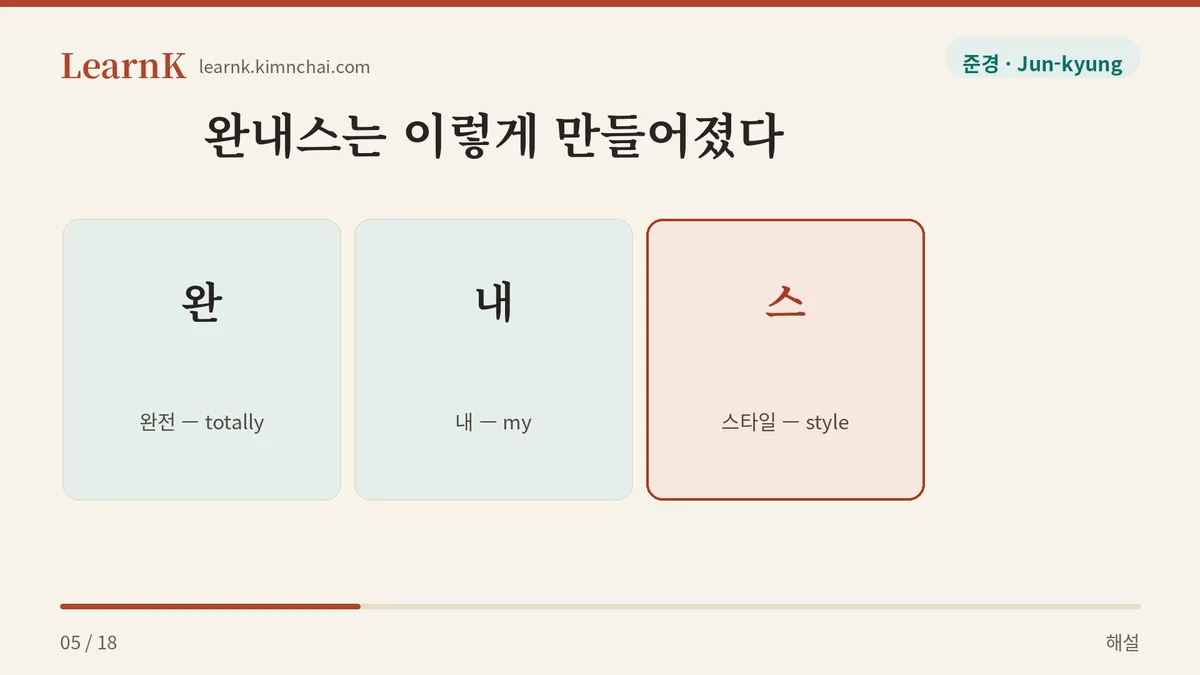
완내스 (wannaeseu) is a shortened form of 완전 내 스타일 (wanjeon nae seutail), “totally my style,” and it’s the little exclamation that jumps out when an object, a song, a place, or a person lands exactly on your taste. A song you’ve never heard before comes on at a café and you pull out your phone to find the title; you’re swiping through secondhand-marketplace photos and your finger stops; you’re at a friend’s place and one particular lamp really gets you — this is the word for that short moment.
The nuance is far more personal than just “good.” 좋다 (jota) means “anyone would agree this is good,” but 완내스 is closer to a declaration: “whatever anyone else thinks, this is the one for me.” So there’s a quiet pride in your own taste mixed into it. The temperature is hot; the weight is light. It’s an immediate reaction, not something you say after mulling it over. It fits best when it comes out the instant you see it or hear it.
The form is flexible too. It works as a predicate — 완내스야 (wannaeseuya), 완내스예요 (wannaeseuyeyo) — and it also attaches like a noun: 완내스인데 (wannaeseuinde), 완내스라서 (wannaeseuraseo). The negative form 완내스는 아니야 (wannaeseuneun aniya) means “it’s not bad, it’s just not my taste,” and works as a soft, face-saving way to turn something down.
A Real Conversation
Setting: Saturday afternoon, the meetup spot in front of an apartment complex for a secondhand deal. Emily is buying a solid-wood desk, and Jun-kyung has come along to look at it with her.
준경: 어, 사진보다 낫네. 상판 색 봐. Oh, it looks better than in the photo. Look at that top.
에밀리: 그치? 나 이거 보자마자 완내스여서 바로 연락했어. Right? The second I saw it, it was totally my style, so I messaged right away.
준경: 근데 다리 좀 흔들리는데? 나사 조이면 되려나. But the legs wobble a bit. Would tightening the screws fix it?
에밀리: 괜찮아, 그 정도는. 나무 결이 완내스라서 다리는 눈에 안 들어와. That’s fine. The wood grain is so my style that I don’t even notice the legs.
준경: 콩깍지 제대로 씌었네. 야, 들어. 삼 층까지 계단이야. You are seriously smitten. Hey, lift. It’s stairs all the way to the third floor.
에밀리: …지금부터 완내스 아니야. …As of right now, it is no longer my style.
Where It Sounds Off
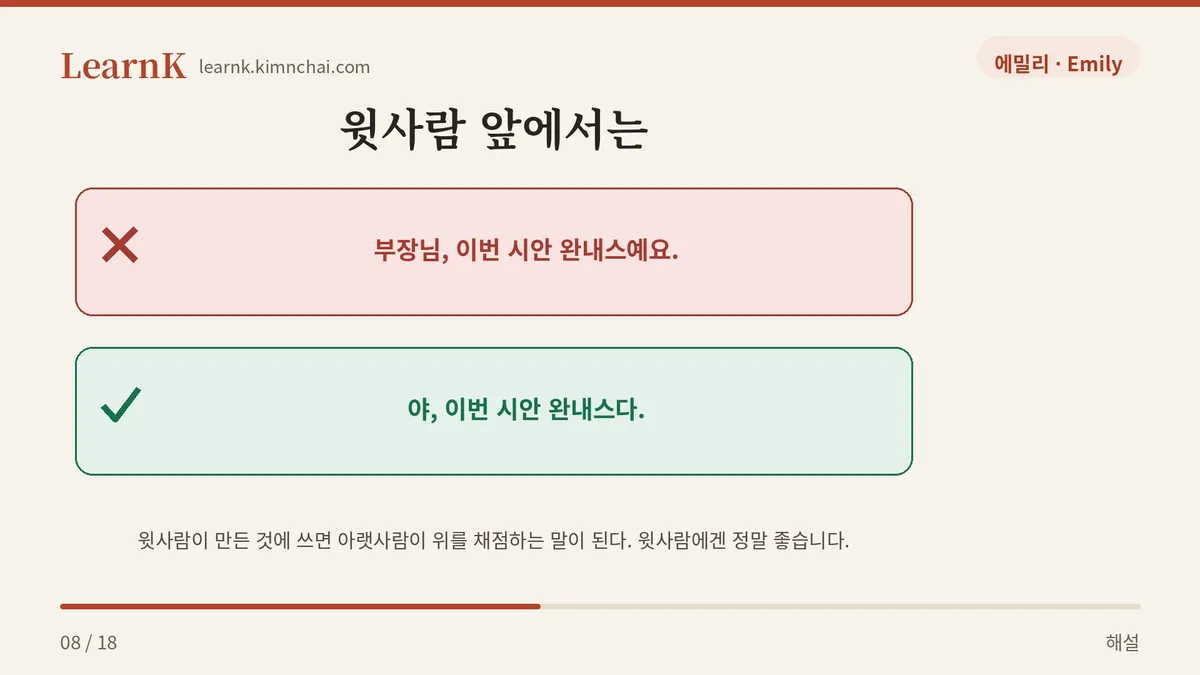
✗ (to your department head) 부장님, 이번 시안 완내스예요. ✓ (to a coworker) 야, 이번 시안 완내스다. → It’s a slangy abbreviation, and on top of that it’s a verdict — “this matches my taste.” Used on something a senior made, it turns into a junior grading a senior. With someone above you, 정말 좋습니다 (jeongmal joseumnida) is the safe choice.
✗ (to someone’s face, on first meeting) 어, 완내스시네요. ✓ (after that person leaves, to a friend) 야, 아까 그분 완내스야. → Said to a person’s face, it sounds like you’ve picked them off a shelf and are rating them. 완내스 about a person happens behind their back, and only among close friends.
Example Sentences by Situation
1. When a song you don’t know comes on at a café
이 노래 뭐야? 완내스인데. i norae mwoya? wannaeseuinde. (What is this song? It’s totally my taste.)
You can practically see the phone coming out and the music-search button being tapped before the sentence is even finished. Trailing off with -인데 (-inde) is the most common shape this expression takes.
2. When you flip over the price tag at a clothing store
디자인은 완내스야. 근데 가격이 문제지. dijaineun wannaeseuya. geunde gagyeogi munjeji. (The design is totally my style. The price, though — that’s the problem.)
완내스 sits nicely in this “the ___ is 완내스, but…” slot, where you grant one point before adding a condition. It’s the sigh you let out when taste and reality don’t line up.
3. The day after a blind date, when a friend asks
나쁘진 않았는데, 완내스는 아니었어. nappeujin anannneunde, wannaeseuneun anieosseo. (They weren’t bad, they just weren’t my type.)
It conveys exactly “not for me” without putting the other person down. This negative form gets used constantly as a cushion for turning someone down.
Politeness Levels and Similar Expressions
완내스 has no proper polite form. You can raise the ending, as in 완내스예요 (wannaeseuyeyo), but the word itself is peer-to-peer slang, so no amount of polite ending will carry it into a formal setting. A close senior at school or a coworker who isn’t much older is about as far as it stretches.
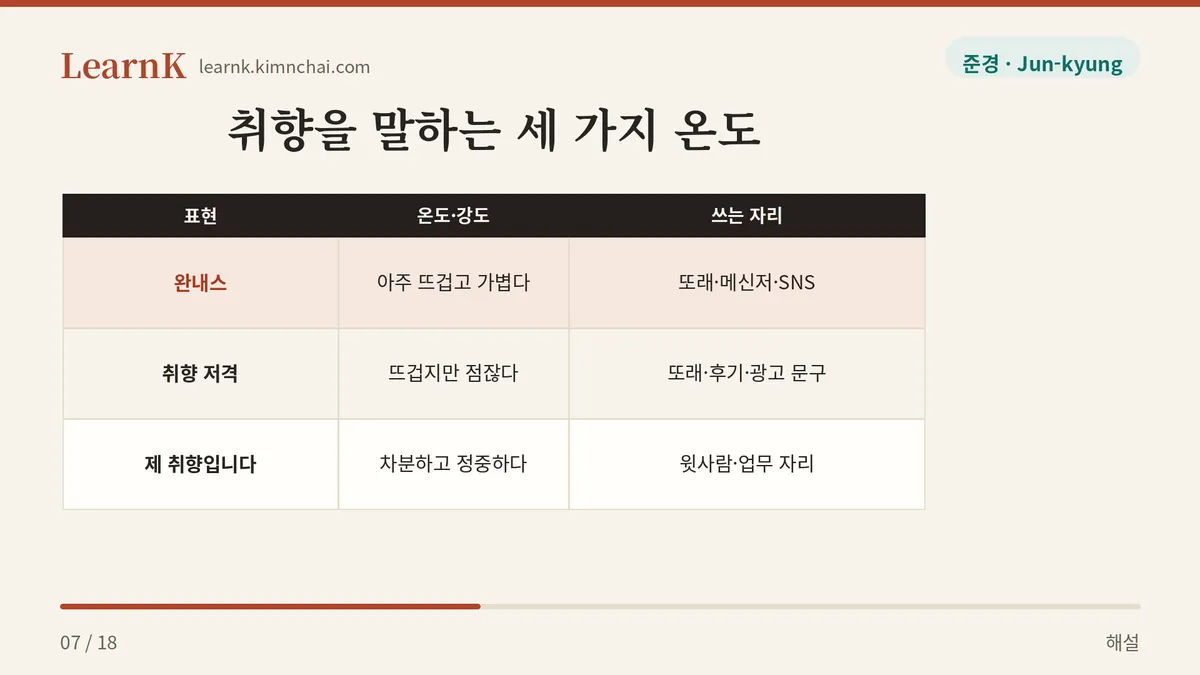
| Expression | Temperature / Intensity | Where to use it |
|---|---|---|
| 완내스 (wannaeseu) | Very hot and very light — instant reaction | Peers, messaging, social media. Not with seniors |
| 취향 저격 (chwihyang jeogyeok) | Hot but a bit more well-behaved | With peers, and also in product reviews and ad copy |
| 내 스타일이야 (nae seutairiya) | Neutral to warm | Anywhere. Shifts naturally into polite speech |
| 제 취향입니다 (je chwihyangimnida) | Calm and courteous | With seniors, at work, in formal conversation |
The feeling may be the same, but in a meeting room you use the last row and in the group chat you use the first. Knowing how to move up and down these four rows is what real Korean ability looks like.
Cultural Background — The Habit of Cutting Words Down to Three Syllables
Korean has a long-standing habit of slicing long phrases down to their first syllables. 완내스 belongs to that lineage — 완전 내 스타일, with only the first syllable of each chunk left standing. Abbreviations got so numerous that even the phrase “별걸 다 줄인다” (“they shorten absolutely everything”) got shortened again, into 별다줄 (byeoldajul). An abbreviation compresses meaning and, at the same time, builds a fence around “us, the people who get this word.” The moment someone catches 완내스 and laughs, the conversation warms up a notch.
Part of why this expression spread so widely is an era in which putting your taste into words became an everyday act. Music streaming pushes a new playlist at you every week; secondhand apps show you other people’s used things all day long. In an environment where you have to decide “this is me, this isn’t me” dozens of times a day, a word that settles the verdict in three syllables is bound to feel convenient.
In dramas and variety shows, the word usually shows up right where a character’s personality needs to land in one stroke. A character who shouts 완내스 over a single piece of decor or a single song is drawn as someone with definite taste who’s honest about their own sensibility. Conversely, a scene where someone drops the word in front of the older generation and gets a “what on earth does that mean?” is a stock setup for playing the generation gap for laughs. One expression tells you a character’s age and their crowd at the same time.
Today’s Quiz
In which of the following situations would 완내스 be the most out of place?
- When a friend shows you the sneakers they just bought
- When evaluating the CEO’s presentation deck at an executive briefing
- When you like the interior of a restaurant you’re visiting for the first time
Show answer
The answer is 2. 완내스 is peer-group slang, and on top of that it’s a verdict — “this matches my taste” — so using it on something a senior produced makes it look like a junior is grading someone above them. In that room, something plain like 자료 정말 좋았습니다 (jaryo jeongmal joatsseumnida), “the materials were really good,” is the safer move. Situations 1 and 3 are exactly where 완내스 fits best: the kind of moment where the reaction comes the instant you see it.
Definitions and example sentences are from the National Institute of Korean Language’s Basic Korean Dictionary (krdict.korean.go.kr); that portion of this post, including our translations, is licensed under CC BY-SA 2.0 KR.