Where's the Bathroom? — The First Korean Phrase You'll Learn on Any Trip
When you travel, there’s always one phrase you’ll need urgently — no matter how stunning the view in front of you. It’s the phrase for finding a bathroom. In a Seoul subway station, in a market alley in Busan, in a café on Jeju Island — knowing this one phrase makes your trip so much more comfortable. Today’s expression is survival Korean that every Korean will understand 100% of the time, and one you absolutely need to pack for your trip.
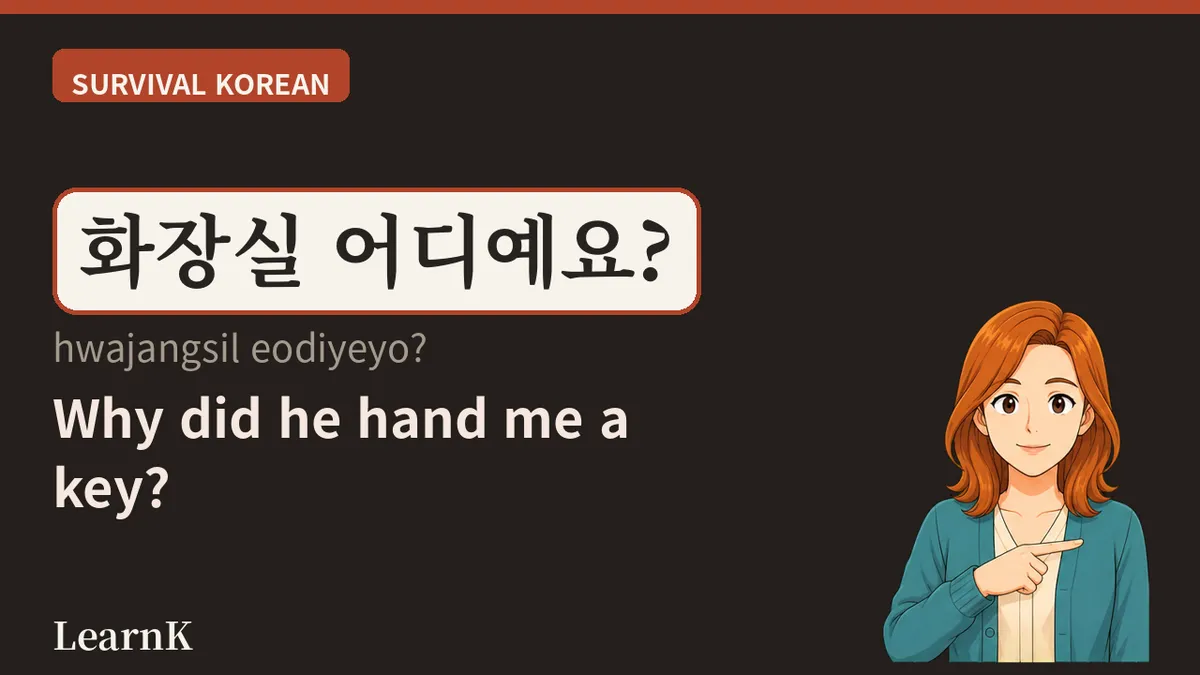
화장실 어디예요?
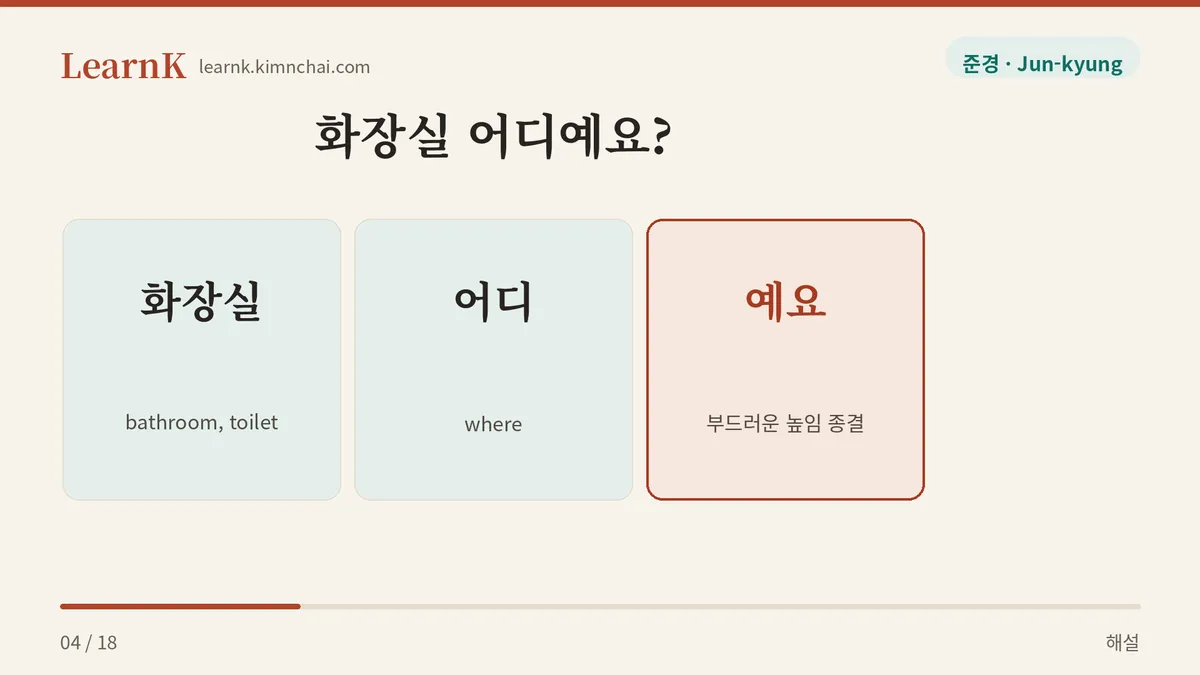
화장실 어디예요? (hwajangsil eodiyeyo?) is the equivalent of “Where is the bathroom?” in English. It’s easy to understand when you break it down word by word.
- 화장실 (hwajangsil): bathroom, i.e. toilet / restroom
- 어디 (eodi): where
- 예요 (yeyo): a soft, polite sentence ending equivalent to “~is”
With full grammar, it would be 화장실이 어디예요? (hwajangsiri eodiyeyo?), but in real conversation people much more often drop the particle 이 (i) and just say 화장실 어디예요? (hwajangsil eodiyeyo?). It’s short but not the least bit rude — in fact, it’s natural, everyday speech. When you’re in a hurry, just remember these five syllables.
Meaning and Nuance
The heart of this expression is the sentence ending 예요 (yeyo). This ending is polite (honorific) yet not stiff, so you can use it comfortably with someone you’ve just met. That makes it an all-purpose phrase you can safely use with anyone — a restaurant employee, a passerby, a hotel front-desk clerk. When you say it, raise the end slightly to give it that question-mark feel. The key is to roll it out softly as 예요 (yeyo), not “에요.”
Example Sentences by Situation
Situation 1 — To an employee at a restaurant
저기요, 화장실 어디예요? (jeogiyo, hwajangsil eodiyeyo?)
Adding 저기요 (jeogiyo) in front makes it a natural “Excuse me~” that grabs the other person’s attention. It’s the phrase Koreans use most often to call an employee, so memorize it as a set.
Situation 2 — To a stranger on the street
실례합니다, 혹시 화장실 어디예요? (sillyehamnida, hoksi hwajangsil eodiyeyo?)
실례합니다 (sillyehamnida) means “Excuse me,” and 혹시 (hoksi) means “by any chance.” Adding these two words gives a much more polite and courteous feel.
Situation 3 — When you also need to ask for the passcode at a café
화장실 어디예요? 그리고 비밀번호 있어요? (hwajangsil eodiyeyo? geurigo bimilbeonho isseoyo?)
Bathrooms at Korean cafés often have a lock on the door, so you frequently need a 비밀번호 (bimilbeonho) — a passcode. In reply, you’ll hear something like “이쪽으로 가세요 (ijjogeuro gaseyo, Go this way)” or get a finger pointing you in the right direction. Wrap it up with 감사합니다 (gamsahamnida) and it’s perfect.
Comparing Polite Speech, Casual Speech, and Similar Expressions
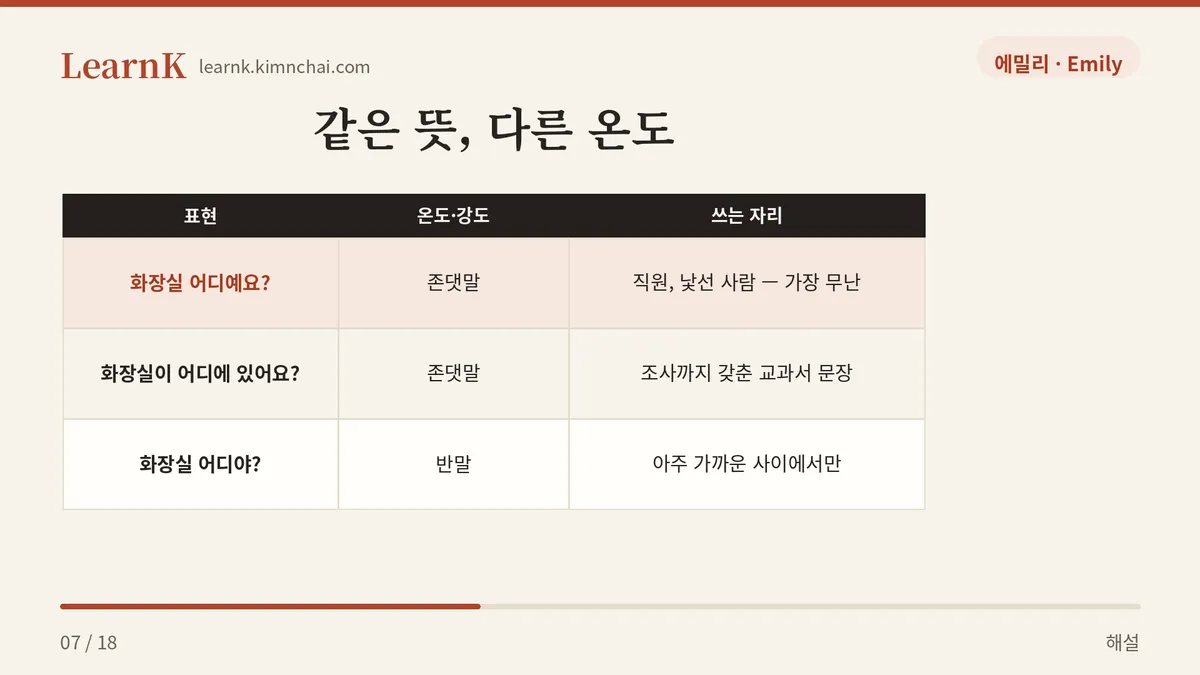
Even with the same meaning, your tone changes depending on who you’re talking to.
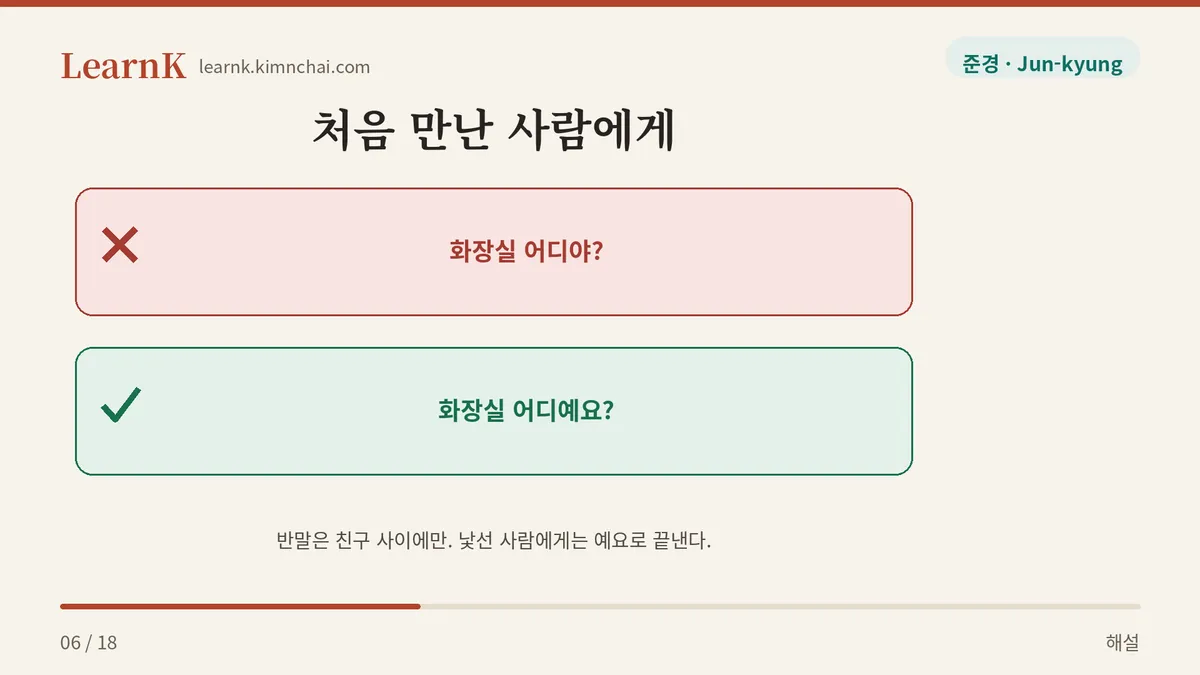
- 화장실 어디예요? (hwajangsil eodiyeyo?) — Polite speech. For strangers and staff. The safest, most versatile choice.
- 화장실이 어디에 있어요? (hwajangsiri eodie isseoyo?) — Polite speech. The textbook sentence with all the particles and the verb in place. It has a proper, carefully-enunciated feel.
- 화장실 어디야? (hwajangsil eodiya?) — Casual speech. Only with friends or people you’re very close to.
For a traveler, the safe choice is always 화장실 어디예요? (hwajangsil eodiyeyo?). There’s no rush to use casual speech — you can always switch to it once you’ve gotten close.
A Bit of Cultural Background
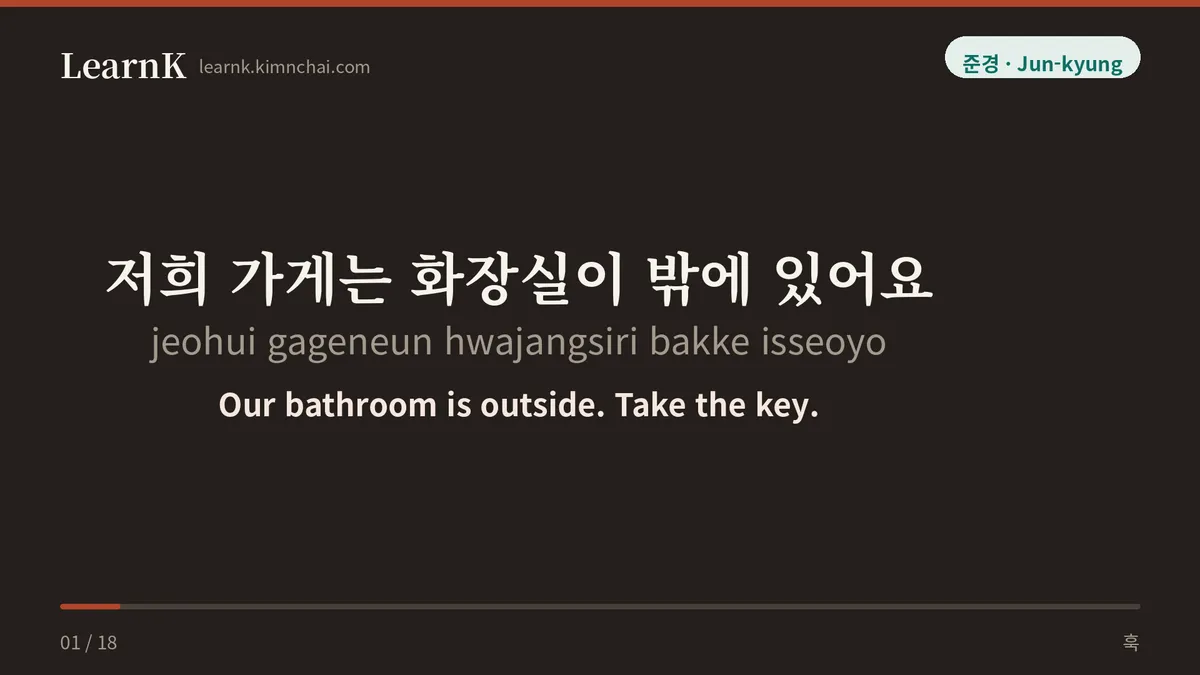
In Korean dramas, you’ll often see characters desperately looking around for a bathroom. In comedies especially, the situation of someone hopping from foot to foot because they can’t find the bathroom is used as a comic beat. In real Korea, public restrooms are well provided everywhere — subway stations, department stores, underground shopping arcades — and they’re generally free, which is very convenient for travelers. That said, in older buildings or small shops the bathroom might be located separately outside, or you might have to get a key — so with this one phrase, you can ask for directions and sort it out anywhere.
Closing Quiz
You want to politely ask a café employee where the bathroom is. Which is the most natural phrase for the blank?
”______ , 화장실 어디예요?”
① 안녕히 가세요 (annyeonghi gaseyo) ② 저기요 (jeogiyo) ③ 잘 먹겠습니다 (jal meokgetseumnida)
The answer is ② 저기요 (jeogiyo). ① is what you say when parting ways, and ③ is what you say before eating — so they don’t fit the situation, right? Be sure to pack today’s expression in your travel bag!