야경 (yagyeong) — The View That Only Appears Once the Lights Come On

야경 (yagyeong)
야경 (yagyeong) means “the scenery you see at night.” Once the sun has dropped all the way below the horizon and the city’s lights come on one by one, things that were gray lumps of concrete during the day suddenly turn into patterns of light. Korean has a name for that changed face: 야경.
This word gets a lot of use in Korea. In Seoul alone, most of the population lives and works in high-rise buildings, a river cuts straight through the middle of the city, and more than twenty bridges are laid across it. It’s a city with a lot of places to go up and a lot to look down on. So Koreans use 야경 보러 가자 (yagyeong boreo gaja) — “let’s go see the night view” — as a kind of plan in itself. When there’s nothing particular to do after dinner. When you’re not quite ready to part with a friend you haven’t seen in a long time. As the last stop of a date. 야경 is less a destination than a way of stretching time out a little longer.
One nuance worth pinning down. The dictionary says 야경 is “the scenery you see at night,” but what’s actually in a Korean speaker’s head when they use the word is usually a landscape made of lights: the yellow glow in each apartment window, the lighting strung along a bridge, the neon of shop signs, the river of headlights flowing down a road. So calling a pitch-black country night — one with no lights at all — a 야경 lands slightly off. That’s not 야경; that’s 밤하늘 (bamhaneul), the night sky.
One more thing. 야경 pairs with 내려다보다 (naeryeodaboda), “to look down at,” overwhelmingly often. Observation decks, rooftops, high floors, halfway up a mountain — wherever the word 야경 turns up, there is almost always height involved. The dictionary examples below show this habit plainly.
Checking It in the Dictionary
야경 (noun) 밤에 보이는 경치. (bame boineun gyeongchi.) — The scenery that is visible at night. [en] night view; nightscape — The view or scene at night. [ja] やけい【夜景】 — 夜、見える景色。 [es] vista nocturna, panorama nocturno, escena nocturna — Paisaje que se ve por la noche. [zh] 夜景 — 夜间看到的景色。 — National Institute of Korean Language, Basic Korean Dictionary (krdict.korean.go.kr)
The dictionary carries no Portuguese definition, so we’ve supplied one ourselves for reference: vista noturna, paisagem noturna — that one line is our own translation, not a quote from the dictionary.
Now let’s look at the actual usage examples the dictionary lists. All five sentences below are exactly as they appear in the original.
우리 회사 건물은 고층 빌딩이라서 옥상에서 내려다보는 야경이 정말 멋있다. (uri hoesa geonmureun gocheung bildingiraseo oksangeseo naeryeodaboneun yagyeongi jeongmal meositda.) Our office building is a high-rise, so the night view you look down on from the roof is really something. — National Institute of Korean Language, Basic Korean Dictionary (krdict.korean.go.kr)
This is the voice of an office worker who stepped up to the roof for a minute during overtime. Notice the reason attached at the front: 고층 빌딩이라서, “because it’s a high-rise.” The sense that 야경 only works if there’s height is built right into the structure of the sentence.
나는 호텔 테라스에서 야경 관망을 하며 쉬었다. (naneun hotel teraseueseo yagyeong gwanmangeul hamyeo swieotda.) I rested on the hotel terrace, taking in the night view. — National Institute of Korean Language, Basic Korean Dictionary (krdict.korean.go.kr)
An evening at a place you’re staying while traveling. That said, 관망 (觀望, gwanmang) — “viewing, surveying” — is a fairly stiff Sino-Korean word. It suits a diary or a travel essay, but it sounds odd if you say it to a friend. Out loud, you’d go with 야경 보면서 쉬었어 (yagyeong bomyeonseo swieosseo).
나는 전망대에 올라 도시의 야경을 관망하였다. (naneun jeonmangdaee olla dosiui yagyeongeul gwanmanghayeotda.) I went up to the observation deck and looked out over the city’s night view. — National Institute of Korean Language, Basic Korean Dictionary (krdict.korean.go.kr)
Written style, the same as above. 전망대에 올라, “going up to the observation deck,” shows up again. 야경 — 전망대 (jeonmangdae, observation deck**)** — 오르다 (oreuda, to go up**)** move almost as a single set.
남산에서 내려다보이는 서울의 야경은 굉장히 아름다워. (Namsaneseo naeryeodaboineun Seourui yagyeongeun goengjanghi areumdawo.) The night view of Seoul that you see looking down from Namsan is incredibly beautiful. — National Institute of Korean Language, Basic Korean Dictionary (krdict.korean.go.kr)
The sentence is in 반말 (banmal), casual speech, so it’s a conversation between friends. 남산 (Namsan) is a mountain right in the heart of Seoul, and N Seoul Tower on top of it is probably the single place where the word 야경 gets pronounced more than anywhere else in the country.
이 도시는 강 주변을 네온사인으로 장식해 야경을 새롭게 단장했다. (i dosineun gang jubyeoneul neonsaineuro jangsikhae yagyeongeul saeropge danjanghaetda.) The city decorated the area around the river with neon signs, giving its night view a fresh look. — National Institute of Korean Language, Basic Korean Dictionary (krdict.korean.go.kr)
A sentence from a news story or a press release. Here 야경 is treated not as something that simply happens, but as something a local government builds with a budget behind it. And in fact, plenty of Korean cities manage their 야경 as a tourism product.
Seeing It in Real Conversation

Setting: a housewarming at the 15th-floor apartment Jun-kyung just moved into. Boxes are still stacked half-height in the living room, and out the window the lights across the river are starting to come on.
Jun-kyung: 에밀리, 그거 내려놓고 이리 와 봐. 불 좀 꺼 줄래? Emily, put that down and come here. Can you turn off the light?
Emily: 갑자기 왜… 어, 우와. 이거 뭐야. 야경 장난 아니다. Why all of a sudden… oh, wow. What is this. The night view is insane.
Jun-kyung: 그렇지? 사실 이거 보고 계약했어. 방은 좁은데 뭐 어때. Right? Honestly I signed the lease because of this. The rooms are small but whatever.
Emily: 나 같아도 그랬겠다. 저 다리 조명은 켜지는 시간 정해져 있어? I’d have done the same. Is there a set time when the bridge lights come on?
Jun-kyung: 응, 여덟 시. 그때부터가 진짜야. 여름엔 창문 열어 놓고 야경 보면서 맥주 마시면 돼. Yeah, eight o’clock. That’s when it really starts. In summer you just open the window, drink a beer, and look at the night view.
Emily: 야, 그럼 나 여름마다 올 거야. 각오해. Hey, then I’m coming every summer. Brace yourself.
Using It This Way Sounds Off
야경 is the name of a thing, so it isn’t a word you have to adjust depending on who you’re speaking to. What trips learners up instead are two boundaries of meaning.
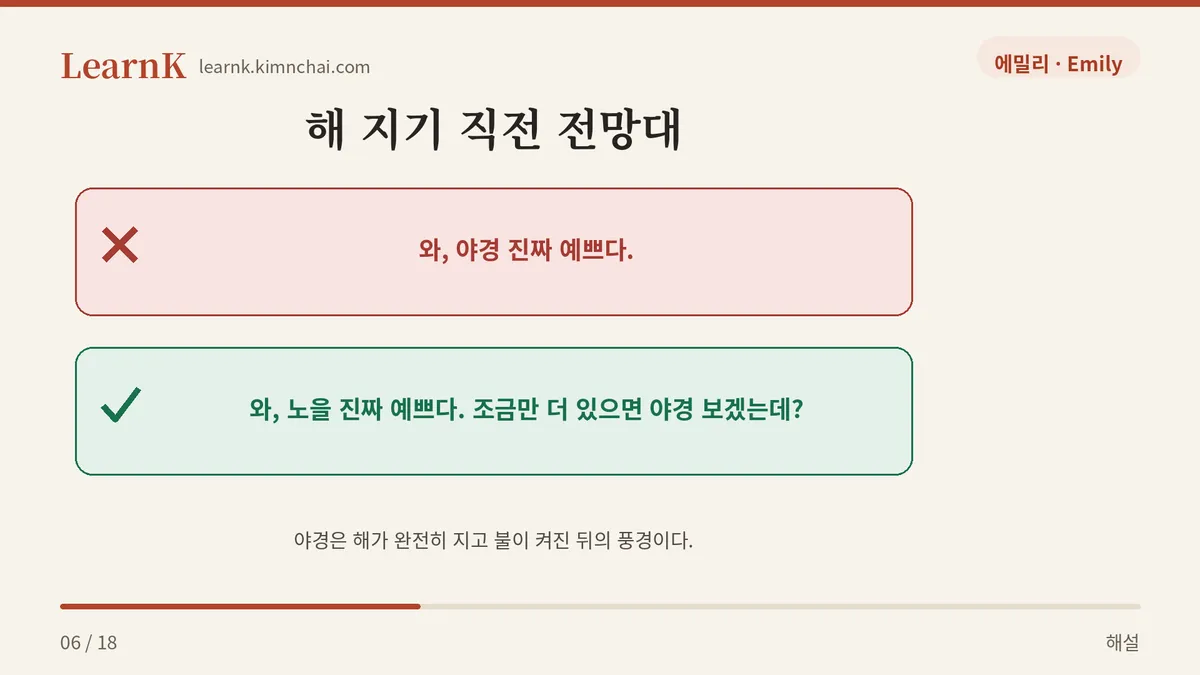
✗ (At an observation deck just as the sun is going down, the sky still red) 와, 야경 진짜 예쁘다. (wa, yagyeong jinjja yeppeuda.) — Wow, the night view is so pretty. ✓ (Same spot) 와, 노을 진짜 예쁘다. 조금만 더 있으면 야경 보겠는데? (wa, noeul jinjja yeppeuda. jogeumman deo isseumyeon yagyeong bogenneunde?) — Wow, the sunset is so pretty. A little longer and we’ll be looking at the night view, huh? → 야경 is the scene after the sun has fully set and the lights have come on. Use it while the sky is still bright and, to a Korean ear, the timetable is off by one slot.
✗ (A countryside campsite with not a single light, stars pouring down) 여기 야경 최고다. (yeogi yagyeong choegoda.) — The night view here is the best. ✓ (Same spot) 여기 밤하늘 최고다. (yeogi bamhaneul choegoda.) / 여기 별 미쳤다. (yeogi byeol michyeotda.) — The night sky here is the best. / The stars here are insane. → 야경 leans toward scenery made by lights that people switched on. Darkness with no artificial light, and stars, is 밤하늘. Conversely, if you say 밤하늘 좋다 in the middle of a city, it means you’re looking at clouds or the moon, not at stars.
Example Sentences by Situation
1. Choosing a place to stay while traveling (casual speech, talking it over with a friend)
여기가 좀 비싼데, 야경 보이는 방으로 할까? (yagyeong boineun bang-euro halkka?) 하루쯤은 돈 더 써도 되잖아. (harujjeumeun don deo sseodo doejanha.) This one’s a bit pricey, but should we go with the room that has the night view? It’s fine to spend a little more for one night.
Read accommodation reviews in Korea and you’ll keep running into phrases like 야경뷰 (yagyeongbyu, “night-view view”) and 야경 맛집 (yagyeong matjip, literally “night-view restaurant,” slang for a place that really delivers). The fact that 야경 is what people reach for to justify a price gap of tens of thousands of won says a lot about how much weight this word carries.
2. After taking a photo (a little let down)
야경은 눈으로 볼 때가 제일 예뻐. (yagyeong-eun nun-euro bol ttaega jeil yeppeo.) 사진에는 반도 안 담기더라. (sajineneun bando an damgideora.) The night view is prettiest when you see it with your own eyes. The photo doesn’t even catch half of it.
That night-view photos never live up to the real thing is an experience just about every Korean shares. Which is why this sentence lands immediately, with no explanation needed. Try it on a friend while you’re traveling.
3. Showing a guest to their seat, in polite speech (restaurant or hotel)
이쪽 창가 자리로 오시면 야경이 한눈에 들어옵니다. (yagyeong-i hannun-e deureoomnida.) If you come over to this window seat, you can take in the whole night view at a glance.
한눈에 들어오다 (hannun-e deureooda) is an idiom meaning “you can see all of it at once.” It travels with 야경 constantly, so it’s worth memorizing as a whole chunk.
Politeness, Casual Speech, and Similar Expressions

야경 is a noun, so it carries no politeness of its own. The level is decided by the predicate that follows it — to a friend, 야경 좋다 (yagyeong jota); to someone older or senior, 야경이 좋네요 (yagyeong-i jonneyo) or 야경이 참 좋습니다 (yagyeong-i cham josseumnida). Just keep one thing straight: attaching a Sino-Korean verb like 관망하다 (gwanmanghada), as we saw above, doesn’t make your speech polite — it makes it literary. Polite and stiff are two different things.
The near-synonyms look like they overlap, but they live in different places.
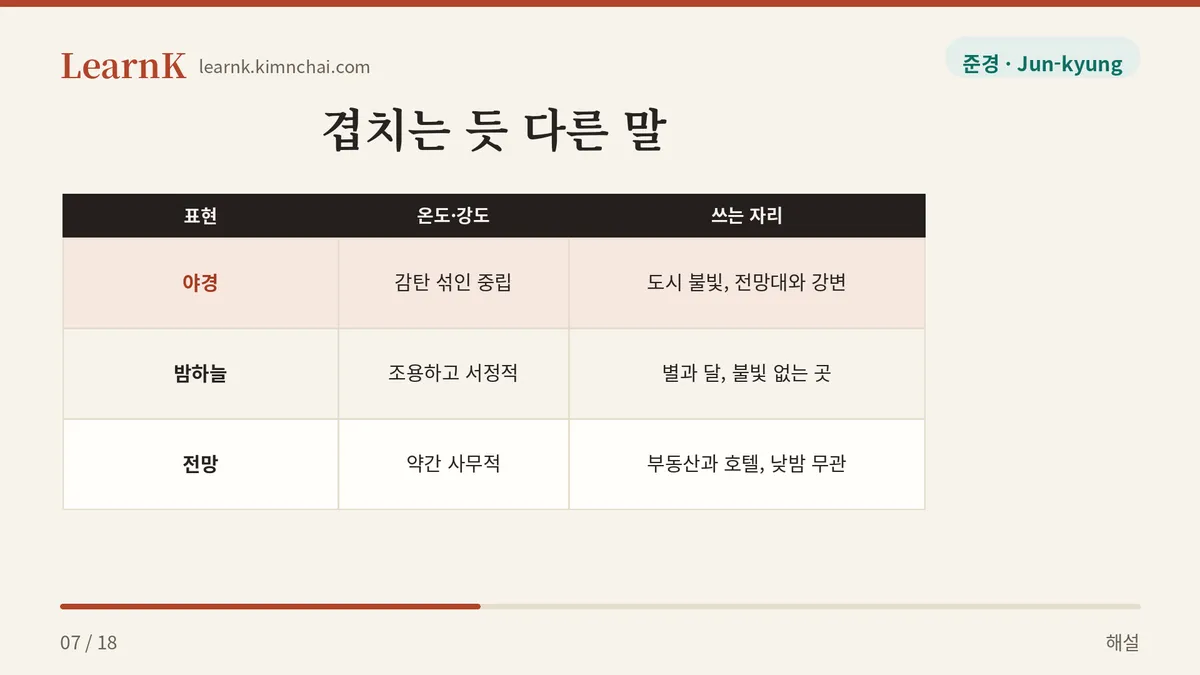
| Expression | Tone / intensity | Where it’s used |
|---|---|---|
| 야경 (yagyeong) | Neutral, with a note of awe | City lights. Observation decks, high floors, riversides. Both speech and writing |
| 밤풍경 (bampunggyeong) | Plain and lyrical | Night scenery in general, countryside, sea, and mountains included. More common in writing |
| 밤하늘 (bamhaneul) | Quiet and lyrical | Stars and the moon. Places with no lights |
| 뷰 (byu) | Light, current slang | Cafe and lodging reviews, social media. Never in official documents |
| 전망 (jeonmang) | Neutral, slightly businesslike | Real estate and hotel listings. Day or night, doesn’t matter |
In practice they get mixed like this. 전망 좋은 집 (jeonmang joeun jip), “a place with a good view,” holds up in daylight; 야경 좋은 집 (yagyeong joeun jip) only holds up at night. A real estate ad says 한강 전망 (Hangang jeonmang, “Han River view”), and to a friend you say 여기 야경 미쳤다 (yeogi yagyeong michyeotda), “the night view here is insane.”
Cultural Background — A Country That Climbs Up to See the Lights
야경 is a Sino-Korean word: 밤 야 (夜), “night,” plus 경치 경 (景), “scenery.” Literally, “the scenery of night.” As a side note, there’s an old word that sounds identical, 야경꾼 (yagyeongkkun), which refers to someone who kept watch over a village at night — and it’s written with different characters (夜警). Same sound, no overlap in meaning whatsoever.
There’s a geographical reason 야경 occupies such a large place in Korea. Seoul is a basin ringed by mountains, and those mountains are close enough to reach from downtown by subway. 남산 (Namsan), 인왕산 (Inwangsan), 응봉산 (Eungbongsan) — if you feel like it, you can be looking down on the entire city within an hour. In Busan, the lights of Gwangan Bridge and Haeundae bleed out across the water; Daegu has 83 Tower; Incheon has the bridges running out to the airport. Every city, without fail, has at least one place tagged as a 야경 명소 (yagyeong myeongso), a famous night-view spot.
Which is why Korean dramas serve up nighttime observation-deck scenes to the point of exhaustion. The confession scene, the breakup scene, the scene where someone finally says the thing they’ve been holding in — all of them play out at a railing with a carpet of lights below. The reason is simple: in front of a 야경, two people end up facing the same direction. You don’t have to look at each other, which makes it possible to say the hard thing. Once you know dramas use this device on repeat, the scene will look a little different the next time you watch one.
There’s a particular feeling attached to 야경, too. Looking at the lights in every apartment window and thinking, “out of all those lights out there, not one of them is mine” — that sentiment shows up again and again in Korean songs and dramas. A 야경 is beautiful, and at the same time it’s the act of watching other people’s lives from a distance. So when someone heading home late after overtime looks out the window and mutters 오늘 야경 좋네 (oneul yagyeong jonne), “the night view’s nice tonight,” it’s half admiration and half exhaustion. Once you hear that double edge, the word 야경 starts to sound a great deal thicker.
Today’s Quiz
You’ve come to a countryside campsite with a friend. There isn’t a single light around, and the sky is full of stars. What’s the most natural thing to say?
- 여기 야경 진짜 좋다. (yeogi yagyeong jinjja jota.)
- 여기 밤하늘 진짜 좋다. (yeogi bamhaneul jinjja jota.)
- 여기 야경 관망하기 좋다. (yeogi yagyeong gwanmanghagi jota.)
Answer: 2
야경 leans toward scenery made by lights that people turned on. In a spot with no artificial light and nothing but stars, the word you want is 밤하늘 (bamhaneul). Option 3 is not only the wrong word choice — it’s doubly awkward, because it drops the literary Sino-Korean verb 관망하다 on a friend at a campsite.
Definitions and example sentences are from the National Institute of Korean Language’s Basic Korean Dictionary (krdict.korean.go.kr); that portion of this post, including our translations, is licensed under CC BY-SA 2.0 KR.