영업하다 (yeongeopada) — How a Sign on a Shop Door Became K-Pop Fandom's Warmest Word for Love
영업하다
영업하다 (yeongeopada) means to run a business or carry out an activity in order to make money. The word’s real home is the front door of a shop. 영업 중 (yeongeop jung) — “Open” — taped to a glass door. 오늘은 영업하지 않습니다 (oneureun yeongeopaji anseumnida) — “We’re closed today” — stuck to a pulled-down shutter. Or a question tossed down a late-night alley: 저기 아직 영업하나 (yeongeopana)? — “Is that place still open?” Walk around Korea for a single day and this word will catch your eye about ten times.
And yet, if you’re a K-pop fan, you probably met it somewhere else first. 내 최애 영업합니다 (yeongeopamnida) — “Let me sell you on my bias.” 나 어제 영업당했어 (yeongeopdanghaesseo) — “I got sold on something yesterday.” 영업 (yeongeop) 영상 좀 추천해 주세요 — “Please recommend some intro videos.” Here, 영업하다 means to introduce a group or a work you love to someone so eagerly that you pull them in as a fan. Not one coin changes hands, but the vocabulary is borrowed straight from the shop counter. Today we’ll look at both faces of this single word.
Why sales language, of all things? Because a fan introducing their group to a friend really does look a lot like a salesperson at work. You sit the other person down, pick the very best stage performance, drill the members’ names and faces into them, and if the reaction is lukewarm, you pull out a different song. But there’s one decisive difference: nobody gets paid. That’s why this word always comes with a self-deprecating laugh attached. “Yes, I know I’m acting like a sales rep right now.” That self-awareness is the word’s temperature.
So 영업하다 is lighter than 추천하다 (chucheonhada), “to recommend” — and at the same time far more affectionate. Recommending is handing over information; 영업 is trying to transplant your own heart into someone else. If it works, you say 영업 성공 (yeongeop seonggong), “sale closed”; if it flops, 영업 망했다 (yeongeop manghaetda), “the pitch bombed.” The person who caves says 영업당했다 (yeongeopdanghaetda) — literally “I was sold to,” using the passive-suffering form. But that isn’t a complaint. It’s a joke about surrender.
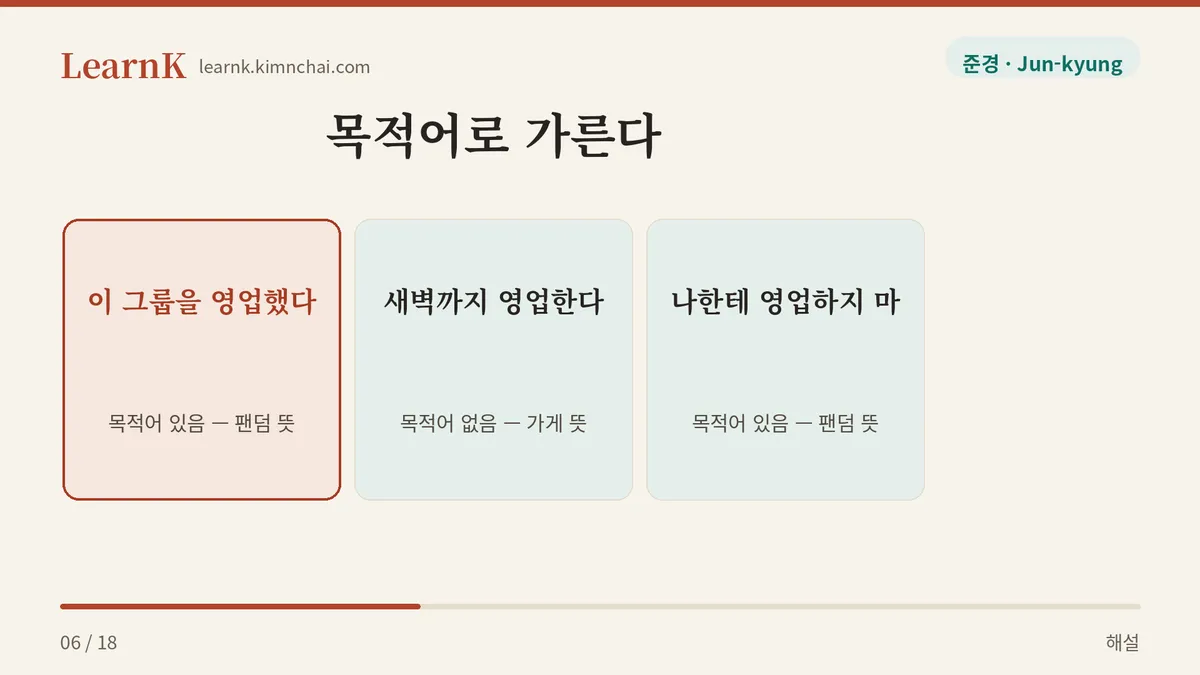
There’s one fun mismatch in the grammar, too. The dictionary 영업하다 doesn’t take an object. The one doing 영업 is a shop or an owner, and you don’t say “to 영업 something.” But fandom usage drags an object right in: 이 그룹을 영업했다 (yeongeopaetda) — “I sold people on this group”; 나한테 그 드라마 영업하지 마 (yeongeopaji ma) — “Don’t try to sell me that drama.” The mismatch itself is a signpost saying “this is language from outside the dictionary.” For learners, that’s actually good news — if there’s an object attached, it’s the fandom meaning; if there isn’t, it’s usually about a shop.
Checking the National Institute of Korean Language Dictionary
First, let’s see exactly how the national language institute records this word.
영업하다 (yeongeopada) [verb] 돈을 벌기 위한 사업이나 활동을 하다.
[en] do business — To engage in a business or activity for the purpose of making money.
[ja] えいぎょうする【営業する】 — 金を稼ぐための事業や活動をする。
[es] hacer negocios — Lleva a cabo negocios o actividades para ganar dinero.
[zh] 营业 — 为赚钱而做生意或进行活动。
— National Institute of Korean Language, Basic Korean Dictionary (krdict.korean.go.kr)
A Portuguese translation isn’t included in this dictionary. For reference, it would be something like fazer negócios — but please note that this one line is our own rendering, not dictionary material.
Here are five of the dictionary’s own usage examples, exactly as they appear.
무허가로 영업하다. (muheogaro yeongeopada.)
정상적으로 영업하다. (jeongsangjeogeuro yeongeopada.)
새벽까지 영업하다. (saebyeokkkaji yeongeopada.)
계속해서 영업하다. (gyesokaeseo yeongeopada.)
직접 영업하다. (jikjeop yeongeopada.)
— National Institute of Korean Language, Basic Korean Dictionary (krdict.korean.go.kr)
Going through the five one by one makes it vivid which world this word originally belongs to.
- 무허가로 영업하다 (muheogaro yeongeopada) — “to operate without a license.” A pairing that shows up constantly in news reports and administrative documents, with not a trace of fandom playfulness in it.
- 정상적으로 영업하다 (jeongsangjeogeuro yeongeopada) — “to be open as usual.” It means the shop is operating normally despite some disruption: construction, an accident, a holiday stretch. You’ll meet this sentence on notices posted in shop windows.
- 새벽까지 영업하다 (saebyeokkkaji yeongeopada) — “to be open until the small hours.” This one is about business hours, and since it travels alongside Korea’s late-night food culture, it’s probably the combination learners will actually use most.
- 계속해서 영업하다 (gyesokaeseo yeongeopada) — “to stay open continuously,” without interruption. It’s the line that comes after talk of a temporary closure or shutting down for good.
- 직접 영업하다 (jikjeop yeongeopada) — “to sell directly,” with no middleman, stepping up and doing it yourself. It pictures the owner meeting customers in person.
There isn’t an idol anywhere in those five sentences. Keep in mind that the fandom usage is a metaphor laid on top of this solid original meaning much later.
Seeing It in Real Conversation
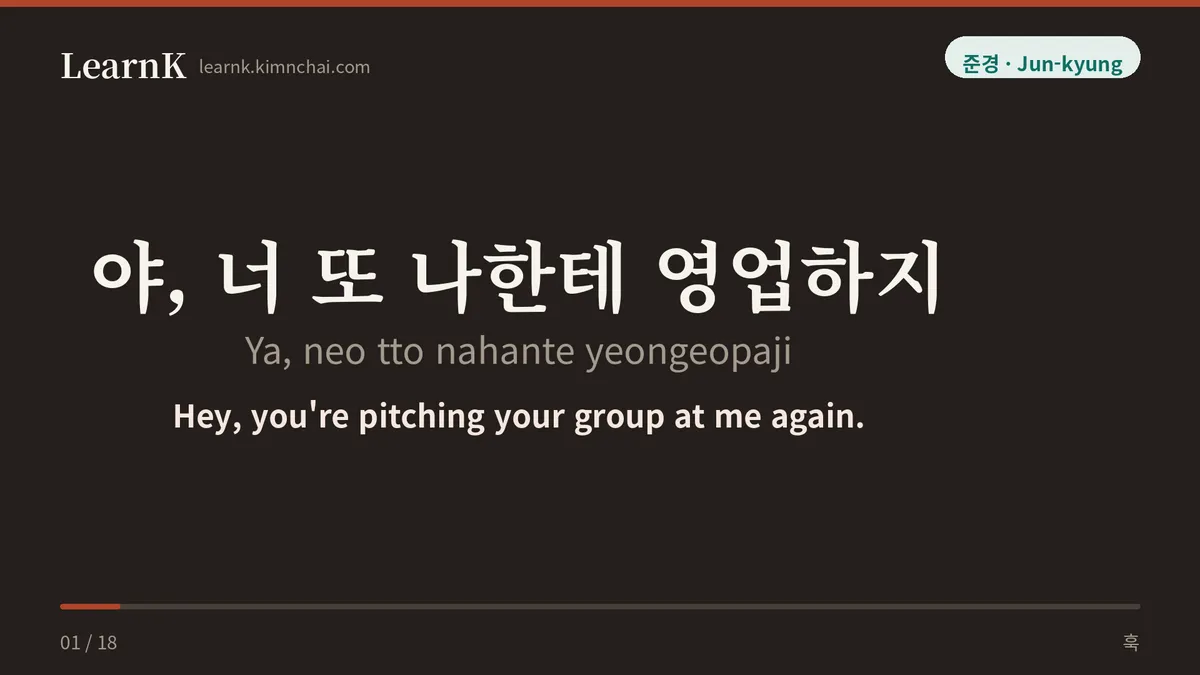
Setting: the subway home on a Friday evening. Emily presses one earbud into Jun-kyung’s hand.
Emily: 자, 딱 한 곡만. 3분이면 돼. Here, just one song. Three minutes, that’s all.
Jun-kyung: 야, 너 또 나한테 영업하지. 지난달에도 이러다가 내가 앨범 샀잖아. Hey, you’re pitching your group at me again. Last month you did this and I ended up buying an album.
Emily: 그건 네가 좋아서 산 거고. 후렴 나온다, 조용히 해 봐. You bought it because you liked it. The chorus is coming — be quiet.
Jun-kyung: …어. 이거 왜 좋냐. …huh. Why is this good?
Emily: 봐, 영업 성공. 그 팝업 스토어 오늘 열 시까지 영업하니까 지금 가면 딱이야. See? Sold. That pop-up store is open until ten today, so now’s the perfect time.
Jun-kyung: 너 방금 같은 단어를 두 가지 뜻으로 썼어. You just used the same word in two different meanings.
Those last two lines are the heart of today’s lesson. In a single breath, 영업 성공 is the fandom meaning and 열 시까지 영업하니까 is the dictionary’s original one. Korean speakers swap between the two without ever thinking about it.
This Sounds Off
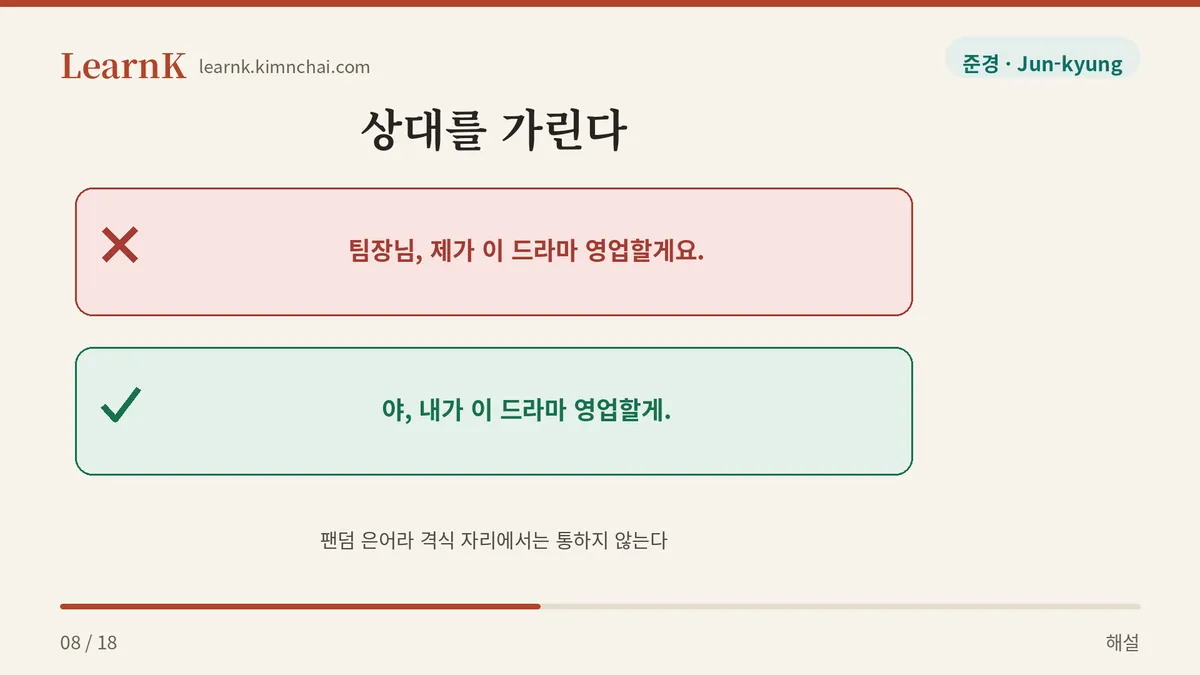
✗ (to your team leader) 팀장님, 제가 이 드라마 영업할게요. — “Boss, let me sell you on this drama.” ✓ (to a friend) 야, 내가 이 드라마 영업할게. — “Hey, let me sell you on this drama.” → It’s fandom slang, so using it with someone outside that context earns you a puzzled face and a “selling what, exactly?” With someone senior to you, 꼭 한번 보세요, 정말 재밌습니다 (“You really should watch it, it’s genuinely fun”) is the safe move.
✗ (when a friend earnestly hands you a book they treasure) 너 지금 나한테 영업하는 거지? — “You’re trying to sell me on this, aren’t you?” ✓ (in the same moment) 그렇게 좋아? 나도 한번 읽어 볼게. — “You love it that much? I’ll give it a read.” → 영업하다 is charming when you aim it at yourself with a smile. Attach it to someone else’s sincerity and it turns into “ah, so you’re pushing this like a sales pitch” — marking down the price of their feelings. The temperature is simply wrong for that moment.
Example Sentences by Situation
1. The fandom meaning — when it’s all you can think about lately
There are stretches when a group you’ve loved for years makes a comeback and you grab everyone you meet to show them a stage video. When a friend asks 요즘 뭐 하고 지내? (“What have you been up to lately?”), you answer like this.
요즘 내 최애 그룹 영업하느라 바빠. (Yojeum nae choeae geurup yeongeopaneura bappa.) “I’ve been busy selling people on my favorite group lately.” It’s a joke that making new fans has practically become your daily job. The ending -느라 (-neura) shows that this is where all your time is going.
2. The dictionary meaning — hunting for somewhere to go late at night
This is the most practical use in Korea. It’s past midnight, you’re hungry, and you need to know what’s still open.
그 카페 새벽 두 시까지 영업해. (Geu kape saebyeok du si kkaji yeongeopae.) “That café is open until two in the morning.” This is the single most common sentence for telling someone a shop’s hours. In polite speech it becomes 새벽 두 시까지 영업해요 (yeongeopaeyo).
3. Where the two meanings overlap — introducing yourself
At a club’s first meeting or a new-hire introduction at work, there’s a half-joking way to open your self-introduction: you put yourself on the shelf like a product and laugh about it.
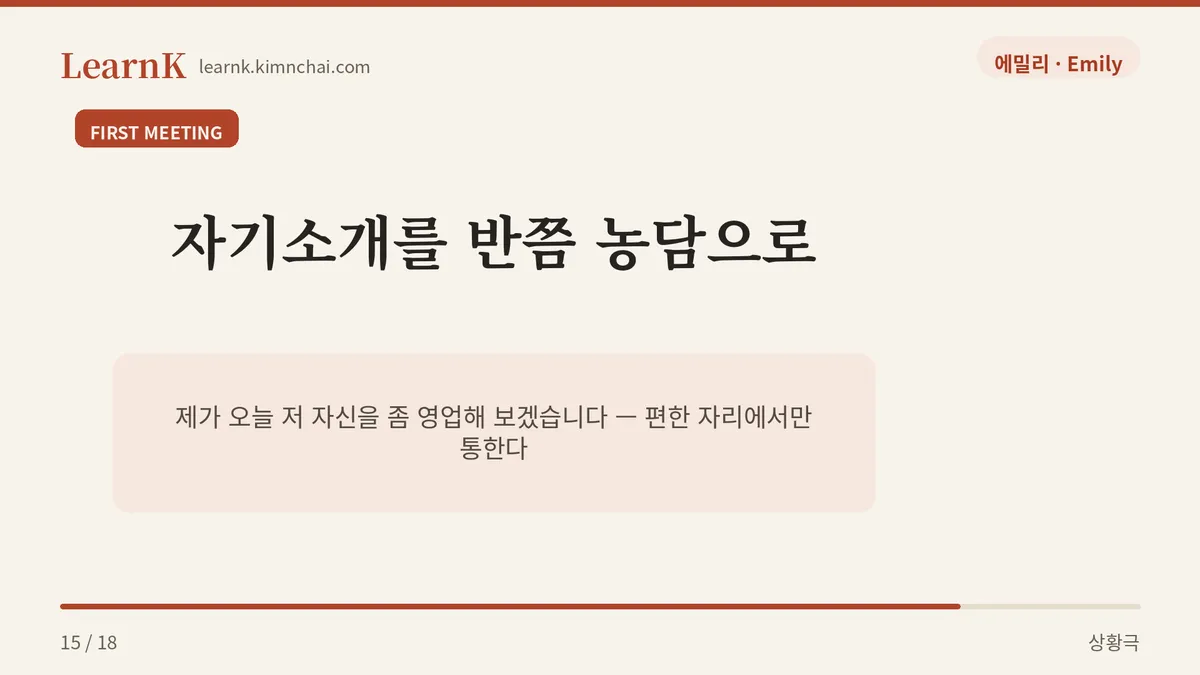
제가 오늘 저 자신을 좀 영업해 보겠습니다. (Jega oneul jeo jasineul jom yeongeopae bogetseumnida.) “Today, allow me to sell you a little on myself.” It’s polite speech, yet it lands light and cheerful. The humor comes from combining a formal ending with slang, so it only works in a relaxed room.
Polite and Casual Forms, and Similar Expressions
Starting with the conjugations: casual forms are 영업해 (yeongeopae) and 영업한다 (yeongeopanda), with the negative command 영업하지 마 (yeongeopaji ma). Polite is 영업해요 (yeongeopaeyo), and more formal still is 영업합니다 (yeongeopamnida). When speaking respectfully about a shop, you’ll even hear things like 저 집은 명절에도 영업하십니다 (yeongeopasimnida) — “That place is open even on holidays.”
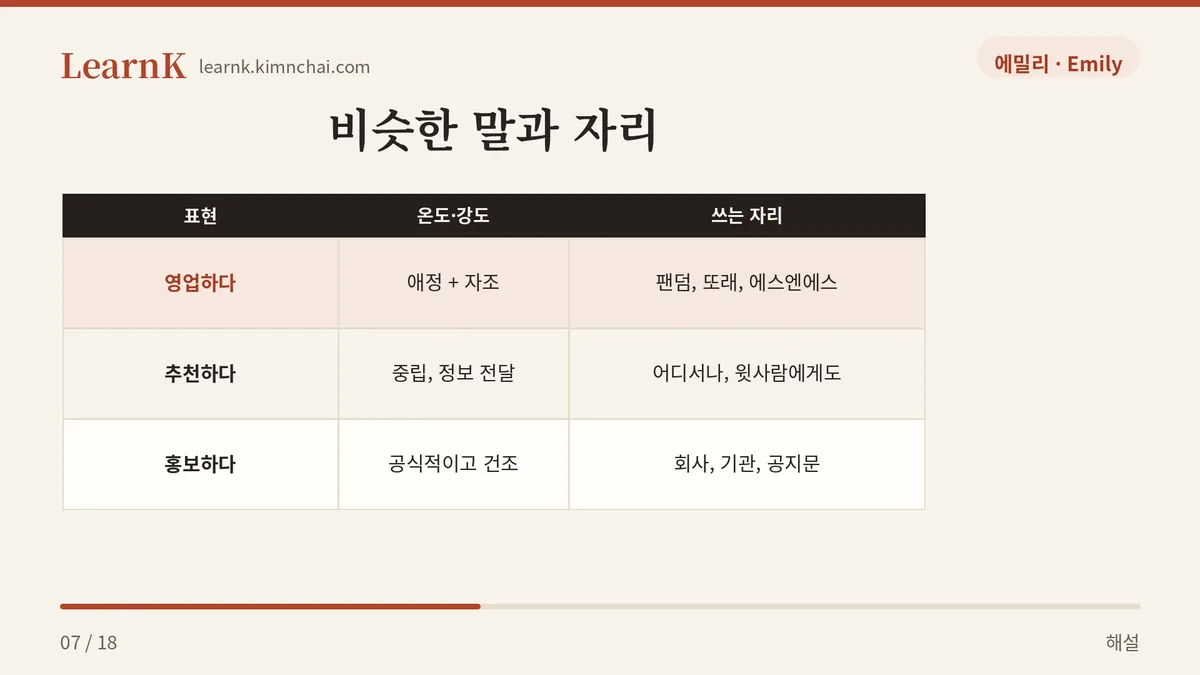
Lining it up next to its neighbors makes its position clear.
| Expression | Tone / intensity | Where it fits |
|---|---|---|
| 영업하다 (yeongeopada) | Affection + self-mockery, mixed with playfulness | Fandom, peers, social media. In public/professional settings, original meaning only |
| 추천하다 (chucheonhada) | Neutral. The feel of handing over information | Anywhere. Safe with people senior to you |
| 강추하다 (gangchuhada) | Pushes hard, but plainly | Peers, reviews, write-ups. Not for formal settings |
| 입덕시키다 (ipdeoksikida) | Strong — it names the result, not just the attempt | Inside fandom. Outsiders won’t follow it |
| 홍보하다 (hongbohada) | Official and dry | Companies, institutions, announcements |
Say the same situation two ways and the difference becomes something you can hold. 이 드라마 추천해 (chucheonhae) hands you one piece of information. 이 드라마 영업할게 (yeongeopalge) is closer to saying “I’m going to sit next to you for the next two hours and watch it with you.”
Cultural Background — When Fans Call Themselves Salespeople
The picture this word paints is simple: it lifts the scene of a merchant selling goods and drops it whole into fandom. Except the goods being sold are your own affection, and the payment you receive is one sentence — “okay, I like them now, too.” That’s why the joke of calling yourself a sales rep is half boast and half embarrassment. Showing your love for something plainly is a little awkward, so you wrap one layer of shop talk around it.
In practice, fandom has grown a whole vocabulary out of this metaphor. An introduction video made to hook new fans is an 영업 영상 (yeongeop yeongsang); the long-form written version is an 영업글 (yeongeopgeul). Someone who becomes a fan after seeing that material says 영업당했다 (yeongeopdanghaetda), and the moment of becoming a fan itself is called 입덕 (ipdeok). And before long, the person who got sold to starts selling to someone else. That’s more or less how a fandom grows.
Meanwhile the original meaning hasn’t aged a day. Korean shop doors still hang 영업 중 (yeongeop jung), “Open,” and 준비 중 (junbi jung), “Getting ready,” and over holiday weekends notices go up reading 정상 영업합니다 (yeongeopamnida) — “Open as usual.” If you live in or travel through Korea, you’ll run into this usage far more often than the fandom one. Know both and you can catch your friend’s joke and find the 국밥 place that’s still open late at night.
Today’s Quiz
Which of the following sentences uses 영업하다 in its original dictionary sense (to run a business or activity in order to make money)?
- 나 어제 친구한테 이 그룹 영업하다가 세 시간 썼어. (Na eoje chinguhante i geurup yeongeopadaga se sigan sseosseo.) — “I spent three hours yesterday selling a friend on this group.”
- 그 국밥집은 새벽 네 시까지 영업한다. (Geu gukbapjibeun saebyeok ne si kkaji yeongeopanda.) — “That gukbap place is open until four in the morning.”
- 이 영상 하나면 영업 끝나. (I yeongsang hanamyeon yeongeop kkeutna.) — “One video and the sale closes itself.”
The answer is number 2. A shop has its doors open and is doing business, which is the dictionary meaning exactly. Numbers 1 and 3 are the fandom metaphor, and the clues are that an object shows up (이 그룹, “this group”) or that the context talks about success and failure. If there’s an object attached, it’s language from outside the dictionary — remember just that today and you’re set.
Definitions and example sentences are from the National Institute of Korean Language’s Basic Korean Dictionary (krdict.korean.go.kr); that portion of this post, including our translations, is licensed under CC BY-SA 2.0 KR.