What Does 연습생 Mean? The Secret Behind a K-pop Debut — Today's Korean

If you’re a fan of Korean idols, there’s a word you’re bound to run into during fan interviews or documentaries. That word is 연습생 (yeonseupsaeng). You’ve probably heard a sentence like “I spent five years as a 연습생 before debuting,” right? Today, we’re going to dig deep into this word — a kind of key to understanding the world of K-pop.
연습생
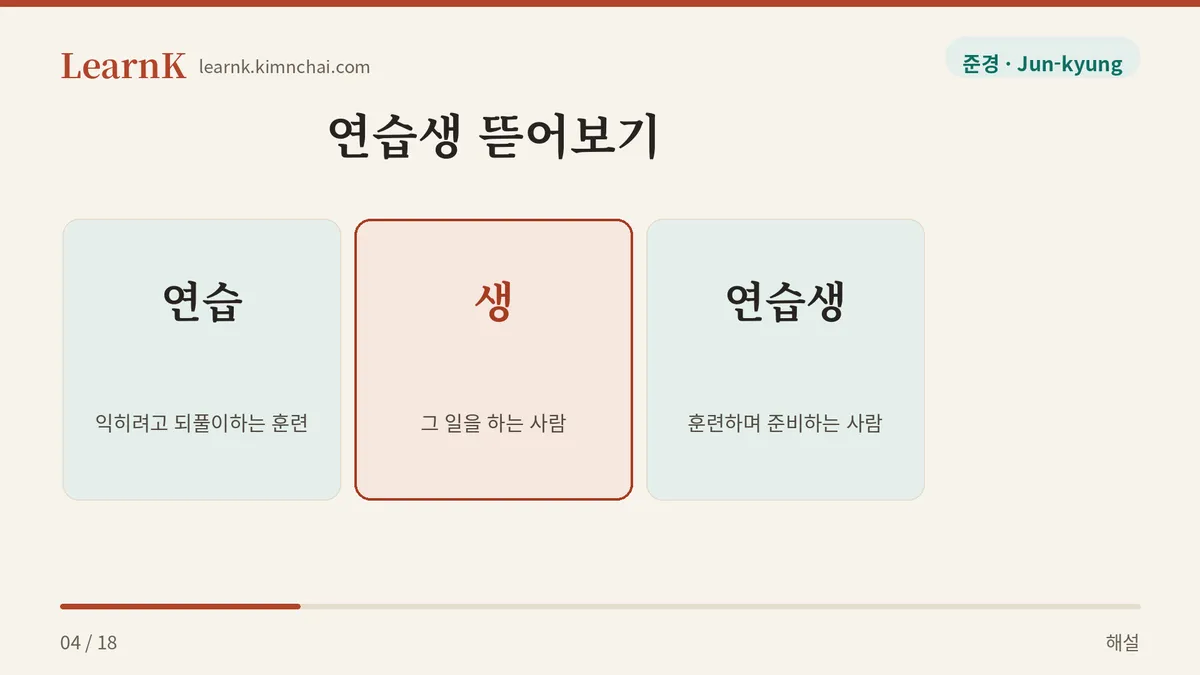
연습생 (yeonseupsaeng) breaks down literally as ‘a person (生) who practices (練習).’ It broadly refers to anyone training to master some skill or body of knowledge. But these days in Korea — especially among fans of the Korean Wave — the word has settled into almost a single meaning: a person who belongs to an agency and is preparing to debut as a singer or actor.
In other words, a 연습생 is a ‘star-in-waiting’ who hasn’t debuted yet. It’s someone who trains every day in singing, dancing, acting, and even foreign languages, waiting for the day they’ll finally step onto a stage. Behind almost every dazzling idol, without exception, lies this grueling 연습생 period. That’s why the word carries feelings like ‘hard work,’ ‘obscurity,’ and ‘waiting’ woven into it.
Checking the National Institute of Korean Language Dictionary

The National Institute of Korean Language’s Basic Korean Dictionary lists two meanings for this word.
연습생 「noun」
- A person who practices to learn a certain skill or knowledge. [en] trainee; apprentice — A person who practices to learn a certain skill or knowledge. [ja] みならい(見習い) [es] aprendiz [zh] 练习生 — National Institute of Korean Language, Basic Korean Dictionary (krdict.korean.go.kr)
- A person who prepares to make a professional debut by practicing as a member of a certain group in the fields of music, acting, sports, etc. [en] trainee — A person who prepares to make a professional debut by practicing as a member of a certain group in the fields of music, acting, sports, etc. [ja] けんしゅうせい(研修生) [es] aprendiz [zh] 练习生 — National Institute of Korean Language, Basic Korean Dictionary (krdict.korean.go.kr)
If the first meaning is the broad one (a cooking 연습생, a hairdressing 연습생, and so on), the one used in K-pop is the second. Shall we look at the actual example sentences the dictionary provides?
가수 연습생은 더 맑고 풍성한 소리가 발성될 수 있게 노래 연습을 거듭하였다. — National Institute of Korean Language, Basic Korean Dictionary (krdict.korean.go.kr)
This is a scene of an aspiring singer, on the verge of debut, repeating their vocal training over and over. The word ‘거듭하다 (geodeuphada)’ captures that endless repetition well.
연습생 시절과 데뷔 후의 모습이 거의 변화가 없는 멤버는 누구입니까? — National Institute of Korean Language, Basic Korean Dictionary (krdict.korean.go.kr)
This is exactly the kind of question fans love to ask. As here, the expression ‘연습생 시절 (yeonseupsaeng sijeol)’ — one’s ‘trainee days’ — comes up especially often.
연습생을 모집하다. — National Institute of Korean Language, Basic Korean Dictionary (krdict.korean.go.kr)
This is a situation where an agency holds auditions to recruit new trainees. It pairs up with ‘모집하다 (mojiphada),’ meaning ‘to recruit.’
Since the dictionary doesn’t include a Portuguese translation, if we render it ourselves, aprendiz would sound the most natural.
Seeing It in a Real Conversation

Scene: The Chuseok holiday dinner table. With the whole family gathered, Jun-kyung brings up some news about a young cousin’s kid.
Jun-kyung: 에밀리, 너 그 소식 들었어? 우리 조카 지원이가 이번에 대형 기획사 연습생 됐대. Emily, did you hear? My niece Jiwon just became a trainee at a big agency.
Emily: 진짜? 대박. 걔 춤 잘 추더니. 근데 연습생 되는 거 엄청 어렵다며? Really? Amazing. She was always a great dancer. But I heard becoming a trainee is super hard?
Jun-kyung: 어렵지. 경쟁률이 몇천 대 일이래. 뽑혀도 몇 년을 연습생으로 버텨야 데뷔할까 말까고. It is. The odds are like thousands to one. And even if you’re picked, you grind as a trainee for years before you maybe debut.
Emily: 헐, 데뷔 보장도 안 돼? 그럼 학교는 어떡하고? Whoa, debut isn’t even guaranteed? Then what about school?
Jun-kyung: 그러니까. 새벽까지 연습하고 아침에 학교 가고… 애 얼굴이 요즘 반쪽이야. Right? She practices till dawn, then goes to school… her face has gotten so thin lately.
Emily: 아이고. 그래도 본인이 좋아서 하는 거면 응원해 줘야지. 지원이 파이팅! Oh dear. Still, if it’s what she loves, we’ve got to root for her. Go Jiwon!
Example Sentences by Situation
1. Watching an audition program “저 친구, 연습생 (yeonseupsaeng) 생활만 7년이래. 드디어 오늘 데뷔한대.” → Words of encouragement for a contestant debuting after a long stretch in obscurity.
2. Sharing your career dream “저는 아이돌 연습생이 되고 (yeonseupsaengi doego) 싶어서 기획사 오디션을 준비하고 있어요.” → A polite way to state your dream. ‘연습생이 되다 (yeonseupsaengi doeda),’ meaning ‘to become a trainee,’ is a common pairing that shows up in the dictionary’s example sentences too.
3. Like a documentary narration “화려한 무대 뒤에는 이름 없는 연습생 수백 명의 땀이 있다.” → A weighty sentence that shines a light even on those who never got to debut.
Polite/Casual Speech and Similar Expressions
연습생 is a noun with no built-in distinction between honorific and plain forms, so it slots into both polite and casual sentences unchanged.
- Casual: “너 연습생이야? (neo yeonseupsaengiya?)”
- Polite: “연습생이세요? (yeonseupsaengiseyo?)”
Let me also sort out some similar words that are easy to mix up.
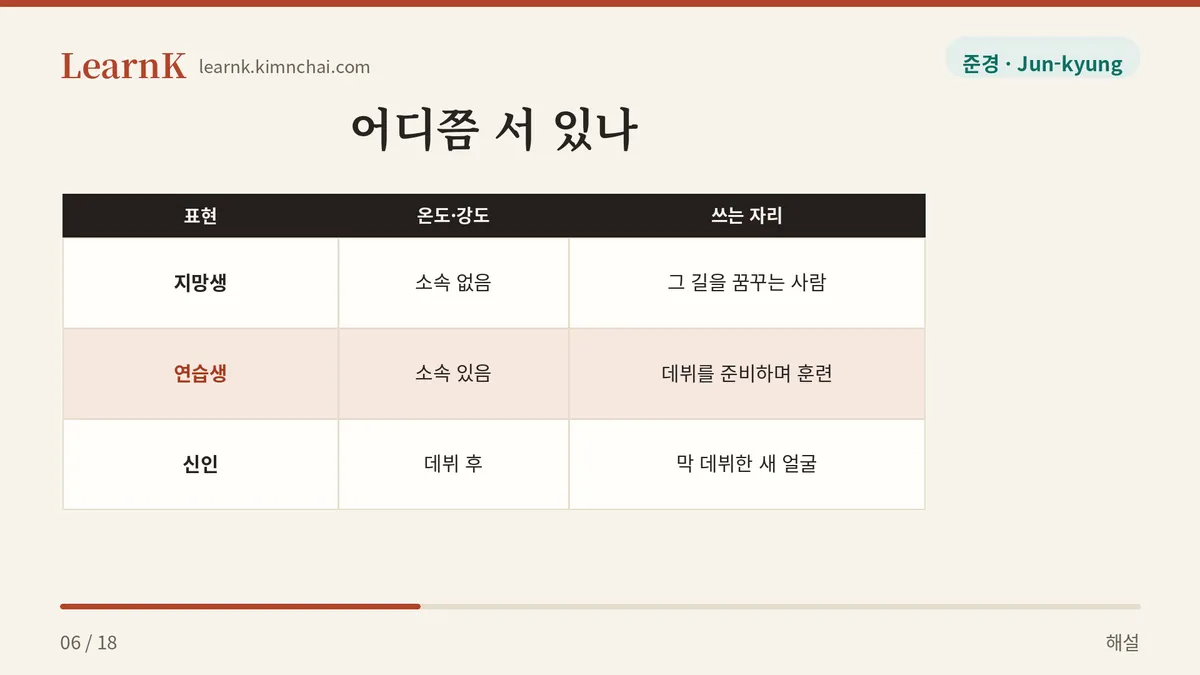
- 지망생 (jimangsaeng): Someone who dreams of that path but hasn’t yet joined an agency (like a 가수 지망생, an aspiring singer). This comes one step before a 연습생.
- 데뷔조 (debwijo): A team whose debut has been confirmed. Its members are selected from among the 연습생.
- 신인 (sinin): A fresh face who has just debuted. This is the stage right after ‘graduating’ from being a 연습생.
So the flow is 지망생 → 연습생 → 데뷔조 → 신인. Once you know this order, idol documentaries become so much easier to follow.
Cultural Background
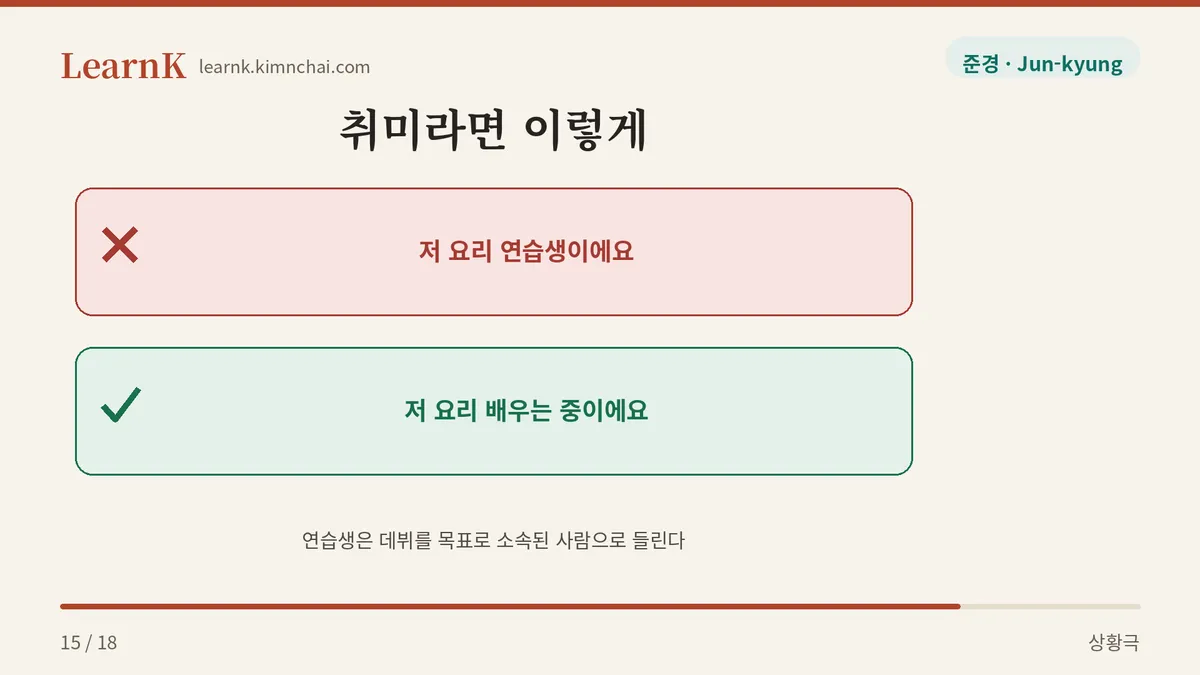
In Korea’s idol-development system, the 연습생 system is like the beating heart of it all. Picked through auditions at a young age, trainees live and train together for years, and every month they’re ranked at evaluation stages. Those who don’t make the cut have to quietly pack their bags. This intensity is also a go-to subject for audition survival programs. That’s why fans hunt down ‘trainee-days’ (‘연습생 시절’) footage of their favorite idols, comparing today’s polished stage with the clumsy movements of back then and getting moved by that growth. It’s the reason the word 연습생 carries both hard work and tenderness within it.
Today’s Quiz
What word should go in the blank below?
“그 배우는 무려 8년간 ( ) 생활을 한 끝에 마침내 데뷔했다.”
① 신인 ② 연습생 ③ 관객
Answer: ② 연습생 (yeonseupsaeng) — Since it refers to the preparation period before debut, 연습생 is correct. 신인 (sinin) is a fresh face after debut, and 관객 (gwangaek) is a member of the audience watching the stage.
Definitions and example sentences are from the National Institute of Korean Language’s Basic Korean Dictionary (krdict.korean.go.kr); that portion of this post, including our translations, is licensed under CC BY-SA 2.0 KR.