열일 (yeoril): The One Word for When Your Favorite Star 'Never Stops Working'
Your favorite actor wraps up a drama and immediately shows up on a variety show, and the very next day they pop up in a new commercial too. As a fan, it’s exciting — but also a little worrying. “How many bodies does that person have these days?” In moments like this, there’s a word Koreans casually toss out, almost like an exclamation of admiration. That word is 열일 (yeoril). Whether you’re scrolling through K-pop fandom, YouTube comments, or Twitter (X), it’s a piece of new slang you’ll run into several times a day.
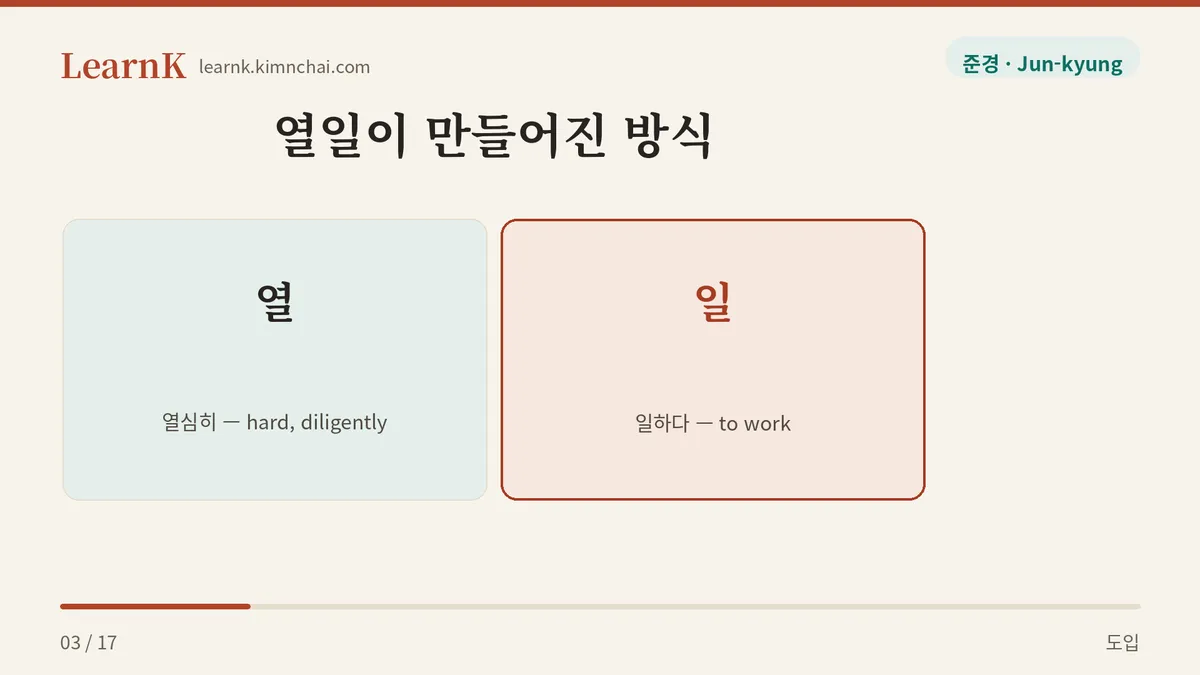
열일
열일 (yeoril) is a shortened form of “열심히 일하다,” meaning “to work hard.” It’s a classic abbreviation (new slang) made by taking just the first syllable of each word, so it isn’t listed as an official dictionary headword — but in everyday language it’s already firmly established.
The meaning is simple: to work or be active very hard and diligently. But the nuance matters. It’s not just “working” — it carries a sense of admiration and praise for someone who’s noticeably busier and more hardworking than others. So when fans see a star who’s actively working, they say it with pride: “우리 애 요즘 열일 중이야 (uri ae yojeum yeoril jung-iya),” meaning “Our star is really working hard these days.”
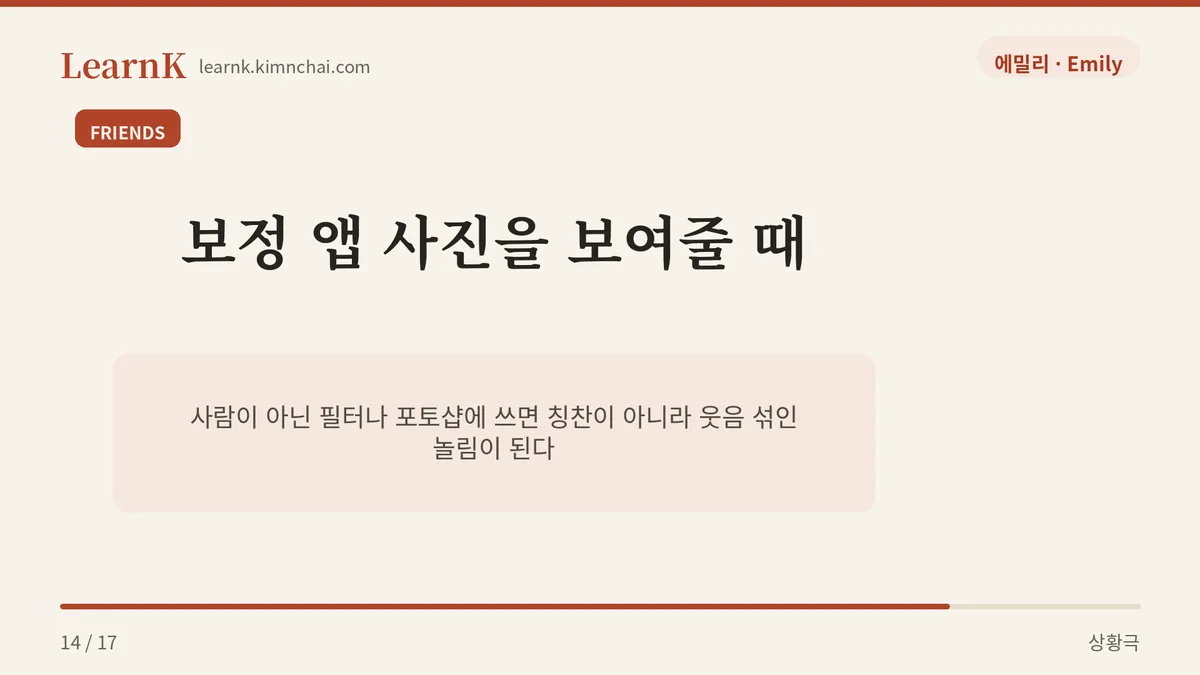
When used as a verb, it takes the form 열일하다 (yeorilhada), and it transforms freely into things like “열일 중” (in the middle of working hard), “열일했다” (worked hard), and “열일해” (work hard). What’s fun is that it can be used for non-human things too. When a photo has been heavily retouched, people jokingly say “포토샵 열일했네 (photoshop yeorilhaenne)” — “Photoshop really worked hard here.”
Seeing It in a Real Conversation
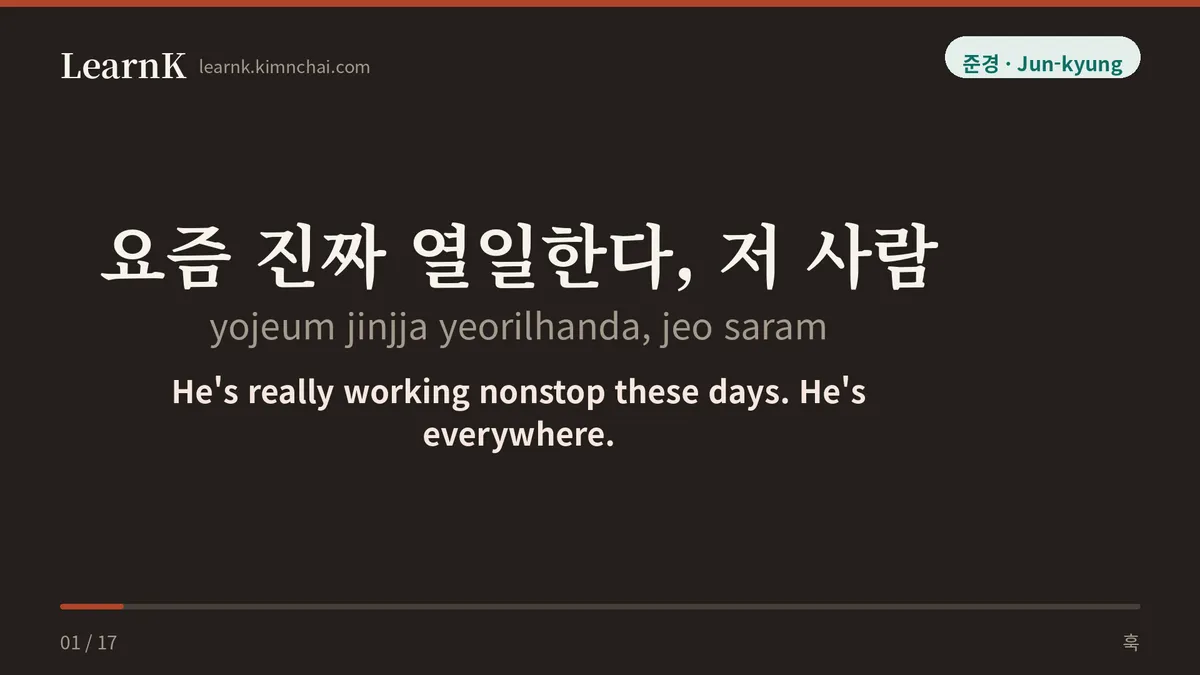
Scene: Saturday night, in Jun-kyung’s living room. A favorite actor finishes a drama and immediately appears on a variety show, followed by a new commercial, one after another.
Emily: 어? 저 배우 아까 드라마에도 나오지 않았어? Huh? Wasn’t that actor in the drama earlier too?
Jun-kyung: 맞아. 요즘 진짜 열일한다, 저 사람. 안 나오는 데가 없어. Yeah. He’s really working nonstop these days. He’s everywhere.
Emily: 대박. 드라마에 예능에 광고까지… 몸이 몇 개야? Wow. Dramas, variety shows, ads… how many bodies does he have?
Jun-kyung: 그니까. 소속사가 열일시키나 봐. 좀 쉬게 해주지. Right? His agency must be working him to the bone. They should let him rest.
Emily: 하긴, 팬 입장에선 자주 보니까 좋긴 한데. Well, as a fan it’s nice to see him so often, though.
Jun-kyung: 그건 그래. 근데 우리도 슬슬 열일해야 되는 거 아냐? 나 내일 출근이야. True. But shouldn’t we get to work soon too? I’ve got work tomorrow.
Example Sentences by Situation
1) When praising a star
요즘 저 아이돌 컴백 준비하느라 열일하고 있대. (yojeum jeo aidol keombaek junbihaneura yeorilhago itdae.)
This is a cheer for a star who’s busy practicing and filming ahead of a new album. The pattern “~하느라 열일하다” means “to work hard because of / in order to do something,” and it’s a very commonly used construction.
2) When using it about yourself
월요일부터 열일 중이라 손이 열 개라도 모자라. (woryoilbuteo yeoril jung-ira soni yeol gaerado mojara.)
This is a slightly playful, exaggerated way of describing yourself working busily without even a weekend off. “손이 열 개라도 모자라다” (even ten hands wouldn’t be enough) is an idiom for having a huge amount to do, so it’s a good one to learn alongside this.
3) When teasing an object or feature
와, 이 필터 열일했네. 실물이랑 완전 다르잖아. (wa, i pilteo yeorilhaenne. silmullang wanjeon dareujana.)
This is a laughing joke you make when a photo-editing app has changed a face way too much. When you use it on something that isn’t a person, this humorous feel really comes alive.
Comparing Formal/Casual Speech and Similar Expressions
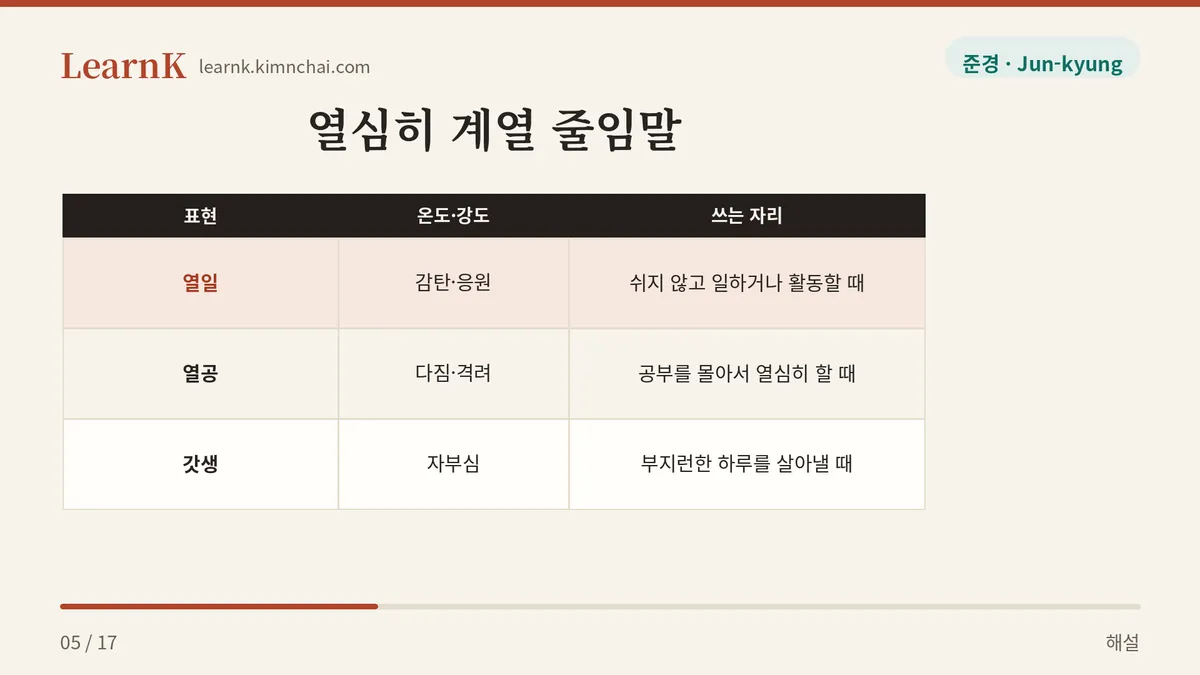
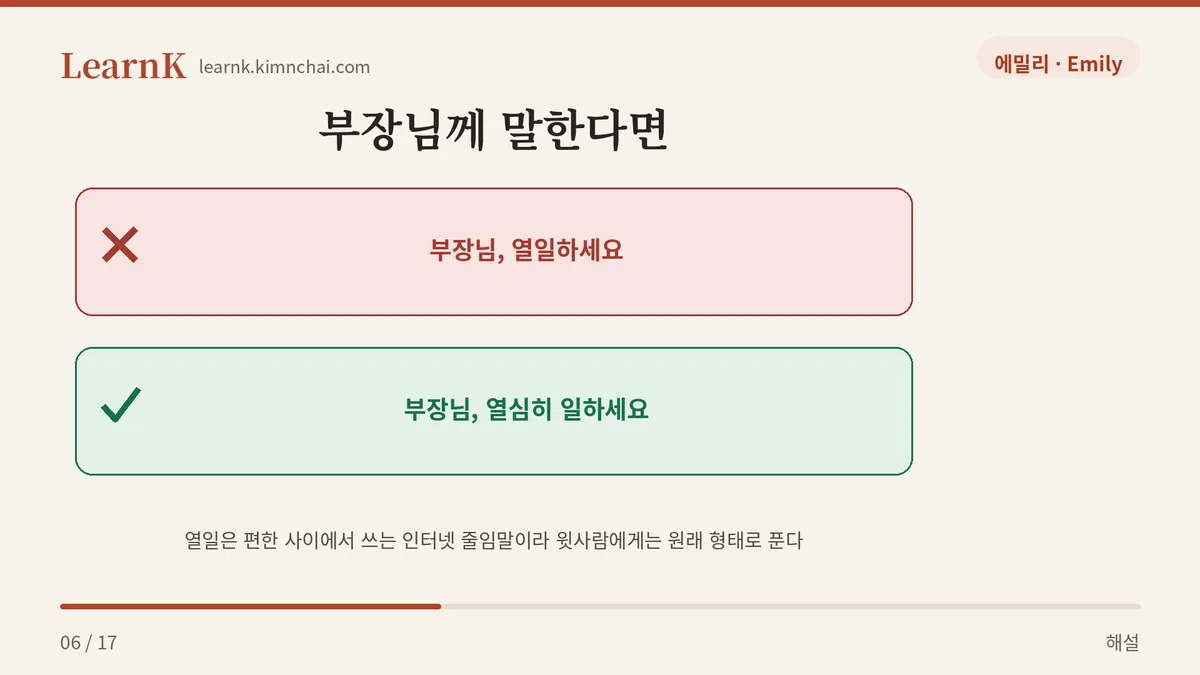
열일 is originally a friendly internet slang term, so it’s most natural in casual speech as 열일해 (yeorilhae) or in the plain declarative form 열일한다 (yeorilhanda). With people older than you or in formal settings, it’s safer to skip the abbreviation and spell it out in its original form, like 열심히 일하세요 (yeolsimhi ilhaseyo) (“please work hard”) or 정말 열심히 활동하시네요 (jeongmal yeolsimhi hwaldonghasineyo) (“you’re really working so hard”). In short, remember that 열일 is a casual word used “among close friends and fellow fans.”
There are lots of similar abbreviations. If you study hard, that’s 열공 (yeolgong, 열심히 공부 — studying hard), and if you live a diligent, dedicated day, that’s 갓생 (gatsaeng, God + 인생/life). All three expressions share that positive energy of “열심히” (hard / diligently).
Cultural Background
The reason 열일 is so beloved ties directly into Korean Wave (Hallyu) fandom culture. Korean idols and actors often work nonstop — albums, concerts, dramas, variety shows, commercials — and fans take pride in that dedication. That’s why the word can carry both the worry of “소속사가 열일시킨다” (the agency is working them to the bone) and the pride of “우리 스타 열일한다” (our star is working so hard) at the same time. These days it’s used naturally in everyday conversation beyond fandom, too. You might smile at a busy coworker and greet them with “오늘도 열일하시네요” (hard at work again today, I see). It’s a short but warm word of encouragement — a very Korean little phrase.
Wrap-Up Quiz
Which of the following uses 열일 most naturally?
- 어제 너무 피곤해서 하루 종일 열일했어. (X — 열일 means “to work hard,” not “to rest.”)
- 요즘 그 배우 광고를 몇 개나 찍었대. 진짜 열일하네! (O)
- 시험이 너무 쉬워서 열일했어. (X)
The answer is number 2! The right place for 열일 is when you’re praising someone for being tirelessly, diligently active. Starting today, when you see news about your favorite star, try leaving a little comment: “우리 스타, 오늘도 열일! 💪” (Our star, working hard again today!)