아귀찜 (agwijjim) — the name that jumps out first when winter work dinners come up
On a winter evening, when someone says “What should we eat tonight?” in an alley on the way home from work, there’s one name that has a very high chance of jumping out. 아귀찜 (agwijjim) means a Korean dish in which monkfish is piled high with bean sprouts and water dropwort, tossed in a spicy sauce, and steamed down until thick. Because the name ends in jjim, it’s easy to imagine something mild and gently steaming — but what actually lands on the table is red, sticky, and hot. First-timers usually start hunting for a water glass around the second bite.
아귀찜
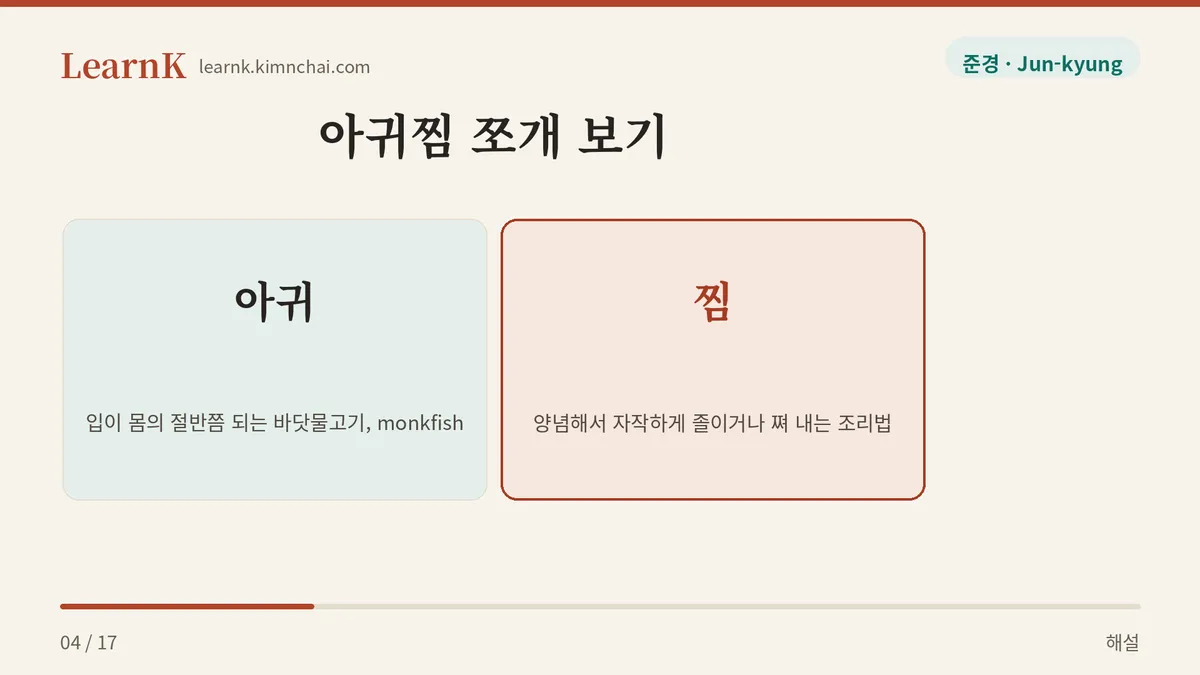
Split the word in two and the meaning is right there. 아귀 (agwi) is a rough-looking sea fish whose mouth takes up about half its body. In English it’s called monkfish, or anglerfish. 찜 (jjim) refers to a cooking method where ingredients are seasoned and then simmered down with just a little liquid, or steamed. 갈비찜 (galbijjim), 코다리찜 (kodarijjim), and 해물찜 (haemuljjim) all belong to the same family. So 아귀찜 is simply “jjim made with monkfish” — there’s no metaphor or hidden meaning in the name itself.
What the word calls up in a Korean person’s head, though, is quite specific. First, it isn’t food you eat alone. One big platter goes in the middle and everyone serves themselves from it. Second, it’s drinking food. It travels with soju, and its name comes up when people are picking a spot for a company dinner. Third, it’s winter food. Monkfish fatten up in winter, and water dropwort is in season then too. Fourth, there’s more bean sprout than monkfish. More than half the platter is bean sprouts, so most of your chopstick work is actually aimed at those. That’s why “아귀찜 먹으러 가자” isn’t simply a suggestion to eat a fish dish — it’s closer to “let’s all sit down tonight with something spicy in front of us and take our time.”
Seeing it in a real conversation
Setting: Friday evening, in the agwijjim alley near the office. They’ve just sat down and opened the menu.
Jun-kyung: 여기 아귀찜 진짜 잘해. 오늘은 딴 거 보지 말고 이걸로 가자. They do a really good agwijjim here. Let’s not look at anything else today.
Emily: 좋아. 근데 둘인데 중자 시키면 남지 않을까? Sounds good. But there’s only two of us — won’t a medium be too much?
Jun-kyung: 소자 시키고 마지막에 밥 볶아 먹자. 그게 딱이야. Let’s get a small and fry rice in the sauce at the end. That’s the sweet spot.
Emily: 콜. 아, 사장님한테 미더덕 빼지 말아 달라고 해 줘. 나 그거 터지는 맛에 아귀찜 먹거든. Deal. Oh, tell them not to leave out the mideodeok. That little pop is why I eat agwijjim.
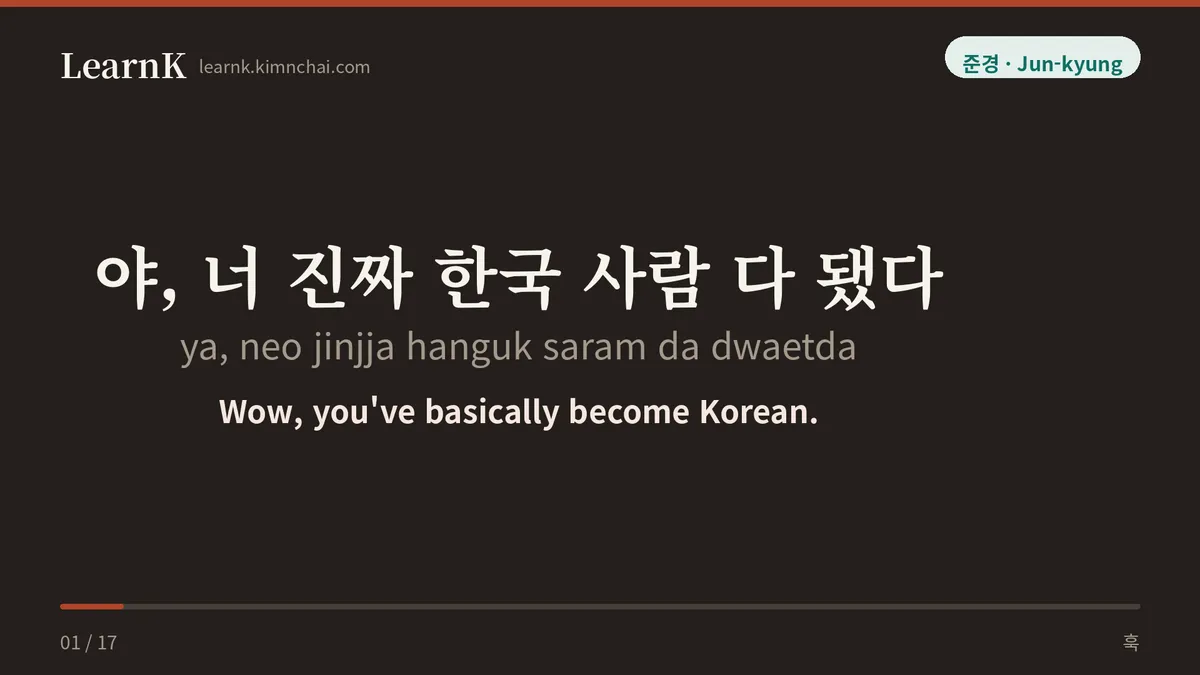
Jun-kyung: 야, 너 진짜 한국 사람 다 됐다. Wow, you’ve basically become Korean.
Emily: 15년인데 이 정도는 해야지. 나 매운 거 못 먹는다고 놀리던 게 누구였더라? Fifteen years — I’d better be. Now who was it that used to tease me for not handling spice?
This is how it sounds off
아귀찜 is a food name that doesn’t discriminate between people, so there’s no setting where it would come across as rude. Instead, here are two misunderstandings learners actually trip over.
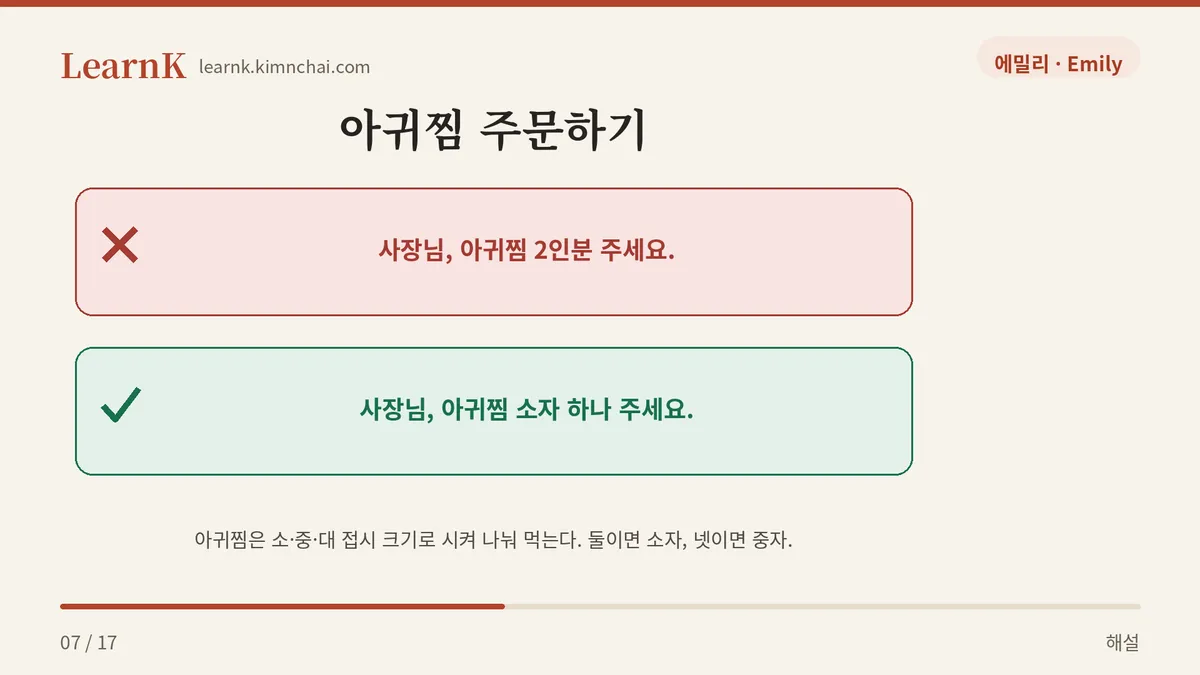
✗ (two of you seated at the restaurant) 사장님, 아귀찜 2인분 주세요. ✓ (two of you seated at the restaurant) 사장님, 아귀찜 소자 하나 주세요. → 아귀찜 isn’t sold by the single portion. You pick one big platter in 소 (so) · 중 (jung) · 대 (dae) — small, medium, large — and share it. For two people, a small; for four, a medium. Saying “2인분” won’t leave anyone confused, but it isn’t how Koreans say it.
✗ (writing a blog post or a report) 마산에서 아구찜을 먹었다. ✓ (writing a blog post or a report) 마산에서 아귀찜을 먹었다. → The standard spelling is 아귀 (agwi); 아구 (agu) is the Gyeongsang-region form. The catch is that restaurant signs overwhelmingly say 아구찜, so it’s easy to write down what your eyes have seen. Nobody cares when you’re speaking, but in writing, 아귀찜 is the safe choice.
Example sentences by situation
1. Suggesting a place for a work dinner
오늘 저녁은 아귀찜 어때요? 매운 거 괜찮으시면요. (oneul jeonyeogeun agwijjim eottaeyo? maeun geo gwaenchaneusimyeonyo.)
When someone proposes agwijjim, a check on spice tolerance almost always follows. If the other person can’t handle spicy food, the whole meal becomes awkward. The moment you add ‘괜찮으시면요’, the proposal turns from a push into a question.
2. Ordering
아귀찜 소자 하나랑 공깃밥 둘 주세요. (agwijjim soja hanarang gonggitbap dul juseyo.)
The sauce is strong enough that rice is basically mandatory. The standard formula: one platter, and rice ordered by headcount. Memorize the size + count pattern of ‘소자 하나’ as a whole chunk and you can reuse it verbatim at 해물찜 and 갈비찜 places.
3. When you’re nearly finished
양념 남았는데 여기 밥 볶아 주세요. (yangnyeom namanneunde yeogi bap bokka juseyo.)
This is the closing ritual of any agwijjim meal. They take the spicy sauce left on the platter and fry it up with rice, seaweed flakes, and sesame oil. Get up without ordering it and the Korean friend you came with may well be startled: “Wait, you’re leaving without the fried rice?”
Polite vs. casual, and related expressions
아귀찜 is a noun, so it carries no politeness level on its own. The level is decided by what you attach after it.
| Expression | Tone & intensity | Where you’d use it |
|---|---|---|
| 아귀찜! (agwijjim!) | Casual speech, tossed out offhand | Deciding on a menu among friends |
| 아귀찜 하나요. (agwijjim hanayo.) | Light, easy politeness | Ordering at a busy restaurant |
| 아귀찜 하나 주시겠어요? (agwijjim hana jusigesseoyo?) | Formal politeness | A shop you’re visiting for the first time, or when you’re with someone senior |
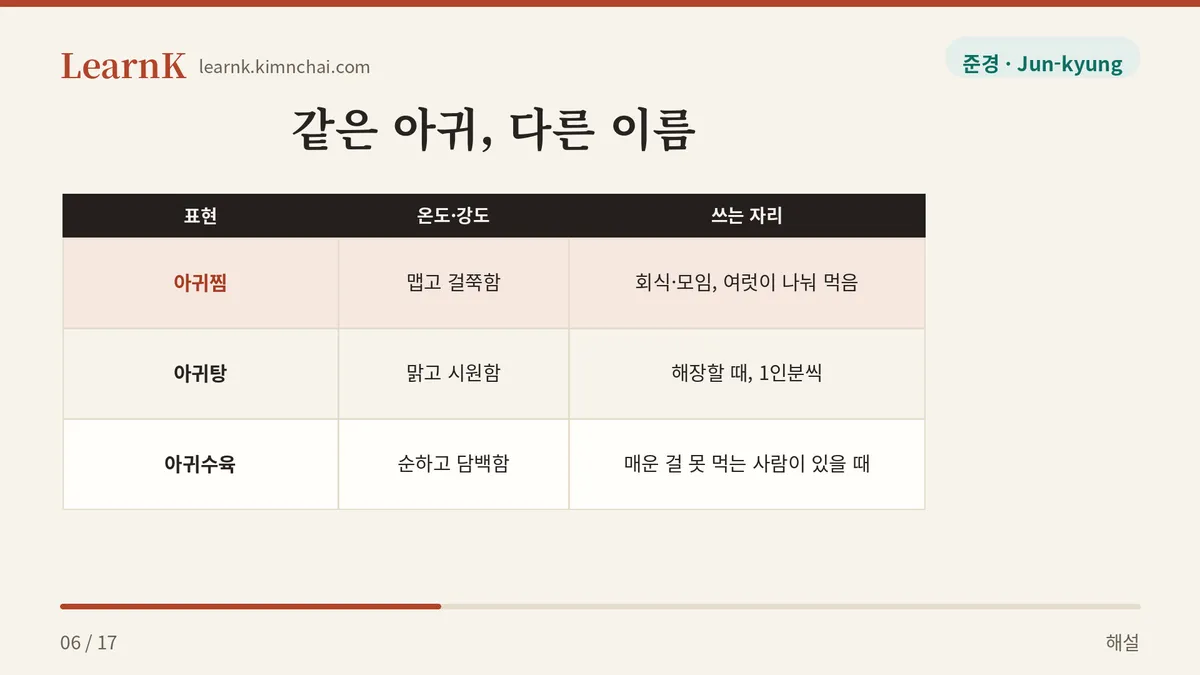
The easily confused neighbouring dishes also come into focus when you line them up side by side.
| Expression | Tone & intensity | Where you’d use it |
|---|---|---|
| 아귀찜 (agwijjim) | Spicy and thick; a strong flavour that calls for rice and drinks | Work dinners and get-togethers. Shared by a group |
| 아귀탕 (agwitang) | Clear and refreshing; the kind of taste that settles your stomach | Curing a hangover. Served in individual portions |
| 아귀수육 (agwisuyuk) | Mild and clean-tasting; for people who can’t do spice | When someone in the group can’t eat spicy food |
| 해물찜 (haemuljjim) | Almost the same sauce as agwijjim, just a wider range of ingredients | Sitting right next to agwijjim on the menu |
Just knowing that one ingredient branches out this way will keep you from floundering in front of the menu. If someone in your party can’t handle spice, ordering one 아귀찜 alongside one 아귀수육 is the Korean solution.
Cultural background — winter in Odong-dong, Masan
One place name never goes unmentioned in any discussion of agwijjim: Masan in South Gyeongsang Province (now part of Changwon). Agwijjim restaurants cluster together around Odong-dong to form a whole alley, and plenty of them advertise themselves as the original. The Masan style dries the monkfish in the winter sea wind until it’s leathery, then rehydrates it, giving the flesh a chewy bite; the style common in Seoul and the greater capital area uses fresh monkfish as is, so the flesh is soft. Same dish name, noticeably different texture — it’s fun to try one of each in both regions.
There’s also a widely told story attached to the fish. In the old days, monkfish were supposedly thrown straight back into the sea when caught, on account of how ugly they looked, and the name 물텀벙 (multeombeong) came from the splash they made hitting the water. Around Incheon you can still find shops with ‘물텀벙이’ on the sign. A fish people used to throw away has become the star of the winter work dinner — and reversals like that are not rare in Korean food.
Every element on the platter has its reason, too. Crunchy 콩나물 (kongnamul), bean sprouts, are the base that absorbs the spicy sauce; strongly fragrant 미나리 (minari), water dropwort, tamps down the fishy smell. Thumbnail-sized 미더덕 (mideodeok), sea squirts, burst with hot juice when you bite them — and the table splits neatly into people who love that and people who fear it. The thick sauce is made with a starch slurry, so the seasoning clings to the ingredients even after the platter cools.
Scenes with agwijjim in Korean dramas and variety shows are more or less fixed: a cramped restaurant, one big platter, soju glasses, and people pushing the platter toward one another to share. Which is to say, this dish belongs less to the category of “a quiet meal by yourself” and more to “time spent sitting together.” So when a Korean says “아귀찜 한번 먹으러 가자,” it’s less a menu suggestion than an invitation to make time for each other.
Today’s quiz
Two of you have gone to an agwijjim restaurant. Which of the following is the most natural order?
- 아귀찜 두 개 주세요.
- 아귀찜 2인분 주세요.
- 아귀찜 소자 하나 주세요.
See the answer
Answer: 3 — 아귀찜 소자 하나 주세요. (agwijjim soja hana juseyo.)
아귀찜 isn’t counted by the number of people; it’s ordered by platter size. Two people, a small; three or four, a medium; more than that, a large. Rice you order separately by headcount, as in “공깃밥 둘 주세요.” And if you can also manage “여기 밥 볶아 주세요” at the end, your evening is complete.
Definitions and example sentences are from the National Institute of Korean Language’s Basic Korean Dictionary (krdict.korean.go.kr); that portion of this post, including our translations, is licensed under CC BY-SA 2.0 KR.