알바 (alba) — The Two Syllables You See Taped to Every Convenience Store Door
알바
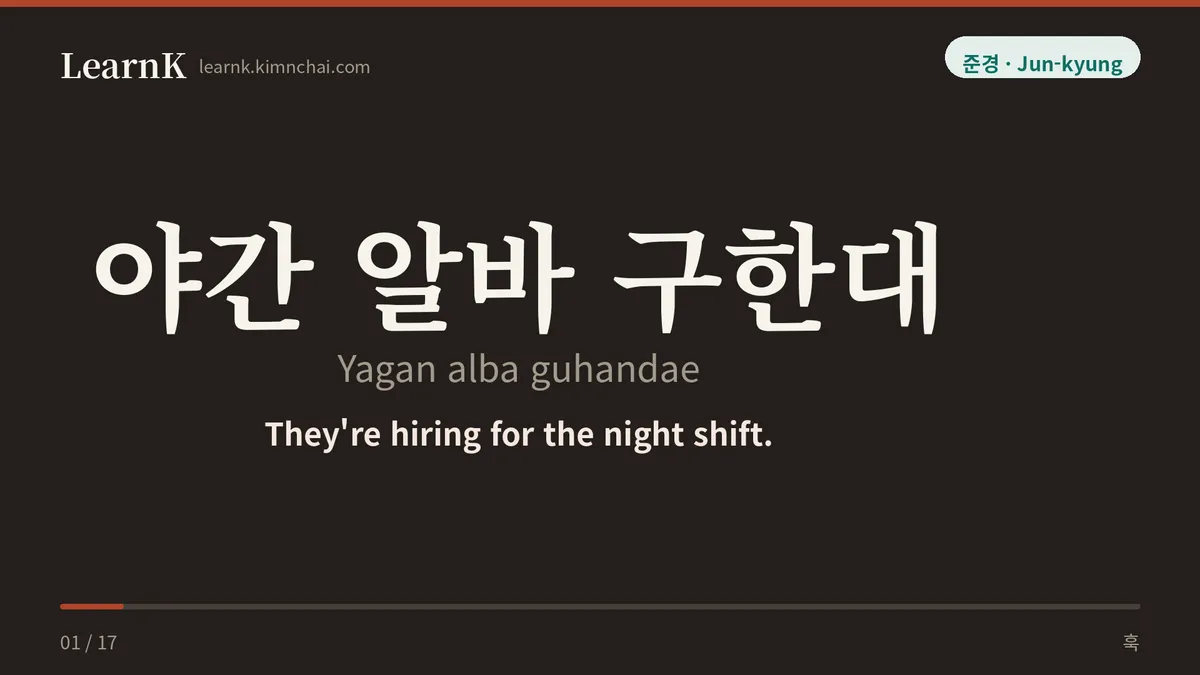
알바 (alba) means work you take on temporarily, outside your main job, to earn money. It’s a two-syllable clipping of 아르바이트 (areubaiteu). Walk through a university district or a residential neighborhood in Korea and you’ll start noticing the slips of paper taped to every glass door: “알바 구함 (alba guham)” — part-timer wanted; “주말 알바 (alba), 시급 협의 (jumal alba, sigeup hyeopui)” — weekend part-time work, hourly pay negotiable; “야간 알바 (alba) 급구 (yagan alba geupgu)” — night part-timer needed urgently. Convenience stores, cafés, barbecue restaurants, distribution centers, PC bangs — the businesses are all different, but the first two syllables on the paper are almost always the same.
There are two keys to the nuance. First, 알바 (alba) is thoroughly spoken language. Between friends, within families, and on a help-wanted sign, it’s 알바 close to 100% of the time — but on a résumé, an employment contract, or in a news article, you’ll see the unclipped 아르바이트 (areubaiteu). Second, the word carries the sense of “temporary,” “not one’s real job.” So if you use 알바 for someone who makes their living from that work for life, it can come across as treating their job lightly. Memorize the meaning but miss this temperature, and you’ll produce sentences that are grammatically correct yet make the room go cold.
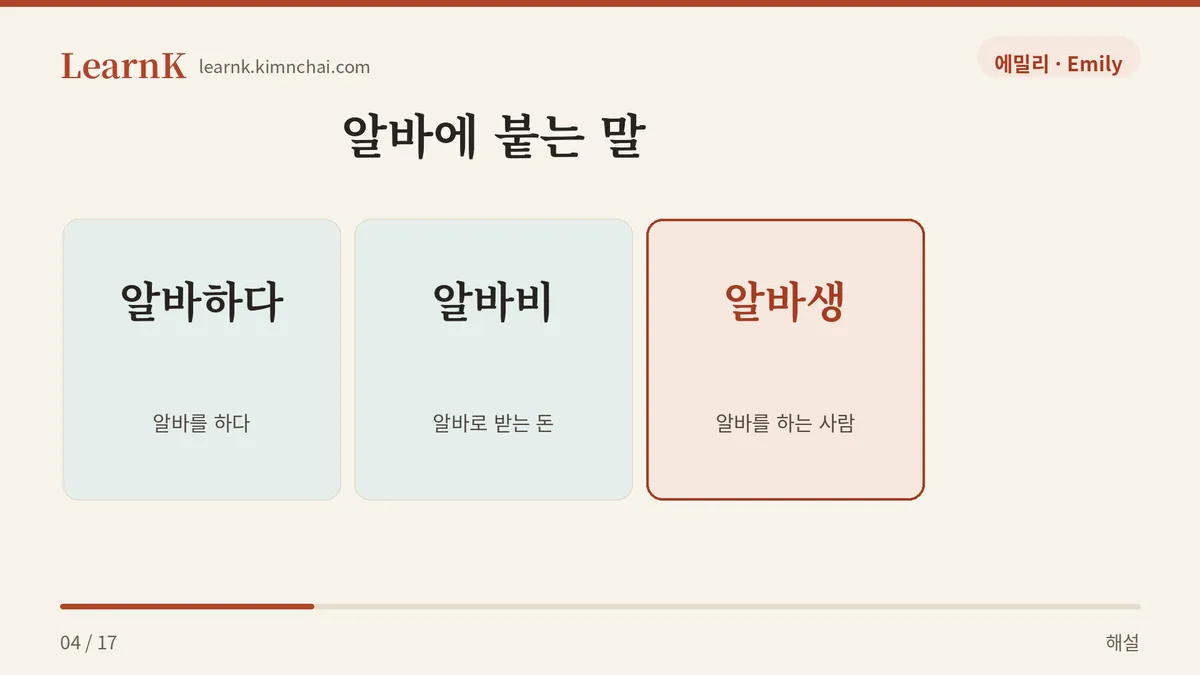
It’s worth learning the related forms too: 알바하다 (alba-hada) — to work a part-time job; 알바를 구하다 (albareul guhada) — to look for a part-time job; 알바를 뛰다 (albareul ttwida) — to juggle several part-time jobs, busily; 알바비 (albabi) — the money you earn from a part-time job; 알바생 (albasaeng) — a person working a part-time job. Learn just these five and you can follow half of what Korean students talk about.
Checking the National Institute of Korean Language dictionary
알바 「noun」 A clipped form of ‘아르바이트,’ referring to work done temporarily outside one’s main job in order to earn money. — National Institute of Korean Language, Basic Korean Dictionary (krdict.korean.go.kr)
The dictionary also carries the definition in five languages.
[en] part-time job — Shortened term for ‘arbait (part-time job),’ something you do temporarily outside of your main job to make money. [ja] アルバイト。バイト。ないしょく【内職】 — 「아르바이트(アルバイト)」の略語で、収入を得るために本業とは別の仕事を臨時にすること。 [es] trabajo a tiempo parcial — Abreviatura de “trabajo a tiempo parcial”. Trabajo temporal además de la propia ocupación que se hace para ganar dinero. [zh] 打工 — “아르바이트(打工)”的缩略语,为赚钱而在自己的主业以外临时做的事。 — National Institute of Korean Language, Basic Korean Dictionary (krdict.korean.go.kr)
A Portuguese gloss isn’t included in this dictionary. For readers in Brazil and Portugal, our own rendering would be something like trabalho de meio período, or colloquially bico. This Portuguese translation is not in the dictionary — it’s ours.
Now let’s look at the actual usage examples the dictionary provides.
민준이는 생활비를 벌기 위해 편의점에서 알바를 시작했다. — National Institute of Korean Language, Basic Korean Dictionary (krdict.korean.go.kr)
(Minjun-ineun saenghwalbireul beolgi wihae pyeonuijeom-eseo alba-reul sijakhaetda.) Minjun started a part-time job at a convenience store to earn living expenses. This is the most typical situation 알바 shows up in. The two phrases “생활비를 벌기 위해 (saenghwalbireul beolgi wihae, to earn living expenses)” and “편의점 (pyeonuijeom, convenience store)” show you exactly where this word lives. In Korea, the convenience store is practically synonymous with 알바.
유민이는 부모님의 가게에서 알바를 하고 있다. — National Institute of Korean Language, Basic Korean Dictionary (krdict.korean.go.kr)
(Yumin-ineun bumonimui gage-eseo alba-reul hago itda.) Yumin is working part-time at her parents’ shop. 알바 is used for helping out at a family business as well. The nuance is still alive: this isn’t a formal hire, just a temporary hand.
그래? 나도 알바를 구해 봐야겠다. — National Institute of Korean Language, Basic Korean Dictionary (krdict.korean.go.kr)
(Geurae? Na-do alba-reul guhae bwayagetda.) Really? Maybe I should look for a part-time job too. This is a casual-speech sentence, said after hearing a friend’s news and making up your mind. 구하다 (guhada) means to look for work, and it’s one of the verbs that most often pairs with 알바.
알바 시급. — National Institute of Korean Language, Basic Korean Dictionary (krdict.korean.go.kr)
(Alba sigeup.) Part-time hourly pay. 시급 (sigeup, 時給) is the amount you earn per hour. In Korea, a conversation about 알바 almost always turns into a conversation about 시급. The information on a help-wanted sign is usually those same three things: days, hours, and hourly pay.
A real conversation
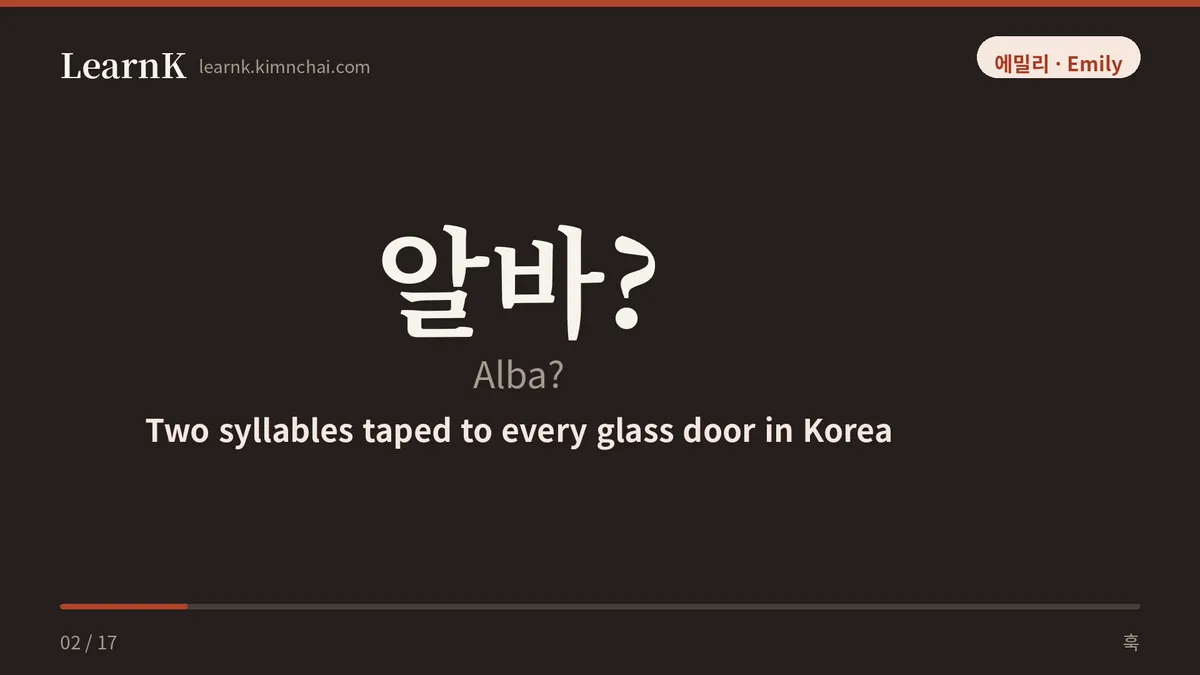
The scene: 11 p.m. at a neighborhood convenience store. On the glass beside the register, a slip of paper reads “야간 알바 구함” — night part-timer wanted.
Jun-kyung: 어, 에밀리? 이 시간에 웬일이야. Oh, Emily? What are you doing here at this hour?
Emily: 자다가 깼는데 라면이 너무 먹고 싶어서. 오빠야말로 뭐 해, 거기서. I woke up craving ramyeon. What about you, standing over there?
Jun-kyung: 이거 봤어? 야간 알바 구한대. 시급이 생각보다 세네. Did you see this? They’re hiring for the night shift. The hourly pay is higher than I thought.
Emily: 설마 지원하게? 회사 다니면서 알바까지 하면 몸 못 버텨. Don’t tell me you’re applying. You can’t survive a part-time job on top of your day job.
Jun-kyung: 아니야, 그냥 옛날 생각나서. 나 대학교 때 여기서 2년 알바했잖아. No, it just brought back memories. I worked here part-time for two years in college, remember?
Emily: 아 맞다. 그래서 삼각김밥을 그렇게 각 잡아서 놓는구나. Oh right. That’s why you line up the triangle gimbap so perfectly.
Where this sounds off
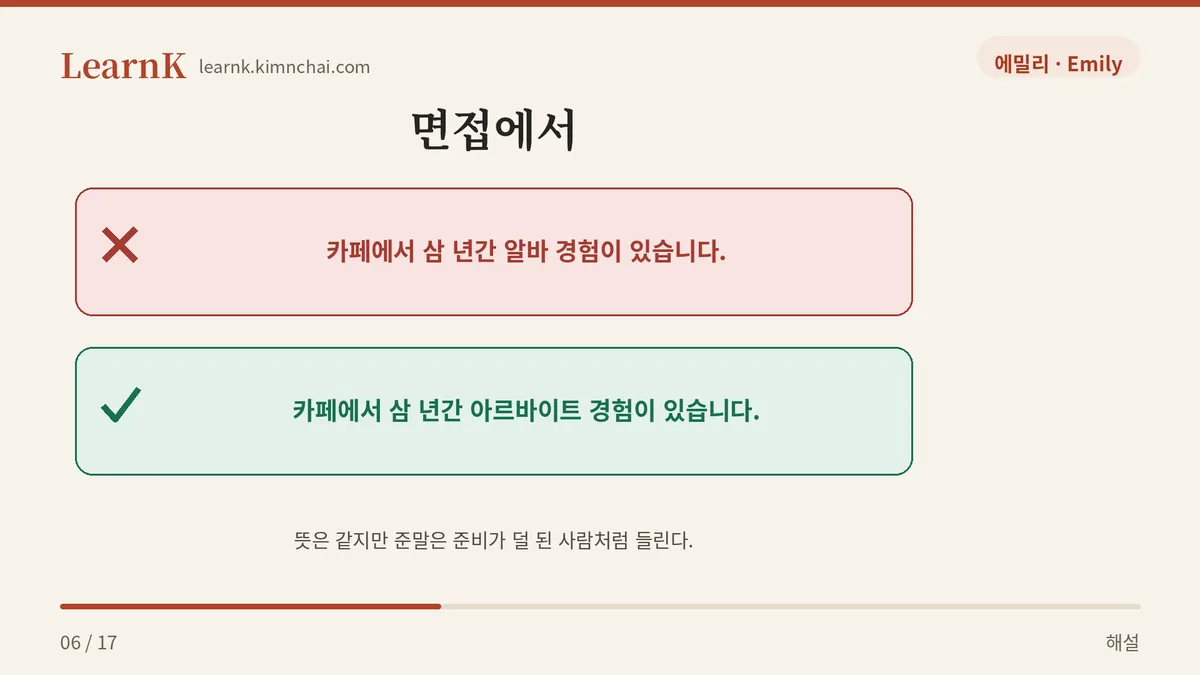
✗ (In a job interview) 저는 카페에서 3년간 알바 경험이 있습니다. (Jeoneun kape-eseo sam-nyeon-gan alba gyeongheom-i itseumnida.) ✓ (In a job interview) 저는 카페에서 3년간 아르바이트 경험이 있습니다. (Jeoneun kape-eseo sam-nyeon-gan areubaiteu gyeongheom-i itseumnida.) — I have three years of part-time work experience at a café. → 알바 is a clipped form you use with friends. In settings that call for formality — interviews, résumés, contracts — use the full 아르바이트. The meaning is identical, but the clipped version makes you sound underprepared.
✗ (To an owner who has run the shop for ten years) 사장님, 여기서 알바 오래 하셨어요? (Sajangnim, yeogiseo alba orae hasyeosseoyo?) ✓ 사장님, 여기서 가게 오래 하셨어요? (Sajangnim, yeogiseo gage orae hasyeosseoyo?) — Have you had this shop for a long time? → 알바 comes attached to the ideas of “temporary” and “not one’s real job.” Use it for someone whose livelihood and career that work is, and you end up treating their job as something they’re just passing through.
Example sentences by situation
1. With a friend, just before the semester starts — cutting back on work because there won’t be enough time during the term.
나 이번 학기엔 주말 알바만 하려고. 평일엔 도저히 시간이 안 나.
(Na ibeon hakgi-en jumal alba-man haryeogo. Pyeongil-en dojeohi sigani an na.) I’m only going to work weekends this semester. I just don’t have time on weekdays.
2. Calling about a help-wanted sign — a first contact, so polite speech is used. Here it’s perfectly natural to pick up the word straight from the sign and say 알바.
안녕하세요, 문 앞에 붙은 알바 공고 보고 전화드렸는데요. 자리 아직 있을까요?
(Annyeonghaseyo, mun ape butteun alba gonggo bogo jeonhwadeuryeonneundeyo. Jari ajik isseulkkayo?) Hello, I’m calling about the part-time job notice posted on your door. Is the position still open?
3. With a friend at the end of the month — checking in on when each other’s pay lands.
이번 달 알바비 들어왔어? 난 아직인데 사장님이 다음 주라 하시더라.
(Ibeon dal albabi deureowasseo? Nan ajik-inde sajangnimi da-eum ju-ra hasideora.) Did your pay come in this month? Mine hasn’t yet — the boss said next week.
Polite vs. casual speech, and similar expressions
The word 알바 itself carries no politeness level. That’s decided at the end of the sentence. To a friend it’s “요즘 어디서 알바해? (Yojeum eodiseo alba-hae?)”; to someone you’ve just met it’s “요즘 알바하세요? (Yojeum alba-haseyo?)”. That said, as we saw above, in genuinely formal settings it’s safer to swap the whole word out for 아르바이트 — attaching a polite ending doesn’t stop a clipped word from sounding clipped.
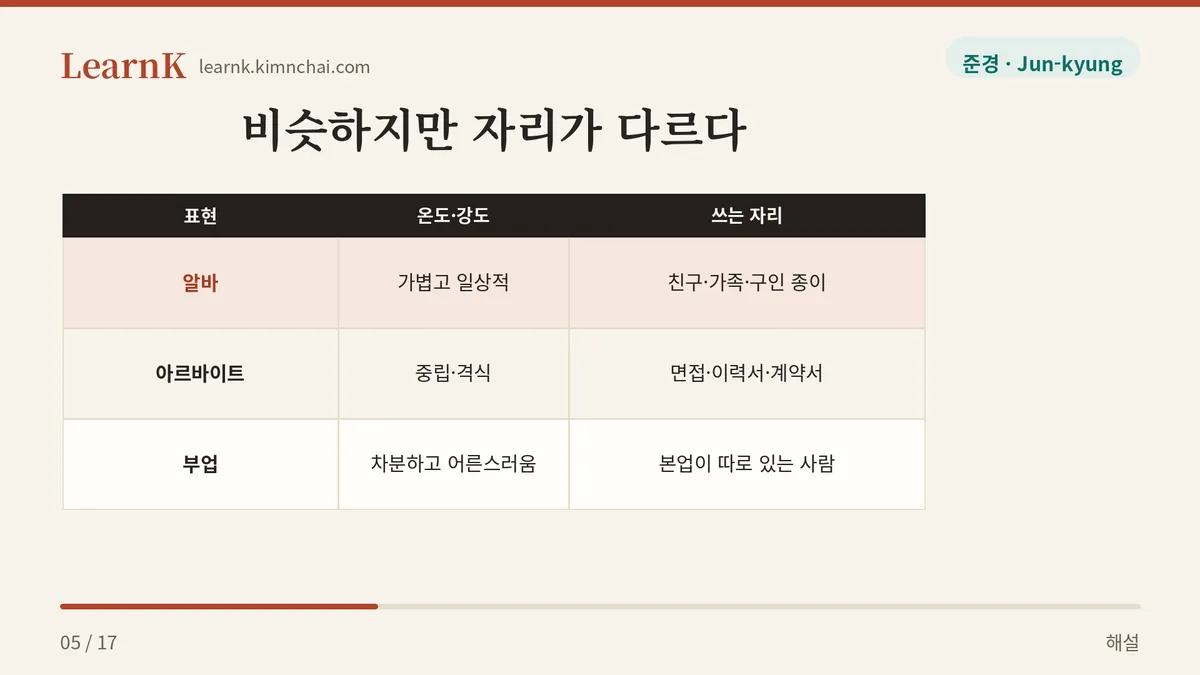
| Expression | Temperature / intensity | Where it’s used |
|---|---|---|
| 알바 (alba) | Light, everyday | Friends, family, help-wanted signs. Not on a résumé |
| 아르바이트 (areubaiteu) | Neutral, formal | Interviews, résumés, employment contracts, news |
| 부업 (bueop) | Calm, grown-up | Work done after hours by someone with a separate main job |
| 투잡 (tujap) | Light, current slang | Peer conversation, social media. Holding down two jobs at once |
The same situation paints a different picture depending on which word you choose. A university student working three days a week at a café is doing 알바; an office worker taking on translation after hours is doing 부업; and when that office worker introduces himself with a grin, it’s 투잡.
Cultural background — how German Arbeit ended up on a convenience store door
This word has taken a long journey. The original form, 아르바이트, comes from German Arbeit (work, labor). But German Arbeit carries no sense of “temporary employment.” It just means work. As the word passed into Japanese as アルバイト (arubaito), its meaning narrowed to the temporary labor students do alongside their studies, and it settled into Korean in that state. Korean then cut it down again, to the two syllables 알바. To get from German’s heavy, broad “labor” to two short syllables on the glass door of a Korean convenience store, the word passed through three languages.
In Korea, 알바 stands for more than just a job. When a drama shows a character standing behind a convenience store counter or cleaning up at a café at closing time, that single shot explains the person’s circumstances and age bracket without a line of dialogue. And the question of what you bought your parents with your first 알바비 has been a staple of variety shows and interviews for years. Since the first place most people encounter words like 시급 (sigeup, hourly pay), 주휴수당 (juhyusudang, weekly holiday allowance), and 근로계약서 (geullogyeyakseo, employment contract) is usually their first 알바, for many Koreans these two syllables are something close to the first door out into society.
One more thing. Online, there’s a usage the dictionary doesn’t list. When a post praises a particular product or person excessively, someone will comment “알바 아니야? (Alba aniya?)” — Aren’t you a paid shill? — suspecting the writer is being paid to manufacture public opinion. This meaning is internet slang and is not listed in the National Institute of Korean Language dictionary, so it’s worth keeping separate from the original sense of an actual job.
Today’s quiz
In which of the following would 알바 (alba) sound off?
- To a friend: “나 다음 달부터 카페에서 알바 시작해. (Na da-eum daR-buteo kape-eseo alba sijakhae.)”
- In a job interview for a new hire: “편의점 알바 경험이 있습니다. (Pyeonuijeom alba gyeongheom-i itseumnida.)”
- Calling about a help-wanted sign: “알바 공고 보고 연락드렸어요. (Alba gonggo bogo yeollakdeuryeosseoyo.)”
The answer is number 2. The meaning is perfectly accurate, but an interview is a setting that calls for formality, so the unclipped “아르바이트 경험이 있습니다 (areubaiteu gyeongheom-i itseumnida)” lands far more solidly. In cases like 1 and 3 — between friends, or in a practical conversation about a job posting — 알바 is the most natural choice, whether you’re speaking politely or casually.
Definitions and example sentences are from the National Institute of Korean Language’s Basic Korean Dictionary (krdict.korean.go.kr); that portion of this post, including our translations, is licensed under CC BY-SA 2.0 KR.