알빠노 (albbano) — When '내가 알 바냐' Shrank to Three Syllables
알빠노 (albbano)
알빠노 (albbano) is internet slang meaning “what’s that got to do with me? — that’s not my business.” Whatever other people do or say, I’m not interested and I’m not responsible. It’s a very short, very strong line in the sand.
The situations where this word pops out usually look like this. A friend passes something along: “Hey, people over there were talking about you.” News about the neighboring team’s staff shuffle lands in the group chat. A relative at the holiday dinner table asks about your marriage plans. Someone writes a long post about another person’s love life on a community board. They all have one thing in common — it’s a matter that has zero effect on you, and yet somebody is demanding a reaction from you. At moments like that, Koreans in their teens through their thirties finish their answer in three syllables. 알빠노.
알빠노 (albbano) has two temperatures mixed into it.
One is shutting things down. It means you refuse to hear another word about the topic the other person brought up, so using it in a serious moment is cold enough to end a relationship on the spot. It’s far stronger than 관심 없어 (gwansim eopseo), “I’m not interested.” That’s because “관심 없어” describes your state, while 알빠노 sets the story the other person carried in down on the floor.
The other is liberation. When someone who has long been worn down by other people’s eyes says, “나 이제 알빠노 하기로 했어 (Na ije albbano hagiro haesseo)” — “I’ve decided to go 알빠노 from now on” — that’s not cynicism so much as a personal declaration. It means: whatever anyone says, I’m going to live at my own pace. This is even where the expression 알빠노 정신 (albbano jeongsin), “the albbano spirit,” came from. In a society full of comparison and reading the room, this is exactly why the word spread so fast.
And one important feature. 알빠노 has no polite (존댓말, jondaenmal) form. Words like “알빠노요 (albbanoyo)” or “알빠놉니다 (albbanomnida)” simply don’t work. The ending itself is a casual question form, so there’s no slot to attach honorifics to. This isn’t just a matter of grammar — it’s a signal that tells you the word’s entire range of use. From the very beginning, this word was built so that you can’t say it to someone above you.
A Real Conversation
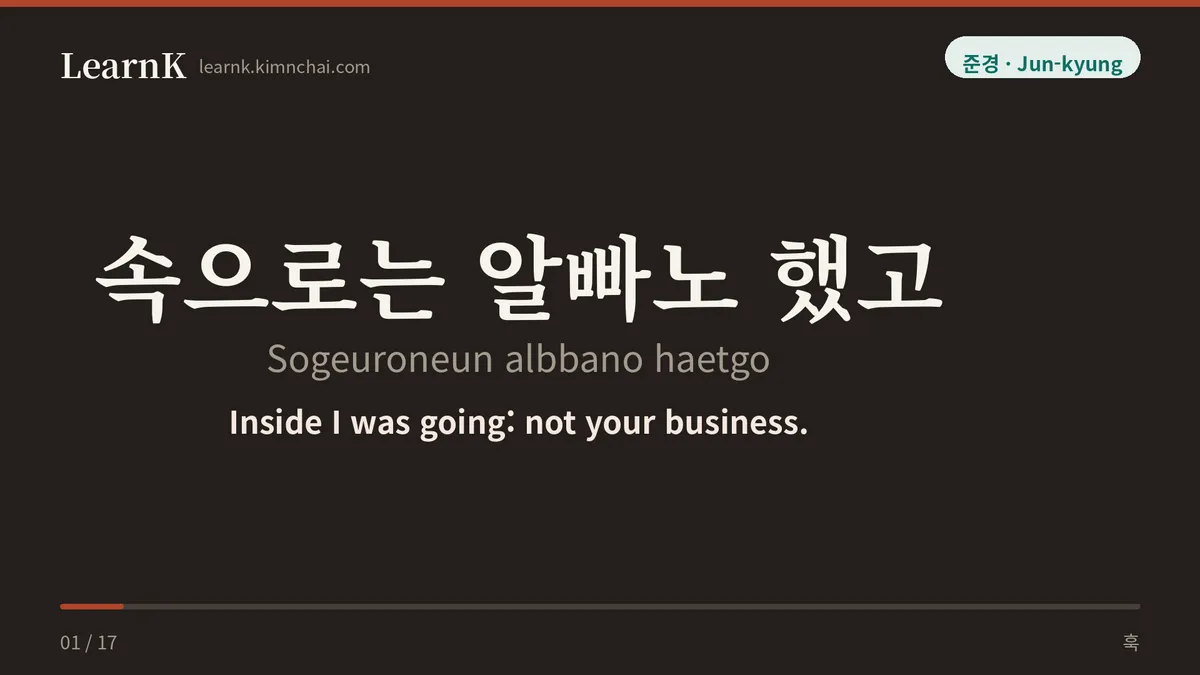
Scene: The evening of the last day of the Chuseok holiday, in the living room of Jun-kyung’s apartment. Jun-kyung, just back from the head family’s house, is sprawled on the sofa, and Emily has brought over some reheated leftover jeon (savory pancakes).
Jun-kyung: 아 진짜, 큰아버지가 또 물어보시더라. 집은 언제 살 거냐고. Ugh, seriously — my uncle asked again. When am I going to buy a house.
Emily: 그래서 뭐라 그랬어? So what did you say?
Jun-kyung: 뭐라 그러긴. 그냥 웃었지. 속으로는 알빠노 했고. What could I say. I just smiled. Inside I was going “not your business.”
Emily: ㅋㅋㅋ 야, 너 그 말 어디서 배웠어. 완전 요즘 애들 말이잖아. Haha, where did you even learn that? That’s totally a kids’ word.
Jun-kyung: 조카가 하루 종일 그러더라고. 뭐만 하면 “알빠노”. 근데 듣다 보니까 좀 시원하긴 해. My nephew says it all day. Every two seconds, “albbano.” But honestly, it feels kind of good to hear.
Emily: 시원하지. 근데 큰아버지 앞에서는 절대 소리 내지 마라. 진짜로. It does. But never say it out loud in front of your uncle. I mean it.
Using It This Way Sounds Off
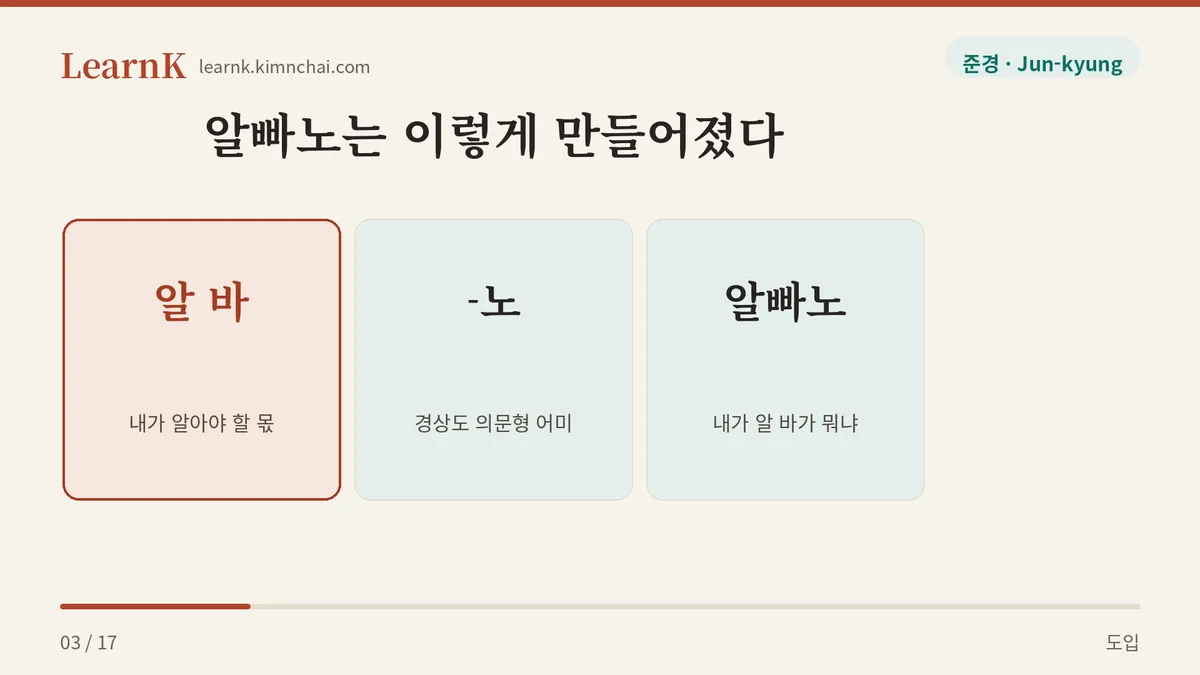
✗ (While a senior colleague is walking you through a task) 선배님, 그건 저는 알빠노인데요. (Seonbaenim, geugeon jeoneun albbanoindeyo.) ✓ (While a senior colleague is walking you through a task) 아, 그 부분은 제가 맡은 건 아니라서요. 한번 확인해 볼게요. (A, geu bubuneun jega mateun geon aniraseoyo. Hanbeon hwaginhae bolgeyo.) — “Ah, that part isn’t actually mine to handle. Let me go check on it.” → Used in front of someone older or senior, it’s not merely rude — it’s a conversation-ender. Tacking on a polite ending doesn’t help either. Because the ending is already casual, “알빠노인데요” actually sounds stranger, not softer.
✗ (While a friend is crying about a breakup) 걔가 왜 그랬는지는 알빠노지. (Gyaega wae geuraenneunjineun albbanoji.) ✓ (While a friend is crying about a breakup) 걔가 왜 그랬는지는 몰라도, 네가 잘못한 건 아니야. (Gyaega wae geuraenneunjineun mollado, nega jalmothan geon aniya.) — “I don’t know why they did that, but it isn’t your fault.” → Used where comfort is called for, you end up pushing away the other person’s feelings too, as if to say “not my problem.” 알빠노 is for pushing back other people’s meddling, not for pushing back someone’s pain.
Example Sentences by Situation
1. When gossip about a couple from another department shows up in the club group chat
야, 남 연애를 왜 우리가 분석하고 있냐. 알빠노. (Ya, nam yeonaereul wae uriga bunseokhago innya. Albbano.) “Hey, why are we sitting here analyzing someone else’s relationship? Not our business.”
When it’s awkward to tell the gossip-spreader outright to “stop,” this is the half-joking way to close the topic. It’s the most common form among peers.
2. When a friend tells you someone else’s score after an exam
걔가 몇 점인지는 알빠노. 나는 내 점수만 보면 돼. (Gyaega myeot jeominjineun albbano. Naneun nae jeomsuman bomyeon dwae.) “What they scored is none of my business. I just need to look at my own score.”
Here it leans toward liberation rather than shutting down. It’s a light way of expressing an attitude of not comparing yourself to others, so the listener doesn’t take offense.
3. When a friend brings up trends about your studio apartment’s décor
— 요즘 그런 조명 촌스럽다던데? (Yojeum geureon jomyeong chonseureopdadeonde?) — “I heard lighting like that is out of style these days?” — 알빠노. 내 방인데. (Albbano. Nae bangindé.) — “Don’t care. It’s my room.”
This is the pattern where you end your answer with a single word and then tack on a short reason. In real conversation, this interjection-like use — standing in for an entire sentence — is by far the most common.
Polite and Casual Alternatives
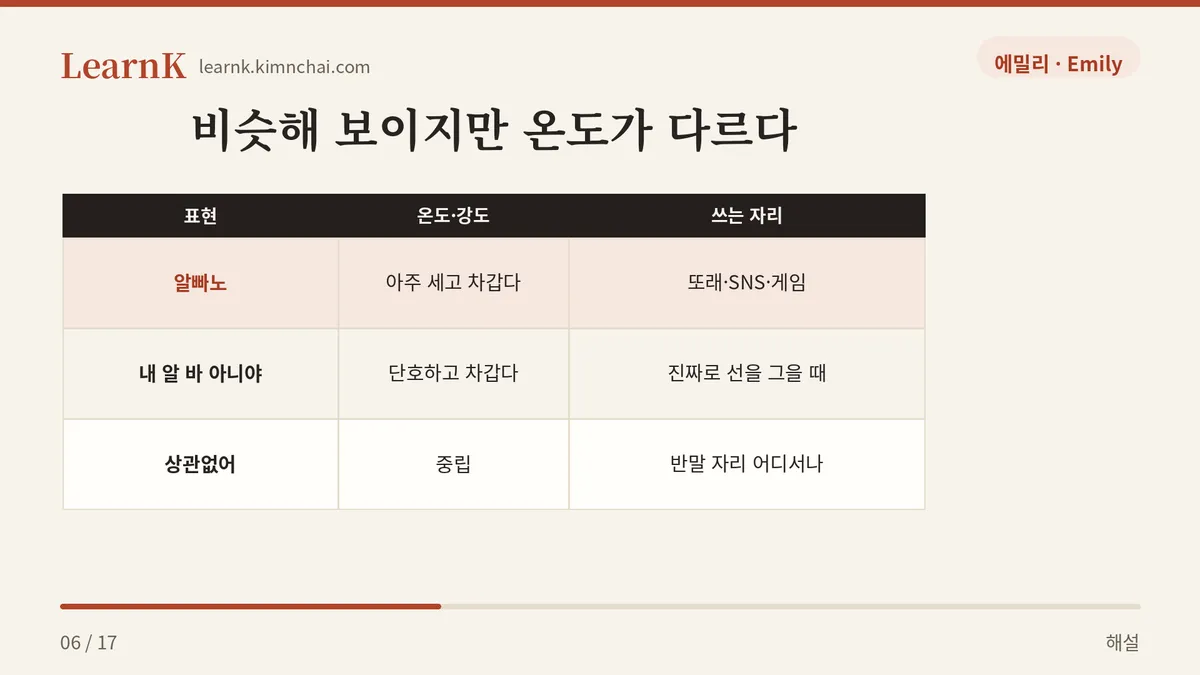
As mentioned above, 알빠노 has no polite counterpart. So in situations that require formality, you have to switch to a completely different expression altogether. These may look similar, but the temperature of each is entirely different.
| Expression | Temperature & strength | Where it’s used |
|---|---|---|
| 알빠노 (albbano) | Very strong and cold, with a playful edge | Peers, social media, gaming. Never with someone senior |
| 내 알 바 아니야 (nae al ba aniya) | Firm and cold. No playfulness | Casual speech. When you’re truly drawing a line |
| 어쩌라고 (eojjeorago) | Confrontational. One step from a fight | Arguments. More aggressive than 알빠노 |
| 상관없어 (sanggwaneopseo) | Neutral | Anywhere. Casual speech in general |
| 저와는 무관한 일입니다 (jeowaneun mugwanhan irimnida) | Stiff, formal register | Work, official documents. The polite replacement for 알빠노 |
Here’s the practical order for learners. Learn the meaning through 알빠노, but when it comes to actually saying something out loud, it’s safest to start with 상관없어 (sanggwaneopseo). 알빠노 is a card you play only after you’re comfortable enough with the other person.
Cultural Background — A Sentence Squeezed Into Three Syllables
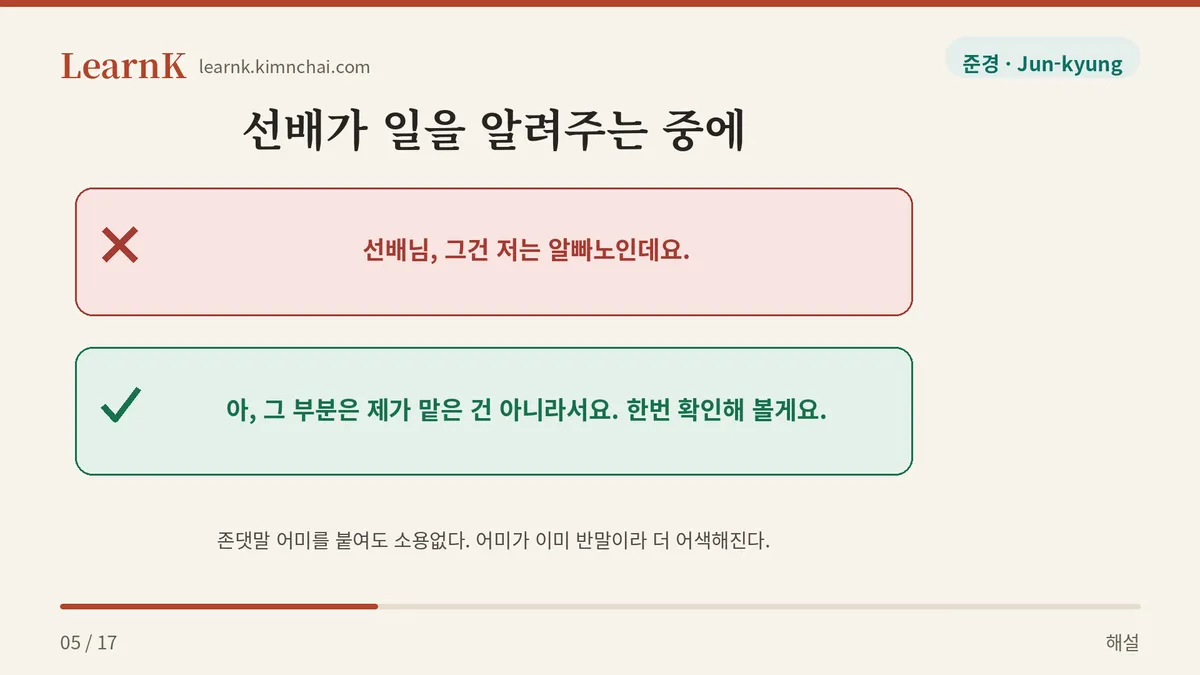
The way 알빠노 was coined is relatively transparent. The front part, “알빠 (albba),” comes from “알 바 (al ba).” “알 바 아니다 (al ba anida)” is an old expression meaning “this is not a 바 (ba) — a matter, a share — that I need to know about.” The back part, “-노 (-no),” is a question ending from the Gyeongsang dialect, used in phrases like “뭐 하노? (Mwo hano?)” and “어디 가노? (Eodi gano?)” Stick the two together and “내가 알 바가 뭐냐? (Naega al baga mwonya?)” — “what business is it of mine?” — gets compressed into three syllables.
But this is where a misunderstanding often creeps in. Just because the ending came from a dialect doesn’t mean 알빠노 is everyday speech for people from the Gyeongsang region. It’s internet language, born when the “-노” ending came into wide use as a distinctive online voice on community boards, and today young people all over the country use it regardless of where they’re from. If you ask a Korean friend, “Is this Busan dialect?” most of them will smile vaguely and say, “Well, not exactly…”
Another characteristic: it’s hard to find this word in drama dialogue. Broadcast dramas still tend not to use slang this rough. Instead, you’ll run into it far more often in variety-show subtitles, web dramas, YouTube comment sections, and game voice chat. It sits at exactly that layer — the kind of word a Korean learner will never learn from a textbook, but will see several times a day the moment they go online.
And the reason the word is so beloved right now is honestly a little sad. In a place where the culture of casually asking about other people’s education, salary, housing, and marriage plans still lingers, these three syllables are the shortest shield the younger generation has found. Even if you can’t say it out loud, just repeating it once inside your head lets you breathe a little easier.
Today’s Quiz
In which of the following situations would it be natural to use 알빠노 (albbano)?
- When your team lead is assigning you a new task in a meeting
- When a friend passes along, “Those people said your clothing style is weird”
- When a friend is crying because their pet is sick
See the answer
Answer: 2
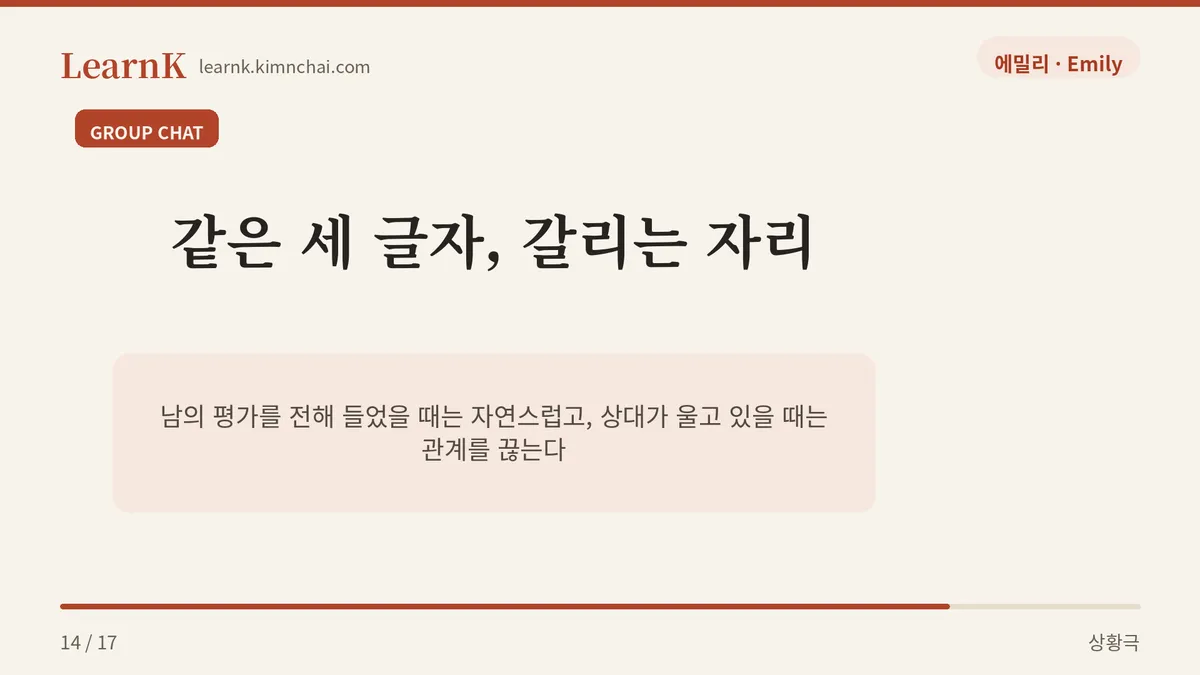
Hearing secondhand about someone else’s judgment of you — something that has nothing to do with you — is the most typical home for 알빠노. Number 1 is a situation with someone senior, so it’s rude, and there’s no polite form to begin with, meaning you couldn’t even build the sentence. Number 3 calls for comfort, so the word would end up pushing away the other person’s feelings too. Remember: this is a word that picks its moment.
Definitions and example sentences are from the National Institute of Korean Language’s Basic Korean Dictionary (krdict.korean.go.kr); that portion of this post, including our translations, is licensed under CC BY-SA 2.0 KR.