알겠어 / 알겠습니다 (algesseo / algetseumnida) — Why Koreans Never Answer with 압니다 (amnida)
알겠어 / 알겠습니다
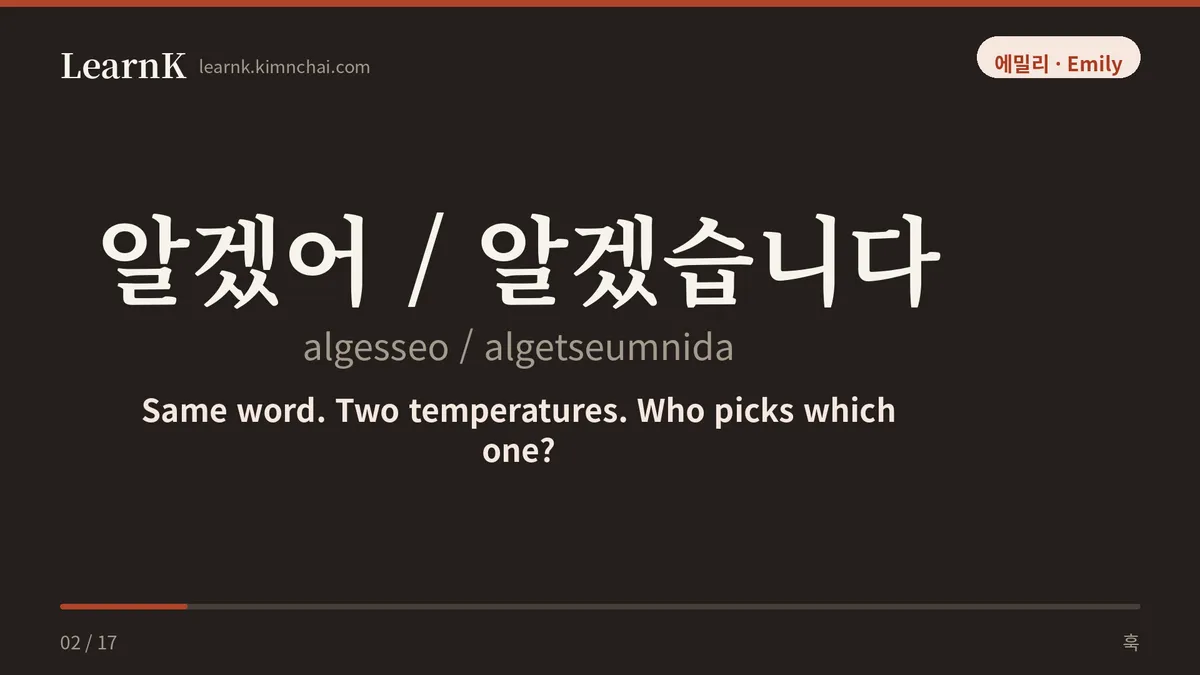
알겠어 / 알겠습니다 (algesseo / algetseumnida) means that you’ve heard what the other person said and you intend to do it. Put into English, it’s three phrases layered into a single word: “Got it,” “I understand,” and “Will do.” Spend even a few days in Korea and you’ll quickly see where this word clusters. When a team leader hands off a task. When the delivery driver says he’ll leave the package at your door. When the hairdresser double-checks how short you want your bangs. When your mom’s nagging is finally winding down. 알겠습니다 is the word that closes a conversation in which an instruction or a request has changed hands. Learn to drop this one word at the right moment and, even if your Korean is still shaky, you become someone people can talk to.
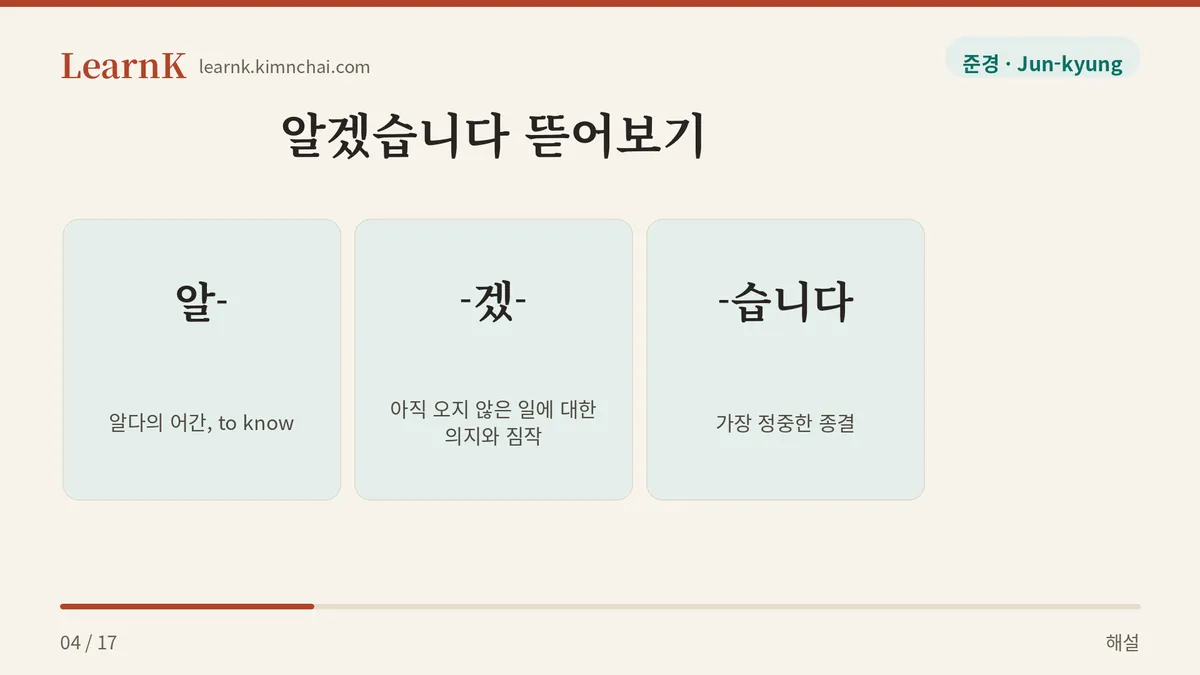
Start with the shape of it. Korean already has the verb 알다 (alda), “to know.” And yet no Korean answers a boss’s instruction with 압니다 (amnida), “I know.” Answered that way, it comes out like “Yes, I was already aware of that,” which leaves the person who just told you feeling a little foolish. Instead, you slot -겠- (-get-) into 알- and turn it into 알겠습니다. -겠- is the ending that carries intention and conjecture about something that hasn’t happened yet. So 알겠습니다, translated literally, is closer to 알게 되겠습니다 (alge doegetseumnida), “I will come to know” — and pulling the assertion back by that one small step is exactly what makes it gentle.
One of the great principles of Korean shows itself here: the side that sounds less certain is the polite side. Once you know this, you also understand why 모르겠어요 (moreugesseoyo) gets used far more often than 몰라요 (mollayo). Both mean “I don’t know,” but 몰라요 shuts the door while 모르겠어요 leaves it slightly ajar.
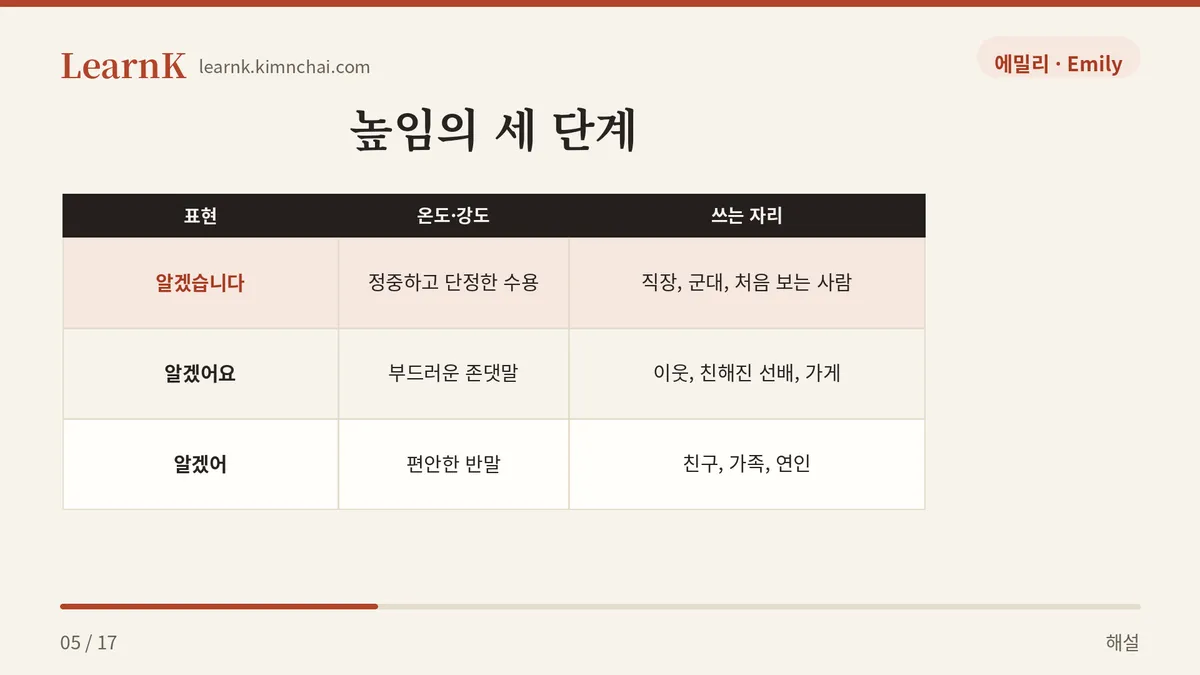
The levels of politeness are just a matter of swapping the ending. To a friend, 알겠어 (algesseo); with a bit of distance, 알겠어요 (algesseoyo); at work, in the military, and in front of someone you’re meeting for the first time, 알겠습니다 (algetseumnida). And then there’s one more that looks similar but runs at a completely different temperature: 알았어 (arasseo). 알았어 is past tense, so it carries a strong “received — end of discussion” feeling. Answer your parents’ worrying with 알았어, 알았어 (arasseo, arasseo), twice like that, and it isn’t acceptance. It’s a door closing.
See It in a Real Conversation
Scene: Emily’s moving day. The living room of the new apartment, half filled with boxes. The ladder truck will be here soon.
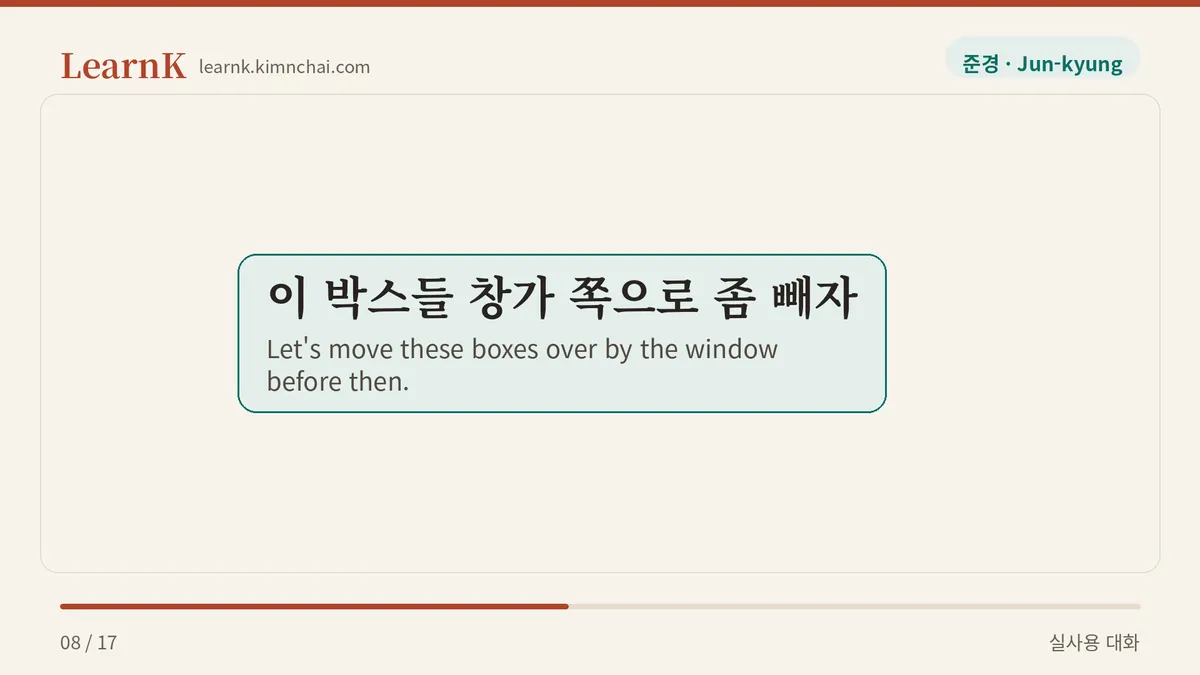
Jun-kyung: 사다리차 삼십 분 뒤에 온대. 그 전에 이 박스들 창가 쪽으로 좀 빼자. The ladder truck’s coming in thirty minutes. Let’s move these boxes over by the window before then.
Emily: 알겠어. 근데 이 냉장고는 어디로 넣지? Got it. But where does this fridge go?
Jun-kyung: 일단 거기 둬. 기사님 오시면 여쭤보고 옮기자. Just leave it there for now. We’ll ask the driver when he gets here.
Emily: (전화를 받으며) 네, 삼백이 호요. 아, 십 분 늦으신다고요? 네, 알겠습니다. 조심히 오세요. (answering the phone) Yes, unit 302. Oh, you’ll be ten minutes late? Yes, understood. Drive safely.
Jun-kyung: 야, 너 방금 존댓말 그냥 자동으로 나오더라. Hey, the polite speech just came out of you automatically.
Emily: 그러게. 기사님한테 ‘알겠어’ 하면 좀 그렇잖아. Right? It’d be weird to say “algesseo” to the driver.
Jun-kyung: 큰일 나지. 자, 그럼 박스부터. You’d be in trouble. Okay, boxes first.
Emily: 알겠습니다, 반장님! Yes sir, boss!
Said This Way, It Sounds Off
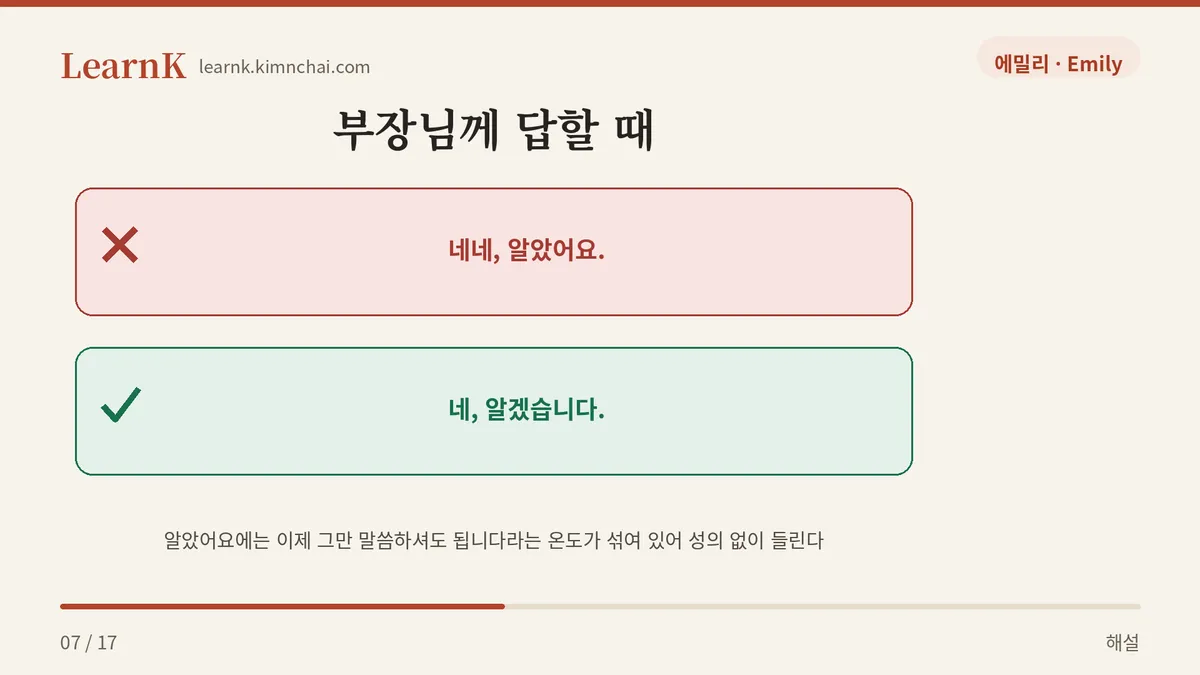
✗ (to your department head) 네네, 알았어요. ✓ (to your department head) 네, 알겠습니다. → 알았어요 (arasseoyo) is unmistakably polite speech, and yet mixed into it is a temperature that says “you can stop talking now.” It’s close to the answer a child gives a parent, so used with someone above you it sounds half-hearted.
✗ (when a friend tells you their grandmother has passed away) 아, 알겠어. ✓ (when a friend tells you their grandmother has passed away) 아… 어떡해. 언제 가면 돼? (a… eotteokhae. eonje gamyeon dwae? — “Oh no… when should I come?”) → 알겠어 is a word for receiving instructions and information. Use it on something someone brought up to share their heart, and it sounds like you’ve processed their grief as a work item. What that moment needs isn’t acceptance — it’s a reaction.
Example Sentences by Situation
1. First day at a café job, and the manager walks you through the closing routine.
네, 알겠습니다. 혹시 남은 원두는 어디에 두면 될까요? (ne, algetseumnida. hoksi nameun wondu-neun eodie dumyeon doelkkayo?) Yes, understood. Where should I put the leftover coffee beans?
The trick is to receive it with 알겠습니다 and then attach a question right away. If you only answer and stop there, it looks like “okay, handled that for now”; with a question trailing behind, it reads as “I really did understand, and I’m already thinking about what comes next.” This is the fastest way a new hire earns trust at a Korean workplace.
2. A friend texts to suddenly change where you’re meeting.
알겠어, 그럼 여섯 시에 이 번 출구에서 봐. (algesseo, geureom yeoseot-si-e i-beon chulgu-eseo bwa.) Got it — see you at exit 2 at six, then.
The casual 알겠어 is short and light. Add a quick recap of what changed and it stops being “I read it” and becomes “I’ve confirmed it.”
3. At the hospital, the doctor explains how to take your medication.
알겠습니다. 그럼 아침 식사 후에 한 알씩 먹으면 되는 거죠? (algetseumnida. geureom achim siksa hue han al-ssik meogeumyeon doeneun geojyo?) Understood. So I take one pill after breakfast, right?
At hospitals, government offices, and banks — places where mishearing something causes real trouble — following 알겠습니다 with a confirming question is practically the formula. Asking again doesn’t make you rude.
Polite and Casual: Similar Expressions
| Expression | Temperature & strength | Where you use it |
|---|---|---|
| 알겠습니다 (algetseumnida) | Courteous, tidy acceptance | Work, the military, official settings. Seniors, people you’ve just met |
| 알겠어요 (algesseoyo) | Soft polite speech | Neighbors, a senior you’ve gotten close to, between a shopkeeper and a customer |
| 알겠어 (algesseo) | Comfortable casual speech | Friends, family, partners |
| 알았어 (arasseo) | Casual, with a cutting-off feel | Close relationships. Depending on intonation, it lands as “enough already” |
| 네 (ne) | The shortest acceptance | Anywhere. A bit flat for long instructions, though |
| 그렇게 하겠습니다 (geureoke hagetseumnida) | The most formal and the heaviest | Contracts, meetings, customer service |
In that table, the difference between 알겠습니다 and 그렇게 하겠습니다 matters most. 알겠습니다 holds both “I understood” and “I’ll do it,” while 그렇게 하겠습니다 keeps only “I’ll do it.” So when you’re locking in a promise in front of a client, the latter is natural; when you’re receiving your boss’s explanation, the former is.
Cultural Background — The Four-Syllable Answer
알겠습니다 is built from the short stem 알- with -겠- and -습니다 attached, a word whose grammar is showing right on the surface. Because the construction is so transparent, it’s an excellent specimen for learners to take apart. Leave the stem alone and slide -겠- in and out — say 압니다 / 알겠습니다 and 몰라요 / 모르겠어요 back to back — and you can hear with your own ears where Korean hides its politeness.
The place this word gets welded most firmly onto Korean tongues is the military. Over the term of service that most Korean men go through, the answer to a superior’s order is effectively standardized down to 알겠습니다 and nothing else. Not 알았습니다 (arasseumnida), not 네 — 알겠습니다. That’s why discharged men keep reaching reflexively for these four syllables even after they join a company, and it’s the same reason military dramas keep repeating scenes of soldiers answering their commanding officer in short, clipped bursts. Listen to something like Descendants of the Sun (KBS2, 2016), where the leads are soldiers, without subtitles, and you can practically count how often this answer comes flying out.
Historical dramas fill the same slot with a different word. When a court official receives a command from the king, far humbler expressions stand in for 알겠습니다; coming down into modern drama, that slot got tidied into 알겠습니다. These days, shorter and lighter answers like 넵 (nep) and 넵넵 (nepnep) in texts and messenger apps are taking over part of 알겠습니다’s territory, but for answers spoken out loud, these four syllables are still the standard. When someone unmutes in a video meeting and 알겠습니다 comes out, that person has already learned the rhythm of a Korean organization.
Today’s Quiz
At the company you’ve just joined, your team leader asks: “이 자료 내일 오전까지 정리해 줄 수 있어요?” (“Can you have this material organized by tomorrow morning?”) What’s the most appropriate answer?
① 네, 알아요. (ne, arayo.) ② 네, 알았어요. (ne, arasseoyo.) ③ 네, 알겠습니다. (ne, algetseumnida.) ④ 어, 알겠어. (eo, algesseo.)
The answer is ③. ① sounds like “Yes, I already knew that” and leaves the other person feeling awkward. ② is polite speech, sure, but mixed into it is a temperature of “you can stop talking now.” ④ is casual speech, so it can’t be used with your team leader. Add “혹시 참고할 자료가 따로 있을까요? (hoksi chamgohal jaryo-ga ttaro isseulkkayo? — “Is there any reference material I should look at?”)” on top of that and you’ve got a perfect score.
Definitions and example sentences are from the National Institute of Korean Language’s Basic Korean Dictionary (krdict.korean.go.kr); that portion of this post, including our translations, is licensed under CC BY-SA 2.0 KR.