악녀 (angnyeo) — Korean Drama's Most Beloved "Bad Woman"
When you watch enough Korean dramas, the character who flips the whole table over tends to stay in your memory longer than the kind-hearted lead. 악녀 (angnyeo) refers to a woman who does wicked things inside a story — a drama, a film, a novel — in other words, a female villain. The one who swaps out the will in the final episode, who steals the heroine’s name and entire life, who destroys people with a smile on her face — Korean viewers call her 악녀 (angnyeo).
악녀 (angnyeo)
To feel the full weight of 악녀 (angnyeo), you have to line it up next to words that look similar. 나쁜 여자 (nappeun yeoja), literally “bad woman,” can be used for someone who simply behaves badly in a relationship — someone who plays too many games or toys with your feelings. But 악녀 goes way past that line. Revenge, conspiracy, swapped identities, sometimes outright crime — it’s the name given to a character who carries the story’s entire conflict on her own shoulders and drags it forward.
One more important point. This word is less a moral verdict on a real person’s character than a label for a role inside a story. That’s why 악녀 in Korean doesn’t carry only hatred. Far more often, there’s admiration mixed in. Saying 「저 배우 악녀 연기 진짜 잘한다」 (“that actress plays a villainess so well”) is one of the highest compliments you can pay a performer, and 「이번 드라마 악녀가 다 살렸다」 (“the villainess carried this whole drama”) means the show was a blast. Viewers curse the 악녀 and wait for the next episode at the very same time.
In terms of temperature: pointed at someone inside the screen, the word is hot and fun; the moment it’s pointed at a real person outside the screen, it turns ice cold. That gap in temperature is the heart of today’s post.
A real conversation
Scene: Eleven o’clock on a Sunday night, the living room of Jun-kyung’s place. The two of them are watching the final episode of a weekend drama, and a decisive scene has just gone by.
Jun-kyung: 야, 봤어? 저 여자가 결국 언니 유서를 바꿔치기했어. Hey, did you see that? She ended up swapping her sister’s will.
Emily: 헐, 대박. 진짜 악녀 중의 악녀 다. Whoa, no way. She’s the villainess of all villainesses.
Jun-kyung: 근데 나 저 배우 이번에 다시 봤다. 악녀 연기를 저렇게 맛있게 하네. But I’ve gained a whole new respect for that actress. She plays the villainess so deliciously.
Emily: 인정. 착한 역 할 때보다 훨씬 살아 있어. Agreed. She’s way more alive than when she plays nice roles.
Jun-kyung: 다음 주부터 뭐 보지? 이거 끝나니까 허전하다. What do we watch from next week? It feels empty now that this is over.
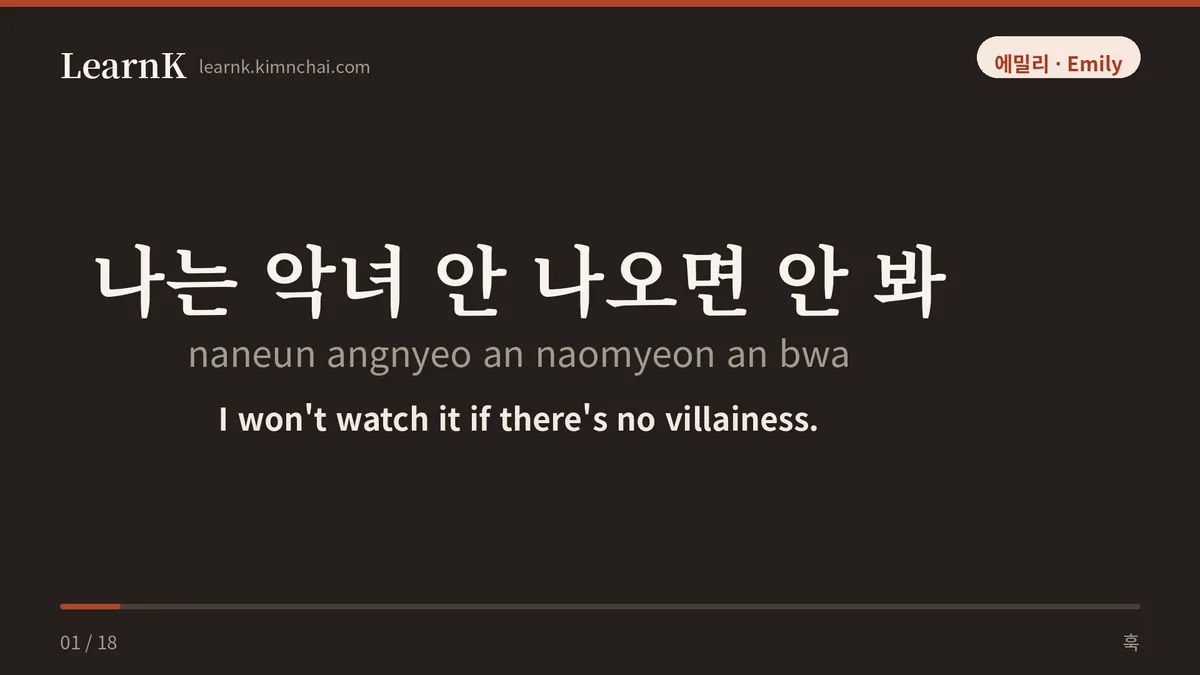
Emily: 나는 악녀 안 나오면 안 봐. 착한 사람만 나오면 졸려. I won’t watch it if there’s no villainess. I get sleepy when everyone’s nice.
This is where it sounds off
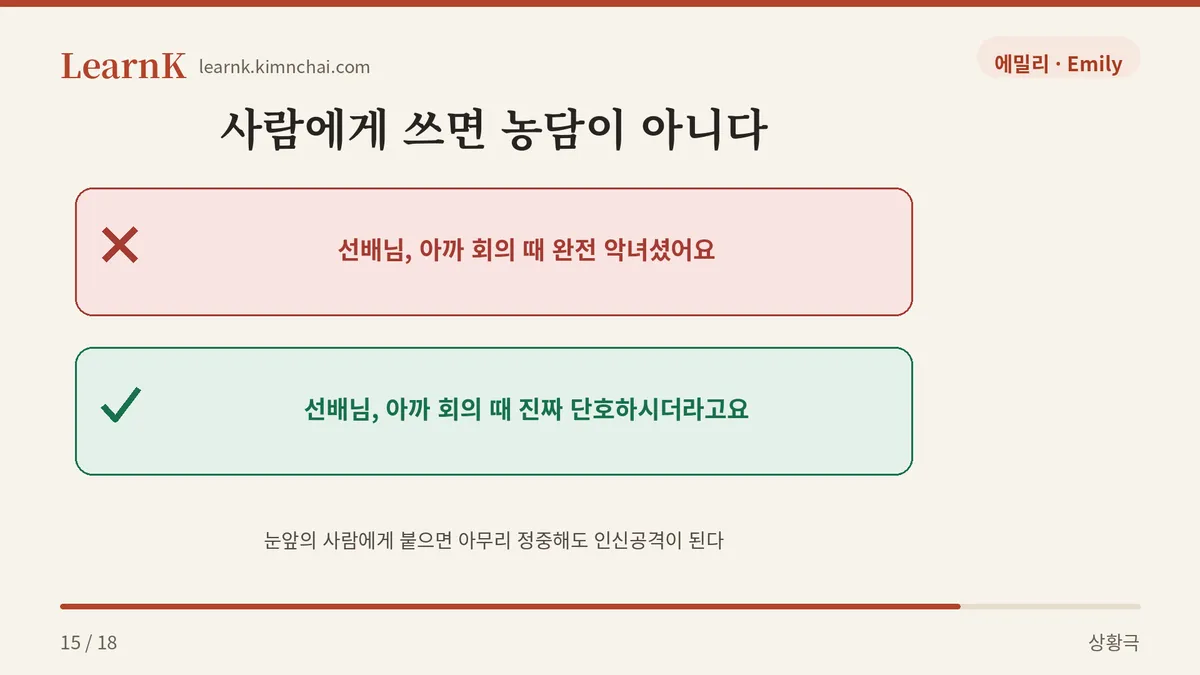
✗ (smiling at a senior colleague on your team) 선배님, 아까 회의 때 완전 악녀 셨어요. (seonbaenim, akka hoeui ttae wanjeon angnyeo syeosseoyo.) ✓ (watching a drama, to a friend) 저 캐릭터 진짜 악녀 다. (jeo kaerikteo jinjja angnyeo da.) → You might think you can toss it out as a joke the way English does with “she’s such a villain,” but in Korean, the instant 악녀 lands on a real person it stops being a joke and becomes a personal attack. When you’re talking about an actual person, it’s safer to switch to something like 「무섭다」 (museopda, “scary”) or 「단호하시다」 (danhohasida, “firm, decisive”).
✗ (pointing at a male actor) 저 남자 배우 악녀 연기 진짜 잘한다. (jeo namja baeu angnyeo yeon-gi jinjja jalhanda.) ✓ (pointing at a male actor) 저 남자 배우 악역 (angyeok) 연기 진짜 잘한다. (jeo namja baeu angyeok yeon-gi jinjja jalhanda.) → The 「녀(女)」 in 악녀 means “woman,” so it’s never used for a male character. To talk about a villain role regardless of gender, use 악역 (angyeok); for a powerful force of evil, use 악당 (akdang) or 빌런 (billeon).
Example sentences by situation
① Posting your thoughts on social media after finishing a drama
- 이번 주 악녀 각성 장면 때문에 소름 돋았어요. (ibeon ju angnyeo gakseong jangmyeon ttaemune soreum dodwasseoyo.) This week’s villainess awakening scene gave me chills.
Korean viewers call the moment when a once-kind character gets hurt and turns ruthless 「각성 (gakseong)」, an “awakening.” Put that word in front of 악녀 and it signals “the counterattack has finally begun.”
② Recommending a drama to a friend
- 이거 악녀 가 너무 매력적이라서 두 편만 보면 못 끊어. (igeo angnyeo ga neomu maeryeokjeogiraseo du pyeonman bomyeon mot kkeuneo.) The villainess in this is so charming that you can’t stop after two episodes.
「악녀가 매력적이다」 (“the villainess is charming”) is the textbook way to praise a drama in Korea. It means the wicked character was written convincingly, which in turn means the script is good.
③ Commenting on an actor’s performance (polite speech)
- 저 배우분은 악녀 역할을 맡을 때 눈빛이 완전히 달라지세요. (jeo baeubuneun angnyeo yeokhareul mateul ttae nunbichi wanjeonhi dallajiseyo.) That actor’s eyes change completely when she takes on a villainess role.
This is a sentence pattern you’ll see all the time in interviews and reviews. 악녀 itself is a noun with no built-in politeness level, so you can change just the sentence ending and use it in any setting.
Politeness levels and similar expressions
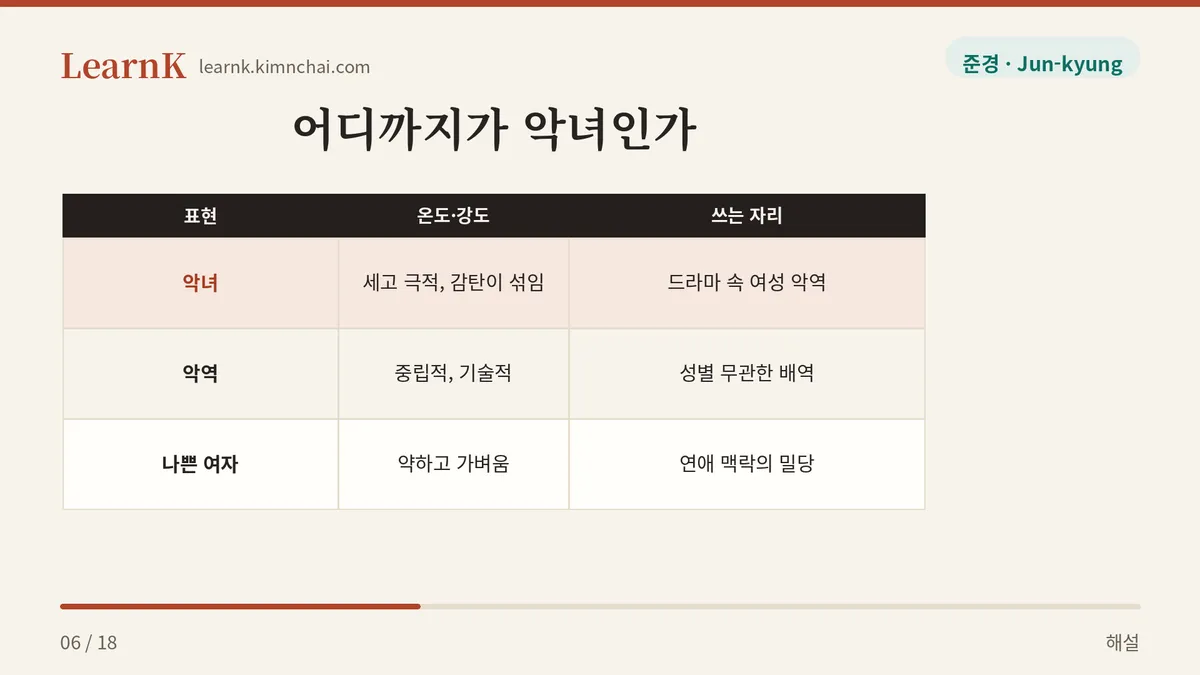
악녀 is a noun, so it carries no honorific level of its own. You simply swap the ending: 「악녀 다 / 악녀 예요 / 악녀 입니다」. But as mentioned above, what decides whether you can use it isn’t grammar — it’s the target. For a character on screen, any speech style sounds natural; for a person standing in front of you, it’s rude no matter how politely you phrase it.
| Expression | Temperature & strength | Where it’s used |
|---|---|---|
| 악녀 (angnyeo) | Strong and dramatic. Mixed with admiration | Female villains in dramas and films. Not used for real people |
| 악역 (angyeok) | Neutral and technical | Any gender. For referring to a villain role objectively |
| 빌런 (billeon) | Light and current | Online and among peers. Also used jokingly, as in 「지하철 빌런」 (“subway villain”) |
| 나쁜 여자 (nappeun yeoja) | Weak, romance context | Games and changes of heart in a love story |
Cultural background — the person you hate and still wait for
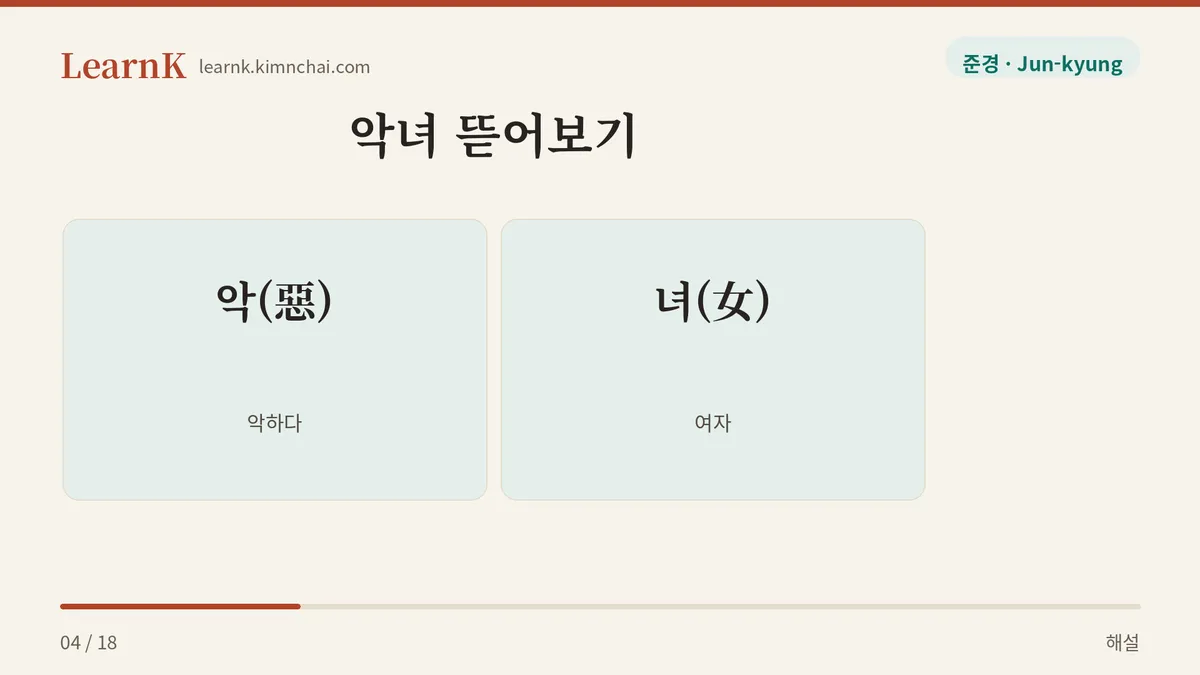
악녀 is a Sino-Korean word formed from 「악할 악(惡)」 (“evil”) and 「여자 녀(女)」 (“woman”). Literally “evil woman” — and because the meaning sits right on the surface of the combination, a learner who knows the characters can read it instantly. The interesting part is that its counterpart 「악남」 is almost never used in Korean. Male villains are called 악당 or 악역, and 악녀 alone hardened into a word with a name all its own.
So why did only the female side get its own special name? It has a lot to do with the history of Korean TV drama. For a long time, the conflicts in morning dramas and weekend dramas grew out of households, inheritances, and family ties, and the character standing at the center of it all, shaking things up, was usually a woman. Viewers cursed her every episode and still never missed the next one. Hatred and addiction served in a single bowl.
From the late 2000s, the current shifted once again. Stories about a woman who was unjustly stripped of everything, then came back with a new name and a new face to pay it all back, became huge hits — and 악녀 stopped being the supporting character who torments the lead and became the lead who drives the story. In Korea this trend is called 「악녀 서사 (angnyeo seosa)」, “the villainess narrative.” There’s even a 2017 action film titled 《악녀》 (The Villainess), which shows just how much this word functions like the name of a genre.
Once you understand this current, two more words Korean drama fans love also fall into place. A plot where the hero just keeps getting stomped on, frustratingly, is called 고구마 (goguma) (“sweet potato”), and a plot where they pay it all back refreshingly is 사이다 (saida) (“soda”) — and 악녀 is the engine that swings a story back and forth between those two flavors. That’s why, for a Korean viewer, the question 「이번 드라마 악녀 어때?」 (“how’s the villainess in this drama?”) is practically the same as asking “is that drama any good?”
Today’s quiz
You’re chatting with a friend about Korean dramas, and you want to praise a terrifying villain played by a male actor. Which word fits the blank?
「저 배우 이번 작품에서 ______ 연기 진짜 잘하더라.」
- 악녀 (angnyeo)
- 악역 (angyeok)
- 나쁜 여자 (nappeun yeoja)
The answer is 2. 악역 (angyeok). 악녀 contains 「녀(女)」, so it’s used only for female characters, and 「나쁜 여자」 is a weak, romance-flavored expression that doesn’t suit a frightening villain at all. When you’re referring to a role regardless of gender, 악역 is the safest choice. For reference, if you were saying this sentence about a female character in a drama rather than a male one, option 1, 악녀, would be a far more vivid compliment.