반반무많이 (banbanmumanhi) — A Whole Chicken Order in Five Syllables
반반무많이 (banbanmumanhi)
반반무많이 (banbanmumanhi) means “make the chicken half seasoned and half plain fried, and give me lots of pickled radish.” Nine o’clock on a Friday night: a voice comes through the phone — 네, 주문하시겠어요? (ne, jumunhasigesseoyo?), “Yes, would you like to order?” — and a Korean will skip the greeting entirely and just toss out these five syllables. And the person on the other end doesn’t ask a single follow-up question. Two flavors, one side dish, and an adjustment to the amount — a request that would take more than twenty syllables spelled out is folded neatly into five. Even now, with delivery apps having all but pushed phone orders out of existence, this phrase has survived. You won’t find it in a dictionary, but anyone who has ever ordered chicken in Korea understands it instantly. It’s an expression rooted firmly on the side of daily life.
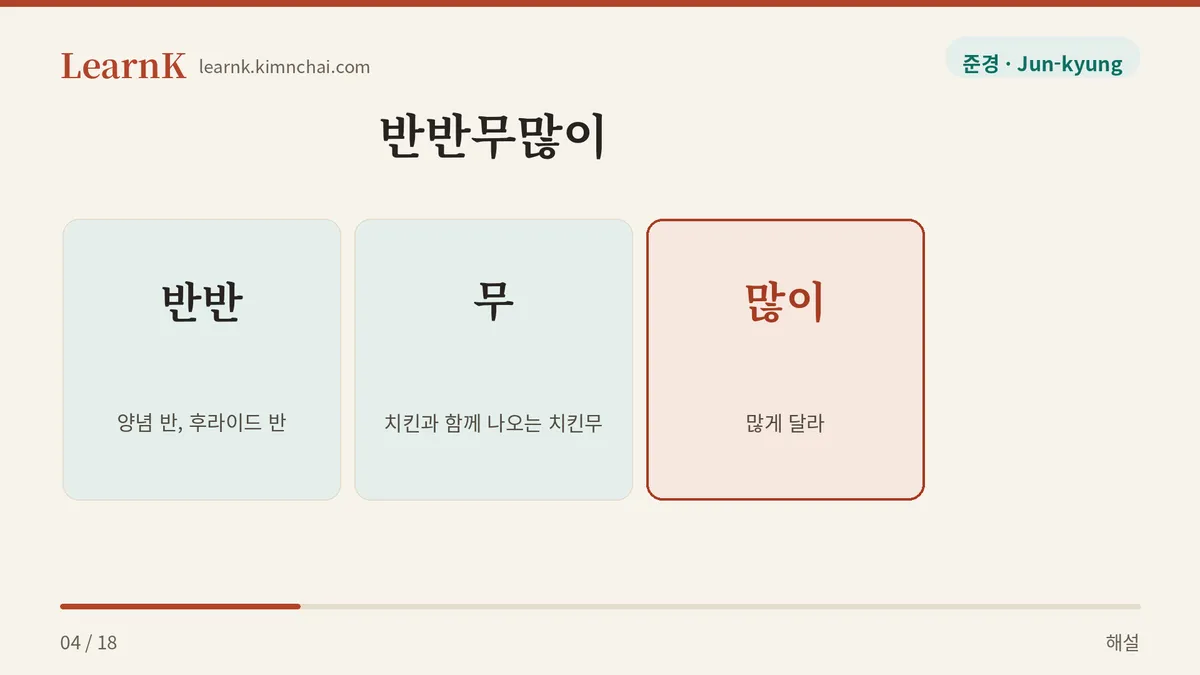
Cut it into three pieces and the structure shows itself immediately. 반반 (banban) means “half each, two kinds”; 무 (mu) is the sweet-and-sour cubed pickled radish that comes alongside fried chicken (치킨무, chikinmu); and 많이 (manhi) means “a lot.” The remarkable part is that there isn’t a single particle or verb ending in it. Unpacked into full Korean, it would be 양념 반 마리와 후라이드 반 마리로 해 주시고, 치킨무는 많이 주세요 (yangnyeom ban mariwa huraideu ban mariro hae jusigo, chikinmuneun manhi juseyo) — “Make it half a seasoned chicken and half a fried one, and please give me lots of pickled radish.” The sheer speed of phone ordering shaved off every particle and ending and left only the five-syllable core. Ordering vocabulary compressed this far is rare in Korean.
The tone is light and friendly. But it isn’t rude, and it isn’t a slang term limited to one generation. Twenty-year-olds and sixty-year-olds alike order chicken with it. That said, because it ends as a bare noun phrase, it’s more natural to round it off at a shop you’re calling for the first time or in a slightly more formal setting. 반반무많이요 (banbanmumanhiyo) or 반반무많이로 주세요 (banbanmumanhiro juseyo) will serve you well anywhere.
These days it has also picked up uses well outside the ordering context. When someone can never quite choose between two options and ends up wanting a little of both, people joke, 쟤는 인생이 반반무많이야 (jyaeneun insaeng-i banbanmumanhiya) — “That guy’s whole life is half-and-half-extra-radish.” Once you know the literal meaning, you can hear the texture of the joke too.
See It in a Real Conversation
Scene: The evening of moving day. They’ve half given up on unpacking and are sitting on the living-room floor with a delivery app open.
Jun-kyung: 아, 못 하겠다. 일단 먹고 하자. 치킨 뭐 시킬까? Ugh, I’m done. Let’s eat first. What chicken should we order?
Emily: 난 양념. 근데 너 후라이드파잖아. I want the seasoned one. But you’re a fried-chicken person.
Jun-kyung: 그럼 답 나왔네. 반반무많이. Then it’s settled. Half and half, extra radish.
Emily: 나 그거 처음 들었을 때 무슨 주문(呪文)인 줄 알았잖아. 다섯 글자를 막 던지길래. When I first heard that, I thought it was some kind of magic spell. You just threw five syllables out there.
Jun-kyung: 다 들어 있잖아. 반반, 무, 많이. 더 줄일 데가 없어. It’s all in there. Half-half, radish, lots. There’s nothing left to cut.
Emily: 알았어, 내가 시킬게. 여기요, 반반무많이 하나요 — 아 참, 앱이지. 왜 소리를 내고 있냐. Okay, I’ll order. “Excuse me, one banbanmumanhi” — oh right, it’s an app. Why am I saying it out loud.
When It Sounds Off
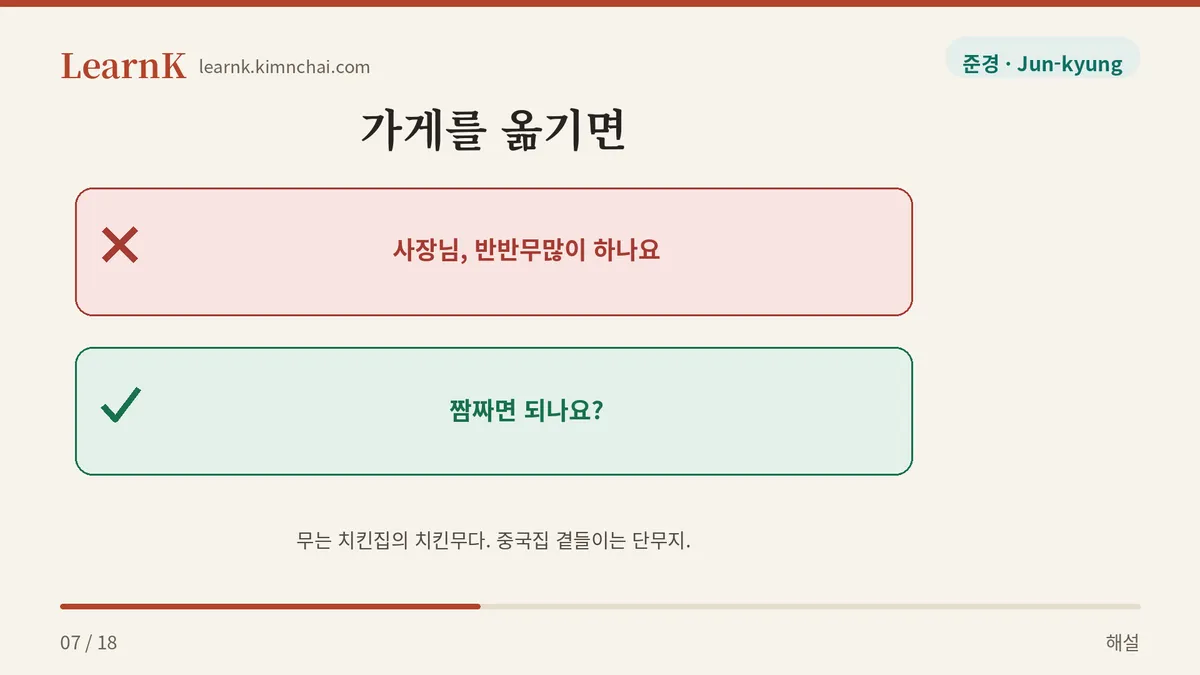
✗ (Calling a Chinese restaurant) 사장님, 반반무많이 하나요. (sajangnim, banbanmumanhi hanayo.) ✓ (Calling a Chinese restaurant) 짜장 하나, 짬뽕 하나요. (jjajang hana, jjamppong hanayo.) / 짬짜면 되나요? (jjamjjamyeon doenayo?) → The 무 (mu) in 무 많이 refers specifically to the pickled radish served with fried chicken, so the phrase stops working the moment you step outside a chicken shop. Chinese-Korean restaurants have their own 반반 (banban), but that means 짬짜면 (jjamjjamyeon) — half 짜장면 (jjajangmyeon) and half 짬뽕 (jjamppong) in one bowl — and the side that comes with it isn’t 치킨무 (chikinmu) but 단무지 (danmuji), yellow pickled daikon. Change the venue and the same five syllables suddenly become a riddle.
✗ (The instant the chicken shop picks up) 반반무많이. (banbanmumanhi.) ✓ (The instant the chicken shop picks up) 안녕하세요, 반반무많이 하나 주세요. 주소는 ○○아파트 101동이요. (annyeonghaseyo, banbanmumanhi hana juseyo. jusoneun ○○ apateu 101-dong-iyo.) → Nothing here is grammatically wrong; the temperature is just off. Dropping a bare noun phrase with no ending is the speech of a familiar regular, but at a shop you’re calling for the first time it lands as curt and careless. Just tacking on -요 (-yo) or 주세요 (juseyo) changes the impression completely.
Example Sentences by Situation
1. When Tastes Differ — The Line That Ends the Argument
When two people want different flavors and have been glaring at the menu for ten minutes straight, this phrase is close to a declaration that negotiations are over.
우리 그냥 반반무많이 하자. 그럼 둘 다 먹잖아. uri geunyang banbanmumanhi haja. geureom dul da meokjanha. (Let’s just go with banbanmumanhi. Then we both get to eat what we want.)
2. In a Group — Attaching a Quantity
At gatherings where you order several birds at once — a work dinner, a housewarming — you add the quantity at the end. Chicken is counted with the counter 마리 (mari).
여기 반반무많이 세 마리요. 무는 넉넉히 부탁드려요. yeogi banbanmumanhi se mariyo. muneun neokneokhi butakdeuryeoyo. (Three banbanmumanhi here, please. And go generous on the radish.)
3. Beyond Ordering — As a Joke
Used to gently tease someone who can never pick just one thing. The joke only lands if the other person knows the literal meaning, so it’s best kept to close friends.
너는 무슨 인생이 반반무많이냐. 하나만 골라. neoneun museun insaeng-i banbanmumanhinya. hanaman golla. (Why does your whole life have to be half-and-half-extra-radish? Just pick one.)
Polite and Casual Forms, and Similar Expressions
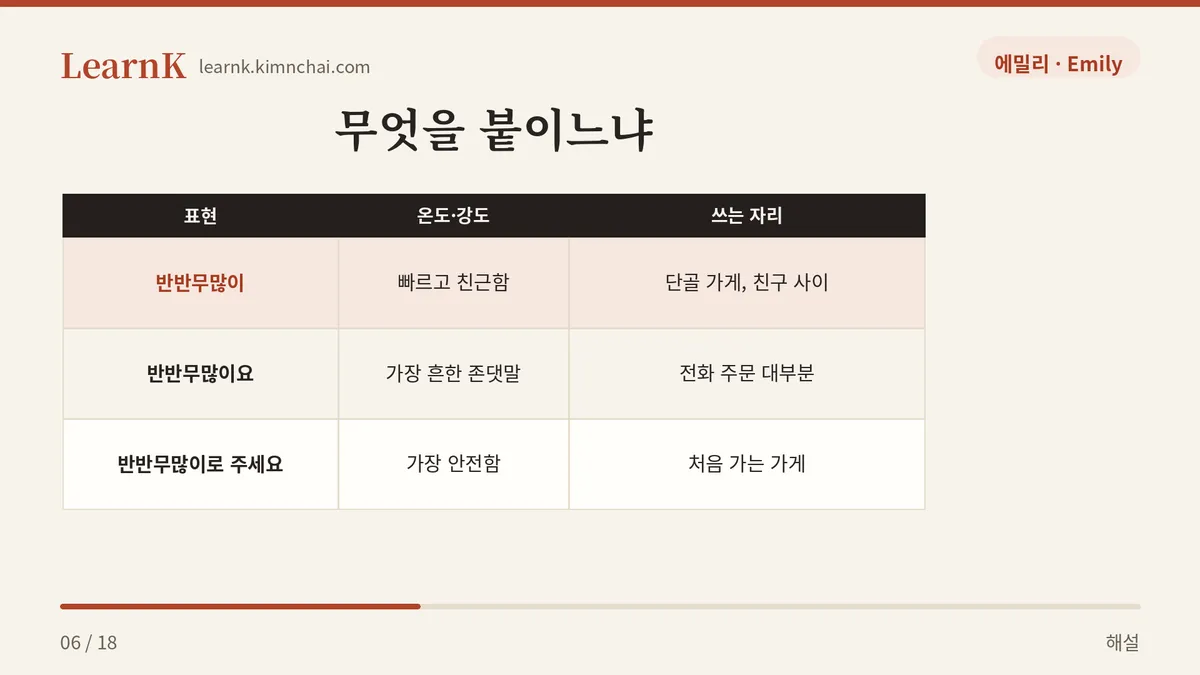
The polite/casual distinction doesn’t exist in the expression itself — it’s a noun phrase, after all. Instead, politeness is decided by what you attach to the end. The casual form is 반반무많이 (banbanmumanhi), the most common polite form is 반반무많이요 (banbanmumanhiyo), and the safest form to use in a shop is 반반무많이로 주세요 (banbanmumanhiro juseyo).
| Expression | Tone & Intensity | Where It’s Used |
|---|---|---|
| 반반무많이 (banbanmumanhi) | Fast and friendly. The speech of a regular | Chicken shop phone calls and counters. Add -요 (-yo) in formal settings |
| 양념 반 후라이드 반 주세요 (yangnyeom ban huraideu ban juseyo) | Neutral, polite | A shop you’re visiting for the first time, or when menu names vary by shop |
| 반반이요 (banbaniyo) | Short, neutral | When it’s already clear what’s being split half and half. Leaves out the side-dish request |
| 무 많이 주세요 (mu manhi juseyo) | A requesting tone | For adding one more line after you’ve finished ordering |
What the table makes clear is that 반반무많이 (banbanmumanhi) is the only one that bundles the flavor choice and the side-dish request into a single lump. The others say only one or the other. That’s exactly why this phrase has lasted so long.
Cultural Background — The Impulse to Split One Chicken in Two
The word formation is transparent: 반반 (banban, half seasoned + half fried) + 무 (mu, pickled radish) + 많이 (manhi, a lot). All three pieces are ordinary existing words; not one syllable was newly invented. What did happen is that the particles and endings dropped out wholesale. A phone order lasted twenty seconds at most, and those twenty seconds whittled the sentence down this far.
If you don’t know 치킨무 (chikinmu), half the meaning of this phrase is missing. At a Korean chicken shop, the fried chicken arrives with a small tub of sweet-and-sour cubed pickled radish. You’re working through greasy fried chicken, you pick up a cube, your mouth feels clean again, and you go back for more — it functions like a rewind button. Because shops generally don’t charge for it, the request 많이 (manhi) is possible in the first place. You’re not paying extra; you’re asking for a bit of generosity — which is why the phrase carries equal parts apology and cheerful nerve.
There’s a picture of Korean-style compromise inside 반반 (banban) too. One whole chicken is usually just the right amount for two people to share, but it’s rare for two people to have the same taste. So the practice took hold of splitting one bird lengthwise and serving half seasoned, half fried. It’s a way for neither side to give up their preference while still sharing the same table. The reason dramas and variety shows are so full of scenes where people spread newspaper on the floor and open a chicken box is that this food is the act of sharing.
One caution. The 반반 (banban) at a Chinese-Korean restaurant belongs to a different family line. Over there it means 짬짜면 (jjamjjamyeon), one bowl holding half 짜장면 (jjajangmyeon) and half 짬뽕 (jjamppong), and the side that comes with it is 단무지 (danmuji), not 치킨무 (chikinmu). Same 반반, but cross the shop’s threshold and what it points to changes.
As delivery apps have become universal, this phrase has fewer and fewer occasions to be spoken aloud. The flavors scattered into checkboxes, the extra radish into the special-requests field. And yet Koreans still open the app and turn to the person next to them and ask, 반반무많이? (banbanmumanhi?) The way we order has changed, but the impulse to split our preferences down the middle and ask for plenty of radish is still sitting right there inside those five syllables.
Today’s Quiz
Which of the following is the most awkward place to use 반반무많이 (banbanmumanhi)?
- Calling a chicken shop with a friend to order one chicken
- Ordering three chickens at once at a work dinner
- Calling a Chinese-Korean restaurant to order 짜장면 (jjajangmyeon) and 짬뽕 (jjamppong)
- Gently teasing a friend who can never choose anything
Answer: 3. The 무 (mu) in 무 많이 refers to 치킨무 (chikinmu), the pickled radish that comes with fried chicken. Chinese-Korean restaurants don’t have 치킨무 — they serve 단무지 (danmuji) — and a bowl holding half 짜장면 (jjajangmyeon) and half 짬뽕 (jjamppong) has its own name: 짬짜면 (jjamjjamyeon). In that setting, it’s more natural to ask 짬짜면 되나요? (jjamjjamyeon doenayo?). The other three situations all work perfectly well, and when you’re ordering several birds as in option 2, just add the quantity at the end, like 세 마리요 (se mariyo).