뵙다 (boepda) — When the Word for "Meet" Knows Its Place
뵙다 (boepda)
뵙다 (boepda) means “to meet someone senior to you.” Pushing open the door into a job interview, sitting down in front of your partner’s parents for the first time, the company president walking into the meeting room — the first words Koreans produce in those moments, almost as a reflex, are 처음 뵙겠습니다 (cheoeum boepgetseumnida). English meet holds up no matter who is on the other side. Age, rank, whether it’s your first time or your fifth — none of it budges the verb. Korean, though, swaps out the verb itself the instant the other person ranks above you. Say 처음 만나겠습니다 (cheoeum mannagetseumnida) in that same room and the grammar is perfectly fine, but the air goes crooked. It doesn’t sound wrong. It sounds like you don’t know where you’re standing.
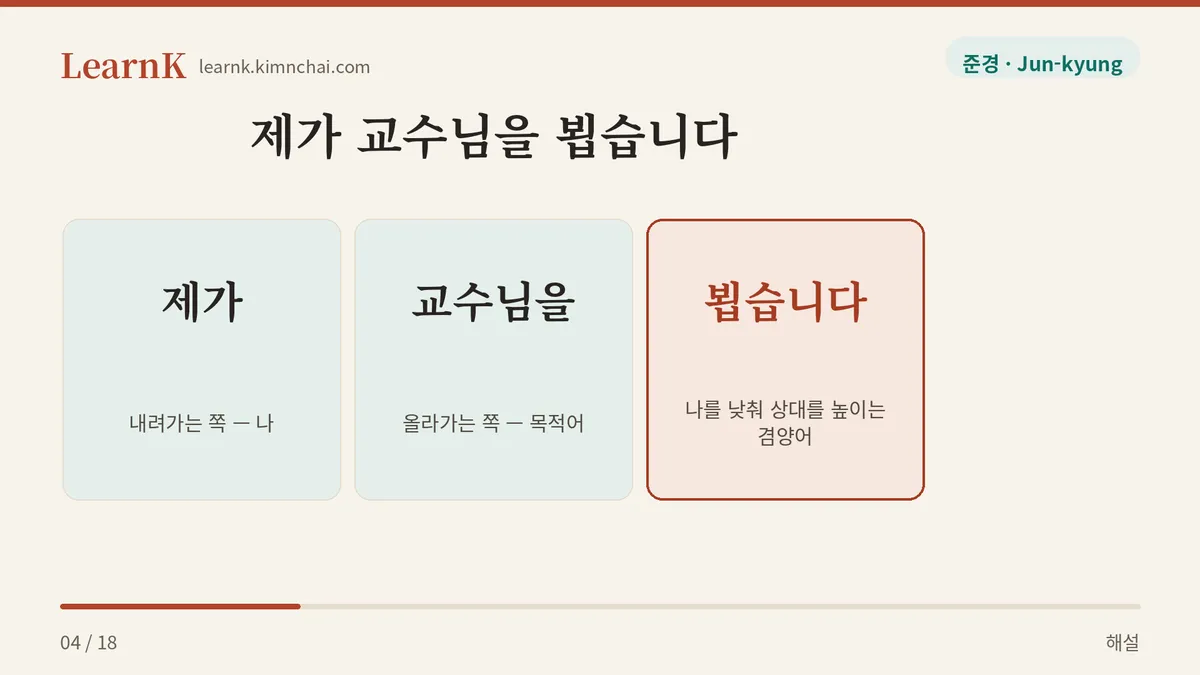
뵙다 (boepda) belongs to the humble register — 겸양어 (gyeomyang-eo) — within Korean honorific speech. Korean elevation runs in two directions. One lifts the other person up (선생님께서 오셨다, seonsaengnim**-kkeseo** osyeotda), and the other lowers you, so that the other person ends up higher as a result. 뵙다 (boepda) is the second kind. That’s why one detail is decisive: the person being raised is not the subject of the sentence but the object. In 제가 교수님을 뵙습니다 (jega gyosunim-eul boepseumnida), the one going up is the professor and the one going down is me. Because of this structure, 뵙다 (boepda) only ever works in one direction — I (or someone on my side of the line) meeting someone above. Flip the direction and the sentence falls apart.
The temperature is different, too. If 만나다 (mannada) draws a picture of two people converging somewhere in the middle, 뵙다 (boepda) carries the shadow of me traveling and standing before them. That’s why it so often expands into 찾아뵙다 (chajaboepda), and why it attaches so naturally to occasions — holidays, hospital visits — where half the meaning is the effort of going.
Checking it in the National Institute of Korean Language dictionary
The National Institute of Korean Language’s Basic Korean Dictionary defines 뵙다 (boepda) this way.
뵙다 (boepda) 〔verb〕 To meet someone who is your senior. [en] see; meet; meet with — To see a person who is elder. [ja] おめにかかる【御目に掛かる】。おあいする【お会いする】 — 目上の人に会う。 [es] ver, visitar, encontrar — Encontrarse con una persona superior. [zh] 拜见 — 与长辈见面。 — National Institute of Korean Language, Basic Korean Dictionary (krdict.korean.go.kr)
There is no Portuguese translation in this dictionary. For reference, it would come out to something like ver / visitar (uma pessoa mais velha ou superior) — but let us be clear that this is our own rendering, not dictionary material.
Line those four definitions up side by side and one thing jumps out. The English and Spanish entries had to tack the other person’s status on as an explanation: elder, persona superior. A single verb in those languages simply can’t carry that information. Japanese, by contrast, maps it straight onto おめにかかる, a humble verb of its own. Which is to say: Korean and Japanese each keep a dedicated verb for this slot, and European languages don’t have one. Learning 뵙다 (boepda) isn’t memorizing a word — it’s learning that the slot exists at all.
Here are the real usage examples listed in the same dictionary.
고승을 뵙다. (goseung-eul boepda.) — To meet with a high monk. 교무실에서 선생님을 뵙다. (gyomusil-eseo seonsaengnim-eul boepda.) — To see one’s teacher in the faculty room. 교황을 뵙다. (gyohwang-eul boepda.) — To have an audience with the Pope. 노부모를 뵙다. (nobumo-reul boepda.) — To visit one’s elderly parents. 노마님을 찾아뵙다. (nomanim-eul chajaboepda.) — To call on the old mistress of the house. — National Institute of Korean Language, Basic Korean Dictionary (krdict.korean.go.kr)
- 고승을 뵙다 (goseung-eul boepda) — the situation of traveling to a temple to pay your respects to a senior monk. A 고승 (goseung) ranks above you not by age but by the depth of their practice, which shows that the “above” in 뵙다 (boepda) isn’t decided by age alone.
- 교무실에서 선생님을 뵙다 (gyomusil-eseo seonsaengnim-eul boepda) — of the five examples, this is the one closest to a learner’s life. There’s no ceremony involved; it’s the school faculty room. In other words, 뵙다 (boepda) isn’t reserved for grand occasions — as long as the other person is your senior, it applies to an ordinary drop-in visit just the same.
- 교황을 뵙다 (gyohwang-eul boepda) — the most distant example on the list. A believer granted an audience with the Pope in Rome. Here 뵙다 (boepda) is so firmly fixed that swapping in 만나다 (mannada) would make the sentence go awkward on the spot.
- 노부모를 뵙다 (nobumo-reul boepda) — you use 뵙다 (boepda) with family, too. This is the heart of the Korean sense of honorifics. No matter how close you are, parents are your elders, and intimacy does not erase elevation.
- 노마님을 찾아뵙다 (nomanim-eul chajaboepda) — the only example with 찾아- (chaja-) attached. 노마님 (nomanim) is an old word for the lady of a great household, so you’ll almost never hear it in modern conversation — but the fact that 찾아뵙다 (chajaboepda) carries the meaning “I go to their house on my own two feet” holds just as true today.
Seeing it in real conversation
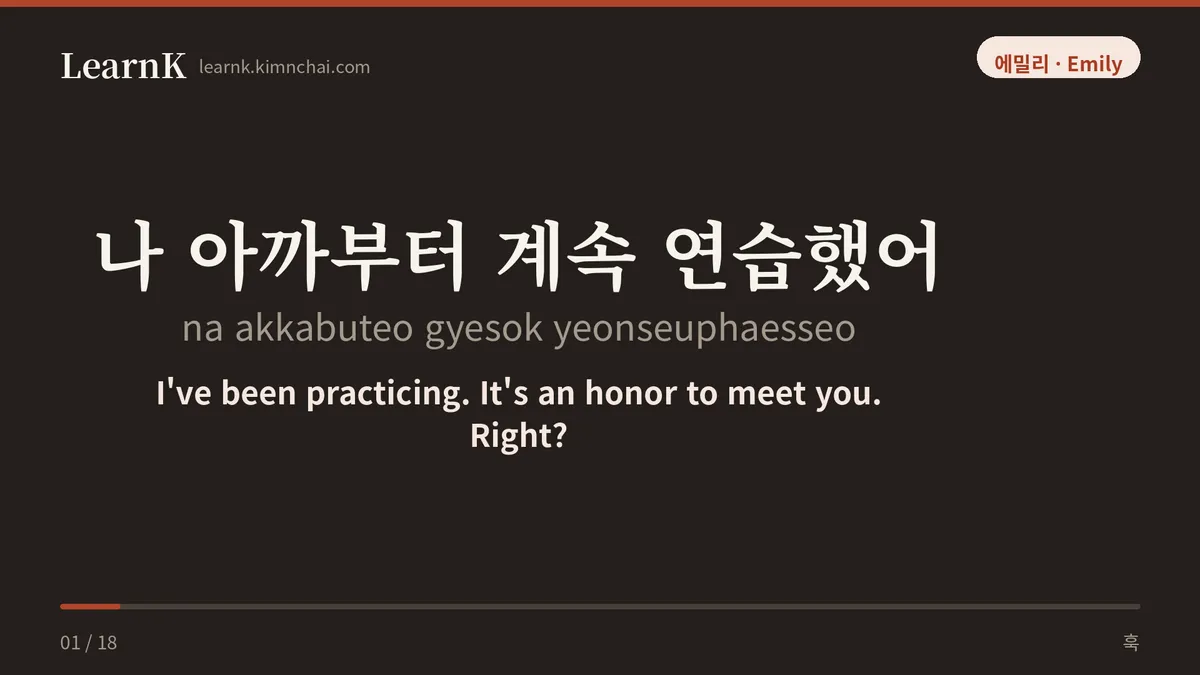
Scene: On an intercity bus to Jun-kyung’s grandmother’s house, the day before Chuseok. Emily is on her way to meet his grandmother for the first time.
Emily: 나 아까부터 계속 연습했어. “처음 뵙겠습니다.” 이거 맞지? I’ve been practicing this whole time. “It’s an honor to meet you.” That’s right, isn’t it?
Jun-kyung: 어, 완벽해. 근데 너무 긴장하지 마. 우리 할머니 되게 편하셔. Yeah, perfect. But don’t be so nervous. My grandma’s really laid-back.
Emily: 편한 거랑 별개지. 나 여기 15년 살았는데도 이런 자리는 아직 떨려. That’s a separate thing. I’ve lived here fifteen years and this kind of occasion still makes me nervous.
Jun-kyung: 하긴, 나도 작년에 너희 부모님 처음 뵀을 때 손 떨었잖아. Fair. I was shaking too when I first met your parents last year.
Emily: 아 맞다, 그때 진짜 웃겼는데. 우리 내려서 과일이라도 사 갈까? Oh right, that was so funny. Should we get off and buy some fruit or something?
Jun-kyung: 벌써 트렁크에 있어. 자주 찾아뵙지도 못하는데 빈손으로 가면 좀 그렇잖아. It’s already in the trunk. We can’t even visit often, so showing up empty-handed would feel off.
Within a single conversation, 뵙다 (boepda) shows up wearing three different shapes. 뵙겠습니다 (boepgetseumnida) is the greeting for a first meeting, 뵀을 (때) (bwaess-eul ttae) is a meeting in the past, and 찾아뵙지도 (못하다) (chajaboepjido mothada) is a visit that includes the effort of going. And notice that the two of them are speaking 반말 (banmal), casual speech, to each other. The reason 뵙다 (boepda) stays alive even in casual speech is that the person being elevated isn’t the listener — it’s the grandmother and the parents inside the sentence.
These usages sound off
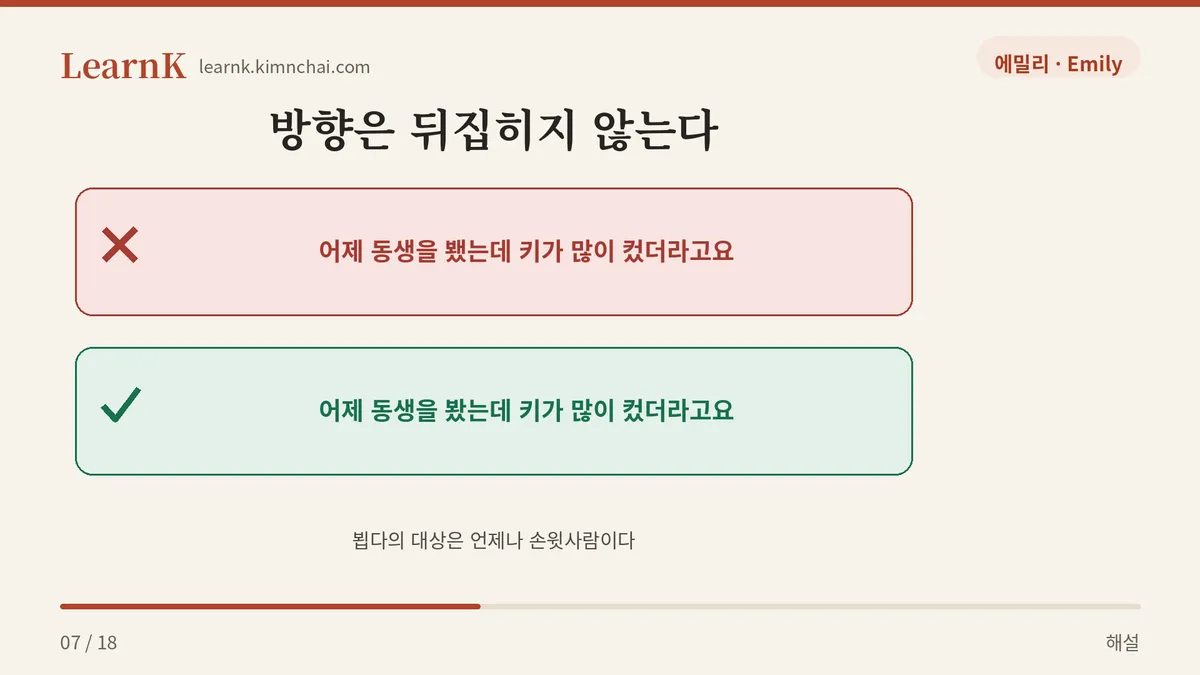
✗ 어제 동생을 뵀는데 키가 많이 컸더라고요. (eoje dongsaeng-eul bwaenneunde kiga mani keotdeoragoyo.) ✓ 어제 동생을 봤는데 키가 많이 컸더라고요. (eoje dongsaeng-eul bwanneunde kiga mani keotdeoragoyo.) → 뵙다 (boepda) only works when the object is someone senior to you. Use it on a younger sibling or a junior and it doesn’t read as modesty — it reads as a sentence that’s slipped out of joint. This is the single most common learner error: over-elevating someone and landing in awkwardness instead.
✗ (to a client) 내일 저희 사무실로 저를 뵈러 오세요. (naeil jeohui samusillo jeoreul boereo oseyo.) ✓ (to a client) 내일 저희 사무실로 저를 만나러 오세요. (naeil jeohui samusillo jeoreul mannareo oseyo.) → Put yourself in the object slot of 뵙다 (boepda) and you end up elevating yourself. Humble verbs are directional by nature; you can’t spin the arrow around. The moment you’re the object, just use 만나다 (mannada).
Example sentences by situation
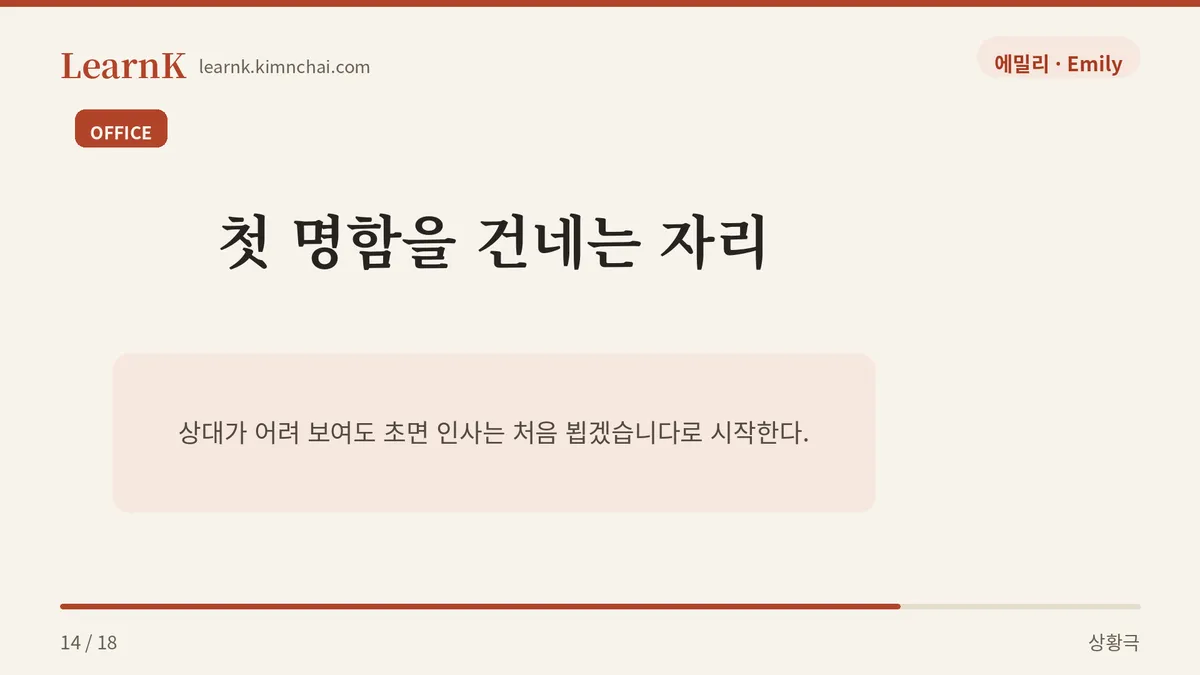
① Handing over your first business card (a first business meeting)
처음 뵙겠습니다. 마케팅팀 김준경입니다. (cheoeum boepgetseumnida. marketing-tim Kim Jun-gyeong-imnida.) — 처음 뵙겠습니다: It’s an honor to meet you for the first time.
At a Korean company, a first-time greeting starts with this sentence almost without exception. Even if the other person looks younger than you or lower in rank, on a first meeting you just use 뵙겠습니다 (boepgetseumnida). When it doesn’t yet know where the other person stands, Korean leans toward elevating them.
② Confirming the next appointment as you part ways
그럼 다음 주 화요일 두 시에 뵙겠습니다. (geureom da-eum ju hwayoil du si-e boepgetseumnida.) — 그럼 다음 주 화요일 두 시에 뵙겠습니다: Then I’ll see you next Tuesday at two.
Try to carry English See you straight across and you’ll say 봐요 (bwayo) — which, depending on who you’re talking to, lands abruptly light. The default form when parting from someone senior is 뵙겠습니다 (boepgetseumnida); to soften it a little, it becomes 봬요 (bwaeyo).
③ When you can’t make it home for the holiday (by phone or message)
이번 설에는 찾아뵙지 못해 죄송합니다. 다음 달에 꼭 찾아뵐게요. (ibeon seolleneun chajaboepji mothae joesonghamnida. da-eum dare kkok chajaboelgeyo.) — 이번 설에는 찾아뵙지 못해 죄송합니다: I’m sorry I can’t come visit you this Lunar New Year.
What’s being apologized for here isn’t failing to meet — it’s failing to go. The “I move” component built into 찾아뵙다 (chajaboepda) is exactly what the apology rests on. In Korea, half of every holiday phone call circles somewhere near this sentence.
Related expressions, formal and casual
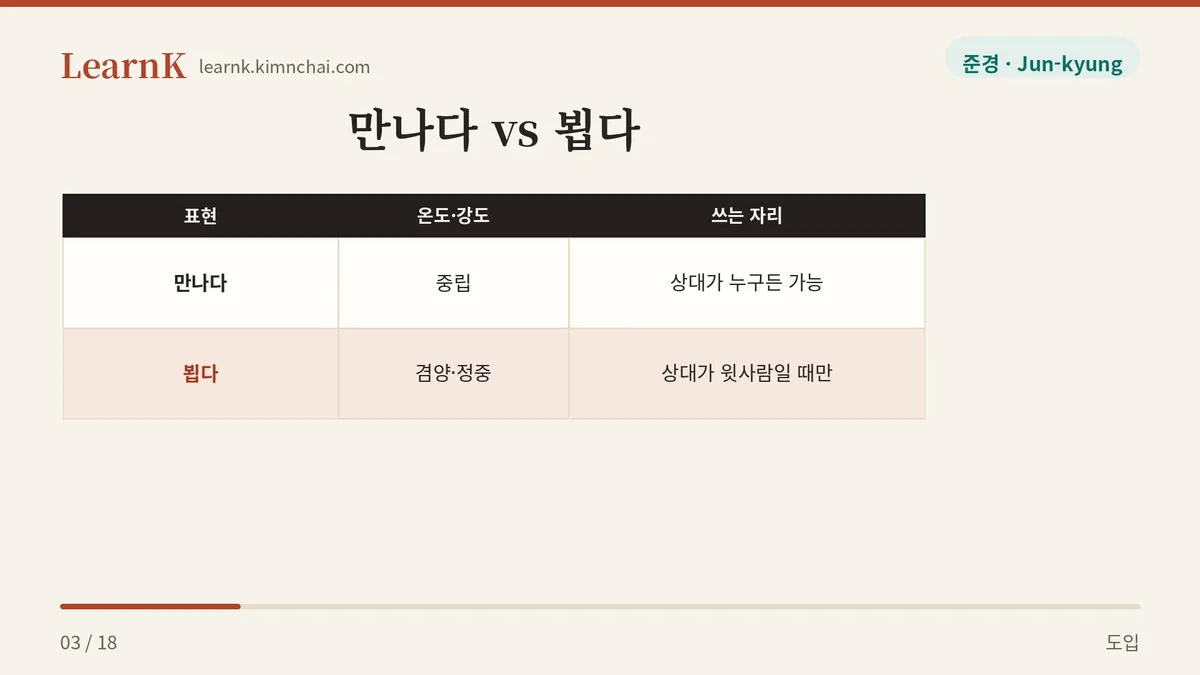
| Expression | Temperature / intensity | Where it’s used |
|---|---|---|
| 뵙다 (boepda) | The most formal and polite | First meetings, official occasions. Used only before consonant-initial endings (뵙겠습니다, 뵙고, 뵙는) |
| 뵈다 (boeda) | Polite but a touch softer | The same humble verb. Used before vowel-initial endings (봬요, 뵀어요, 뵐게요) |
| 찾아뵙다 (chajaboepda) | Polite + I go there myself | Holidays, hospital visits, courtesy calls. The effort of going is part of the meaning |
| 만나 뵙다 (manna boepda) | Formal, written register | Emails, official notices. “만나 뵙게 되어 영광입니다” (manna boepge doeeo yeonggwang-imnida) |
| 만나다 (mannada) | Neutral | Works with anyone. Used with a senior, it lands slightly flat |
| 보다 (boda) | The most casual | Peers and juniors. “내일 봐” (naeil bwa) |
The first two rows in that table are what trip learners up the most. 뵙다 (boepda) and 뵈다 (boeda) are a pair with the same meaning, but they take different endings. 뵙- (boep-) survives only before endings that begin with a consonant (뵙겠습니다 boepgetseumnida, 뵙고 싶습니다 boepgo sipseumnida), and when a vowel ending comes along it turns into 뵈- (boe-): 뵈어요 (boe-eoyo) → 봬요 (bwaeyo), 뵈었어요 (boe-eosseoyo) → 뵀어요 (bwaesseoyo). Which is why the form 뵙어요 (boebeoyo) simply does not exist. Koreans mix this up constantly too, typing 다음에 뵈요 (da-eume boeyo) in messages — but the standard spelling is 봬요 (bwaeyo), because it’s a contraction of 뵈어요 (boe-eoyo).
A note on the casual side as well. It’s not that 뵙다 (boepda) has no casual conjugations. 너 어제 교수님 뵀어? (neo eoje gyosunim bwaesseo?) and 나 내일 할머니 뵐 거야 (na naeil halmeoni boel geoya) are both perfectly natural. The listener is a friend, but the person being elevated is the professor and the grandmother inside the sentence. And if you swap 뵀어 (bwaesseo) for 봤어 (bwasseo) here, the meaning splits in a subtle way. 교수님 봤어? (gyosunim bwasseo?) is closer to a sighting — did you spot them in the hallway? — while 교수님 뵀어? (gyosunim bwaesseo?) is a face-to-face encounter: did you go see them, greet them, talk with them? One syllable, and the weight of the meeting changes.
Cultural background — what it means to 찾아뵙다 (chajaboepda)
뵙다 (boepda) and 뵈다 (boeda) are generally explained as contracted forms of 보이다 (boida), which is 보다 (boda) plus the suffix -이- (-i-). Follow that explanation and the picture sharpens. It isn’t that I look at them — it’s that I show myself before them. The initiative of the gaze doesn’t belong to me; it sits with the senior. The whole sensibility of Korean humble speech is compressed into that one syllable.
So the occasions where 뵙다 (boepda) gets passed back and forth most often are fairly fixed. 설 (Seol) and 추석 (Chuseok) — the two days when every highway in the country grinds to a halt — are in practice “days for 찾아뵙기 (chajaboepgi).” When people can’t get tickets, or work gets in the way and they can’t go, they call to say they’re sorry. Not for failing to meet, but for failing to go. The same goes for the 상견례 (sanggyeollye), the formal first meeting between two families. In that room where the two households sit down across from each other for the first time, the opening line is nearly always 처음 뵙겠습니다 (cheoeum boepgetseumnida) — and a hospital visit, pushing open the door of a patient’s room, and a message to a long-out-of-touch former teacher all ride on this same verb.
Watch enough Korean dramas and you’ll run into scenes where this word does real work, again and again. In the episode where one partner goes to greet the other’s family for the first time, the door opens, the head bows, and this is the first thing out of their mouth. The subtitles usually just say Nice to meet you — but the original sentence has one more layer laid underneath that the subtitle can’t carry over. Something like a declaration: I am standing in the lower seat of this house right now.
It’s fixed in broadcast language, too. What news anchors and variety-show hosts say to close out a program is 다음 주에 뵙겠습니다 (da-eum ju-e boepgetseumnida). It’s a conventional greeting that places the viewer in the senior’s seat, and it’s so thoroughly set by now that it simply reads as the formal farewell itself. For someone learning Korean, there’s no better textbook. Watch any broadcast through to the end and this expression will land in your ear, in natural intonation, several times a day.
Today’s quiz
Which of the following sentences uses 뵙다 (boepda) incorrectly?
- 내일 오전에 회장님을 뵙기로 했습니다. (naeil ojeone hoejangnim-eul boepgiro haetseumnida.)
- 이번 명절에는 부모님을 찾아뵈려고 기차표를 미리 끊었어요. (ibeon myeongjeoreneun bumonim-eul chajaboeryeogo gichapyo-reul miri kkeunheosseoyo.)
- 어제 동생을 뵀는데 키가 많이 컸더라고요. (eoje dongsaeng-eul bwaenneunde kiga mani keotdeoragoyo.)
- 처음 뵙겠습니다. 앞으로 잘 부탁드립니다. (cheoeum boepgetseumnida. apeuro jal butakdeurimnida.)
See the answer
The answer is number 3. A younger sibling is your junior, so they can’t be the object of 뵙다 (boepda). The correct version is 어제 동생을 봤는데 키가 많이 컸더라고요 (eoje dongsaeng-eul bwanneunde kiga mani keotdeoragoyo). As a side note, the 찾아뵈려고 (chajaboeryeogo) in number 2 sits before the vowel-initial ending -려고 (-ryeogo), so it takes 뵈- (boe-) rather than 뵙- (boep-) — a correct conjugation.
Definitions and example sentences are from the National Institute of Korean Language’s Basic Korean Dictionary (krdict.korean.go.kr); that portion of this post, including our translations, is licensed under CC BY-SA 2.0 KR.