복불복 (bokbulbok) — The Word for Things You Can't Know Until You Open Them
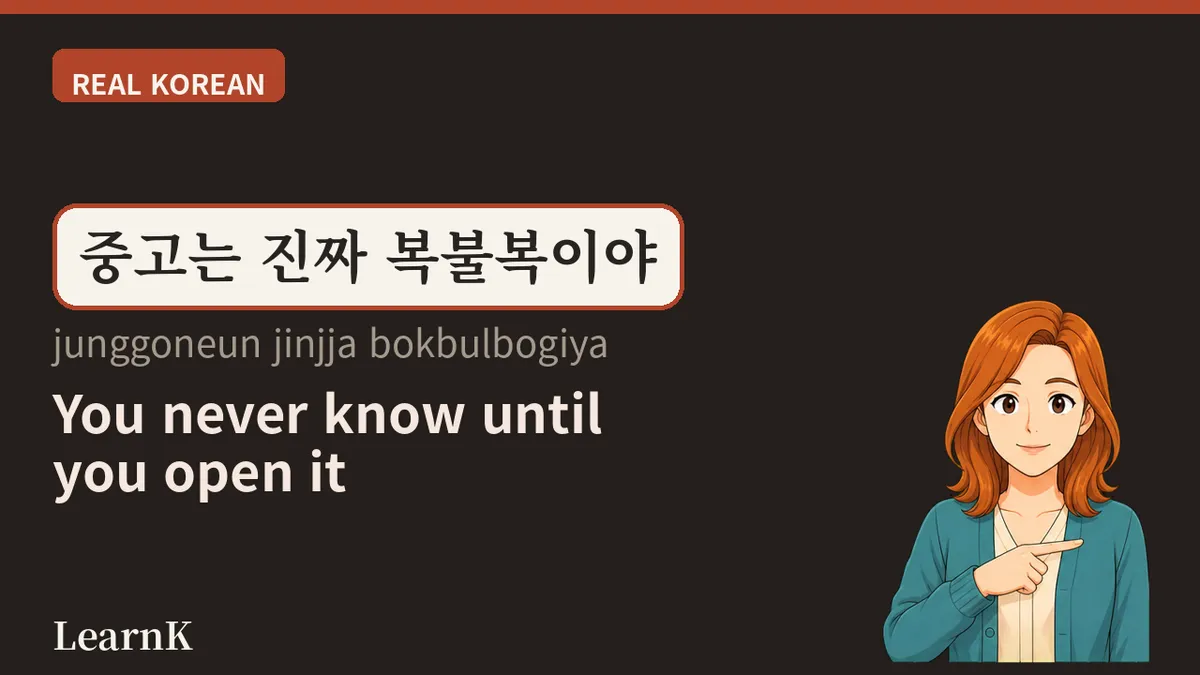
복불복 (bokbulbok)
복불복 (bokbulbok) means that you can’t know in advance which side you’ll land on, and the outcome rests purely on luck. You pay the same price, stand in the same line, choose under the same conditions — and yet one person gets the good one and another doesn’t. That split itself is what this single word names.
The situations where this word pops out are fairly predictable. Right before you press the power button on something you bought secondhand. The moment you sit down in the chair at a hair salon you’ve never been to. When an unfamiliar professor’s name shows up on your new semester timetable. They all have one thing in common: there’s no room left for you to do any better. You can read more reviews, you can shop around more — in the end, you have to open the lid to find out. At moments like that, Koreans give a little shrug and say, “뭐, 복불복이지.” (mwo, bokbulbogiji.)
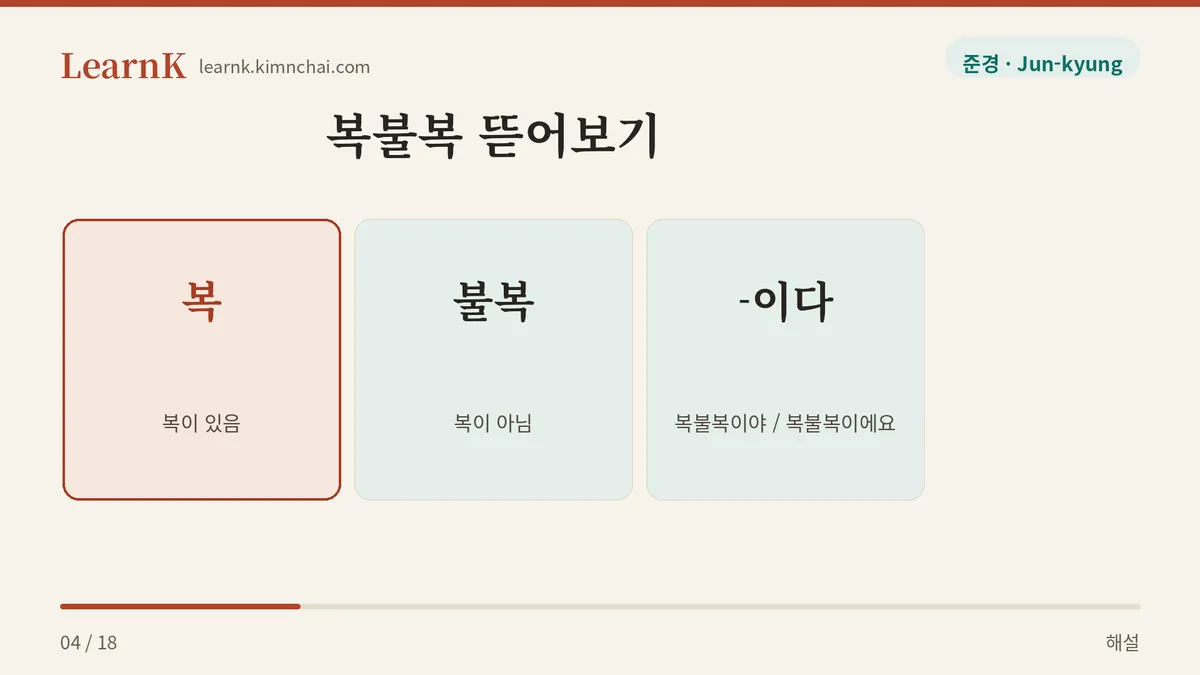
It’s a noun. So most of the time you attach -이다 (-ida) to use it as a predicate. Casually, that’s 복불복이야 (bokbulbogiya); politely, 복불복이에요 (bokbulbogieyo) or 복불복입니다 (bokbulbogimnida). It’s also very common to put whatever is left to chance in front of it — 디자이너 복불복 (dijaineo bokbulbok, “stylist luck”), 날씨 복불복 (nalssi bokbulbok, “weather luck”), 판매자 복불복 (panmaeja bokbulbok, “seller luck”).
Tone matters. 복불복 sounds like a complaint, but it actually takes the heat out of things. It’s a word that hands everyone a pass: if the result was bad, it wasn’t because you fell short — the draw just went that way. That’s why it usually comes with half a laugh. Conversely, laying this word over something genuinely unfair or serious makes the situation sound trivial. That line is the heart of today’s post.
Seeing It in a Real Conversation
Setting: Saturday afternoon, on a bench in front of an apartment complex. Emily has just picked up a mini oven she bought through a secondhand deal.
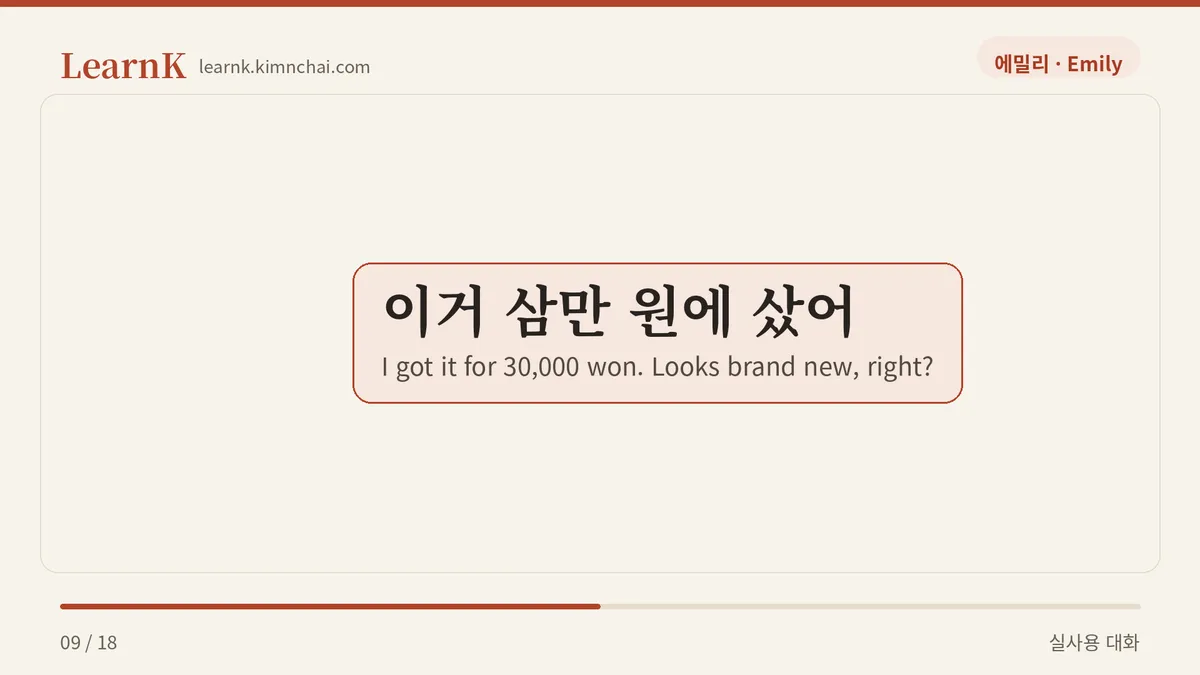
Emily: 봐 봐, 이거 3만 원에 샀어. 완전 새것 같지? Look at this — I got it for 30,000 won. Looks brand new, right?
Jun-kyung: 오, 싸게 샀네. 근데 중고는 진짜 복불복이야. 나 저번에 산 청소기는 이틀 만에 죽었어. Oh, that’s a steal. But used stuff is really a coin toss. The vacuum I bought last time died in two days.
Emily: 아 맞다, 그 얘기 했었지. 판매자가 좋은 사람이면 반은 성공인 것 같아. Oh right, you told me about that. If the seller’s decent, you’re already halfway there.
Jun-kyung: 그러니까. 사람 만나는 것도 복불복이지 뭐. Exactly. Who you end up meeting is a roll of the dice too.
Emily: 그럼 나 오늘은 복 쪽에 걸린 거네. 아저씨가 전원선도 새것으로 껴 주셨어. Then today I landed on the lucky side. He even threw in a new power cord.
Jun-kyung: 야, 그 정도면 로또지. 얼른 올라가서 켜 봐, 켜지면 진짜 성공이고. Dude, that’s basically the lottery. Go plug it in — if it turns on, you really won.
When It Sounds Off
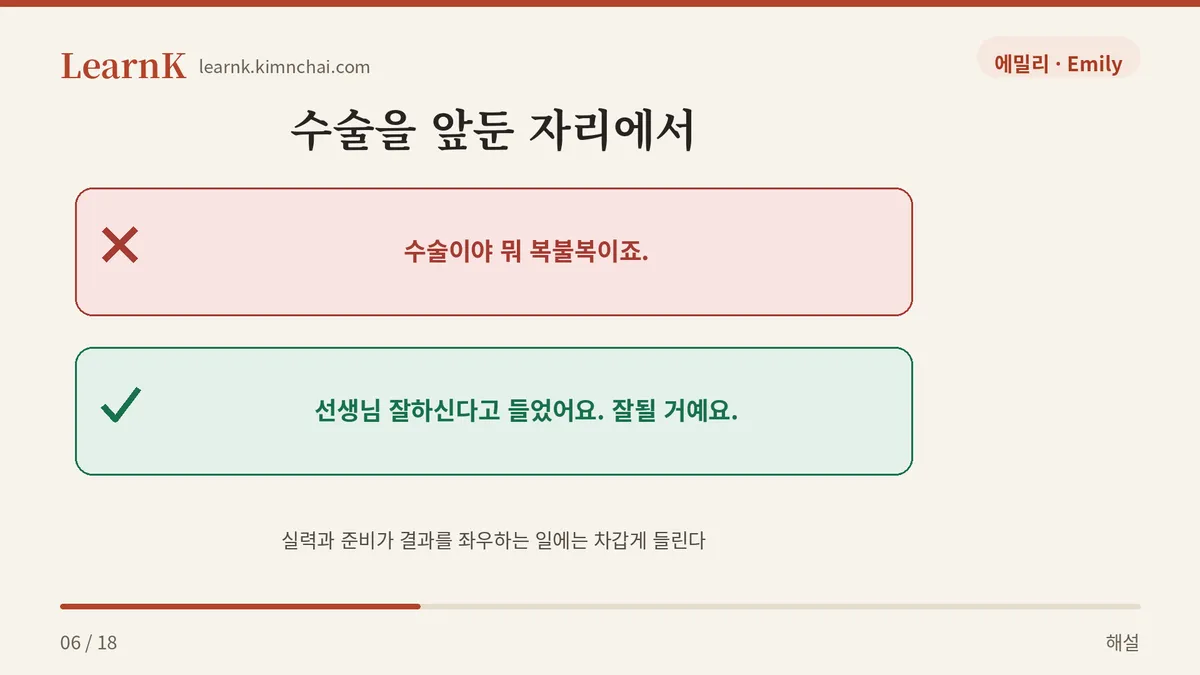
✗ (to a friend keeping vigil before a family member’s surgery) 수술이야 뭐 복불복이죠. “Surgery is a coin toss, I guess.” ✓ (in the same moment) 선생님 잘하신다고 들었어요. 잘될 거예요. “I hear the doctor is excellent. It’ll go well.” → Don’t use it for things where a person’s skill and preparation largely decide the outcome, or for something the other person desperately cares about. Even if you toss it out as comfort, it lands as “there’s nothing to do but leave it to luck,” which sounds cold.
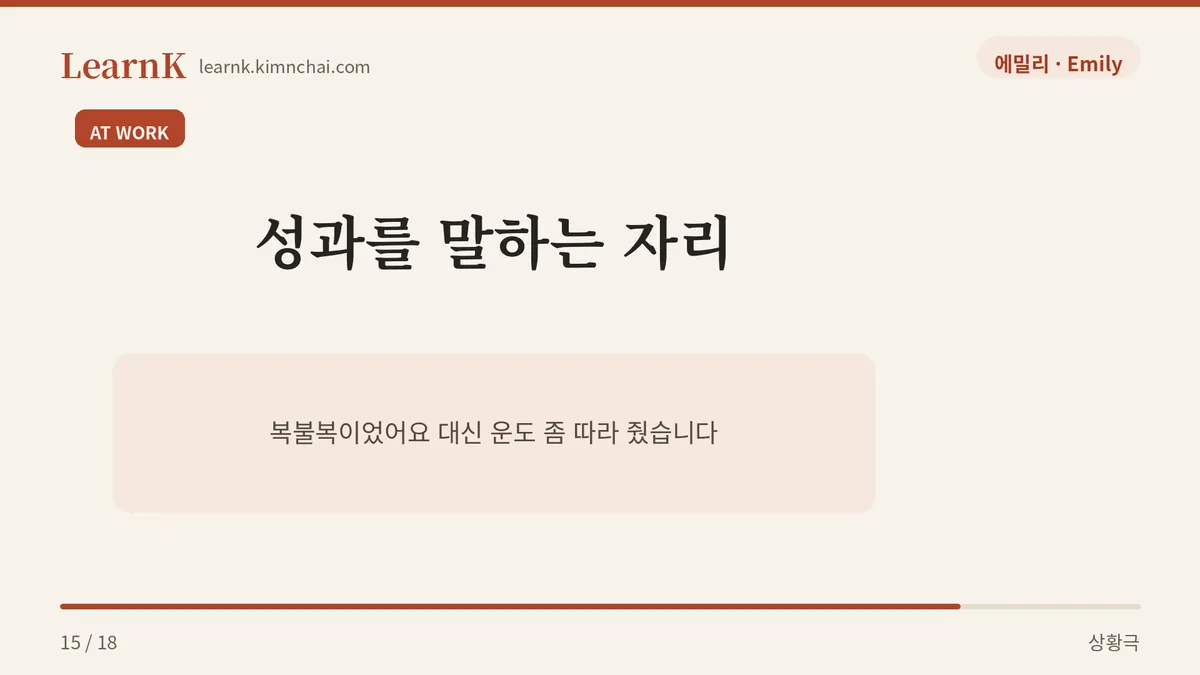
✗ (to your team lead) 이번에 계약 딴 건 그냥 복불복이었어요. “Landing this contract was just the luck of the draw.” ✓ (to your team lead) 운도 좀 따라 줬습니다. “We had a bit of luck on our side, too.” → It sounds like modesty, but it writes off the effort of everyone who worked alongside you as mere chance. When you’re talking about results, something like “운도 따랐다 (undo ttarattda, luck was with us too)” is the safe choice.
Example Sentences by Situation
1. First week of the semester, comparing timetables
The same course can have a completely different atmosphere and workload depending on who’s teaching it.
같은 수업인데 교수님이 누구냐가 복불복이라 다들 개강 전에 후기부터 찾아봐. (gateun sueobinde gyosunimi nugunyaga bokbulbogira dadeul gaegang jeone huugibuteo chajabwa.) It’s the same class, but which professor you get is the luck of the draw, so everyone looks up reviews before the semester starts.
2. Out looking at studio apartments
Used to say the place itself is fine, but there are things you can’t know until you actually live there.
방은 괜찮은데 원룸은 옆집 복불복이잖아요. 소음은 들어가 봐야 알죠. (bangeun gwaenchanheunde wonrumeun yeopjip bokbulbogijanhayo. soeumeun deureoga bwaya aljyo.) The room is fine, but with studios it’s all down to who’s next door, right? You don’t know about the noise until you move in.
3. Planning a trip
For when you acknowledge the variables you can’t control, no matter how well you plan.
계획은 다 짰는데 날씨는 복불복이니까 실내 코스도 하나 넣어 두자. (gyehoegeun da jjatneunde nalssineun bokbulboginikka silrae koseudo hana neoeo duja.) The plan is all set, but the weather is a gamble, so let’s slot in one indoor option too.
Politeness Levels and Similar Expressions
복불복 itself has no separate honorific form. Since it’s a noun, you adjust the politeness level by changing the -이다 (-ida) that follows it. With friends, 복불복이야 (bokbulbogiya); with someone older or senior, 복불복이에요 (bokbulbogieyo) or 복불복입니다 (bokbulbogimnida) — all perfectly natural, and the word itself isn’t rude. As we saw above, though, it does pick and choose the setting and the subject.
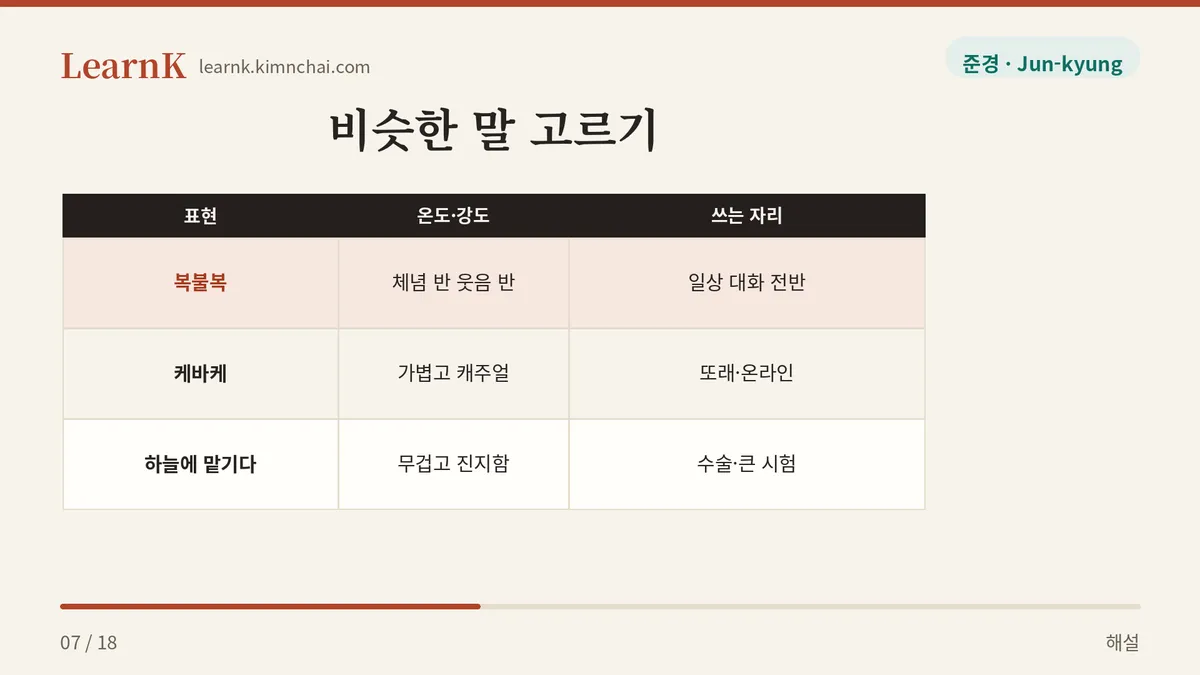
| Expression | Tone & Intensity | Where It’s Used |
|---|---|---|
| 복불복 (bokbulbok) | Half resignation, half laughter. The outcome splits two ways, good or bad | Everyday conversation generally. For polite speech, attach it as “복불복이에요” |
| 케바케 (kebake) | Light, casual slang | Among peers and online. Usually avoided with seniors |
| 운에 달렸다 (une dallyeotda) | Neutral and matter-of-fact | Anywhere. Fine even in formal settings |
| 하늘에 맡기다 (haneure matgida) | Heavy and serious | Big, heartfelt matters like surgery or major exams |
People especially mix it up with 케바케 (kebake). 케바케 comes from the English “case by case” and points to the variation — “it differs from case to case” — while 복불복 puts the weight on leaving it to luck which side you personally land on. “이 브랜드는 케바케야 (i beurandeuneun kebakeya)” is closer to information: the products vary. “이 브랜드는 복불복이야 (i beurandeuneun bokbulbogiya)” is closer to a feeling: you won’t know until you buy it and open it up.
Cultural Background — How to Smile at a Lucky Draw
복불복 is a Sino-Korean word. It sets “having good fortune” (福) right next to “not having it” (不福), turning the picture — it’s either fortune or it isn’t, one of the two — directly into a word. The structure is simple enough that the meaning is visible at a glance, which is why learners from abroad tend to remember it after hearing it just once.
A big reason this word ended up on everyone’s lips was the power of variety TV. In the late 2000s, the KBS travel variety show 《1박 2일》 (1bak 2il, 2 Days & 1 Night) made its cast play games decided purely by chance, with sleeping arrangements and dinner on the line — and the name of that segment was 복불복. Whoever lost had to sleep outdoors in winter. What matters here isn’t the rules but the attitude. The losers laughed along, and the winners felt bad even as they were relieved — as that scene repeated week after week, 복불복 came to carry an extra feeling with it: losing to luck is nothing to be ashamed of.
So when a Korean brings out this word, they’re usually opening a conversation rather than closing it. It signals that no one is going to hold the failure against you, and it becomes a door for “the same thing happened to me last time” stories. Out come the tales of a bad secondhand purchase, a haircut gone wrong, a whole trip spent in the rain. That’s exactly why this word is so useful for learners. Knowing when to drop it so the mood loosens up is far more valuable than just knowing what it means.
Today’s Quiz
A friend says she’s booked an appointment at a hair salon she’s never been to, and she’s nervous. What’s the most natural thing to say?
- 미용실은 디자이너 복불복이니까 너무 기대하지 말고 가.
- 미용실은 디자이너 복불복이라 하늘에 맡겨야겠네요.
- 미용실 가는 건 복불복이었습니다.
Answer: 1. 복불복 is a word you attach to things whose outcome you can’t know in advance, to take some pressure off the other person — which pairs well with casual speech between friends. Option 2 piles the heavy expression “하늘에 맡기다 (haneure matgida)” onto something as everyday as a haircut, so it sounds overblown. Option 3 puts something that hasn’t happened yet into the past tense, so the situation and the tense don’t match.
Definitions and example sentences are from the National Institute of Korean Language’s Basic Korean Dictionary (krdict.korean.go.kr); that portion of this post, including our translations, is licensed under CC BY-SA 2.0 KR.