본캐 (bonkae) — The Self You Come Back To, No Matter How Many Alter Egos You Add
본캐 (bonkae)
You’re watching a Korean variety show. A cast member who has spent the whole episode running around under an unfamiliar name in an unfamiliar outfit suddenly snaps back into their usual self, and a caption flashes in the corner of the screen: 본캐 등장 (bonkae deungjang) — “the main character has entered.” 본캐 (bonkae) is short for 본래 캐릭터 (bollae kaerikteo), “original character” — among all the identities a person might carry, the one at the center, the original you. In games it means the main character you actually pour your time into across several accounts; used about a person, it points to their day job or their ordinary, real self.
If you’re a K-pop fan, there’s one place you’ll meet this word more than anywhere else. A member who was being goofy under a comic nickname and concept shows up a few days later in stage clothes under the lights, and the comment section fills up with a single sentence: 본캐 돌아왔다 (bonkae dorawatda) — “the main is back.” The funny one is that person, and the one on stage is the same person, yet fans know which of the two is the “center.” The name for that center is 본캐 (bonkae).
The nuance is light and playful, because it compares a human being to a game character. So it’s neither a compliment nor a put-down — it’s closer to play. The important thing is that this word never travels alone. 본캐 (bonkae) almost always comes paired with 부캐 (bukae) — 부 캐릭터, a “sub character,” another self built off to the side. A 부캐 (bukae) has to exist for 본캐 (bonkae) to mean anything. Ask someone with no alter ego at all, 네 본캐가 뭐야? (ne bonkaega mwoya?) — “So what’s your main?” — and the question just spins in place.
One more thing. 본캐 (bonkae) carries a quiet weight. You can delete a 부캐 (bukae) anytime, but you can’t delete your 본캐 (bonkae). That’s why lines like 본캐가 흔들린다 (bonkaega heundeullinda), “your main self is wobbling,” or 본캐부터 챙겨라 (bonkaebuteo chaenggyeora), “take care of your main self first,” end up being serious statements wearing the costume of a joke. That’s exactly why this bit of slang has stuck around so long.
Seeing it in a real conversation
Setting: a PC bang (internet café) on a Friday night. Jun-kyung peers over at Emily’s screen in the next seat.
Jun-kyung: 어? 너 캐릭터 왜 이렇게 레벨이 낮아? 어제 만렙 찍었다며. Huh? Why is your character such a low level? You said you hit max level yesterday.
Emily: 아, 이건 부캐야. 본캐는 다른 계정에 있어. Ah, this one’s my alt. My main is on another account.
Jun-kyung: 부캐를 왜 또 키워. 하나도 벅차구만. Why are you leveling an alt on top of that? One is already too much.
Emily: 본캐로 들어가면 사람들이 자꾸 말 걸어서 피곤해. 부캐는 아무도 날 모르니까 편해. When I log in on my main, people keep talking to me and it’s tiring. On the alt nobody knows me, so it’s easy.
Jun-kyung: 하긴. 요즘은 사람도 부캐 하나씩 있잖아. 낮엔 회사원, 밤엔 유튜버, 뭐 이런 거. True. These days people have alter egos too. Office worker by day, YouTuber by night, that kind of thing.
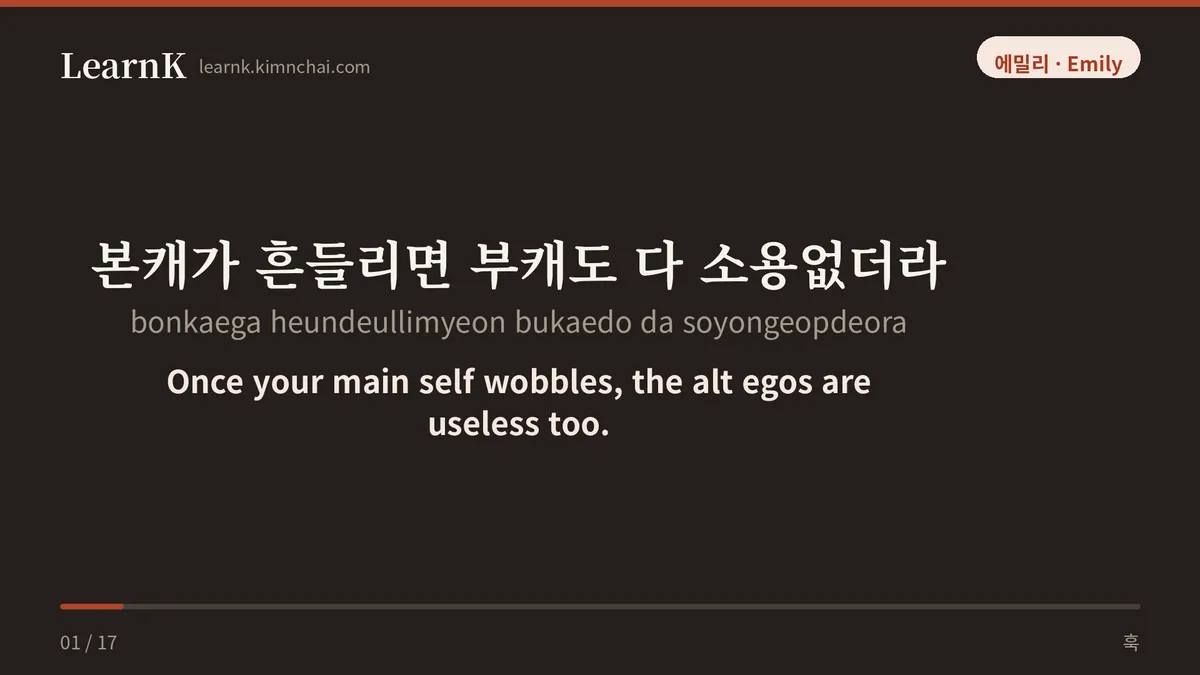
Emily: 그니까. 근데 본캐가 흔들리면 부캐도 다 소용없더라. Right. But once your main self starts wobbling, the alter egos are useless too.
Where this sounds off
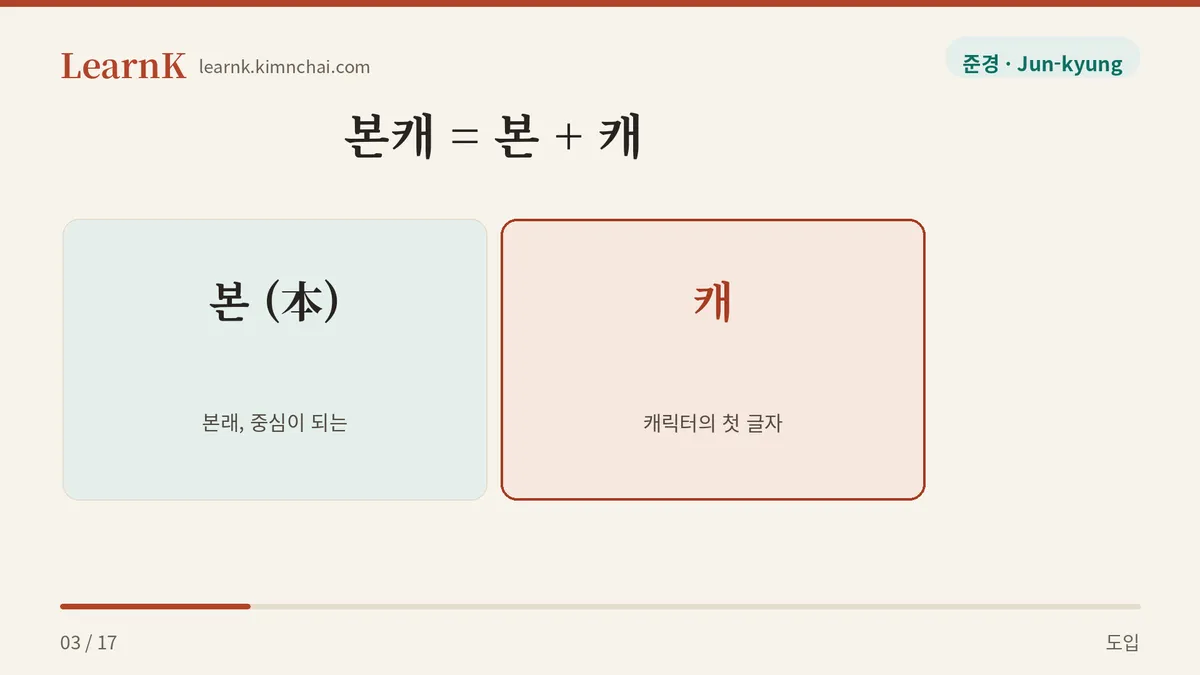
✗ (In a job interview) 제 본캐는 마케팅입니다. (je bonkaeneun maketingimnida — “My main is marketing.”) ✓ (In a job interview) 제 **본업 (boneop)**은 마케팅입니다. (je boneopeun maketingimnida — “My main line of work is marketing.”) → The meaning gets through, but it’s playground language borrowed from gaming, so in a formal setting it makes you sound lightweight. In interviews, reports, and news writing, use 본업 (boneop, “main occupation”), 전공 (jeongong, “major/specialty”), or 주 업무 (ju eommu, “primary duties”).
✗ (To your department head) 부장님, 본캐가 원래 뭐예요? (bujangnim, bonkaega wollae mwoyeyo? — “Sir, what’s your main, originally?”) ✓ (To your department head) 부장님, 원래 어떤 일 하셨어요? (bujangnim, wollae eotteon il hasyeosseoyo? — “Sir, what kind of work did you do originally?”) → The word treats the listener like a game character, so aimed at someone senior it feels like you’re making a plaything of them. It’s funny among peers, but it doesn’t travel upward.
Example sentences by situation
1) What fans say to each other when they see their bias playing a 부캐 (bukae) on a variety show
예능에서는 저렇게 망가져도 본캐로 돌아오면 눈빛이 완전히 달라져. yeneungeseoneun jeoreoke manggajyeodo bonkaero doraomyeon nunbichi wanjeonhi dallajyeo. (예능에서는 저렇게 망가져도 본캐로 돌아오면 눈빛이 완전히 달라져 — Even if he goofs off like that on variety shows, the moment he’s back as his main self his eyes are completely different.)
This is admiration expressed by setting one person’s two faces side by side. Here the 본캐 (bonkae) is “that person on stage” and the 부캐 (bukae) is “that person on the variety show.” Fans love this line because it says they adore both versions while still knowing which one is the root.
2) To a coworker who plays in a band on weekends
형 본캐는 회계팀인데 부캐가 너무 잘나가는 거 아니에요? hyeong bonkaeneun hoegyetiminde bukaega neomu jallaganeun geo anieyo? (형 본캐는 회계팀인데 부캐가 너무 잘나가는 거 아니에요? — Your main is the accounting team, but isn’t your side character doing a bit too well?)
It sounds like teasing, but it’s really a compliment. Even with the polite ending -요 (-yo) attached, the word 본캐 (bonkae) itself still only works between people who are comfortable with each other. Fine for a close senior colleague; not fine for an executive you’ve just met.
3) When you’re talking about social media accounts
그 계정은 부계고 본캐는 따로 있어. 거긴 진짜 아무 말이나 올려. geu gyejeongeun bugyego bonkaeneun ttaro isseo. geogin jinjja amu marina ollyeo. (그 계정은 부계고 본캐는 따로 있어. 거긴 진짜 아무 말이나 올려 — That account is my alt; my main is somewhere else. On that one I post literally whatever.)
For social media, Koreans also use 본계정 (bongyejeong), “main account,” shortened to 본계 (bongye). Use 본계 (bongye) when you mean the account and 본캐 (bonkae) when you mean the person’s identity — split them that way and it sounds natural.
Politeness levels and similar expressions
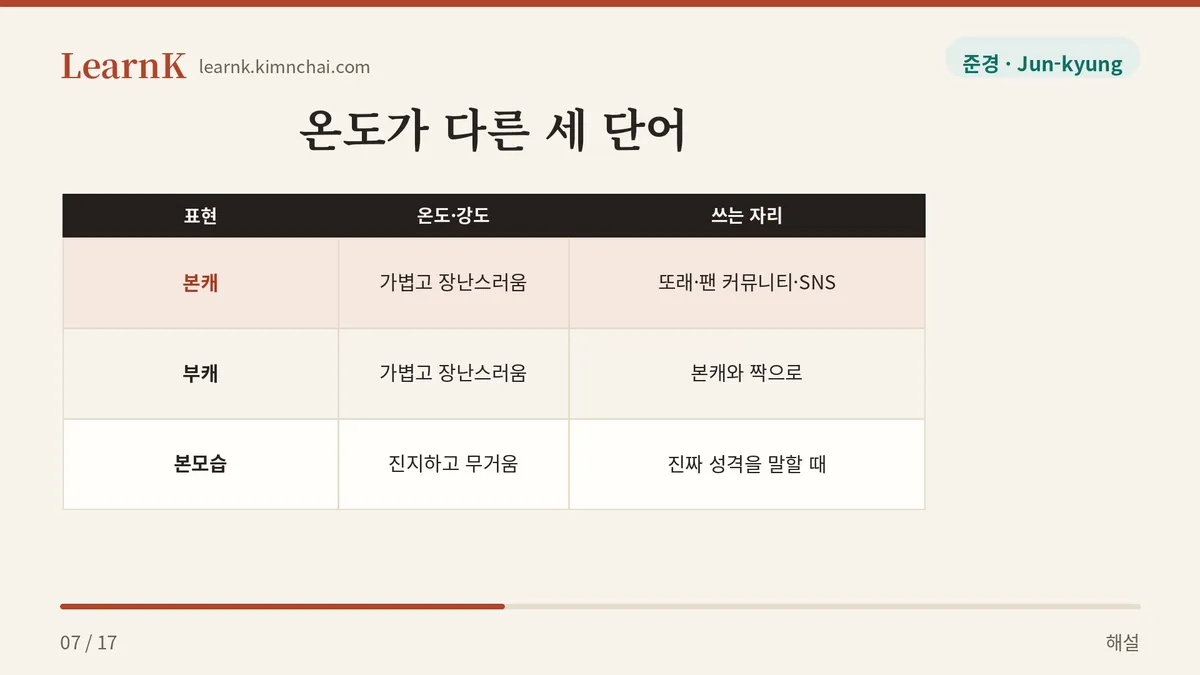
본캐 (bonkae) has no separate polite form. You can raise the ending, as in 본캐예요 (bonkaeyeyo), but the word itself is peer language, so polishing the ending doesn’t make it usable with someone above you. Depending on the setting, you have to switch to an entirely different word.
| Expression | Tone & intensity | Where it’s used |
|---|---|---|
| 본캐 (bonkae) | Light and playful | Among peers, in fan communities, on social media. Not with seniors or in formal settings |
| 부캐 (bukae) | Light and playful | As the partner to 본캐. Using 본캐 with no 부캐 in the picture sounds odd |
| 본업 (boneop) | Neutral, businesslike | Anywhere. Safe for interviews, articles, and self-introductions |
| 본모습 (bonmoseup) | Serious and heavy | For a person’s true character. No playful nuance |
If there’s one spot worth flagging, it’s the gap between 본캐 (bonkae) and 본모습 (bonmoseup). 술 마시면 본모습이 나온다 (sul masimyeon bonmoseubi naonda), “drinking brings out someone’s true self,” means a hidden real character is exposed — and it’s often negative. By contrast, 술 마시면 본캐가 나온다 (sul masimyeon bonkaega naonda) is far lighter and carries almost no bad implication. 본모습 (bonmoseup) is something that gets peeled off; 본캐 (bonkae) is something that comes back.
Cultural background — what the 부캐 (bukae) craze left behind
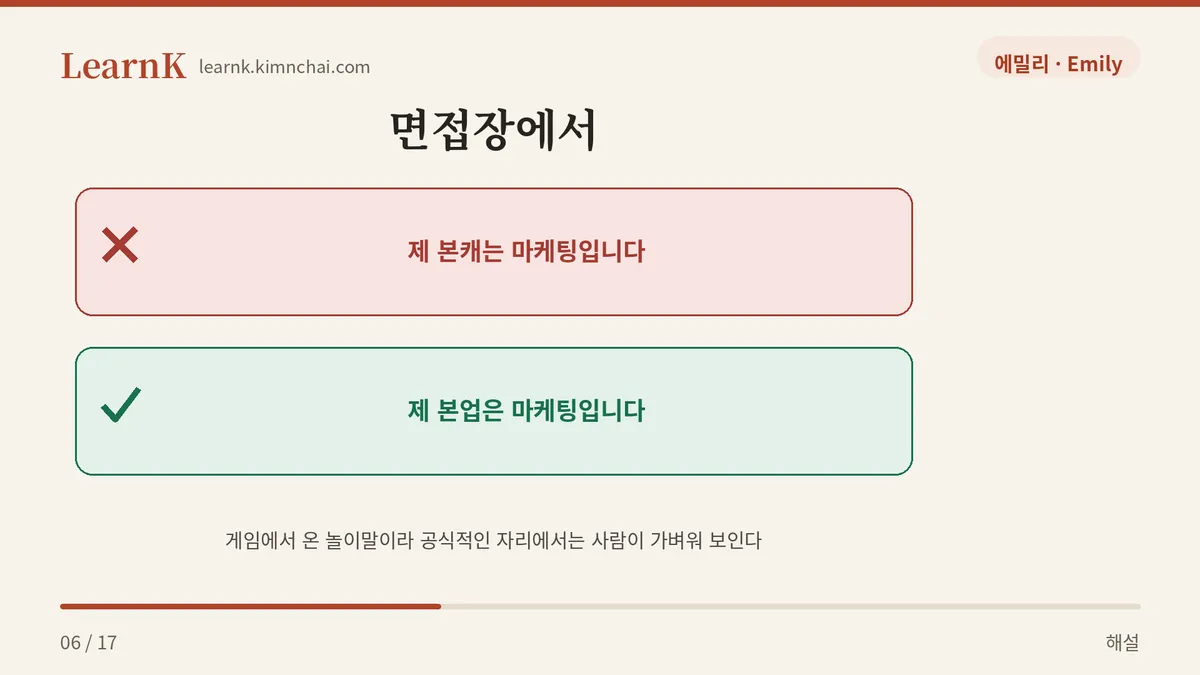
The word-building is simple: take the Sino-Korean character 본 (本, “origin, main”) and attach 캐 (kae), the first syllable of 캐릭터 (kaerikteo, “character”). It’s a textbook example of the classic Korean slang formula — one Sino-Korean syllable plus a clipped loanword. The same frame gives you 부 (副, “sub”) + 캐 = 부캐 (bukae).
The starting point was online gaming. In a culture where you make several accounts, raise one with real care, and play the other loosely, people needed names to tell the two apart. Then, between 2019 and 2020, a variety program in which a beloved national MC kept transforming into completely different people — a trot singer, a harpist, a producer — became a huge hit, and the word walked right out of the gaming world. 부캐 (bukae) landed on that year’s lists of Korean trend keywords. From that point on, 본캐 (bonkae) and 부캐 (bukae) stopped being gamer jargon and simply became Korean.
K-pop absorbed the word especially well. Every group has its own worldview, and members put on different names and different personalities depending on the concept. On variety shows they sometimes work as entirely separate characters. Fans enjoy every one of those layers while still calling the person on stage the 본캐 (bonkae). Dramas keep producing the same shapes too — the chaebol heir hiding their identity to live an ordinary life, the character who is one person by day and another by night — and today’s viewers naturally sum all of it up with the words 본캐 (bonkae) and 부캐 (bukae).
So why did this word spread so far? For a long time, the way you introduced a person in Korean society was with a single job. For decades, one question — “무슨 일 하세요? (museun il haseyo?)”, “What do you do?” — was enough to file a person away. 본캐 (bonkae) and 부캐 (bukae) cracked that frame open. I’m an office worker, but that isn’t all of me — the words compressed that long sentence into two syllables, and people were glad to have them. Which means learning 본캐 (bonkae) isn’t just learning one vocabulary item; it’s learning how Koreans today divide themselves up when they look at who they are.
Today’s quiz
In which of the following situations would 본캐 (bonkae) sound the most out of place?
- When a friend tells you they made a new game account
- Chatting with fellow fans when your favorite idol appears as a different character on a variety show
- Introducing your college major at a job interview
- Teasing a senior coworker who goes out taking photos every weekend
See the answer
Answer: 3
본캐 (bonkae) is playground language that came out of gaming, so even when the meaning is clear, it makes you sound lightweight in a formal setting like a job interview. There you’d use 본업 (boneop), “main occupation,” or 전공 (jeongong), “major.” Situations 1, 2, and 4 all involve peers, comfortable relationships, or fan-to-fan talk, so 본캐 (bonkae) fits naturally.
The definitions, example sentences, and dialogue in this post were all written by our editorial team. 본캐 (bonkae) is not yet listed as a headword in the National Institute of Korean Language’s Basic Korean Dictionary (krdict.korean.go.kr), so this entry includes no dictionary citations.