부캐 (bukae) — On Weekends, I Become Someone Else
부캐 (bukae)
부캐 (bukae) is a shortened form of 부(副)캐릭터 — literally “sub-character” — meaning “another me” that you take out and use depending on the situation, separate from your original self. The quiet accounting-team employee on weekdays who plays drums in a band on weekends; the cram-school instructor by day who runs an art account with thirty thousand followers by night — that second face is exactly what 부캐 (bukae) means.
Korean self-introductions have gained one extra sentence over the past few years. It used to be that a single line — ○○ 회사 다닙니다 (○○ hoesa danimnida, “I work at ○○ company”) — was the whole thing. These days, at a gathering, something like 본캐는 회사원이고 부캐는 베이킹이에요 (bonkae-neun hoesawon-igo bukae-neun beiking-ieyo, “My main character is office worker, and my 부캐 is baking”) follows naturally. It’s also a signal that the era when one business card explained a person completely is coming to an end.
What matters here is the temperature of the word. 부캐 (bukae) is not a heavy word. Unlike 이중생활 (ijung saenghwal, “double life”), which points to a life you have to hide, a 부캐 is a second face that you don’t mind being caught with — one you actually want to show off. There’s a playfulness built into the word itself, so wherever 부캐 talk comes up, laughter usually comes with it. When someone says 저 부캐 있어요 (jeo bukae isseoyo, “I have a 부캐”), it isn’t a confession so much as an invitation. It means: please ask me more.
Its range of use is wide, too. It attaches not only to people but to social media accounts, hobbies, side jobs — even to a personality that only comes out at drinking parties. Here are the phrases it most often pairs with:
- 부캐를 키우다 (bukae-reul kiuda) — to keep steadily building up a second activity, the way you level up a game character
- 부캐를 파다 (bukae-reul pada) — to create a new identity and really push into it
- 부캐가 더 바쁘다 (bukae-ga deo bappeuda) — your hobby schedule is more packed than your day job. Koreans love this joke
Seeing It in a Real Conversation
Setting: Saturday morning, a flea market by the Han River. Jun-kyung is strolling past the booths when he spots Emily at a stall selling hand-knit hats.
Jun-kyung: 어? 에밀리? 너 여기서 뭐 해… 설마 이거 다 네가 만든 거야? Huh? Emily? What are you doing here… don’t tell me you made all of these?
Emily: 어, 주말엔 내가 뜨개 작가야. 부캐지 뭐. Yeah, on weekends I’m a knitting artist. It’s my alter ego, I guess.
Jun-kyung: 와, 대박. 회사에선 그런 티도 안 나더니. Wow, unbelievable. You never show any sign of that at work.
Emily: 티 내면 재미없잖아. 부캐는 아무도 모를 때가 제일 재밌어. Where’s the fun in showing it? An alter ego is most fun when nobody knows.
Jun-kyung: 그럼 나도 하나 팔까? 나는… 주말엔 순대국 평론가. Then should I start one too? Me… weekend sundae-guk critic.
Emily: 야, 그건 부캐가 아니라 그냥 너야. Dude, that’s not an alter ego, that’s just you.
That last line goes straight to the heart of the word. A 부캐 (bukae) has to be a face with a different grain from your original self. Simply renaming something you were already doing anyway doesn’t make it a 부캐.
These Uses Sound Awkward
✗ (in a job interview) 제 부캐는 프리랜서 디자이너입니다. (je bukae-neun peurillaenseo dijaineo-imnida — “My 부캐 is a freelance designer.”) ✓ (in a job interview) 주말에는 프리랜서로 디자인 작업도 하고 있습니다. (jumare-neun peurillaenseo-ro dijain jageopdo hago itseumnida — “On weekends I also do design work as a freelancer.”) → 부캐 (bukae) is a slang term with a strong sense of play. Using it in a formal setting where you need to explain a side job or your career seriously gives the impression that you’re making light of your own work.
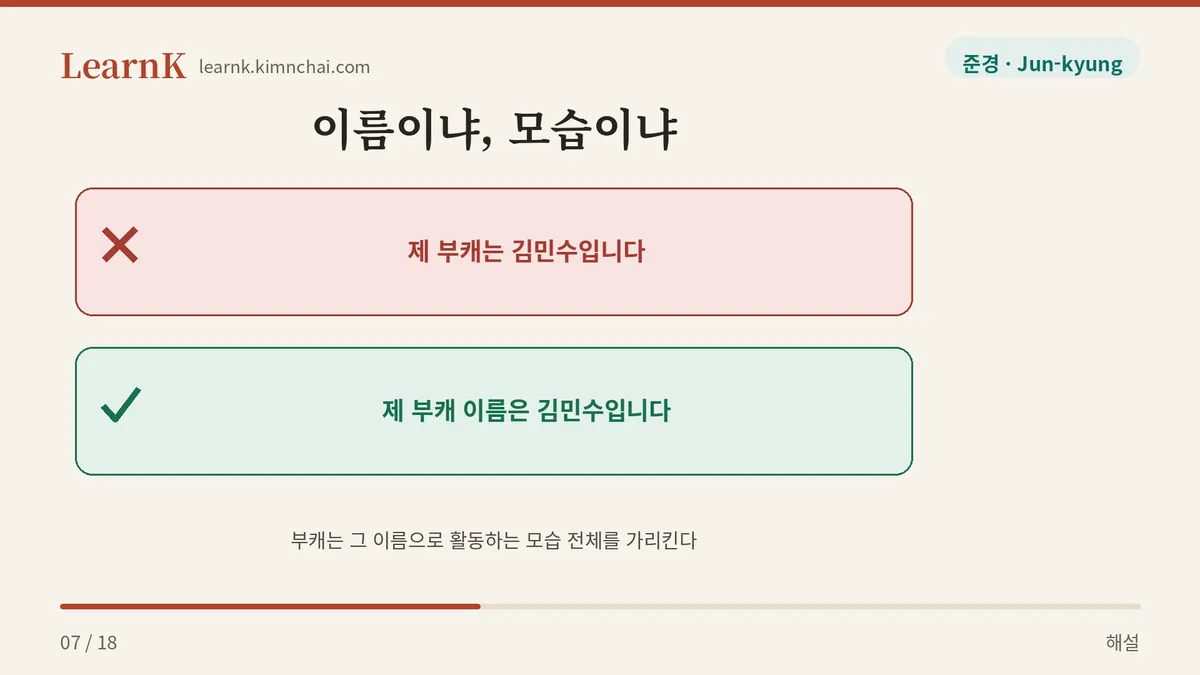
✗ 제 부캐는 ‘김민수’입니다. (je bukae-neun ‘Kim Min-su’-imnida — “My 부캐 is ‘Kim Min-su’.”) ✓ 제 부캐 이름은 ‘김민수’입니다. / 제 필명은 ‘김민수’입니다. (je bukae ireum-eun ‘Kim Min-su’-imnida / je pilmyeong-eun ‘Kim Min-su’-imnida — “My 부캐’s name is ‘Kim Min-su’.” / “My pen name is ‘Kim Min-su’.”) → This is a very common misunderstanding. A 부캐 (bukae) is not a name — it refers to the entire persona you act out under that name. Think of it as closer to the person wearing the outfit than to the outfit itself.
Example Sentences by Situation
Situation 1 — When you stumble across a friend’s secret social media account
야, 이 계정 뭐야? 너 언제부터 부캐 키웠어? (ya, i gyejeong mwoya? neo eonjebuteo bukae kiwosseo?) Hey, what’s this account? Since when have you been growing an alter ego?
This is the 부캐 sentence you’ll hear most often among Korean friends. The key here is the verb 키우다 (kiuda, “to raise/grow”) attached to it — the feeling of leveling up a character in a game is still fully intact. It carries the nuance that this didn’t appear overnight, but that they’ve been quietly putting effort into it.
Situation 2 — Introducing yourself at a club’s first meetup
평일엔 회계팀 직원이고, 여기선 그냥 부캐로 왔어요. (pyeongire-n hoegyetim jigwonigo, yeogiseon geunyang bukae-ro wasseoyo.) On weekdays I work in accounting; here I’ve just come as my alter ego.
This is close to a declaration that you won’t be leading with your job, age, or job title at a hobby gathering. In Korean club culture, the moment a pecking order gets settled, people stop being able to speak comfortably — so the single line “here, I’m my 부캐” pushes that pressure away with a smile.
Situation 3 — When your hobby is going better than your day job
요즘은 본캐보다 부캐가 더 바빠요. (yojeumeun bonkae-boda bukae-ga deo bappayo.) These days my alter ego is busier than my main self.
It sounds like a joke, but it’s a subtle brag. The natural flow is for the listener to play along with something like 오, 잘되나 봐요? (o, jaldoena bwayo? — “Oh, it must be going well?”)
Politeness Levels and Similar Expressions
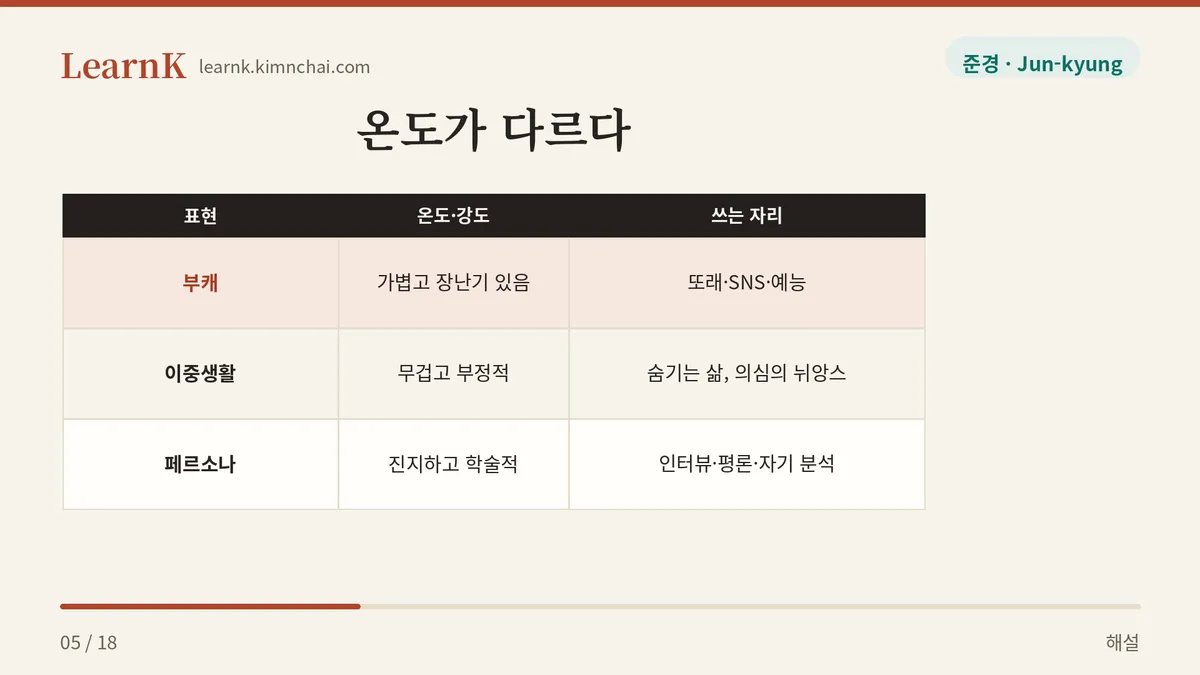
Since 부캐 (bukae) is a noun, it can be grammatically raised to polite forms: 부캐야 (bukae-ya) / 부캐예요 (bukae-yeyo) / 부캐입니다 (bukae-imnida). But even when you raise the form, the temperature of the word itself stays on the casual side. That’s why the awkwardness comes not from the grammar, but from the setting.
| Expression | Temperature & Intensity | Where It’s Used |
|---|---|---|
| 부캐 (bukae) | Light and playful | Among peers, on social media, on variety shows. Not used in official documents or interviews |
| 본캐 (bonkae) | The word that pairs with 부캐 | Natural only in a setting where 부캐 has already come up |
| 페르소나 (pereusona) | Serious, somewhat academic | Interviews, criticism, self-analysis |
| 이중생활 (ijung saenghwal) | Heavy and negative | A hidden life. Used seriously, it carries a nuance of suspicion |
| 별명 (byeolmyeong) | Neutral | Simply a name people call you instead of your own. Applies even with no activity attached |
It’s especially important not to confuse it with 이중생활 (ijung saenghwal). A 이중생활 is the kind of thing where you’re in deep trouble if you’re caught; a 부캐 is the kind of thing that gets more fun when you’re caught. The very same situation can leave a completely different impression of a person depending on which word you choose.
Cultural Background — A Word That Came Out of a Game’s Character Screen
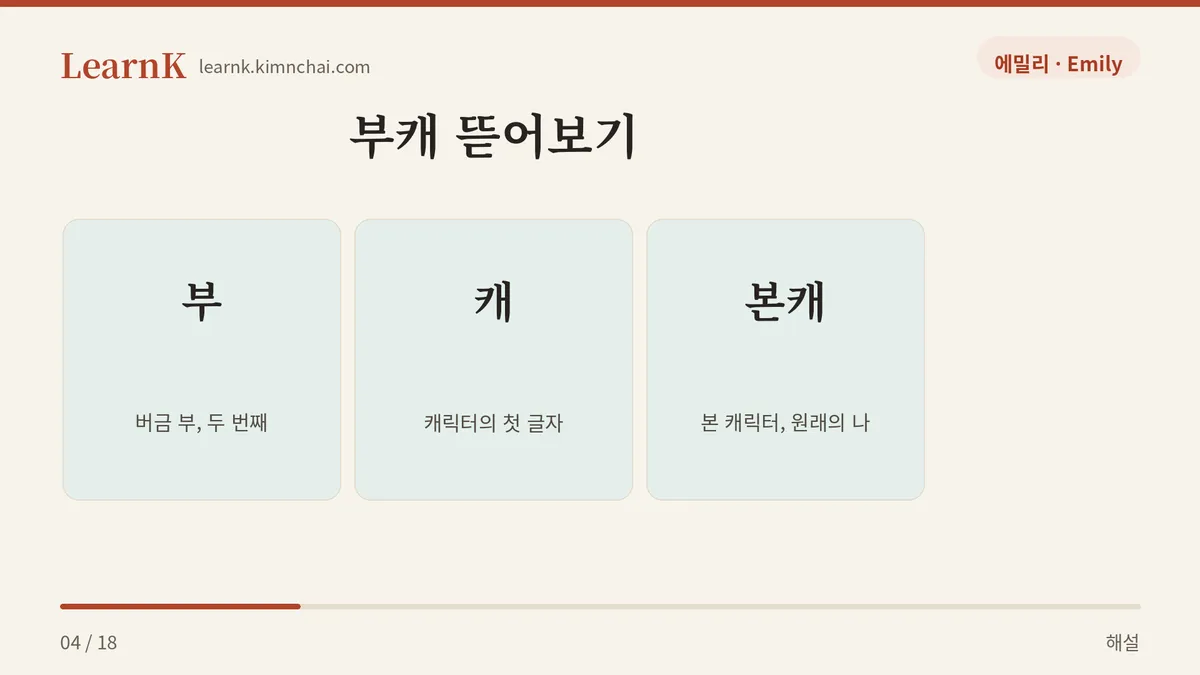
The way the word is formed is simple and transparent. Take the Chinese character 부 (副, “secondary”) and attach the first syllable of 캐릭터 (kaerikteo, “character”) to get 부캐 (bukae); attach it to 본 (本, “main, original”) and you get 본캐 (bonkae). Originally, this was talk about online games. When you got worn out raising your main character, you’d make one more character and play around with a different class, a different personality — that in-game habit is what walked out of the game and into life outside it as 부캐.
What lifted this word from gamer slang to a word for the whole nation was variety TV. Starting in 2019, on MBC’s 《놀면 뭐하니?》 (Nolmyeon Mwohani?, “Hangout with Yoo”), Yoo Jae-suk took on new personas such as the trot singer 유산슬 (Yusanseul), and the game of one person having many faces was broadcast into living rooms every week. After that, 부캐 stopped belonging only to celebrities.
Why did this word take root so strongly in Korea in particular? Korea is a society where you ask someone you’ve just met about their job and their affiliation first. In a culture where that one line was treated as the sum total of a person, 부캐 became a way of saying, with a smile, “I’m wider than that one line.” It’s the same reason more and more people now draw under a different name outside of work, lead running crews, or write reviews with their identity hidden. So if a Korean friend brings up their own 부캐, you can safely read it as a sign that you’ve gotten pretty close.
Today’s Quiz
Which of the following uses 부캐 most naturally?
- (in a job interview) 제 부캐는 프리랜서 디자이너입니다. “My 부캐 is a freelance designer.”
- (to a friend) 야, 이 그림 계정 뭐야? 너 언제부터 부캐 키웠어? “Hey, what’s this art account? Since when have you been growing a 부캐?”
- (at a first meeting with a client) 부장님 부캐가 궁금합니다. “I’m curious about your 부캐, Director.”
- (at a bank counter) 제 부캐 이름으로 계좌 하나 만들어 주세요. “Please open an account under my 부캐’s name.”
Answer: 2
부캐 (bukae) is most natural among peers, in settings where casual speech is flying back and forth. Numbers 1 and 3 are formal settings, so the word sounds too light there, and number 4 is awkward because a 부캐 is not a legally existing name. A 부캐 isn’t an identity you write on official paperwork — it’s an identity that rolls along, with laughter, between people.