차박 (chabak) — A Night in the Car Instead of a Tent: How Koreans Get Away Every Weekend
차박 (chabak)
차박 (chabak) means a trip where you sleep overnight inside your car. Instead of pitching a tent, you fold the back seats down and turn that space into a bed.
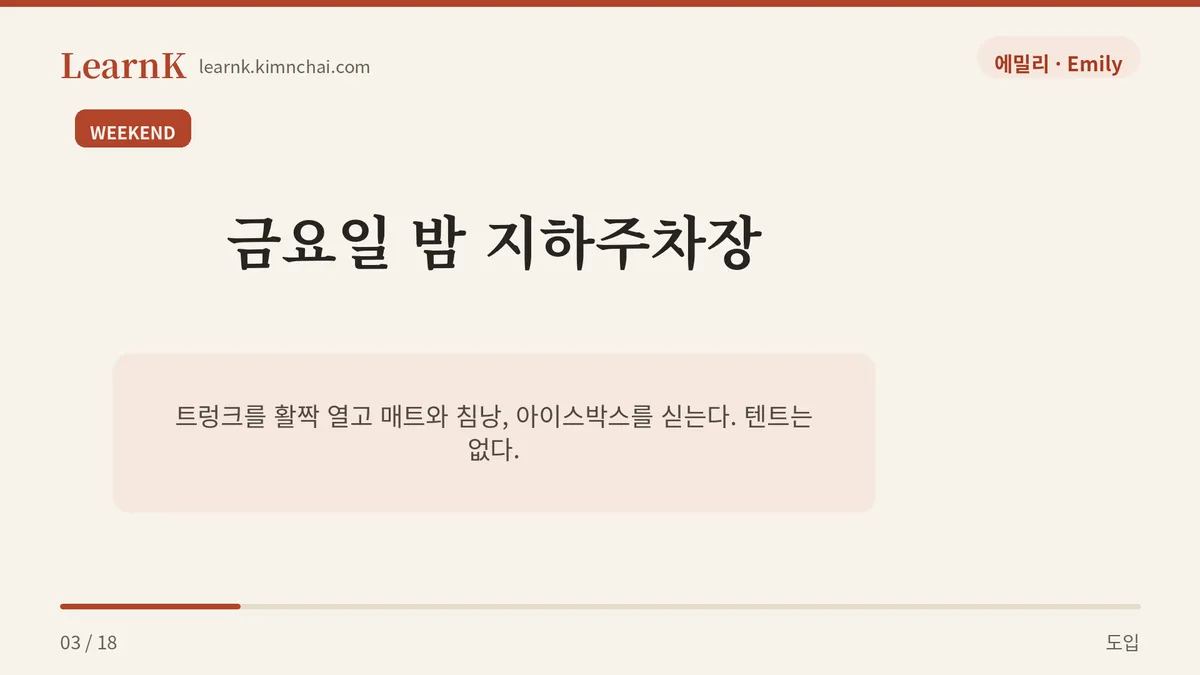
Go down to the underground garage of a Korean apartment building on a Friday night and you’ll find people loading up with their trunks thrown wide open. A folding mat, a sleeping bag, a small lantern, a cooler packed with ice. But no tent. And no room booked at the other end either — because the car is the lodging. Setting off at eleven at night, parking in some lot on the east coast at three in the morning, and lying there watching the sun come up out of the sea through the rear window — that is exactly what Koreans call 차박 (chabak).
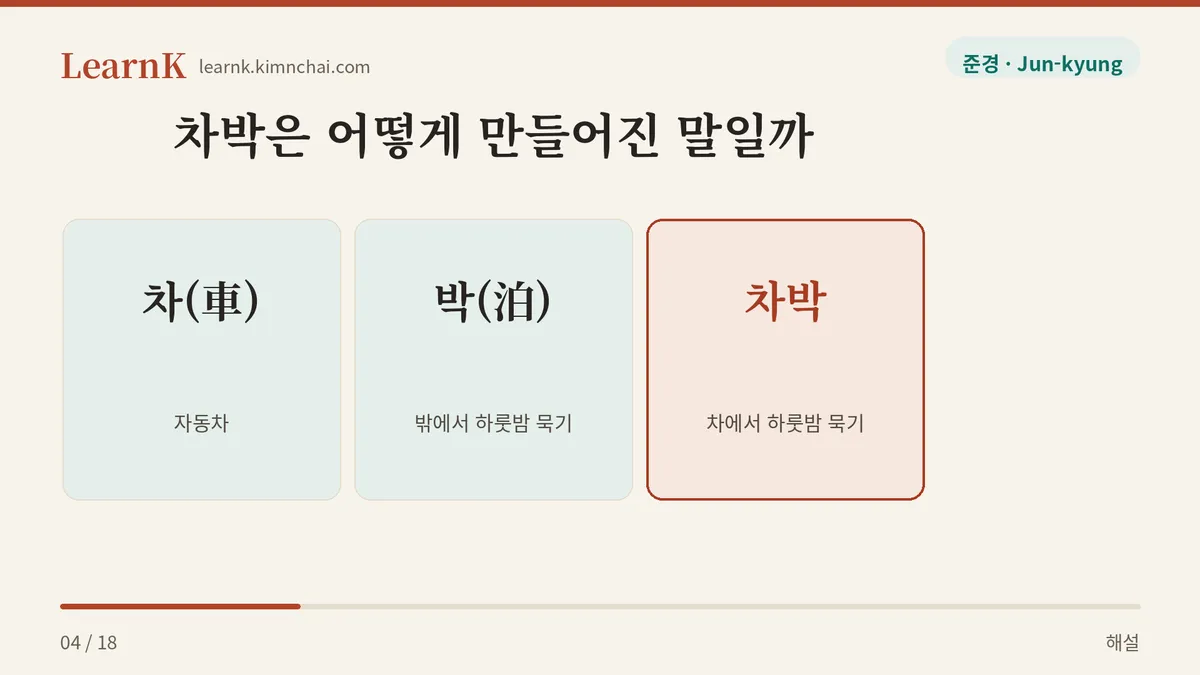
‘박(泊)’ is the Chinese character for spending a night away from home. It’s the 박 in 1박 2일 (il-bak i-il, ‘one night, two days’) that gets tacked onto travel packages, and the 박 in 민박 (minbak, a countryside guesthouse) where you sleep over in someone’s home. Add ‘차(車)’, car, and you get, literally, ‘staying the night in a car.’ The word is put together so simply that a Korean hearing it for the first time works out the meaning with no explanation at all.
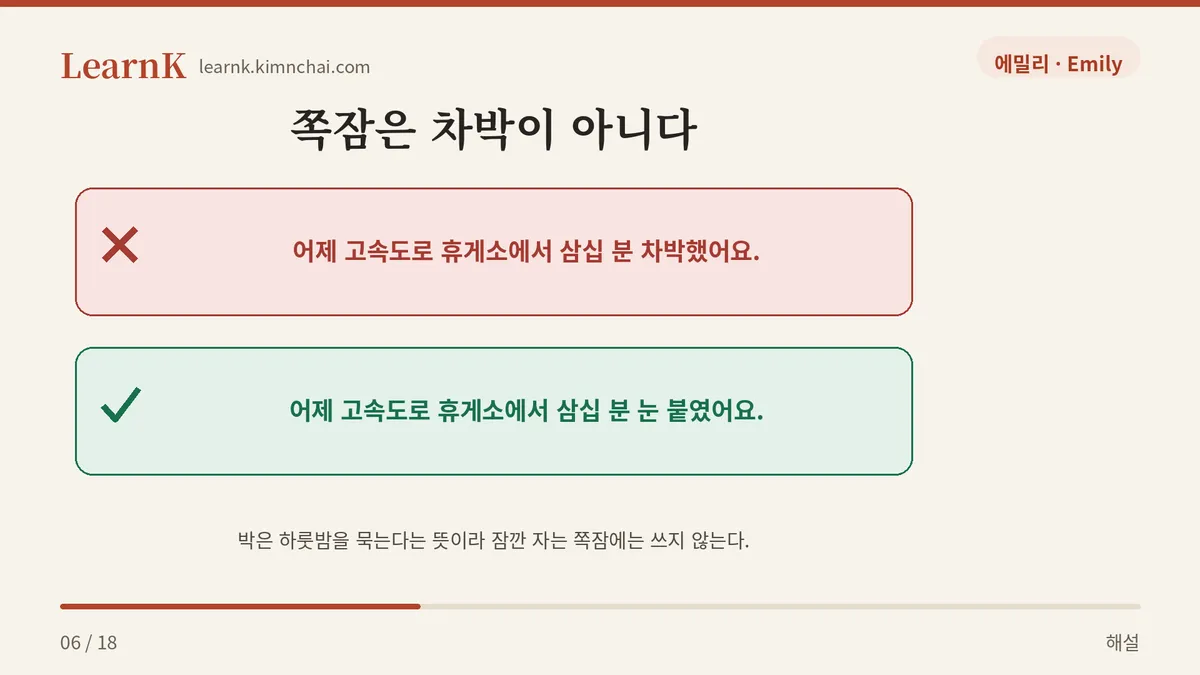
What matters is that this word asks for two things at once. First, the place you sleep has to be inside the car. Second, you have to have set out intending to stay the night. Drop either one and it isn’t 차박 (chabak). Pulling into a rest stop for twenty minutes because you got drowsy at the wheel isn’t 차박 (chabak) — that’s a 쪽잠 (jjokjam, a quick catnap). And driving out to a campground and sleeping in a tent isn’t 차박 (chabak) either — that’s just camping.
The tone is light and bright. It isn’t hardship you’re stuck with but a trip you pick because it’s fun, so when someone says 차박 갔다 왔어 (chabak gatda wasseo, ‘I went on a chabak trip’), the listener comes back automatically with 좋았겠다 (joatgetda, ‘that must’ve been nice’). As we’ll see further down, that puts it at the exact opposite pole from 노숙 (nosuk).
To use it as a verb, attach ‘하다’ and you get 차박하다 (chabakhada) — 차박했어, 차박하러 가, 차박할까? (chabakhaesseo, chabakhareo ga, chabakhalkka?). Set in front of nouns, it also builds words like 차박지 (chabakji, a good spot for chabak) and 차박 용품 (chabak yongpum, chabak gear).
Seeing It in Real Conversation
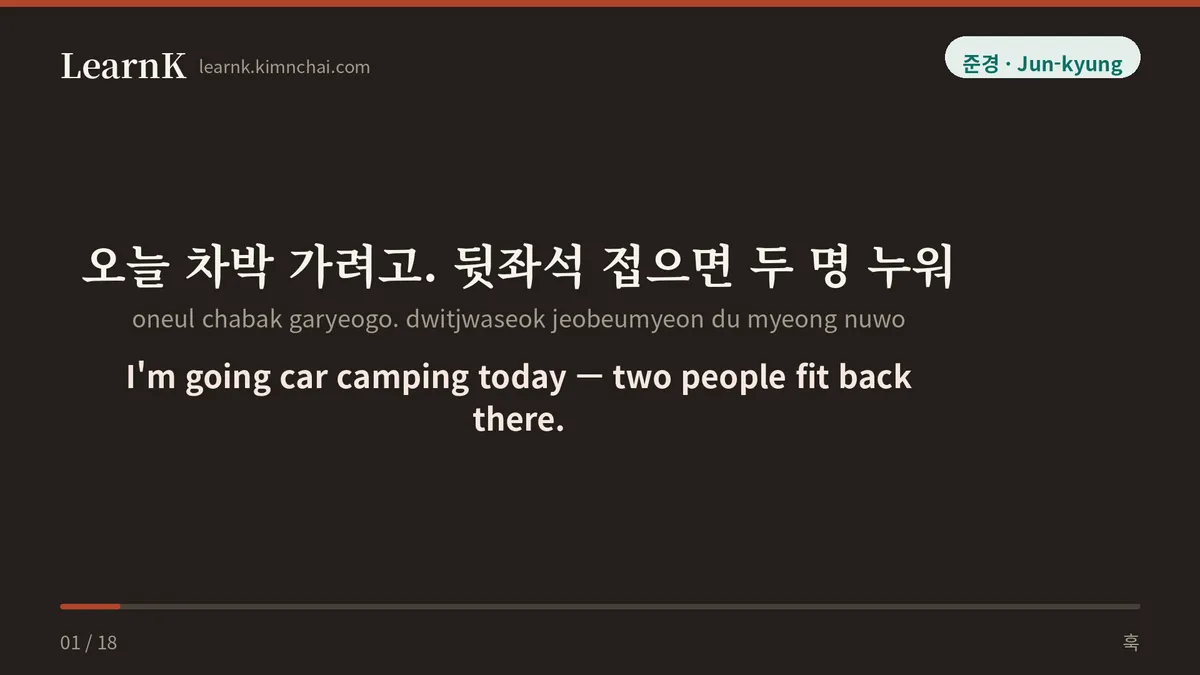
Scene: Saturday morning, the underground parking garage of an apartment building. Jun-kyung is folding down the back seats of his SUV and laying out a mat when Emily, on her way down with the recycling, walks past and notices.
에밀리: 어? 오빠 뭐 해요? 이사 가요? Huh? What are you doing? Are you moving out?
준경: 아니, 오늘 차박 가려고. 뒷좌석 이렇게 접으면 딱 두 명 누워. No, I’m going car camping today. Fold the back seats down like this and exactly two people fit.
에밀리: 아, 텐트 안 치고 차에서 자는 거? 안 불편해요? Ah, sleeping in the car instead of pitching a tent? Isn’t it uncomfortable?
준경: 매트만 깔면 괜찮아. 비 와도 안 젖고, 새벽에 추우면 시동 잠깐 걸면 되고. It’s fine once you lay a mat down. You don’t get wet if it rains, and if it gets cold before dawn you just run the engine for a bit.
에밀리: 오, 다음엔 저도 껴 줘요. 저 차박은 한 번도 안 해 봤어요. Oh, count me in next time. I’ve never done car camping before.
준경: 그래. 근데 첫 차박은 화장실 있는 데로 가자. 아무 데나 세우면 큰일 나. Sure. But for your first one, let’s go somewhere with a bathroom. Parking just anywhere is asking for trouble.
Saying It This Way Sounds Off
✗ 어제 고속도로 휴게소에서 삼십 분 차박했어요. (eoje gosokdoro hyugesoeseo samsip bun chabakhaesseoyo.) ✓ 어제 고속도로 휴게소에서 삼십 분 눈 붙였어요. (eoje gosokdoro hyugesoeseo samsip bun nun butyeosseoyo. — ‘I caught thirty minutes of sleep at a highway rest stop yesterday.’) → ‘박(泊)’ means staying a whole night. It isn’t used for a short nap. No matter that you slept in the car — if you didn’t sleep through the night, it isn’t 차박 (chabak).
✗ (after sleeping in a tent) 우리 어제 계곡에서 차박했어. (uri eoje gyegogeseo chabakhaesseo.) ✓ 우리 어제 계곡에서 캠핑했어. / 텐트 치고 잤어. (uri eoje gyegogeseo kaempinghaesseo. / tenteu chigo jasseo. — ‘We camped by the valley stream yesterday. / We pitched a tent and slept.’) → 차박 (chabak) only applies when your bed for the night is inside the car. If you drove there and slept in a tent, that’s 오토캠핑 (otokaemping, car-access camping). The car was only your ride, not your lodging.
Example Sentences by Situation
1. Monday morning, when a coworker asks what you did over the weekend
차박 다녀왔어요. 강릉 쪽으로요. (chabak danyeowasseoyo. Gangneung jjogeuro-yo.)
‘다녀오다’ means you went and came back. Add just one place name to it and you have the answer a Korean would give most naturally. From this one line, the other person picks up the whole picture — ‘so you drove out Friday or Saturday night, slept in the car, and came home in the morning.’
2. When you call a campground or camping area to ask
혹시 거기 차박 되나요? (hoksi geogi chabak doenayo?)
‘되나요?’ is the colloquial short form of ‘is it allowed?’ In Korea, whether 차박 (chabak) is permitted varies from place to place, which is why this is the sentence people actually use most. There are spots where tents are fine but 차박 (chabak) isn’t, and, the other way around, spots that take only 차박 (chabak).
3. When you’re talking a friend into it (casual speech)
이번 주말에 차박 갈래? 내 차 뒤에 두 명은 누워. (ibeon jumare chabak gallae? nae cha dwie du myeong-eun nuwo.)
‘차박 가다’ is short for ‘차박하러 가다’ (to go in order to do chabak). ‘~ㄹ래?’ is a light suggestion between friends. As in the second sentence, telling people how many can lie down in your car is the standard way to extend a Korean 차박 (chabak) invitation.
Formality, and Similar Expressions
차박 (chabak) itself is a noun with no built-in politeness level, so whether you’re speaking formally or casually is decided by the verb that follows it. Casual gives you 차박했어 / 차박 갔어? (chabakhaesseo / chabak gasseo?); polite gives you 차박 다녀왔어요 / 차박 가셨어요? (chabak danyeowasseoyo / chabak gasyeosseoyo?). That said, because this is fairly recent spoken slang, very formal settings like news copy or official documents will sometimes spell it out as 차량 내 취침 (charyang nae chwichim, ‘sleeping inside a vehicle’). In everyday conversation, people of every age just say 차박 (chabak).
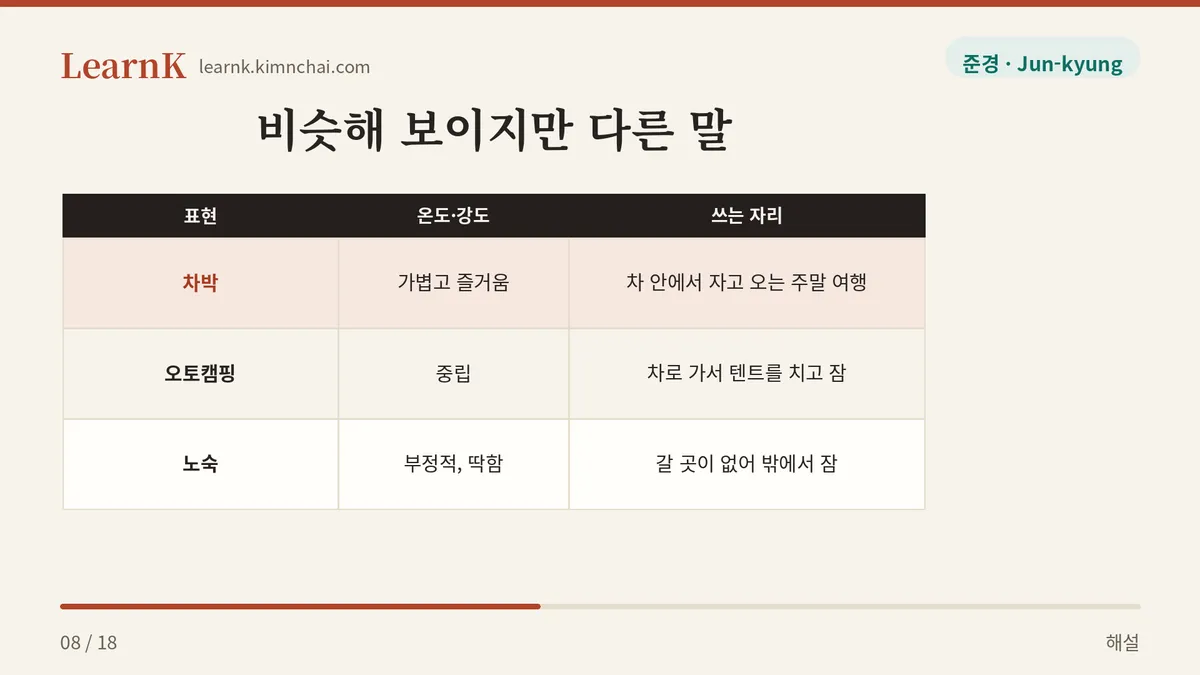
| Expression | Tone & intensity | Where it’s used |
|---|---|---|
| 차박 (chabak) | Light and fun, current slang | Among peers, on social media, in hobby groups. Rarely in writing |
| 캠핑 (kaemping) | Neutral, the broadest term | Anywhere. 차박 is one kind of camping |
| 오토캠핑 (otokaemping) | Neutral, suggests full gear | When you drive out and pitch a tent |
| 노숙 (nosuk) | Negative, pitiable | Sleeping outdoors because you have nowhere to go. Never interchangeable with 차박 |
차박 (chabak) and 노숙 (nosuk) may look alike from the outside, but in Korean they belong to completely different worlds. 차박 (chabak) is a choice; 노숙 (nosuk) is a circumstance. Saying ‘노숙하셨네요 (nosukhasyeonneyo, “so you slept rough”)’ to someone, even as a joke, is deeply rude.
Cultural Background — When One Car Becomes One Room
There’s a geographic reason 차박 (chabak) took hold so firmly in Korea. From Seoul it’s three hours to the East Sea, two to the West Sea. Leave after work on a Friday night and you’re at the beach before midnight; set off the moment you open your eyes on Sunday morning and you’re home before lunch. It’s that sense of distance that makes a trip with ‘no lodging, one night’ work at all.
On top of that came peak-season room rates and the scramble for reservations. The good places sell out months ahead, and a room with an ocean view costs serious money for a single night. 차박 (chabak) has no reservations. And then around 2020, when people needed a way to travel with less contact, this style spread in a big way all over again. It became a common enough hobby that whether the back seats fold completely flat, and how long the vehicle is, turned into criteria for choosing a car.
The etiquette problems grew right along with it. Engines idling all night in parking lots, meat grilled in no-cooking zones, trash left behind — because of these, the number of lots with ‘차박 금지 (chabak geumji, no overnight car camping)’ signs posted has genuinely risen. So even among Koreans, whenever 차박 (chabak) comes up, talk of which spots are good is always followed by talk of manners. That’s the context behind Jun-kyung’s line in the dialogue above about how parking just anywhere is asking for trouble.
For someone learning Korean, 차박 (chabak) is worth more than a single vocabulary item. Understand it and be able to use it, and you can step straight into conversations about weekends, about cars, about travel plans. It’s one of the most frequent topics going around a Korean office on a Monday morning.
Today’s Quiz
Which of the following situations can be called ‘차박 (chabak)’?
- Getting drowsy on a long drive, pulling into a rest stop, and catching thirty minutes of sleep.
- Driving to a campground, pitching a tent, and sleeping there for the night.
- Folding the back seats down, laying out a mat, sleeping the night in the car, and heading home in the morning.
- Parking in a lot with an ocean view, eating a packed lunch, and going straight home.
Answer: 3. 차박 (chabak) requires ‘sleeping inside the car’ and ‘staying overnight’ to be true at the same time. In 1 the night was never crossed, so that’s a 쪽잠 (jjokjam, catnap); in 2 the bed was a tent, so that’s 오토캠핑 (otokaemping); and in 4 there was no sleeping at all, so it’s just an outing.