첫눈에 반하다 (cheonnune banhada): Love That Falls Like the First Snow — That Drama Expression
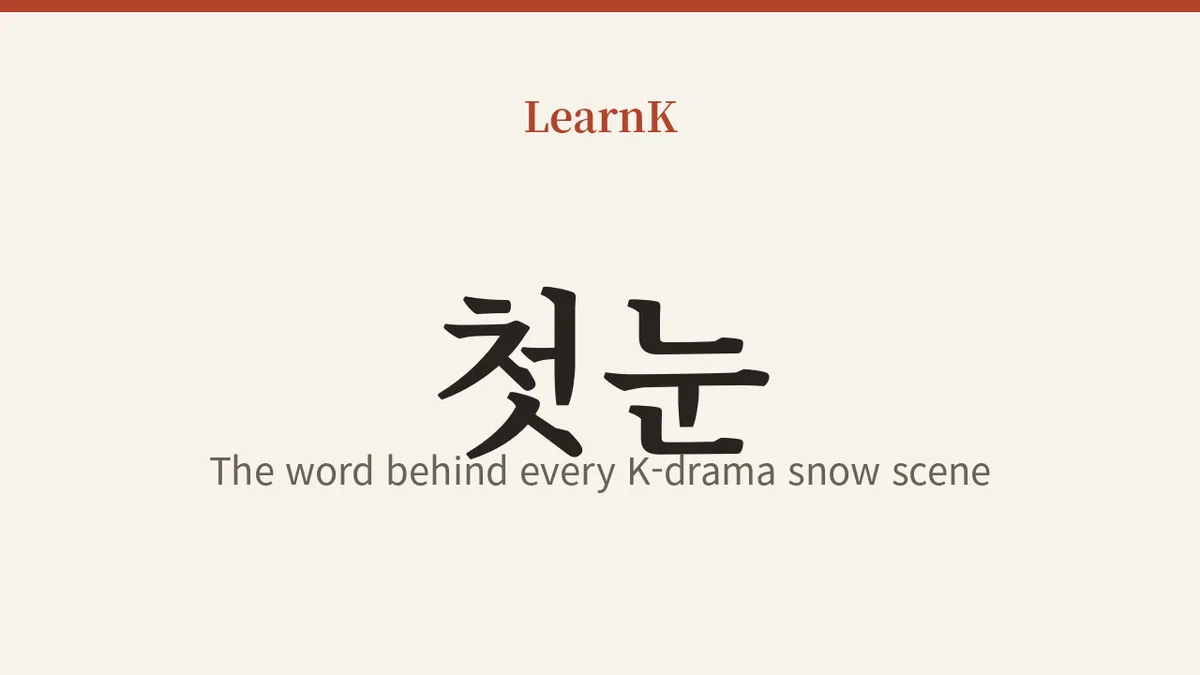
첫눈
When you watch Korean dramas, you’ll often come across scenes where the male and female leads lock eyes, time seems to stop, and white snow drifts through the air. In that moment, the word fans on the other side of the screen think of is exactly 첫눈 (cheotnun). But this word has two faces. One is “the feeling you get when you first see something,” and the other is the first snow that falls in winter — that is, the “first snow(fall).” Since they’re pronounced and spelled identically, drama writers love to use this exquisite overlap in their love stories.
Meaning and Nuance
The meaning we’ll focus on today is the first one: “the impression of the moment you first see something.” In particular, 첫눈에 반하다 (cheotnune banhada) means “to fall in love the moment you see someone” — it overlaps perfectly with the English love at first sight. And when you add the sound of ‘눈 (nun),’ meaning snow, on top of it, you get a romantic pun: falling in love at first sight (첫눈에 반하다) on the day the first snow (첫눈) falls. That’s why this word isn’t just a simple piece of vocabulary — it carries the very sentiment of Korean-style romance.
Checking with the National Institute of Korean Language Dictionary
First, let’s check the definition from an authoritative national institution’s dictionary.
첫눈 (noun): The feeling or impression from when you first see something. [en] first impression; first sight — A feeling or impression from the first encounter. [es] primera sensación, primera intuición — Impresión o sentimiento que se percibe al ver algo por primera vez. [zh] 第一眼,一眼,一见 — 第一次看见时的感觉或印象。 (The Portuguese translation is not in the dictionary, so we add our own — [pt] primeira impressão: sensação ao ver algo pela primeira vez.) — National Institute of Korean Language, Basic Korean Dictionary (krdict.korean.go.kr)
Let’s also read the actual example sentences the dictionary provides.
신입생 환영회에서 여자 친구를 처음 보고 제가 첫눈에 갔어요. — National Institute of Korean Language, Basic Korean Dictionary (krdict.korean.go.kr)
This is a story about seeing your now-girlfriend for the first time at a freshman welcome party and having your heart stolen. ‘첫눈에 가다 (cheotnune gada)’ is a colloquial expression similar to ‘첫눈에 반하다 (cheotnune banhada).’
두 사람은 첫눈에 반해 서로에게 걷잡을 수 없이 빠져들었다. — National Institute of Korean Language, Basic Korean Dictionary (krdict.korean.go.kr)
This is a classic romance-narrative sentence: they fell in love the moment they saw each other and fell for one another uncontrollably.
승규는 귀밑머리를 한 소녀가 그네를 뛰는 모습을 보고 첫눈에 반했다. — National Institute of Korean Language, Basic Korean Dictionary (krdict.korean.go.kr)
This is a picture-perfect scene of falling for a girl as she swings on a swing. It could easily appear as-is in a drama’s flashback scene.
첫눈 오는 날 우리 이 커피숍에서 다시 만나자. — National Institute of Korean Language, Basic Korean Dictionary (krdict.korean.go.kr)
Here, ‘첫눈 (cheotnun)’ is used to mean the first snow of winter. A promise to reunite at this café on the day of the first snow is a romantic promise Korean couples actually make quite often.
Example Sentences by Situation
Now let’s get a feel for it with some sentences we made ourselves.
-
A situation where your heart is stolen by someone you happen to run into at a café: 그 사람을 본 순간 첫눈에 반해 버렸어요. (geu sarameul bon sungan cheotnune banhae beoryeosseoyo.) — It means you fell in love the very moment you saw them.
-
A situation where a first impression is later overturned: 첫눈에는 차가워 보였는데, 알고 보니 정말 다정한 사람이었어요. (cheotnuneneun chagawo boyeonneunde, algo boni jeongmal dajeonghan saramieosseoyo.) — Here, ‘첫눈 (cheotnun)’ is used to mean ‘first impression.’
-
A situation where a couple promises to meet again: 첫눈 오는 날, 우리 꼭 다시 만나요. (cheotnun oneun nal, uri kkok dasi mannayo.) — This expression uses the winter’s first snow as a signal for a promise.
Comparing Polite/Casual Speech and Similar Expressions
Even the same feeling is spoken differently depending on who you’re talking to.
- Casual (to a friend): 나 걔한테 첫눈에 반했어. (na gyaehante cheotnune banhaesseo.)
- Polite (formally): 저는 그분에게 첫눈에 반했어요. (jeoneun geubunege cheotnune banhaesseoyo.)
A similar expression is 한눈에 반하다 (hannune banhada), which has a strong nuance of “with a single look,” so the meaning is almost the same. For the noun that refers to the first impression itself, you use 첫인상 (cheotinsang) — as in “첫인상이 좋았어요 (cheotinsangi joasseoyo)” (“The first impression was good”).
Cultural Background — 첫눈 in Dramas
In Korean romance dramas, ‘첫눈에 반하다 (cheotnune banhada)’ is practically a formula. The setup where the leads meet as if by fate on a day when snow falls softly is so famous that even in fantasy romances like Goblin (도깨비), the first snow is portrayed as a mysterious signal that connects two people. Rather than quoting lines directly, let’s introduce it through situation: a representative scene is one where the male lead sees the female lead for the first time on a snowy street and has his heart stolen. Real Korean young people also love to talk about the romantic superstition that “if you confess your feelings on the day of the first snow, it will come true.” So a single word overlaps season, fate, and love all at once.
Closing Quiz
What word goes in the blank below?
“나는 그 사람을 처음 본 순간 (______)에 반했어.” (“The moment I first saw that person, I fell for them at ______.”)
① 첫인상 (cheotinsang) ② 첫눈 (cheotnun) ③ 한겨울 (hangyeoul)
The answer is ② 첫눈 (cheotnun)! That’s because ‘첫눈에 반하다 (cheotnune banhada)’ is the natural idiomatic expression. If the first snow falls today, why not slip this expression to someone you’ve got your eye on?
Definitions and example sentences are from the National Institute of Korean Language’s Basic Korean Dictionary (krdict.korean.go.kr); that portion of this post, including our translations, is licensed under CC BY-SA 2.0 KR.