총공 (chonggong) — The Night a Fandom Sets Its Clocks Together
총공
총공 (chonggong) means an organized, concentrated show of support in which fans pour their streaming, voting, and album buying into one place at one agreed-upon time. Korean idol fandoms use it almost every week — and yet it’s also a word you won’t find no matter how hard you dig through a dictionary.
Around eleven at night on comeback day, drop into a fan community and you’ll see a table posted, sliced into one-hour blocks. Midnight to one, this music site; from one o’clock, that app; this many accounts at most; this many songs mixed into the playlist. The moment people all across the country look at that table and switch on their screens at the same time, each in their own room — that is 총공. If cheering is a feeling, 총공 is that feeling copied out onto a timetable.
The temperature is hot and the character is organized. It’s a different texture from “I cheered hard.” For the word 총공 to hold up, three things usually have to be in place.
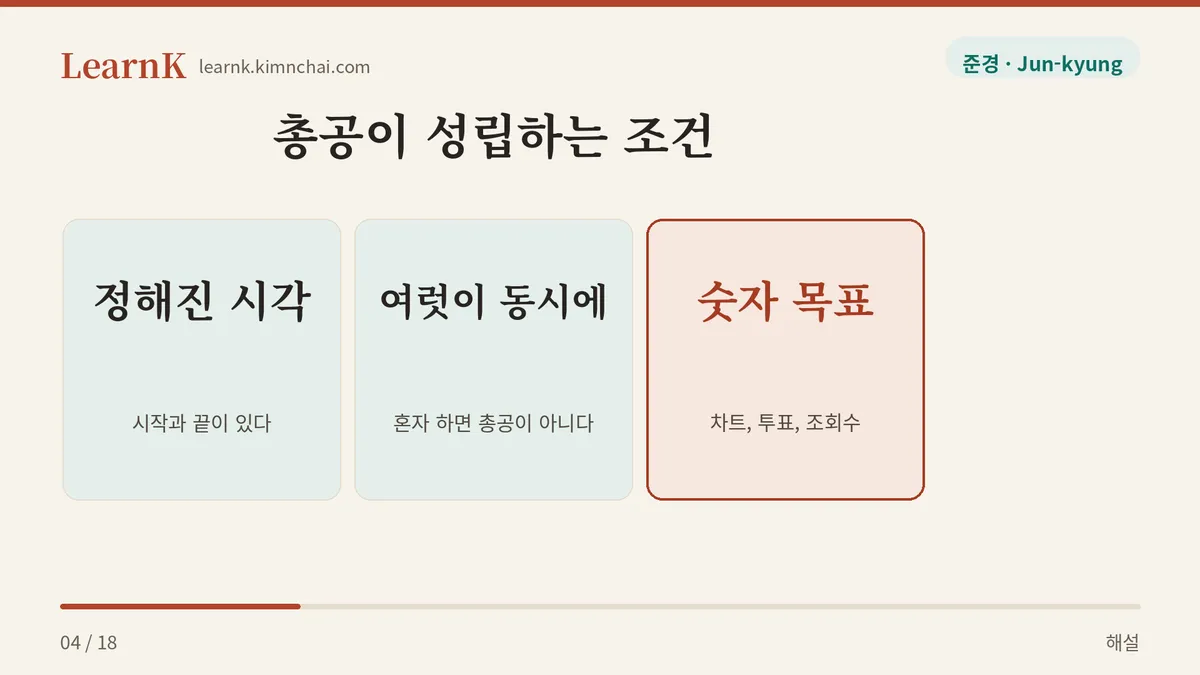
First, the time is fixed. Midnight, eight in the evening, three hours before the deadline — there’s a start and an end. Second, many people do it at the same time. Leaving songs playing by yourself all night isn’t 총공; that’s just 스밍 (seuming). Third, there’s a number to hit. Chart ranking, first place in a vote, a hundred million views — you need a visible figure before “the 총공 succeeded” makes any sense.
Here are the forms it usually takes. 총공 뛰다 (chonggong ttwida) means to take part in a 총공; 총공 돌리다 (chonggong dollida) means to keep accounts or playlists running without a break; and 총공 들어가다 (chonggong deureogada) is what you use in the announcement that kicks things off. In polite speech, 총공 들어갑니다 (chonggong deureogamnida) sounds far more natural than 총공합니다 (chonggonghamnida).
Seeing it in real conversation
Setting: 11:50 p.m. on comeback night, on the last subway train. Both are standing with their phones out.
Jun-kyung: 야, 십 분 남았어. 앱 다 켜 놨어? Hey, ten minutes left. Have you got all the apps open?
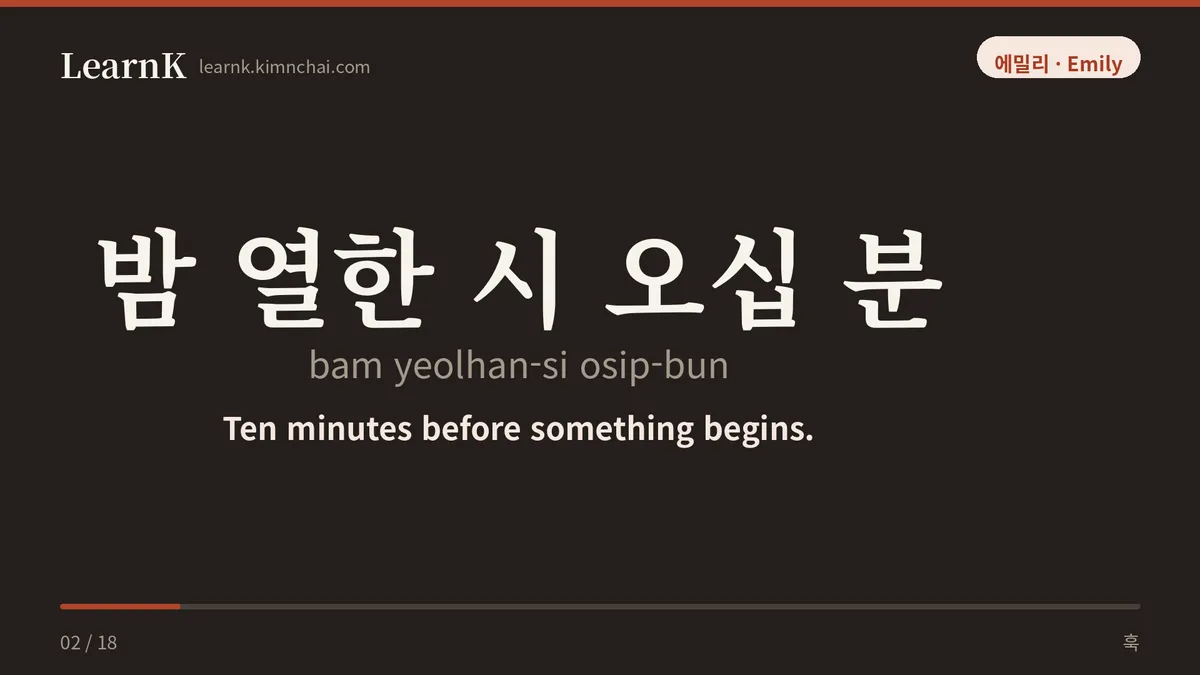
Emily: 켜 놨지. 근데 나 다음 역에서 갈아타는데, 거기 지하라 신호 끊긴단 말이야. I did. But I transfer at the next station, and it’s underground — the signal cuts out.
Jun-kyung: 아 맞다. 그럼 지금 미리 다운받아 놔. 총공 시작되면 서버도 밀려서 더 안 돼. Oh right. Then download it now. Once the chonggong starts, the servers get jammed too.
Emily: 오케이. 근데 오늘 총공 몇 시까지야? Okay. By the way, how late does today’s chonggong run?
Jun-kyung: 새벽 두 시. 아까 시간표 올라왔잖아, 한 시간씩 끊어서. Till two in the morning. The schedule went up earlier, remember — split into one-hour blocks.
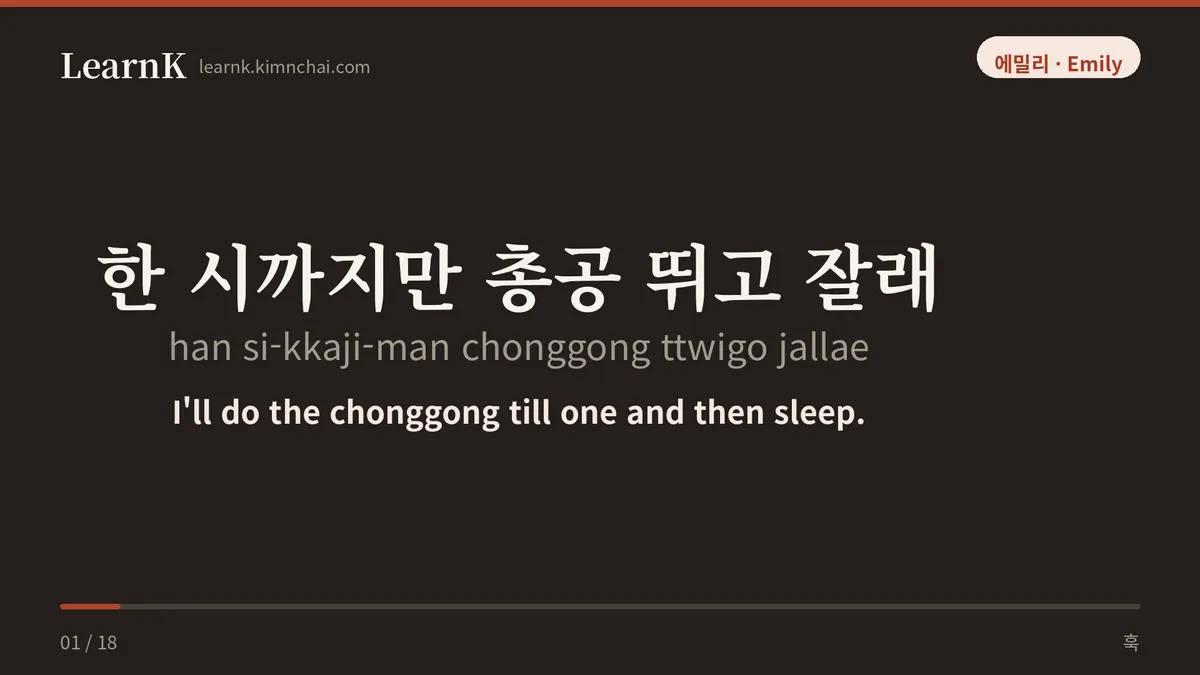
Emily: 두 시?! 나 내일 아홉 시 출근인데… 한 시까지만 총공 뛰고 잘래. Two?! I start work at nine tomorrow… I’ll do the chonggong till one and then sleep.
Using it this way sounds off
✗ (to your team lead in a quarterly meeting) 팀장님, 이번 실적 다 같이 총공 한번 가시죠. (timjangnim, ibeon siljeok da gachi chonggong hanbeon gasijyo.) — “Boss, let’s all go on a 총공 for this quarter’s numbers.” ✓ (in a fan chat room) 얘들아, 오늘 밤 열두 시부터 총공 한번 가자! (yaedeura, oneul bam yeoldu-si-buteo chonggong hanbeon gaja!) — “Guys, let’s run a 총공 from midnight tonight!” → It’s slang that grew up inside fandom, so dropping it into a meeting room lands as a joke rather than a serious proposal. At work, ‘다 같이 총력을 모으시죠 (da gachi chongnyeogeul moeusijyo)’ — “let’s pool all our efforts” — is the safer choice.
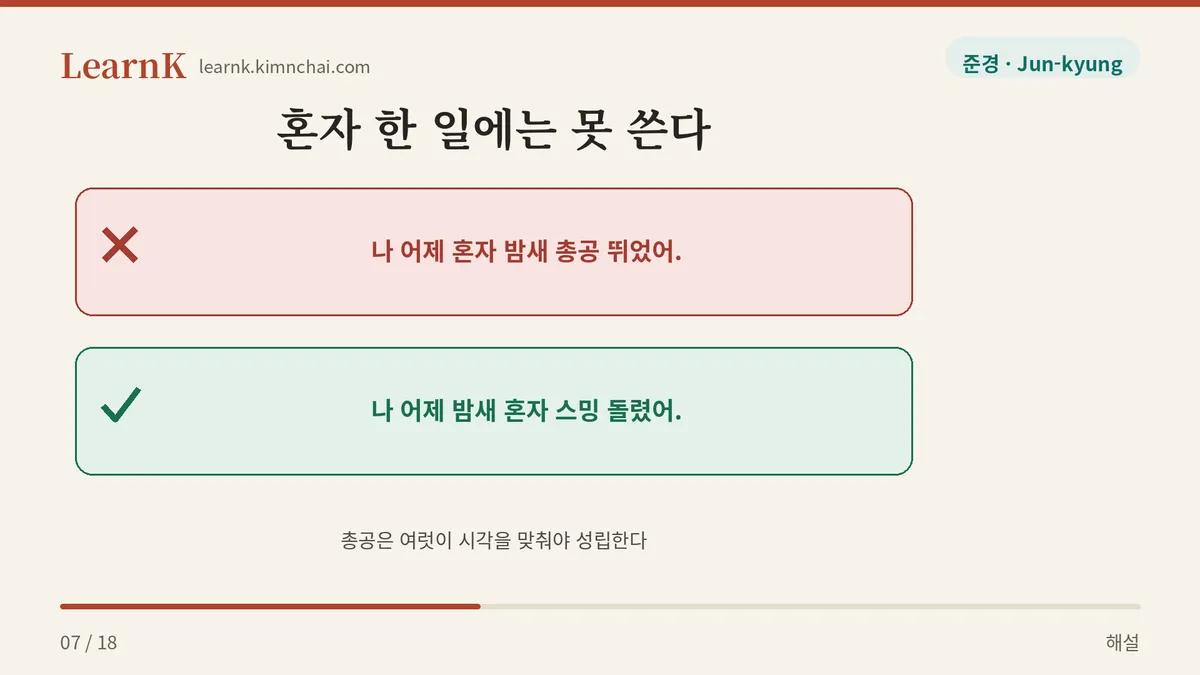
✗ 나 어제 혼자 밤새 총공 뛰었어. (na eoje honja bamsae chonggong ttwieosseo.) — “I did a 총공 alone all night yesterday.” ✓ 나 어제 밤새 혼자 스밍 돌렸어. (na eoje bamsae honja seuming dollyeosseo.) / 어제 총공 때 나도 끝까지 있었어. (eoje chonggong ttae nado kkeutkkaji isseosseo.) → 총공 is a group action that only exists when several people sync their clocks. Attach it to something you did alone and the word goes slack. No matter how long you kept at it, nobody says “a solo 총공.”
Example sentences by situation
1) When a fan account posts an announcement
오늘 밤 12시부터 새벽 2시까지 음원 총공 들어갑니다. 시간표 꼭 확인해 주세요. (oneul bam yeoldu-si-buteo saebyeok du-si-kkaji eumwon chonggong deureogamnida. siganpyo kkok hwagin hae juseyo.)
Almost every 총공 announcement follows this shape: start time, end time, link to the timetable. Because it’s addressed to an open crowd, it uses the polite ‘~합니다’ style and often closes with ‘부탁드립니다 (butakdeurimnida)’.
2) The day before award-show voting closes, to a friend
투표 총공 오늘이 마지막이야. 계정 있는 대로 다 돌려. (tupyo chonggong oneuri majimagiya. gyejeong inneun daero da dollyeo.)
총공 takes a target in front of it: 음원 총공 (eumwon chonggong, music-streaming), 투표 총공 (tupyo chonggong, voting), 조회수 총공 (johoesu chonggong, view count). The structure puts what you’re concentrating firepower on up front, so changing that one word changes the whole situation.
3) In a game guild’s chat room
아홉 시에 보스 총공이니까 늦지 마. (ahop-si-e boseu chonggong-inikka neutji ma.)
총공 isn’t fandom-only. In online games, guild members syncing up to hit one target is also called 총공 — because the conditions are identical: set a time, gather a crowd, pour everything into one spot.
Polite and casual forms, and similar expressions
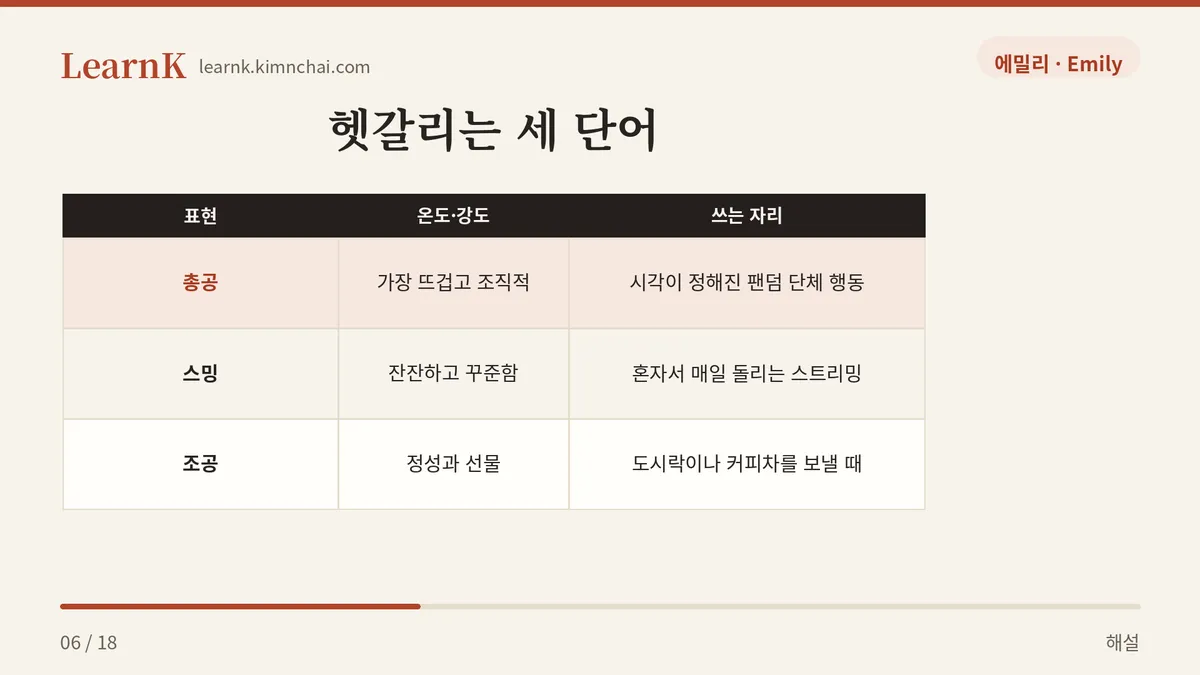
총공 is a noun, so the burden of politeness falls on the verb that follows. Casually: ‘총공 뛰자 (chonggong ttwija)’ / ‘총공 가자 (chonggong gaja)’. Politely: ‘총공 들어갑니다 (chonggong deureogamnida)’ / ‘총공 참여 부탁드립니다 (chonggong chamyeo butakdeurimnida)’. When explaining it to someone outside fandom, it usually lands better to skip the word and unpack it as “a streaming event.”
| Expression | Temperature / intensity | Where it’s used |
|---|---|---|
| 총공 (chonggong) | Hottest, most organized | Fandom group action at a set time |
| 스밍 (seuming) | Calm and steady | Streaming you run on your own, every day |
| 조공 (jogong) | Care, gift-giving | Sending idols lunchboxes or a coffee truck |
| 응원 (eungwon) | Neutral | Anywhere — sports, exams, performances |
총공 and 조공 differ by a single syllable, so learners mix them up constantly. 총공 is about pushing numbers up; 조공 is about sending things.
Cultural background — a word that came from 총공격
총공 is short for 총공격 (chonggonggyeok). Originally it’s a military term for an all-out assault in which troops are thrown in all at once. When fandoms and gaming communities borrowed the word, only the target of the attack changed — charts instead of enemy lines, the play button instead of weapons. That’s why battle vocabulary still clings to 총공. A fandom’s size is called 화력 (hwaryeok, “firepower”), moving according to the timetable is called 작전 (jakjeon, “the operation”), and when it’s over people write 총공 성공 (chonggong seonggong, “mission accomplished”).
There’s a reason the word took root this deeply. Korean music sites in the 2010s had real-time charts that refreshed every hour, and those rankings fed directly into TV appearances and buzz. When the ranking is real-time, the cheering becomes real-time too. Inside a system where a song dropped at midnight and the first ranking appeared at one in the morning, fans carved up their sleep to build timetables. That’s why 총공 is so distinctly a language of the night.
Now that real-time charts are gone and counting has shifted to daily totals, the shape of 총공 has changed too. Instead of one midnight surge, fans push long through the first week of release, and the weight has moved from music streaming toward music-video views and award-show voting. Still, the word survives. When the five characters ‘오늘 총공 (oneul chonggong, “today’s chonggong”)’ appear in a fan community, people still set their alarms.
The places this word shows up in Korean dramas and variety shows are usually similar too. It drifts by like background sound over a scene of people staring at their screens all night, in shots of idols or their fans. If you don’t know what it means, it’s just two syllables passing through; once you do, you can see what that scene compresses — a night belonging to people who tried turning affection into numbers.
Today’s quiz
Which of the following sentences uses 총공 (chonggong) naturally?
- 나 어제 혼자 밤새 총공 뛰었어. (na eoje honja bamsae chonggong ttwieosseo.)
- 오늘 밤 12시부터 두 시간, 다 같이 총공 들어갑니다! (oneul bam yeoldu-si-buteo du sigan, da gachi chonggong deureogamnida!)
- 팀장님, 다음 분기 실적 총공 한번 부탁드립니다. (timjangnim, da-eum bungi siljeok chonggong hanbeon butakdeurimnida.)
Answer: number 2. The time is fixed (two hours from midnight), it’s done together (다 같이), and since it’s an announcement, the ‘들어갑니다’ style is right. Number 1 can’t be a 총공 because it was done alone (‘스밍 돌렸어’ is the right phrase), and number 3 drops fandom slang into a meeting room, so it comes across as a joke.
Definitions and example sentences are from the National Institute of Korean Language’s Basic Korean Dictionary (krdict.korean.go.kr); that portion of this post, including our translations, is licensed under CC BY-SA 2.0 KR.