취향저격 (chwihyangjeogyeok) — The Moment Something Hits Your Taste Dead Center
취향저격 (chwihyangjeogyeok)
취향저격 (chwihyangjeogyeok) describes the feeling when an object, a song, a shop, or a piece of work fits your taste so exactly that it’s as if someone took aim at your taste and fired. In Korea, the moment this word comes out is usually very short and very strong. The moment the first line of a song comes through the earbud a friend just handed you, the moment you see the color of the lighting in a café you’ve walked into for the first time, the moment your hands stop halfway through tearing open a package — this is the word that leaps out before you’ve even finished forming a sentence.
The important thing is that this is not a verdict on quality. 좋다 (jota), “it’s good,” can pretend to be objective, but 취향저격 takes me as the measuring stick from beginning to end. A well-made thing isn’t 취향저격 if it isn’t to my taste, and something everyone else calls tacky is 취향저격 if I love it. That’s why there’s a quiet little confession folded into this word. The moment I say 이거 취향저격이야 (igeo chwihyangjeogyeogiya), “this is totally my taste,” I’ve handed the other person one coordinate of my taste.
The intensity runs high, too. If 마음에 든다 (ma-eume deunda), “I like it,” is lukewarm water, then 취향저격 is closer to boiling. That’s why words like 완전 (wanjeon) (totally), 너무 (neomu) (so, really), and 인정 (injeong) (admitted, agreed) so often come attached to it. In a sentence it can work as a noun, as in 취향저격이다 (chwihyangjeogyeogida), or you can make yourself the one who got hit, as in 취향저격당했다 (chwihyangjeogyeokdanghaetda). It’s an unusual passive form — you’re saying you got shot, and yet it feels great.
See It in a Real Conversation
Situation: Emily’s housewarming party. She’s just tearing open the gift box Jun-kyung brought.
Jun-kyung: 별거 아니야. 지나가다 보고 네 생각나서 그냥 집어 왔어. It’s nothing. I just saw it on my way and thought of you.
Emily: (포장을 뜯다 말고) 어머… 야, 이거 완전 취향저격인데? (stopping halfway through the wrapping) Oh my… hey, this is totally my taste!
Jun-kyung: 진짜? 다행이다. 색깔 고르느라 삼십 분 서 있었어. Really? What a relief. I stood there for thirty minutes picking the color.
Emily: 너 내 취향 어떻게 이렇게 잘 알아? 좀 무섭다 진짜. How do you know my taste this well? Honestly, it’s a little scary.
Jun-kyung: 네가 맨날 인스타에 올리는 거 보면 답 나오지. 이 정도면 취향저격 맞지? Your Instagram gives it all away. This counts as a bullseye, right?
Emily: 인정. 제대로 저격당했어. 오늘 설거지는 내가 할게. Admitted. You shot me right through. I’ll do the dishes tonight.
When It Sounds Off
✗ (to your team lead, in a meeting) 팀장님, 이번 기획안 제 취향저격이었습니다. ✓ (to a coworker) 야, 이번 기획안 완전 취향저격이더라. → The grammar is perfectly fine, but the setting is wrong. You end up measuring a superior’s work against the yardstick of your own personal taste, and because the word is slang, the comment sounds lightweight. With a team lead, 인상 깊었습니다 (insang gipeotseumnida), “it made a strong impression,” is the safer choice.
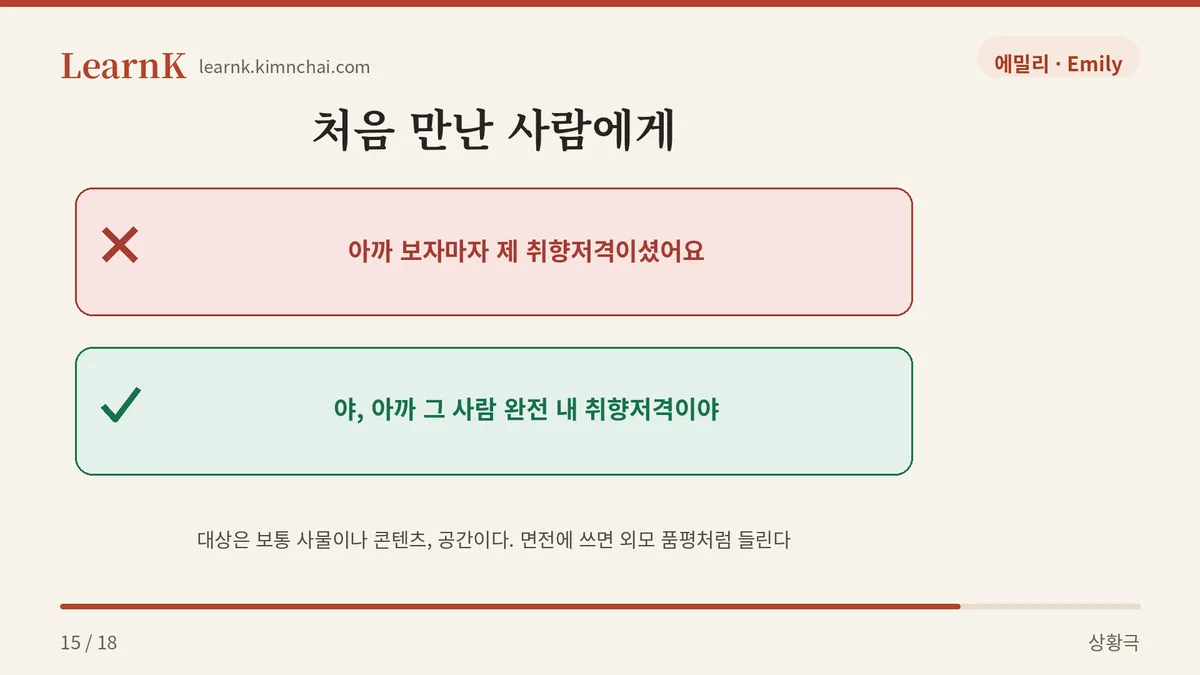
✗ (to someone you’ve just met) 사실 아까 보자마자 제 취향저격이셨어요. ✓ (to a friend) 야, 아까 그 사람 완전 내 취향저격이야. → The target of 취향저격 is usually a thing, a piece of content, or a place. Said to a person’s face, it comes across as commentary on their looks or as an abrupt pick-up line. When you do use it about a person, it’s natural in a conversation with a friend — when that person isn’t around.
Example Sentences by Situation
1. At a shop you’ve walked into for the first time (to a friend, casual speech)
여기 음악이랑 조명 진짜 취향저격이다. 나 여기 단골 될 듯. yeogi eumagirang jomyeong jinjja chwihyangjeogyeogida. na yeogi dangol doel deut. The music and the lighting here are so my taste. I think I’m going to become a regular. (Full form: 여기 음악이랑 조명 진짜 취향저격이다. 나 여기 단골 될 것 같아.)
Rather than the shop as a whole, pointing at concrete elements like the music and the lighting sounds much more natural. 취향저격 is, after all, a word about taking aim and hitting — tell people where you got hit, and the sentence comes alive.
2. Talking about a drama (to a colleague, polite speech)
어제 그 드라마 1화부터 취향저격이라 새벽 세 시까지 봤어요. eoje geu deurama ilhwabuteo chwihyangjeogyeogira saebyeok se sikkaji bwasseoyo. That drama was my taste from episode one, so I watched until three in the morning.
You can drop it straight into a polite sentence like this. That said, it works when the listener is a peer or a colleague around your age. If there’s a big age gap or the setting is formal, it’s better to switch to something like 취향에 딱 맞아서요 (chwihyange ttak majaseoyo), “because it fit my taste perfectly.”
3. In an online shopping review (to a general audience)
사진보다 색감이 훨씬 예뻐요. 색 취향저격이라 다른 색도 주문했습니다. sajinboda saekgami hwolssin yeppeoyo. saek chwihyangjeogyeogira dareun saekdo jumunhaetseumnida. The color is much prettier than in the photos. The color was exactly my taste, so I ordered another one.
In writing like shopping reviews and café visit reviews, this word is used almost as a set phrase. It’s common in advertising copy too, so you’ll often spot 취향저격 embedded right in a product description.
Politeness Levels and Similar Expressions
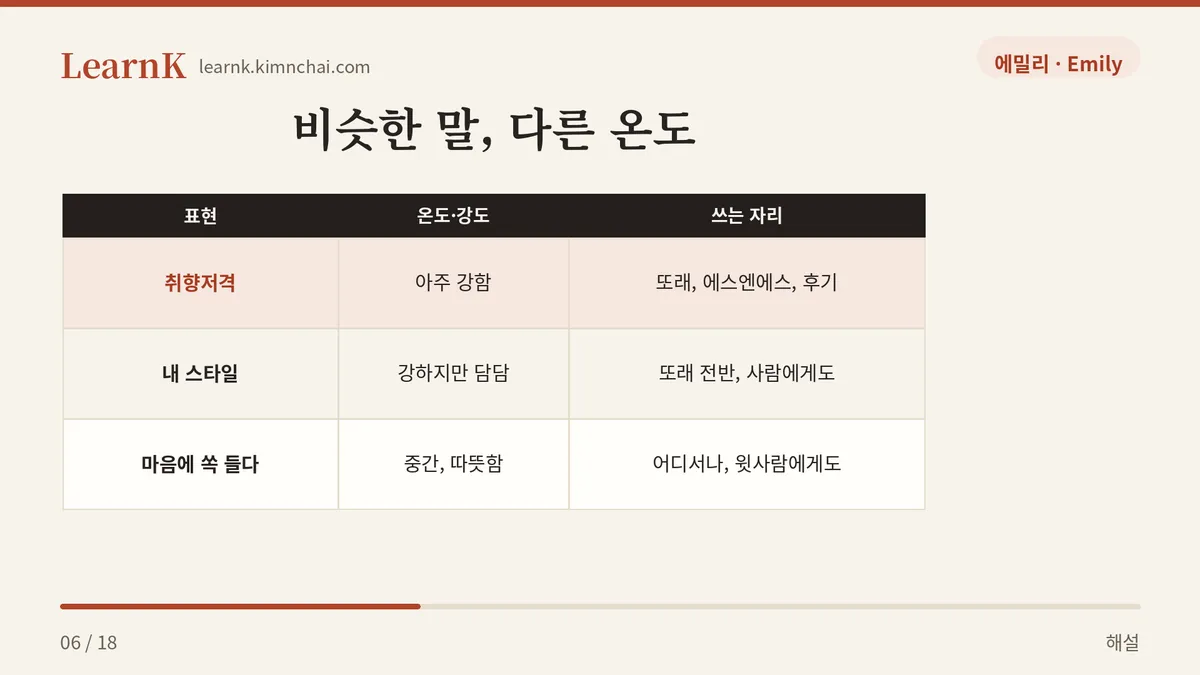
취향저격 itself has no separate honorific form. You can make the sentence polite by changing the ending (취향저격이에요, chwihyangjeogyeogieyo), but the fact that the word is slang doesn’t go away. So in front of someone senior to you, it’s better to change the word itself.
| Expression | Temperature & intensity | Where it’s used |
|---|---|---|
| 취향저격 (chwihyangjeogyeok) | Very strong. Close to an exclamation | Peers, social media, reviews. Avoid with seniors |
| 취저 (chwijeo) | Strong, but lighter | Chats, comments. Rarely spoken aloud |
| 내 스타일 (nae seutail) | Strong. A bit calmer than 취향저격 | Peers in general. Can be used about people too |
| 마음에 쏙 들다 (ma-eume ssok deulda) | Medium. Warm | Anywhere. Safe even with seniors |
| 딱이다 (ttagida) | Medium. Practical satisfaction | Peers. When it’s about fit or function rather than taste |
Even receiving the very same gift, you choose different words. To a friend, 취향저격; to your mother-in-law, 마음에 쏙 들어요 (ma-eume ssok deureoyo). The meanings overlap, but the temperature doesn’t.
Cultural Background — The Age of Algorithms Taking Aim
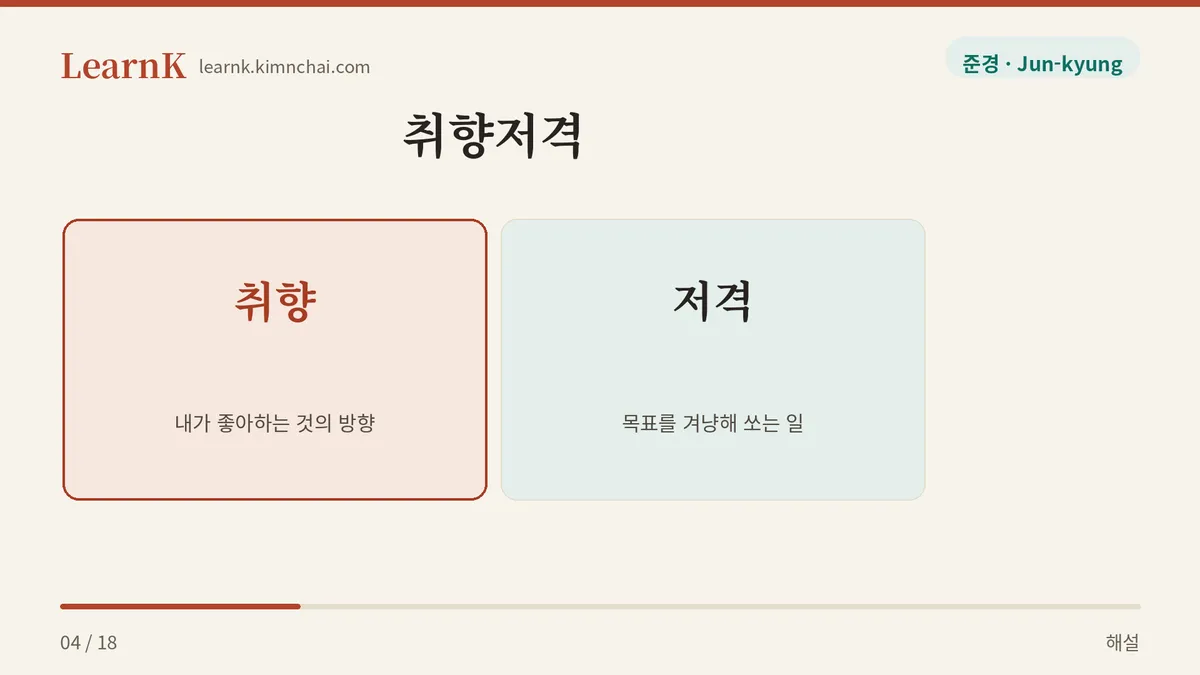
The shape of this word is simple. 취향 (chwihyang) is the direction your heart leans in what it likes, and 저격 (jeogyeok) is taking aim at a target and firing. Put them together and you get the picture directly: my taste was carefully sighted and hit dead center. In Korean, 저격 was originally a heavy word tied to guns, but as it passed through the internet it broadened toward “singling out a specific target.” Calling a post written to target someone 저격글 (jeogyeokgeul) comes from the same current. 취향저격 is the one case where being aimed at is welcome.
Popular music played a part in this expression spreading so widely in the mid-2010s. The group iKON, which debuted in 2015, released a song titled 취향저격, and as the song became widely known, the word settled into everyday language along with it. These days it feels less like slang and more like a familiar word — one that has even worked its way into ad copy and product names.
There seems to be a reason you hear it even more often now. We live in an age where music apps and video platforms fire something at our tastes every single day. When an algorithm-generated playlist fits uncannily well, Koreans say: 알고리즘 취향저격이네 (algorijeum chwihyangjeogyeogine), “the algorithm hit my taste dead on.” Admiration at the precision, and a faint chill at how much it knows about you, sit inside one single word. That’s exactly the feeling behind Emily saying it was “a little scary” in the conversation above.
There’s a separate reason this word is especially useful for Korean learners. In conversations among peers in Korea, taste makes up a big part of introducing yourself. In plenty of settings, what music you listen to and which cafés you go to come up before what you do for a living. In those conversations, 취향저격 is a signal that you’re laying your taste over someone else’s. Throw this word at something the other person recommended, and it isn’t just a compliment — it’s closer to saying, “I think we’re on the same wavelength.”
Today’s Quiz
The company workshop has just wrapped up, and your department head asks how the course was. Which reply sounds natural?
- 부장님, 이번 코스 완전 취향저격이었습니다.
- 코스가 저한테 정말 잘 맞았습니다. 재미있게 다녀왔습니다.
- 취저였습니다.
Show the answer
Answer: 2
취향저격 and its abbreviation 취저 (chwijeo) are slang used among peers. The grammar isn’t wrong, but in front of your department head the reply sounds flippant — and tossing out just the abbreviation, as in option 3, comes across as careless. It’s safer to switch to ordinary words like 마음에 들었다 (ma-eume deureotda), “I liked it,” or 잘 맞았다 (jal majatda), “it suited me well.” If you were quietly saying it to the colleague sitting next to you at that same event, though, option 1 would be exactly the right thing to say.