할아버지 댁 (harabeoji daek) — There Are Places Where You Must Not Say “House”
댁 (daek)
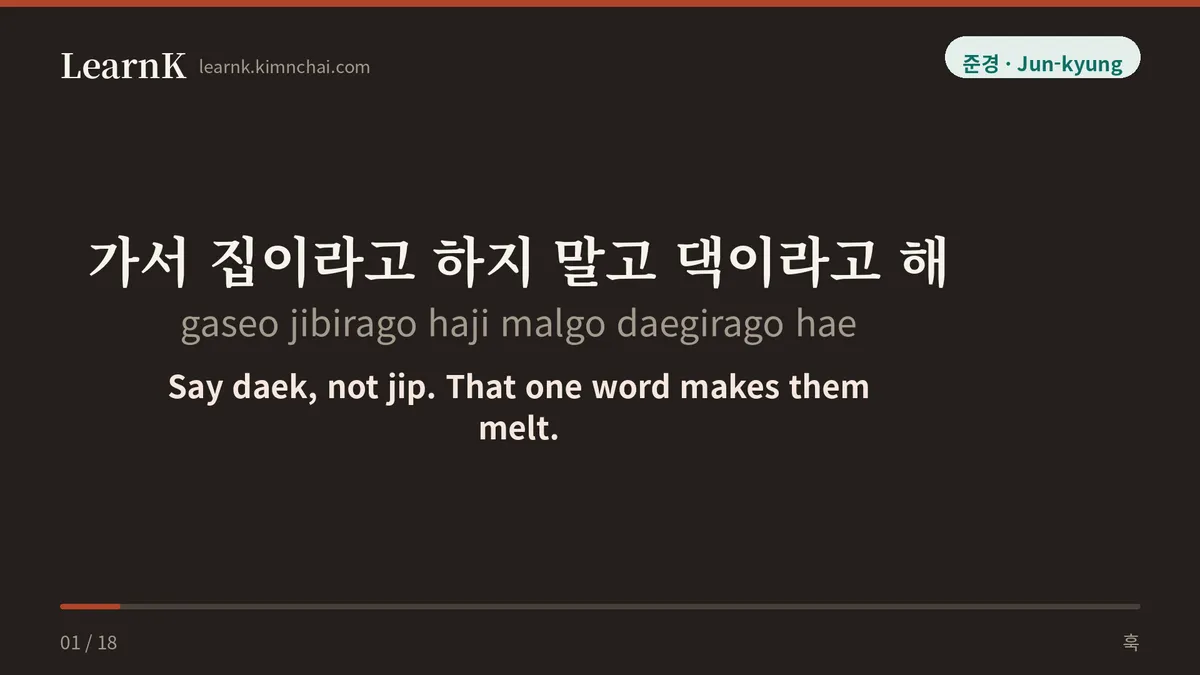
댁 (daek) means another person’s house or family, spoken with respect. In Korean dramas, the moment a holiday scene starts, there’s one line you’re almost guaranteed to hear — “**할아버지 댁 (harabeoji daek)**에 가야지.” (“We have to go to Grandpa’s.”) But the English subtitle just reads grandpa’s house. So a lot of learners file this word away as a fancier synonym for “house” and move on. Korean speakers, though, never mix the two. Between 집 (jip) and 댁 (daek) there is a line — drawn not by grammar but by manners — and whether you cross it is what separates “someone who studied Korean” from “someone who knows Korean.”
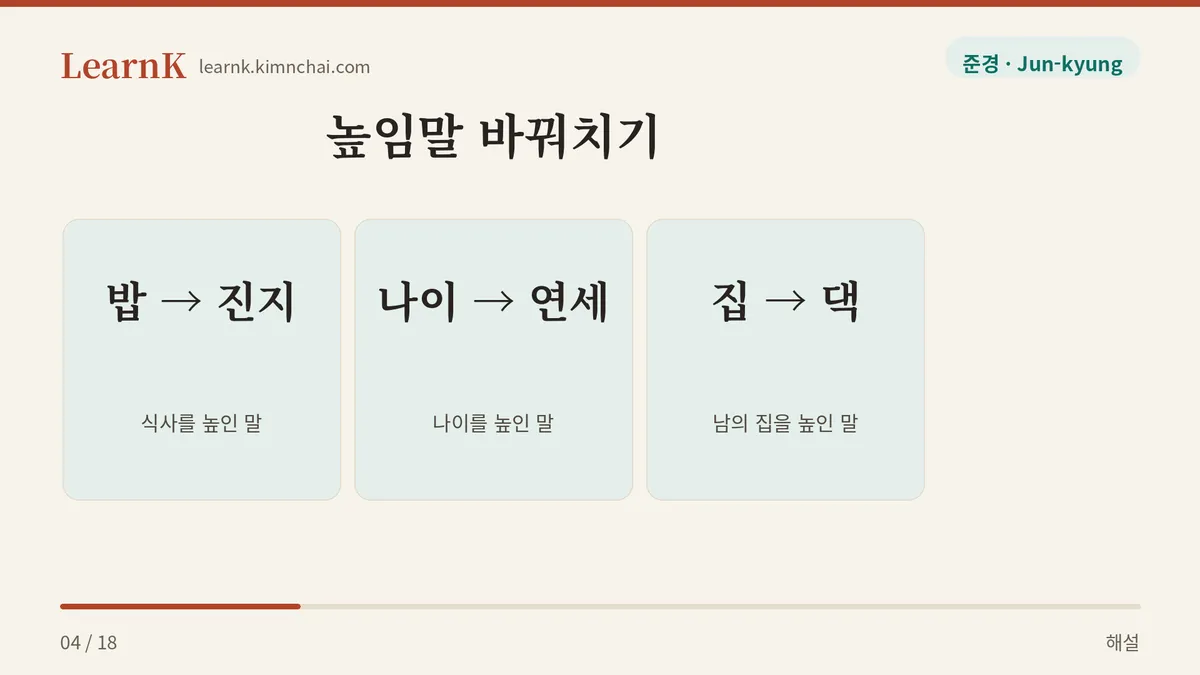
Here’s the key. 댁 (daek) doesn’t elevate the building — it elevates the people who live in it. So no matter how big and beautiful my house is, my own home can never be a 댁 (daek). Conversely, even a single rented room becomes a 댁 (daek) if an elder lives there. The thing being honored is a person, not bricks. Most Korean honorifics move this way — 진지 (jinji) instead of 밥 (bap) for “meal,” 연세 (yeonse) instead of 나이 (nai) for “age,” 말씀 (malsseum) instead of 말 (mal) for “words.” You change the name of the object in order to raise the person.
One more thing. 댁 (daek) doesn’t point only at a physical house. As the dictionary definition says — “another person’s home or family” — it’s also a word that bundles everyone living in that house into one unit. When you say “아저씨 댁에는 식구가 많다” (“There are a lot of people in the man’s household”), you’re not saying his building is spacious; you’re talking about the size of that family’s life together. And this word appears far more often attached to the end of another word than standing alone — 시댁 (sidaek), 큰댁 (keundaek), 처가댁 (cheogadaek), 외갓댁 (oegatdaek), 새댁 (saedaek). The Korean family map is, in effect, drawn with “-댁 (-daek).”
Checking the National Institute of Korean Language Dictionary
댁 「명사」
- (높이는 말로) 남의 집이나 가정. [en] one’s family — (polite form) Another person’s home or family. [ja] おたく【お宅】 — 人の家や家庭を敬っていう語。 [es] casa, hogar — (EXPRESIÓN DE RESPETO) Hogar o casa de otros. [zh] 府,贵府 — (敬语)别人的家或家庭。 — National Institute of Korean Language, Basic Korean Dictionary (krdict.korean.go.kr)
- (높이는 말로) 남의 아내. [en] one’s wife — (polite form) Another person’s wife. [ja] ふじん【夫人】 — 人の妻を敬っていう語。 [es] esposa — (EXPRESIÓN DE RESPETO) Esposa de otro. [zh] 令夫人 — (敬语)别人的妻子。 — National Institute of Korean Language, Basic Korean Dictionary (krdict.korean.go.kr)
- ‘부인’, ‘집’, ‘가정’ 등의 뜻을 나타내는 말. [en] wife; home; family — A term meaning one’s wife, home, family, etc. [ja] おたく【お宅】。ふじん【夫人】 — 「夫人」、「家」、「家庭」などの意を表す語。 [zh] — 表示“夫人”、“家”、“家庭”等意义的词。 — National Institute of Korean Language, Basic Korean Dictionary (krdict.korean.go.kr)
A Portuguese definition isn’t included in this dictionary, so the following is our own translation (not the dictionary’s original text): casa, lar — (forma de respeito) a casa ou a família de outra pessoa.
Below are the dictionary’s own usage examples, quoted as they appear, with a note on the kind of situation each one comes from.
설날 아침에 우리 가족은 한복으로 옷을 갈아입고 할아버지 댁에 갔다. — National Institute of Korean Language, Basic Korean Dictionary (krdict.korean.go.kr)
On the morning of Lunar New Year, my family changed into hanbok and went to Grandfather’s 댁 (daek).
This is the classic setting where 댁 (daek) shows up most often. On New Year’s morning, the whole family dresses properly and heads for the home where the elders live. Writing “할아버지 집 (harabeoji jip)” here wouldn’t be ungrammatical, but it clashes with the formality of the holiday scene, and the whole sentence collapses.
명절인데 할아버지 댁에 무슨 선물을 사 갖고 가면 좋을지 모르겠어요. — National Institute of Korean Language, Basic Korean Dictionary (krdict.korean.go.kr)
It’s a holiday and I have no idea what gift I should buy to bring to Grandfather’s 댁 (daek).
Same place, but this time it’s a worry. Underneath the sentence lies the instinct that you don’t show up empty-handed at an elder’s home. It’s also, realistically, one of the most-searched sentences among Korean learners as a holiday approaches.
시간이 늦었으니 제가 댁까지 모셔다 드릴게요. — National Institute of Korean Language, Basic Korean Dictionary (krdict.korean.go.kr)
It’s late, so let me see you home to your 댁 (daek).
Here nothing is attached in front — 댁 (daek) stands alone. That’s because “the other person’s home” is already built into the word itself. Paired with the honorific predicate 모셔다 드릴게요 (mosyeoda deurilgeyo), the temperature of the whole sentence turns courteous. You can use this exact line at night after a company dinner, when you’re seeing off an older colleague or your boss.
손님 대접이 후했던 아저씨 댁에는 객식구가 10명이 넘었다. — National Institute of Korean Language, Basic Korean Dictionary (krdict.korean.go.kr)
The man’s 댁 (daek), generous to guests, had more than ten people staying under its roof.
The 댁 (daek) in this sentence isn’t a building — it’s a household. It refers to the man’s entire domestic life. This is the second half of definition 1, “another person’s home or family,” coming alive.
나는 결혼한 직후 엄격한 시댁의 가풍에 적응하느라 힘든 시간을 보냈다. — National Institute of Korean Language, Basic Korean Dictionary (krdict.korean.go.kr)
Right after getting married, I had a hard time adjusting to the strict traditions of my 시댁 (sidaek).
This is definition 3 — the word attached to the end of another word. 시댁 (sidaek) means the house where the husband’s parents live, and also that family as a whole. What was hard in this sentence wasn’t the building; it was the atmosphere and the rules of that family.
Seeing It in Real Conversation
Situation: The first morning of the Lunar New Year holiday, in an apartment parking lot. Jun-kyung is loading gift boxes into his trunk when Emily comes out carrying a big paper bag.
Jun-kyung: 어? 에밀리, 이 시간에 어디 가. 짐이 한가득이네. Huh? Emily, where are you off to this early? You’re loaded down.
Emily: 지훈이네 부모님 댁에 가. 나 명절에 초대받은 거 처음이야. I’m going to Jihoon’s parents’ place. It’s my first time being invited for the holidays.
Jun-kyung: 오, 잘됐다. 근데 그거 뭐야, 선물? Oh, nice. What’s that, a gift?
Emily: 응, 홍삼. 근데 이거면 될까? 어른 댁에 처음 가는 건데. Yeah, red ginseng. But is this enough? It’s my first visit to an elder’s home.
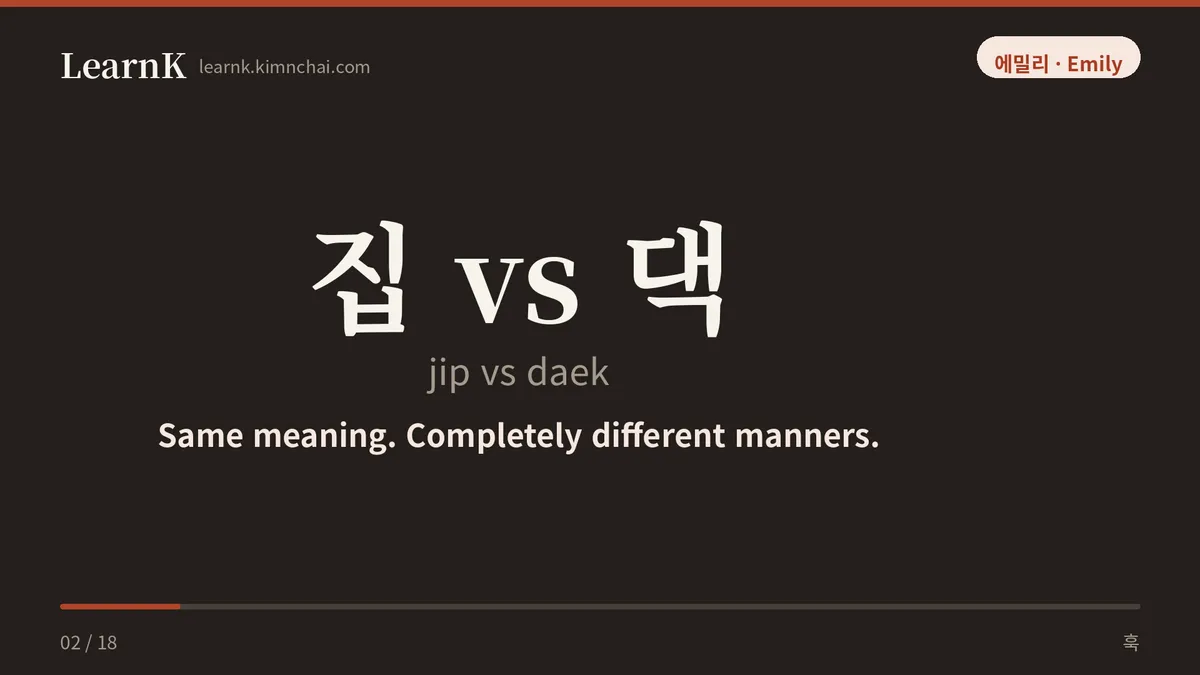
Jun-kyung: 충분해, 충분해. 아, 가서 “집”이라고 하지 말고 “댁”이라고 해. 그거 하나에 어른들 표정 풀려. More than enough. Oh — say “daek” instead of “jip” when you’re there. That one word makes them melt.
Emily: 야, 나 여기 산 지 15년이야. 그 정도는 알지. Hey, I’ve lived here 15 years. I know that much.
These Uses Sound Off
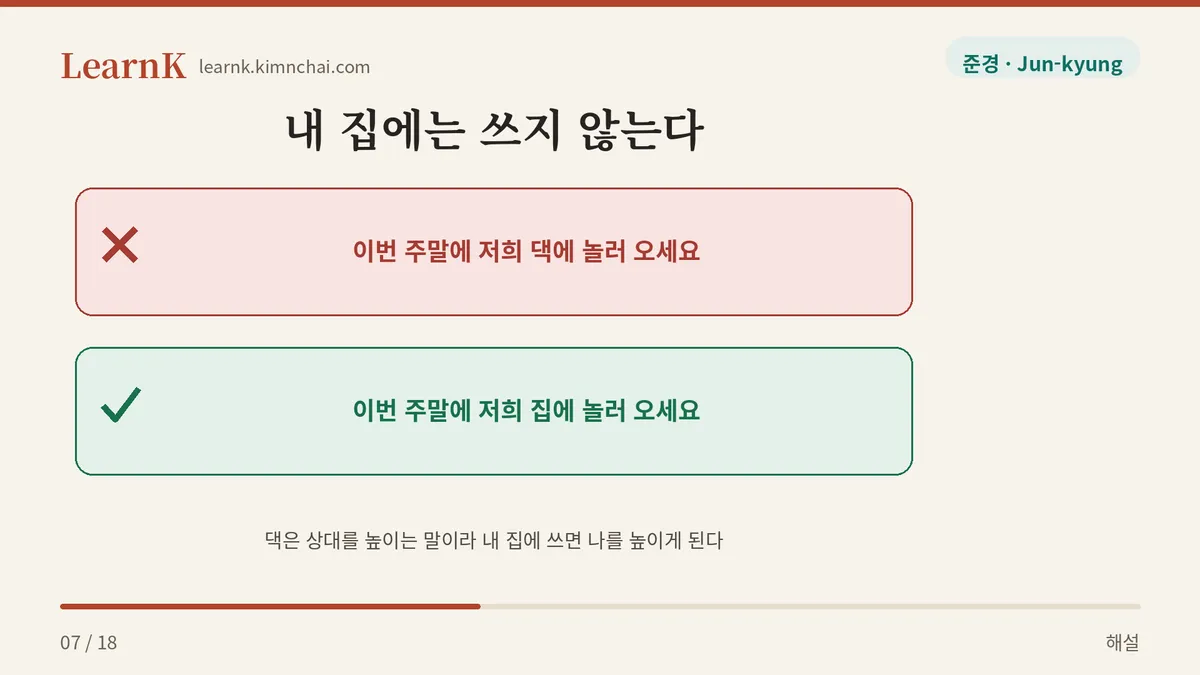
✗ 이번 주말에 저희 댁에 놀러 오세요. ✓ 이번 주말에 저희 집에 놀러 오세요. → (Come visit our place this weekend.) 댁 (daek) is a word that raises the other person, so you can’t use it for your own home. Calling your own house a 댁 (daek) amounts to elevating yourself — far from polite, it just sounds ridiculous. When you’re lowering yourself, it’s 저희 집 (jeohui jip).
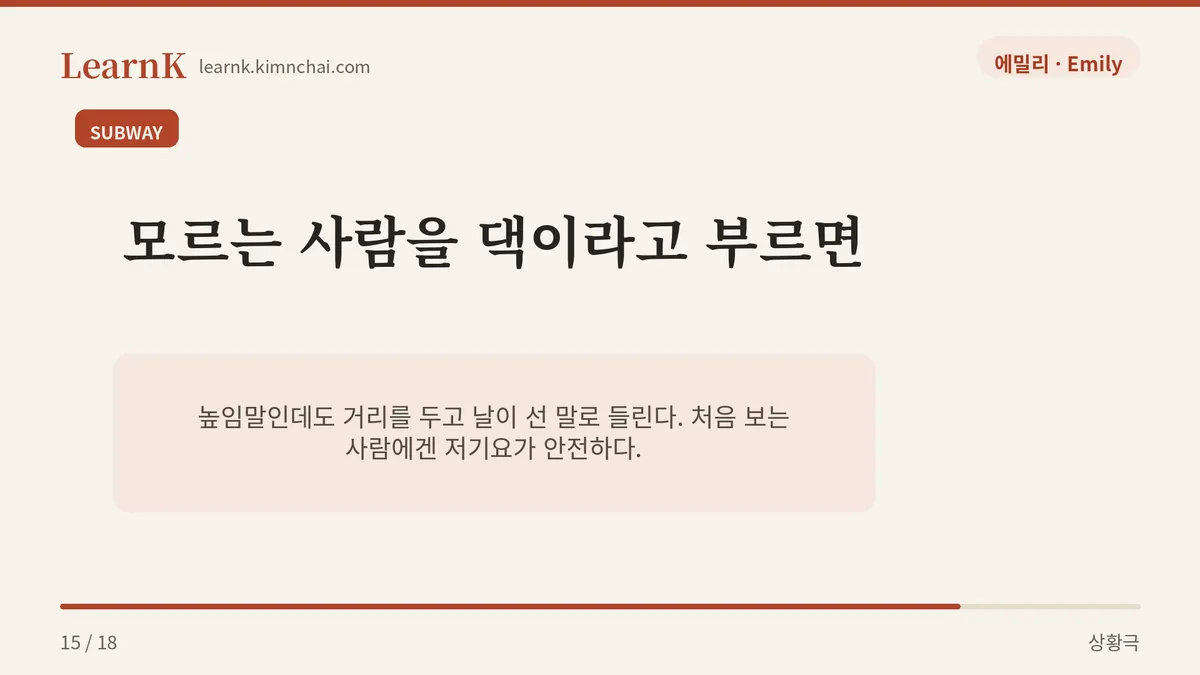
✗ (지하철에서 처음 본 사람에게) 댁이 아까 제 발 밟으셨죠? ✓ (지하철에서 처음 본 사람에게) 저기요, 혹시 방금 제 발 밟으셨나요? → (To a stranger on the subway: “Excuse me, did you just step on my foot?”) Used to point at the person you’re talking to, 댁 (daek) is formally an honorific but in practice it’s a word that keeps its distance and shows an edge. It tends to appear right before an argument breaks out, and in online comment fights you’ll see it in lines like “댁이나 잘하세요 (daegina jalhaseyo)” — “mind your own business.” With a stranger, 저기요 (jeogiyo) is the safe choice.
Example Sentences by Situation
1. Eleven at night after a company dinner, while your team lead is waiting for a taxi
부장님, 댁이 어디세요 (daegi eodiseyo)? 제가 택시 잡아 드릴게요.
(Sir, where do you live? Let me flag a taxi for you.) It’s the same 댁 (daek), but here there’s nothing confrontational about it. When it’s followed by an honorific ending like -세요 (-seyo) and the listener is your senior, the word lands at a completely different temperature from “댁이 뭔데요 (daegi mwondeyo)” — “and who are you?” This is also the version taxi drivers use with their passengers.
2. Checking whose house you’ve called
실례합니다, 여기가 김민수 선생님 댁 (daek) 맞습니까?
(Excuse me, is this Mr. Kim Minsu’s residence?) This is the opening line when you phone a household you don’t know. Saying “김민수 선생님 집 맞습니까 (Kim Minsu seonsaengnim jip matseumnikka)” sounds businesslike and a little rude. The instant you attach 댁 (daek) after the name, the sentence extends respect to everyone in that house.
3. Giving a delivery driver the shipping address
이 상자는 오늘 안에 할머니 댁으로 (daegeuro) 보내 주세요.
(Please send this box to my grandmother’s place by the end of today.) Even though it’s the speaker’s own grandmother’s house, 댁 (daek) is what you use. Family or not, anyone senior to you is a target of honorific language. This is a crucial feature of the Korean honorific system — being family gets you no exemption.
Similar Expressions Across the Politeness Range
| Expression | Temperature / Strength | Where It’s Used |
|---|---|---|
| 댁 (daek) | Raises the listener; warm and courteous | The home of an elder, a senior, or a guest. Never your own home |
| 집 (jip) | Neutral | Anywhere. Your house, a friend’s house, someone else’s house |
| 자택 (jataek) | Formal, cold and literary | News, official documents, articles. “자택에서 발견됐다 (found at his residence)” |
| 댁 (daek, pointing at the listener) | Distant, with an edge | Right before a fight. Safer for learners not to use it |
The most striking thing about the table is that the first row and the last row are the same syllable. Meaning “someone else’s home,” it couldn’t be more polite; the moment it points directly at a person, it turns icy. This is a phenomenon where a Korean honorific becomes so precise that it starts to feel like a wall — and 당신 (dangsin) walked exactly the same road. It was originally an honorific, but today, unless you’re speaking to your spouse, it mostly comes out during an argument.
Cultural Background — Between 안동댁 (Andong-daek) and 큰댁 (keundaek)
댁 (daek) is the same character as the Chinese character 宅, “house” (택, taek). It’s the 택 (taek) in 자택 (自宅, jataek) and 주택 (住宅, jutaek), but when it points to someone else’s home it is read as 댁 (daek). One character — and politeness is marked purely by how you pronounce it.
Line up the words built from this character and you get a map of Korean kinship. 시댁 (sidaek) is the husband’s parents’ house, 큰댁 (keundaek) is the eldest uncle’s house, 작은댁 (jageundaek) is a younger uncle’s house, 처가댁 (cheogadaek) is the wife’s family home, and 새댁 (saedaek) is what you call a newly married woman. When a holiday drama drops the line “올해는 큰댁에서 모인다” (“This year we’re gathering at the eldest uncle’s”), Korean viewers instantly read off the family’s pecking order — and who’s going to be worked hardest that day — from that one phrase.
Go a little further back and you find titles made by attaching 댁 (daek) to a place name. 안동댁 (Andong-daek), 목포댁 (Mokpo-daek), 부산댁 (Busan-daek) — these were ways of calling a woman who had married into a family by the name of the hometown she’d left behind. You’ll often see elders address a daughter-in-law this way in period dramas or dramas set in the countryside. It’s a trace of an era when a person was called not by her name but as “the one who came from such-and-such a house,” so it’s almost never used now — yet this single form of address explains why 댁 (daek) came to mean a person, a house, and a family all at once. Back then, a person simply was a household.
And twice a year, this word sets the entire country in motion. At 설날 (Seollal) and 추석 (Chuseok), tens of millions of people take to the highways, and the name of that destination is 댁 (daek). What’s waiting at the end of a ten-hour traffic jam has to be not a 집 (jip) but a 할아버지 댁 (harabeoji daek). That one-syllable difference holds the whole reason Koreans put up with everything the holidays demand.
Today’s Quiz
Eleven at night, after a company dinner. Your team lead is standing at the curb waiting for a taxi. How do you ask where he’s headed?
① 부장님, 집이 어디세요? ② 부장님, 댁이 어디세요? ③ 부장님, 저희 댁이 어디세요?
The answer is ②. Option ① is grammatical but lacks the courtesy you owe a senior, and in ③ the words 저희 (jeohui, “our”) and 댁 (daek) have been stuck together, turning it into an elevation of your own home. Someone else’s home gets 댁 (daek), your own home gets 집 (jip) — remember just that one thing.
Definitions and example sentences are from the National Institute of Korean Language’s Basic Korean Dictionary (krdict.korean.go.kr); that portion of this post, including our translations, is licensed under CC BY-SA 2.0 KR.