들어가세요 (deureogaseyo) — The Warmest Goodbye, Offered to Someone's Back as They Walk Away
들어가세요
들어가세요 (deureogaseyo) means “please go on inside (go home) now.” It’s a polite parting phrase you offer to someone’s back as the two of you separate. Turning to leave after walking a friend to their door late at night; your parents standing at the front gate waving; putting your department head into a taxi after a company dinner — this is a phrase Koreans use several times a day.
The farewell you learn first in textbooks is usually 안녕히 가세요 (annyeonghi gaseyo). That’s not wrong. But live in Korea for just a few months and you’ll notice that 들어가세요 shows up far more often in actual goodbyes. If the other person is on their way home, nine times out of ten it’s this one.
The difference comes down to a single syllable. 가세요 (gaseyo) speaks only of the direction the other person is heading. 들어가세요 speaks of the place they’ll arrive — opening the door, taking off their shoes, turning on the light, sitting down. That’s why the phrase carries an extra layer of meaning: “get there safely and rest.” Because it takes home as the assumed destination, it holds a warmth beyond a plain goodbye.
It’s used in three broad ways. First, as a literal instruction to go inside — like a nurse at a hospital saying “3번 진료실로 들어가세요 (sambeon jillyosillo deureogaseyo),” meaning “please go into exam room 3.” Second, telling someone who came out to see you off to stop standing there and head back in. Third, closing out a phone call: “네, 그럼 들어가세요 (ne, geureom deureogaseyo).” The second and third are what learners run into most, and they actually grow from the same root — because in Korean, the end of a day is “going into” your home.
Seeing It in Real Conversation
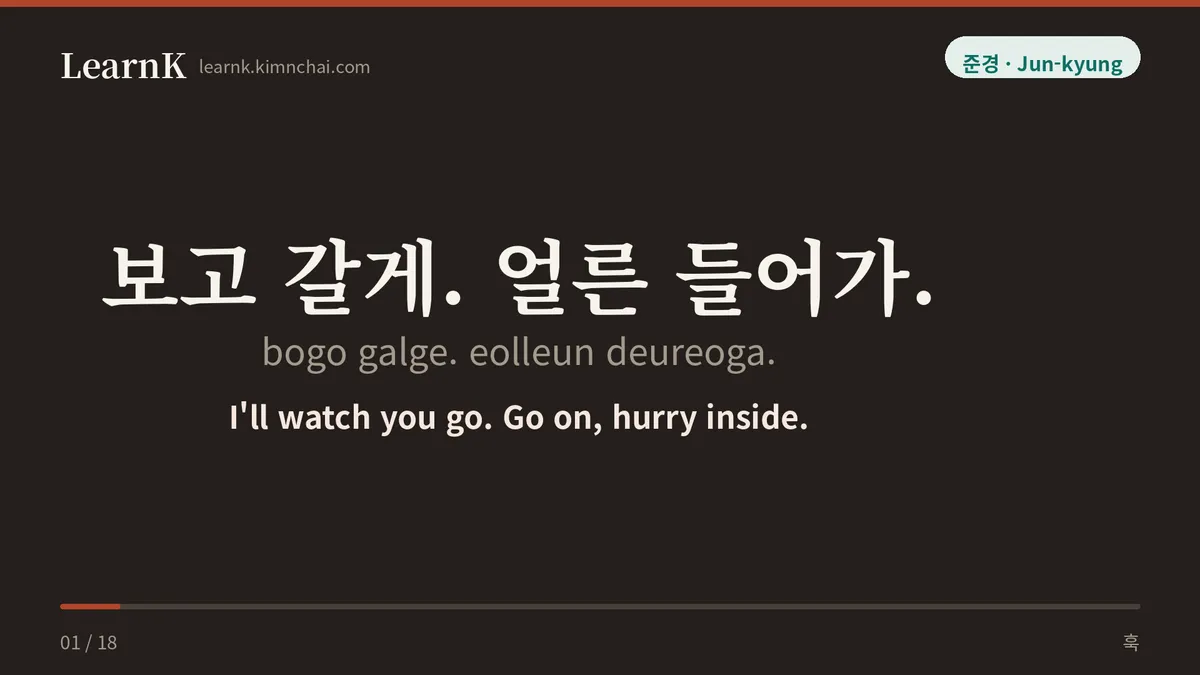
Situation: Eleven at night, after a company dinner. In front of Exit 2 of the subway station, the team drifts apart one by one until only Jun-kyung and Emily are left.
Jun-kyung: 부장님 택시 태워 드렸어. 아까 네가 들어가세요 하니까 엄청 좋아하시더라. I got the manager into a taxi. He really liked it when you said “deureogaseyo” earlier.
Emily: 그치? 나 그 말 진짜 좋아해. 안녕히 가세요보다 훨씬 따뜻하잖아. Right? I love that phrase. It’s so much warmer than “annyeonghi gaseyo.”
Jun-kyung: 맞아. 그만 가라는 게 아니라 얼른 쉬라는 뜻이니까. Exactly. It’s not “off you go” — it’s “go rest.”
Emily: 아 맞다, 나 막차 끊기겠다. 오빠 먼저 들어가. Oh no, I’ll miss the last train. You head in first.
Jun-kyung: 무슨 소리야. 개찰구 통과하는 거 보고 갈게. 얼른 들어가. No way. I’ll wait till you’re through the gate. Go on, hurry.
Emily: 알았어, 알았어. 오빠도 조심히 들어가세요~ Okay, okay. You get home safe too~
These Uses Sound Off
✗ (Heading home while your department head stays behind for overtime) 부장님, 들어가세요 (bujangnim, deureogaseyo). ✓ (Heading home while your department head stays behind for overtime) 부장님, 먼저 들어가 보겠습니다. 고생하셨습니다. (bujangnim, meonjeo deureoga bogetseumnida. gosaenghasyeotseumnida.) → Said to someone who is still at their desk working, it lands as pressure — “wrap it up and go home already.” 들어가세요 only works when the other person is already on their way back. When you’re the one leaving first, the right phrase is 먼저 들어가 보겠습니다 (meonjeo deureoga bogetseumnida), “I’ll be heading in first.”
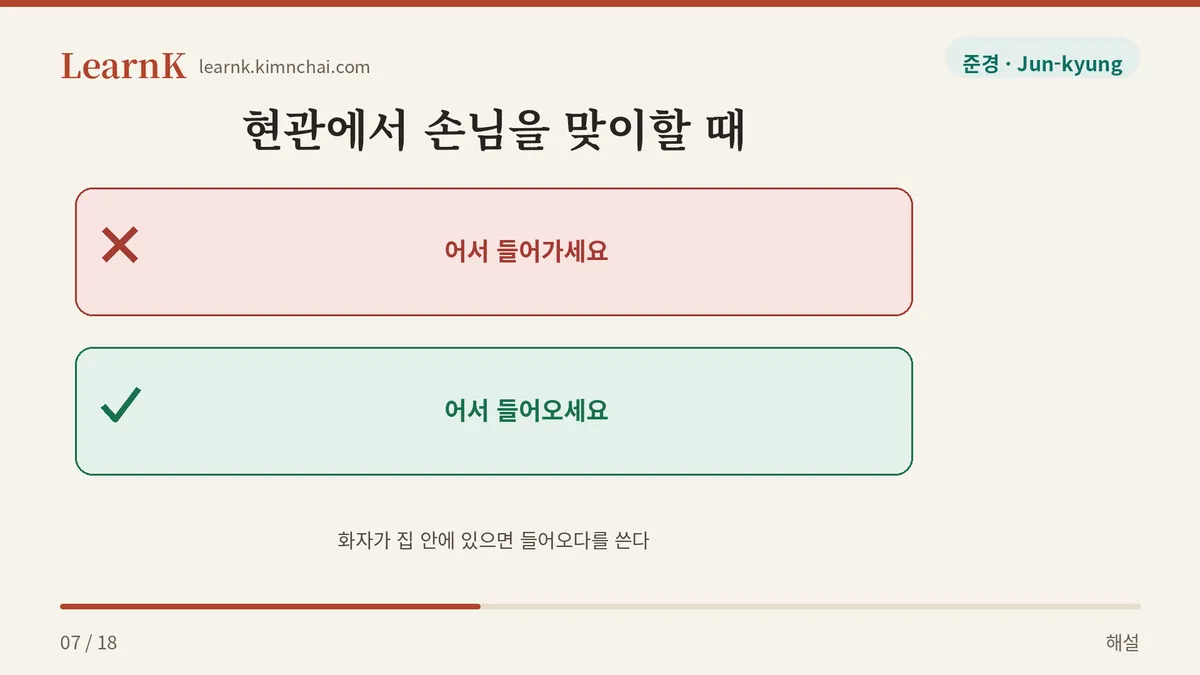
✗ (Welcoming a guest at your front door) 어서 들어가세요 (eoseo deureogaseyo). ✓ (Welcoming a guest at your front door) 어서 들어오세요 (eoseo deureooseyo). → The direction is reversed. If the speaker is inside, it’s 들어오다 (deureooda), “come in”; if the speaker stays outside while the other person heads in, it’s 들어가다 (deureogada), “go in.” Memorize 들어가세요 as an all-purpose greeting and you’ll end up sending your guest right back out the door.
Example Sentences by Situation
① Wrapping up a phone call
You’ve been on the phone with a contact at a client company for over thirty minutes and you’re bringing it to a close. Just hanging up feels bare, and 안녕히 계세요 (annyeonghi gyeseyo) somehow sounds too businesslike.
— 네, 그럼 그렇게 진행하겠습니다. 들어가세요. (ne, geureom geureoke jinhaenghagetseumnida. deureogaseyo.) — Yes, we’ll go ahead with that, then. Take care getting home.
People say this without having any idea where the other person actually is. That’s how firmly it has settled in as the stock phrase for ending a call. It’s the safest way to close out a call with someone senior to you or with a business contact.
② Leaving your parents’ house
The holiday is over and the bags are loaded into the car. Your mother has come out to the front gate and is standing there. She looks ready to stay put until the car is all the way out of the alley.
— 어머니, 이제 그만 들어가세요. 바람 차요. (eomeoni, ije geuman deureogaseyo. baram chayo.) — Mom, that’s far enough — go on inside. The wind is cold.
Paired with 이제 그만 (ije geuman), “that’s enough now,” it becomes a signal to end the send-off right there. It isn’t rushing her along; it’s worry, which makes it feel all the more affectionate. Saying 안녕히 계세요 here would sound off — it amounts to leaving your mother standing at the gate exactly as she is.
③ After walking someone home late at night
A rainy night. You held the umbrella over them all the way to their door. Now you have to turn back, but they’re hesitating, feeling bad about it.
— 저 여기서 볼게요. 조심히 들어가세요. (jeo yeogiseo bolgeyo. josimhi deureogaseyo.) — I’ll watch from here. Get inside safely.
Adding 조심히 (josimhi), “carefully,” layers on a note of concern about the dark streets, the long way home, the bad weather. Between friends, it drops straight into casual speech as 조심히 들어가 (josimhi deureoga).
Polite, Casual, and Related Expressions
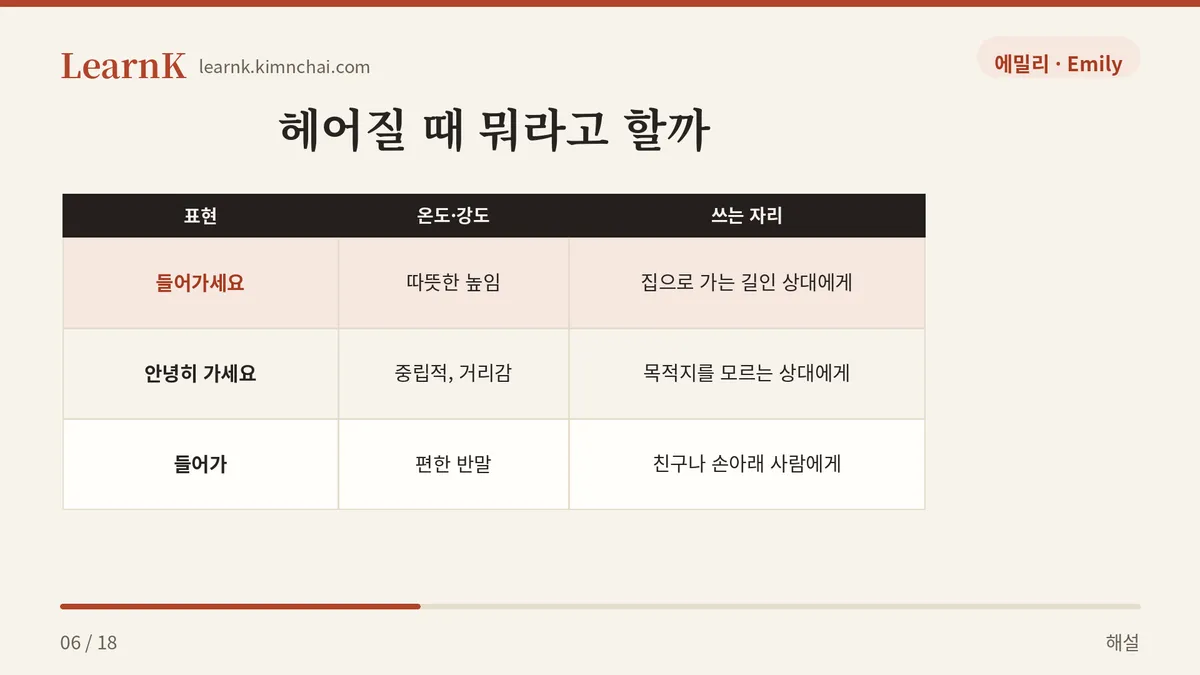
| Expression | Warmth & intensity | Where it’s used |
|---|---|---|
| 들어가세요 (deureogaseyo) | Warm and polite | When the other person is heading home or inside. Seniors, neighbors, business contacts |
| 들어가 (deureoga) | Casual and affectionate | To friends or people younger than you. Not honorific, so never to someone senior |
| 들어가십시오 (deureogasipsio) | Maximum formality, a bit stiff | Official announcements, formal occasions |
| 안녕히 가세요 (annyeonghi gaseyo) | Neutral, with some distance | When you don’t know where they’re headed. Shop customers, first-time acquaintances |
| 살펴 가세요 (salpyeo gaseyo) | Old-fashioned and dignified | An elder sending off someone younger |
There’s one more pair that’s easy to mix up. To the person leaving, you say 안녕히 가세요; to the person staying, 안녕히 계세요 (annyeonghi gyeseyo). 들어가세요 takes that distinction one step further — it’s for when the person staying is staying at their own home. That’s exactly why it becomes the phrase you offer to someone who came out to see you off.
Cultural Background — The Send-Off at the End of the Alley
Korean send-offs cover distance. When a guest stands up, you follow them to the entryway; from the entryway to the elevator; from the elevator to the front of the apartment building — one stage at a time. When you visit an elder’s home, it’s common for them to stand at the front gate until your car has completely cleared the alley. This kind of send-off is affection and burden at once, because you feel bad leaving someone standing outside in the cold. 들어가세요 comes from exactly that point — this is far enough, now please go inside.
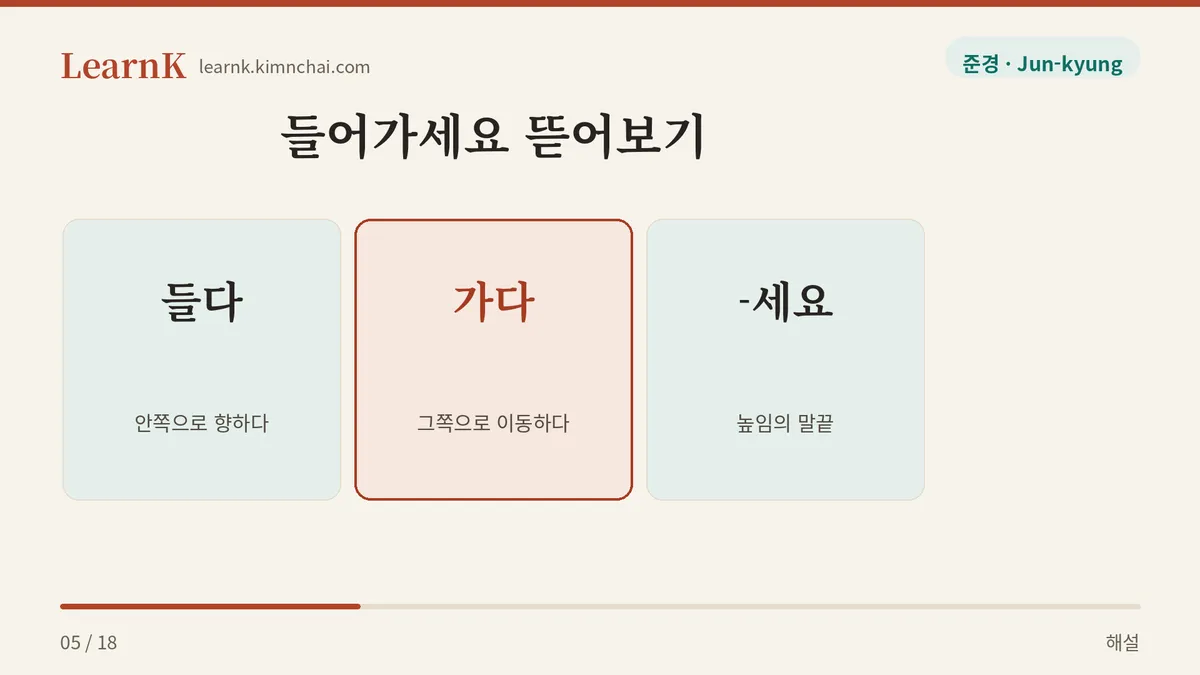
The word formation is simple. 들다 (deulda), “to enter,” joins with 가다 (gada), “to go,” to make 들어가다 (deureogada), and the honorific ending -세요 (-seyo) is attached. What’s worth noticing is that in Korean this word has come to mean “to go home” outright. About leaving the office, people ask “오늘 몇 시에 들어가? (oneul myeot sie deureoga?)” — “what time are you heading in today?” And when a message arrives late at night, it’s “들어갔어? (deureogasseo?)” — “did you get in?” The line between inside the home and outside it is sharply drawn, and the sense that a day only truly ends once you’ve crossed to the inner side of that line lives on right there in the language.
In dramas, this phrase is remembered less as a line than as a scene. Reply 1988 (응답하라 1988, tvN, 2015), set in the alleyways of 1980s Ssangmun-dong, returns again and again to the image of someone who has walked another person home standing at the end of the alley, watching until they disappear through the gate. They wave the other person in first, and only after that person is inside do they turn around. You don’t have to quote a single line of dialogue — that one scene explains the temperature of 들어가세요. It’s a phrase for sending someone off, and yet the person who says it is the one who stays behind.
The same goes for phone calls. When ending a call with someone older, there’s a habit of not hanging up right away but laying down one 들어가세요 first. People say it without knowing whether the other person was out on the street or sitting in an office. That’s how thoroughly it has hardened into a greeting, and at its root is the wish that you make it home safely again today. The moment a learner makes this phrase their own, their Korean goodbyes take a step outside the textbook.
Today’s Quiz
Ten at night. You’ve just finished dinner at your parents’ house and stepped outside. Your mother has come out and is standing at the front gate. What’s the most natural thing to say?
① 어머니, 안녕히 계세요. (eomeoni, annyeonghi gyeseyo.) ② 어머니, 이제 그만 들어가세요. (eomeoni, ije geuman deureogaseyo.) ③ 어머니, 어서 들어오세요. (eomeoni, eoseo deureooseyo.)
Answer: ②
① isn’t grammatically wrong, but it amounts to leaving your mother standing at the gate in the cold wind exactly as she is. ③ has the direction reversed — that’s what you say when the speaker is inside the house. ② means “you’ve come far enough, now please head on inside,” and it’s what Koreans actually say in this moment. Add 바람 차요 (baram chayo), “the wind is cold,” and it sounds even more natural.
The definitions, example sentences, and dialogue in this post are all original work written by us. (For this entry, a search of the National Institute of Korean Language’s Basic Korean Dictionary returned no results, so it was written without any dictionary citations.)