뒤끝 없다 (dwikkeut eopda) — Why Someone Who Had a Huge Fight With You Yesterday Asks "밥 먹었어? (bap meogeosseo?)" This Morning
뒤끝 없다
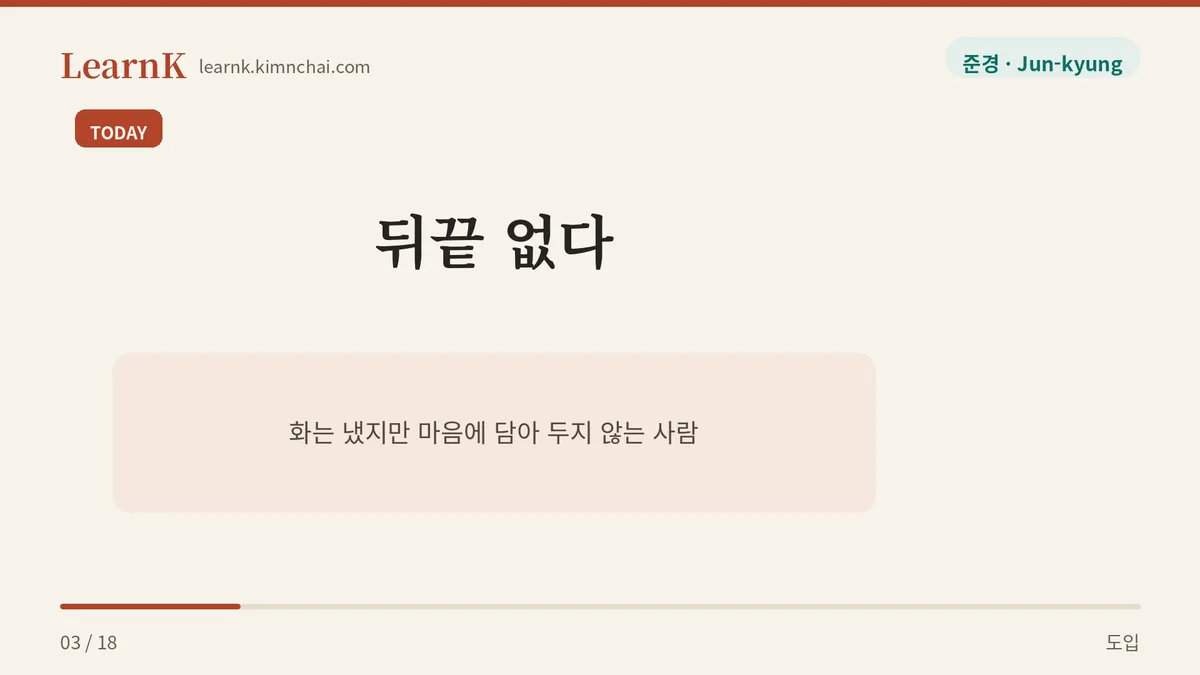
뒤끝 없다 (dwikkeut eopda) means not keeping bad feelings in your heart after a fight or an unpleasant incident. Picture the scene: the person who was raising their voice at you last night walks up this morning and asks 밥 먹었어? (bap meogeosseo?) — “Have you eaten?” — as if nothing ever happened. Koreans describe that person as 뒤끝 없다. For a Korean learner, the hard part isn’t the meaning. It’s two other things: the fact that this is a compliment, and the fact that its temperature changes completely depending on who is saying it about whom.
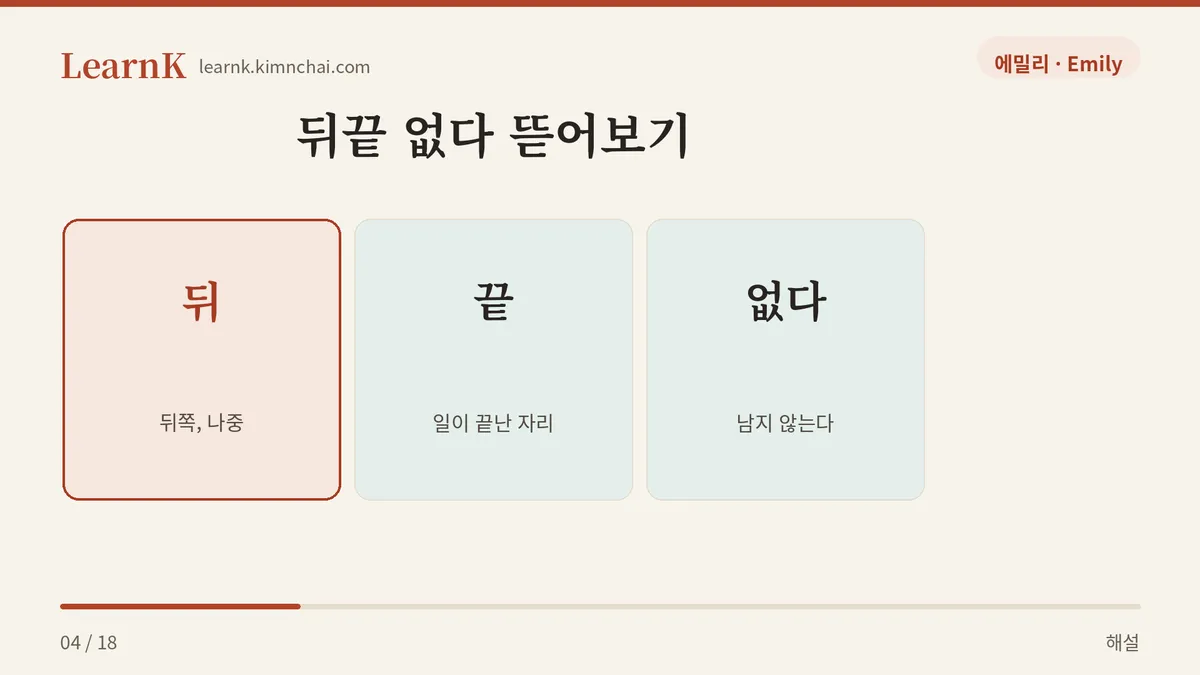
뒤끝 (dwikkeut) is 뒤 (dwi, “the back,” “afterward”) joined to 끝 (kkeut, “end”). Read literally, it’s “the part left over after something has ended.” So when the word is applied to emotions, it points to the residue still sitting in your heart after the argument, the scolding, or the apology is all finished. Add 없다 (eopda), “not to exist,” and you get: that residue doesn’t stay behind. When you pronounce it, the final consonants carry over, so it sounds like [뒤끄덥따].
The important thing is that this does not mean “never gets angry.” If anything, it’s closer to the opposite. The textbook 뒤끝 없는 사람 in Korea is someone who blows up in the moment but forgets all about it the second they turn around. The person who swallows their anger and then drags the whole thing up again three months later — that’s someone who is 뒤끝이 있는 (dwikkeuti inneun), who “has 뒤끝.” In other words, this expression measures the duration of a feeling, not its size.
There are two branches of usage. One is about a person’s character — 걔는 뒤끝이 없어 (gyaeneun dwikkeuti eopseo), “He/she doesn’t hold grudges.” The other is about alcohol or food — 이 술은 뒤끝이 없어 (i sureun dwikkeuti eopseo) means this drink won’t leave your head hurting the next day. Same word, but one is about what stays in your heart and the other about what stays in your body. If it comes up at a drinking table, just understand it as talk about hangovers, not personality.
Seeing It in Real Conversation
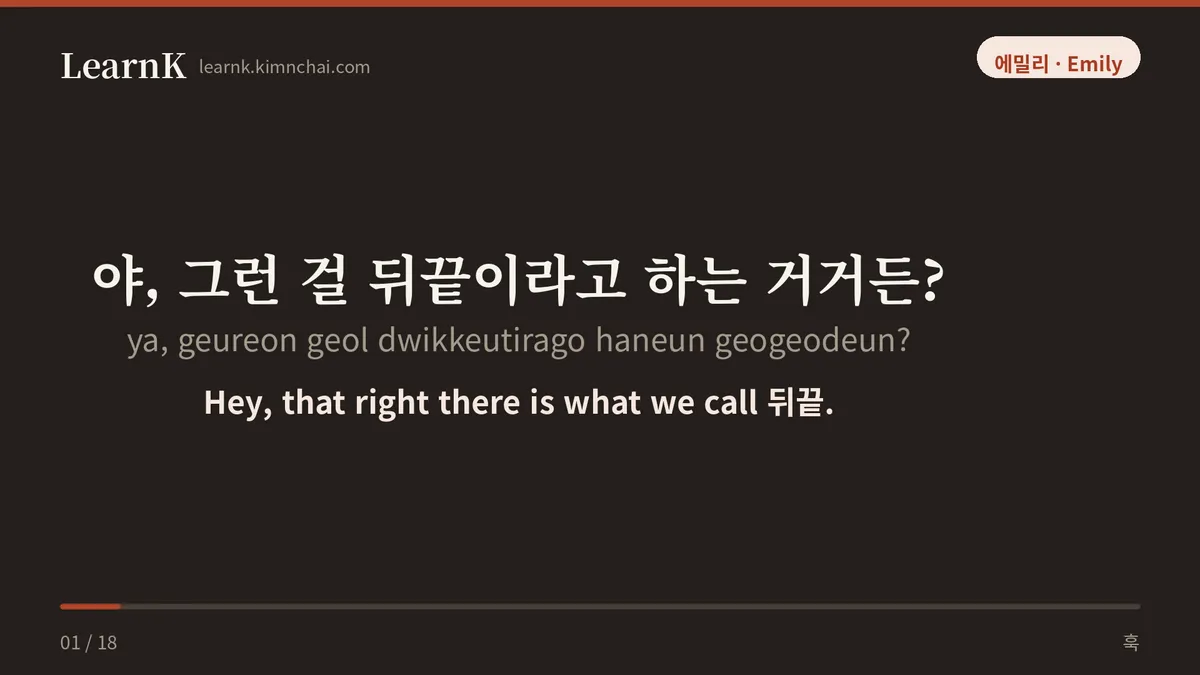
Setting: Sunday morning at the apartment complex recycling area. The evening before, the two of them had an argument over something trivial.
Jun-kyung: (박스 접으며) 어, 왔어? 어제 일은 뭐… 됐어. 나 원래 뒤끝 없어. Oh, hey. About yesterday — forget it. I don’t hold grudges.
Emily: 근데 어제 내가 보낸 톡은 왜 읽고 씹었는데? Then why’d you leave my text on read?
Jun-kyung: 아, 그건… 폰 배터리가 없었어. Ah, that was… my phone died.
Emily: 야, 그런 걸 뒤끝이라고 하는 거거든? Hey, that right there is what we call 뒤끝.
Jun-kyung: 아니라니까. 나 진짜 뒤끝 없는 사람이야. 커피 살게, 가자. I’m telling you, no. I’m really not that type. Let me buy you a coffee, come on.
Emily: 아이스로. 그럼 뒤끝 없는 걸로 쳐 줄게. Iced. Then I’ll let it count as “no grudges.”
Saying It This Way Sounds Off
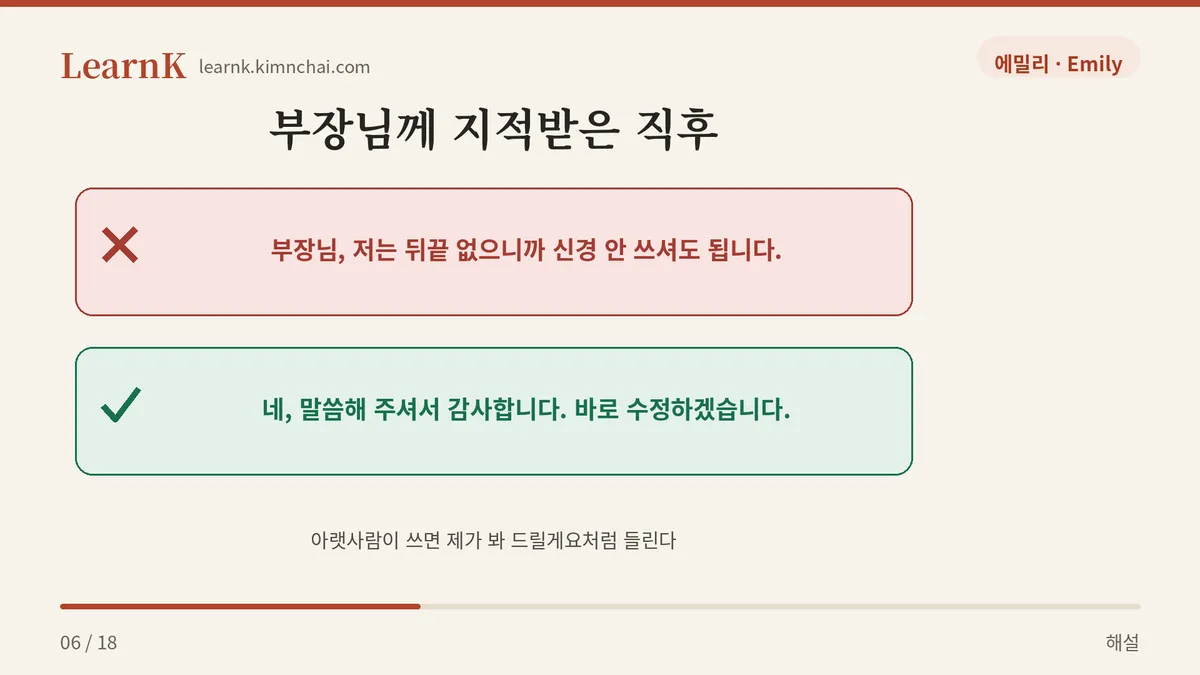
✗ (right after being criticized by your department head) 부장님, 저는 뒤끝 없으니까 신경 안 쓰셔도 됩니다. Sir, I don’t hold grudges, so you don’t need to worry about it. ✓ (to your department head) 네, 말씀해 주셔서 감사합니다. 바로 수정하겠습니다. Yes, thank you for telling me. I’ll fix it right away. → “뒤끝 없다” carries a nuance of granting the other person forgiveness. When someone junior says it to someone senior, it comes out sounding like “I’ll let this one slide for you” — which is cheeky. A senior saying it to a junior — “난 뒤끝 없으니까 걱정 마” (“I don’t hold grudges, so don’t worry”) — is perfectly natural. The expression has a built-in direction.
✗ (the other person is genuinely hurt, and you haven’t apologized) 됐어, 지난 일이야. 나 뒤끝 없어. Never mind, it’s in the past. I don’t hold grudges. ✓ 어제 내가 말이 심했어. 미안해. I said too much yesterday. I’m sorry. → When the person who owes an apology reaches for this line, it isn’t reconciliation — it’s avoidance. In fact, this expression is worth the least when you use it about yourself, and the most when someone else says it about you. There’s even a running joke in Korea that the more often someone says “나 뒤끝 없어” (“I don’t hold grudges”), the more 뒤끝 they actually have.
Example Sentences by Situation
1. To a junior colleague asking what the new team lead is like
김 팀장님? 화는 좀 내시는데 뒤끝은 없으셔. (Kim timjangnim? Hwaneun jom naesineunde dwikkeuteun eopseusyeo.) — Team lead Kim? He does snap at you, but he doesn’t carry it around.
This is the single most common sentence structure Koreans use to size up a boss at work. The key point is that “gets angry” and “holds a grudge” are treated as two separate line items. The first is a flaw, but if the second is absent, the verdict comes out as “a decent person.”
2. Recommending a low-proof drink at a night out
이거 한번 마셔 봐. 뒤끝이 없어서 다음 날 안 힘들어. (Igeo hanbeon masyeo bwa. Dwikkeuti eopseoseo da-eum nal an himdeureo.) — Try this one. It doesn’t leave anything behind, so you’re fine the next day.
Here it’s used about a drink, not a person. “뒤끝” in this case means the hangover. It’s occasionally used about soups and stews or medicine, too.
3. Introducing yourself honestly
난 좀 뒤끝 있는 편이야. 한 번 서운하면 오래 가더라. (Nan jom dwikkeut inneun pyeoniya. Han beon seoun-hamyeon orae gadeora.) — I’m the type who holds on a bit. Once I feel hurt, it lingers.
This flips the phrase into the positive form. Saying “뒤끝 있다” about yourself isn’t a black mark — it comes across as an honest, even endearing confession. Say “뒤끝 없다” about yourself, on the other hand, and you invite suspicion. The direction of this expression crosses over in a curious way.
Polite and Casual Forms, and Similar Expressions
The casual form is 뒤끝 없어 (dwikkeut eopseo), and the polite forms are 뒤끝 없으세요 / 뒤끝 없으시네요 (dwikkeut eopseuseyo / dwikkeut eopseusineyo). That said, the polite forms are almost always used only to compliment the other person, as in “부장님은 참 뒤끝이 없으시네요” (“Sir, you really don’t hold on to things”). Attaching it to yourself — “저는 뒤끝 없습니다” (“I don’t hold grudges”) — is rare.
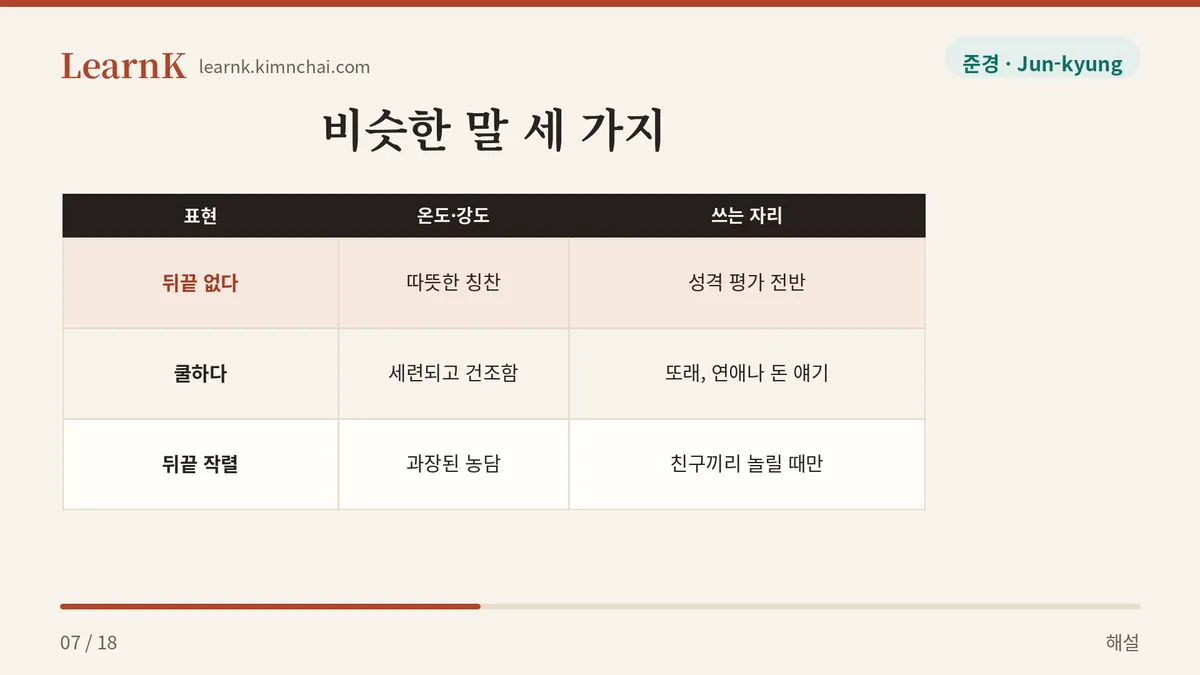
| Expression | Temperature / intensity | Where it’s used |
|---|---|---|
| 뒤끝 없다 (dwikkeut eopda) | Warm praise. Acknowledges that the anger happened, then moves past it | Character assessment in general. Good when said about others; draws suspicion when said about yourself |
| 쿨하다 (kulhada) | Polished and dry. Shows no emotion at all | Among peers and on social media. Especially common in talk about dating and money |
| 마음에 담아 두지 않다 (maeume dama duji anta) | Dignified and neutral | Formal settings; a safe substitute in conversation with someone senior |
| 털털하다 (teolteolhada) | Easygoing and unfussy. Describes the whole personality | When introducing someone. Covers not just grudges but clothing and speaking style too |
| 뒤끝 작렬 (dwikkeut jangnyeol) | Exaggerated joke. “Grudge explosion” | Online and teasing among friends. Never used toward someone senior |
It’s easy to confuse this with “쿨하다,” but the difference lies in whether the anger happened at all. A 쿨한 사람 was never rattled in the first place; a 뒤끝 없는 사람 was rattled badly and then bounced back fast. In Korea, the second is generally seen as the more human of the two.
Cultural Background — Get Angry, but Don’t Store It Up
In Korean organizational culture, conflict has tended to be handled less as something to “eliminate” and more as something to “shake off and move on from.” The line you hear so often at company dinners — “자, 오늘로 다 털자” (“All right, let’s shake it all off tonight”) — is the compressed version of that. Voices were raised in the meeting room during the day, but everyone eats together that evening and greets each other normally the next morning. The person who keeps that flow intact is a “뒤끝 없는 사람,” and the person who breaks it by dredging the whole thing up a few days later is a “뒤끝 있는 사람.”
This virtue has its shadow side, though. If apology and resolution get skipped and everything is papered over with “뒤끝 없이 가자” (“let’s move on without hard feelings”), then only the person swallowing their emotions keeps on swallowing them. That’s exactly why Korea’s younger generation today doesn’t take “뒤끝 없다” as an unconditionally good thing. So this is an asymmetric expression: in the mouth of the person who caused the harm it becomes an excuse, and in the mouth of the person who was harmed it becomes generosity. That’s a point worth filing away as a learner.
In TV dramas, it’s often used as a device to show a character’s personality in a single stroke. When the protagonist who talked back to their boss and got chewed out is sitting down to a bowl of gukbap with that same boss in the next scene, viewers read the relationship without a word of dialogue. Conversely, when a character smiles quietly and writes something down in a notebook, that’s nine times out of ten a signal that this one has 뒤끝.
Online, the teasing phrase 뒤끝 작렬 (dwikkeut jangnyeol) is also widely used. It gets attached to behavior like still checking an ex’s social media after a breakup, or suddenly summoning up something that happened years ago. It’s a joke between friends, so don’t use it with anyone senior to you.
Today’s Quiz
Which of the following three sentences uses 뒤끝 없다 (dwikkeut eopda) the most awkwardly?
- (to a coworker) 팀장님 화는 자주 내셔도 뒤끝은 없으셔. The team lead gets angry a lot, but he doesn’t hold on to it.
- (right after being scolded, to your department head) 부장님, 저는 뒤끝 없으니까 신경 안 쓰셔도 됩니다. Sir, I don’t hold grudges, so you don’t need to worry about it.
- (to a friend) 이 술 뒤끝 없네. 어제 그렇게 마셨는데 멀쩡해. This drink leaves nothing behind. I drank that much yesterday and I’m totally fine.
Answer: number 2
“뒤끝 없다” has a built-in direction of “I’m cutting you some slack,” so when someone junior says it to someone senior, it sounds impertinent. In that situation, “말씀해 주셔서 감사합니다” (“Thank you for telling me”) is the safe choice. Number 1 applies it to a person’s character and number 3 to alcohol — both natural examples.
The definitions, example sentences, and dialogue in this post are all original work written by us. The expression featured in this installment is not listed as a headword in the National Institute of Korean Language’s Basic Korean Dictionary (krdict.korean.go.kr), so this post was written without citing the dictionary.