어디야? / 어디세요? — The One Line Koreans Send More Than Any Other, Every Single Day
어디야? / 어디세요?
어디야? (eodiya?) / 어디세요? (eodiseyo?) both ask the person on the other end “what place are you at right now?” The first one, 어디야?, is 반말 (banmal), the casual form you use with friends and family; the second, 어디세요?, is 존댓말 (jondaenmal), the polite form for elders and people you’re meeting for the first time.
If you had to pick just three sentences Koreans trade back and forth most in a day, this one would have to be on the list. Five minutes after the meeting time has come and gone. Standing in front of a subway station with eight different exits. When the delivery driver calls. To the kid who still hasn’t gotten in touch late at night. The situations are completely different, but Korean handles every one of them in three syllables — or four. It looks easy because it’s short, but this phrase covers an enormous temperature range. The same 어디야? (eodiya?) can be delight, a nudge, or an interrogation.
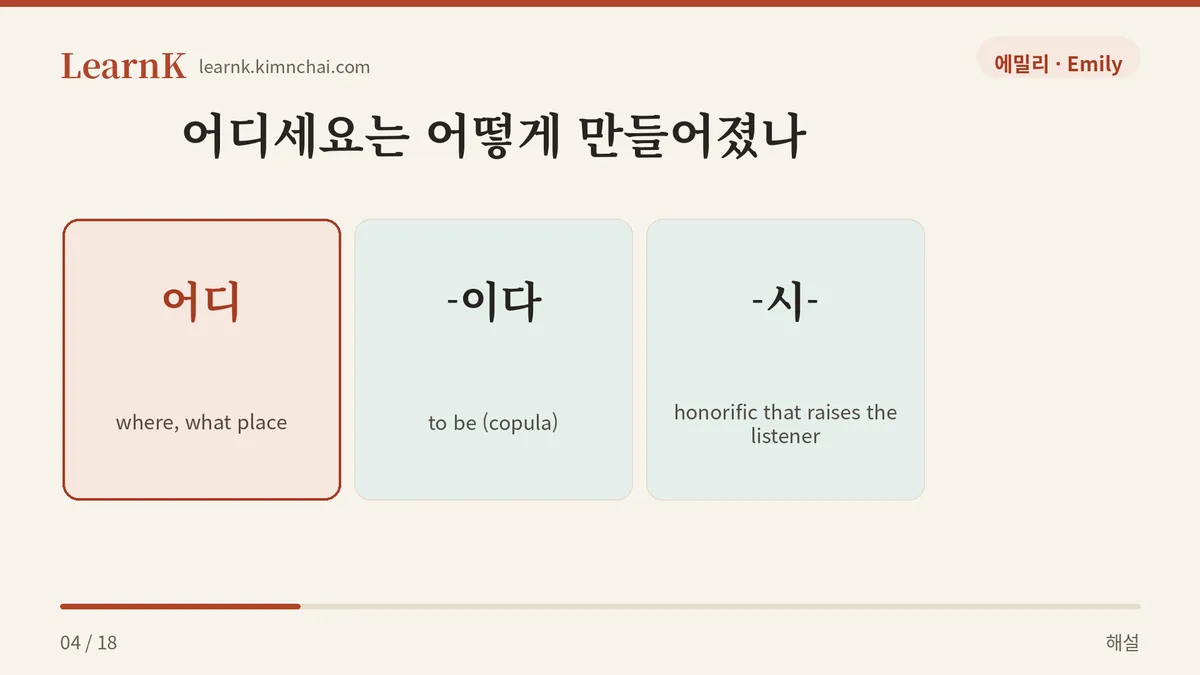
Start with the structure and it isn’t hard at all. It’s 어디 (eodi), the word for “where,” with the copula 이다 (ida), “to be,” attached. In casual speech that gives you 어디야? (eodiya?); in the all-purpose polite form, 어디예요? (eodiyeyo?); and when the honorific ‘-시- (-si-)’, which raises the person, goes in, you get 어디세요? (eodiseyo?). In other words, the 세 (se) in 어디세요 isn’t just polite decoration — it’s a marker that elevates the listener themselves. That single syllable explains nearly every one of the mistakes that come later in this post.
The nuance splits three ways. The first is a pure location check: asking the person you’re meeting “how many meters do you have left?” This is by far the most common use. The second is a nudge. When the meeting time has already passed, 어디야? is the same sentence, but it’s half mixed with “why aren’t you here yet?” The third is worry — or an interrogation. An 어디야? that arrives at midnight isn’t being sent because someone doesn’t know your location. That’s why, for Korean learners, the hard part of this expression is not the meaning but when you send it.
One more thing. When you pick up the phone, 어디세요? (eodiseyo?) isn’t asking about the other person’s physical location — it’s asking which company or organization they’re calling from. If you answer an unknown number with ‘실례지만 어디세요? (sillyejiman eodiseyo?)’, you don’t mean “where are you standing right now,” you mean “where are you calling from?” Learners who don’t know this usage end up carefully reciting their home address.
Seeing it in a real conversation
Situation: Saturday, 2 p.m. Ten minutes past the meeting time. Jun-kyung is calling from in front of exit 6 of the subway station.
Jun-kyung: 여보세요? 야, 너 지금 어디야? Hello? Hey, where are you right now?
Emily: 나 출구 앞인데? 근데 여기 나 혼자야. I’m in front of the exit. But I’m the only one here.
Jun-kyung: 야, 그럼 정확히 어디야? 나 6번 출구. Then where exactly are you? I’m at exit 6.
Emily: 아… 나 4번이다. 미안, 1분만 기다려! Ah… I’m at exit 4. Sorry, give me one minute!
Jun-kyung: 천천히 와. 아, 아까 모르는 번호로 전화 와서 ‘어디세요?’ 했더니 카드 회사더라. Take your time. Oh, I got a call from an unknown number, and when I asked “who’s calling?” it was the credit card company.
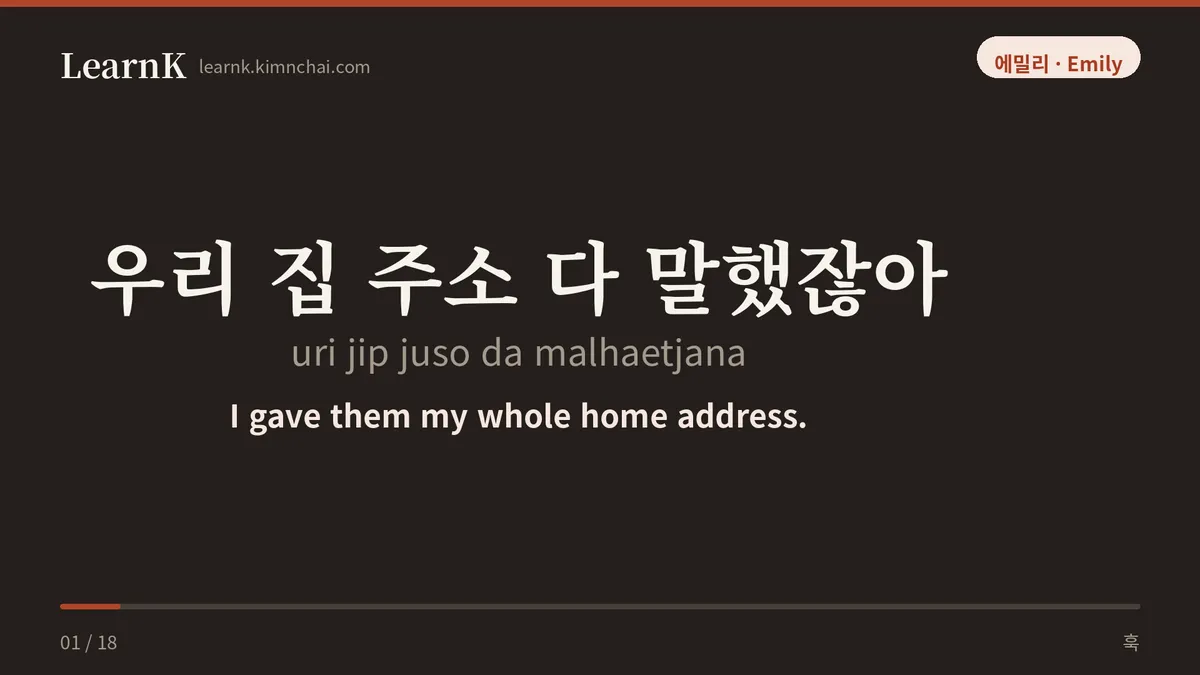
Emily: 아 맞다, 전화에선 그게 ‘어디서 거셨어요?‘라는 뜻이지. 나 처음엔 그거 몰라서 우리 집 주소 다 말했잖아. Oh right, on the phone that means “where are you calling from.” I didn’t know that at first and gave them my whole home address.
These versions sound off
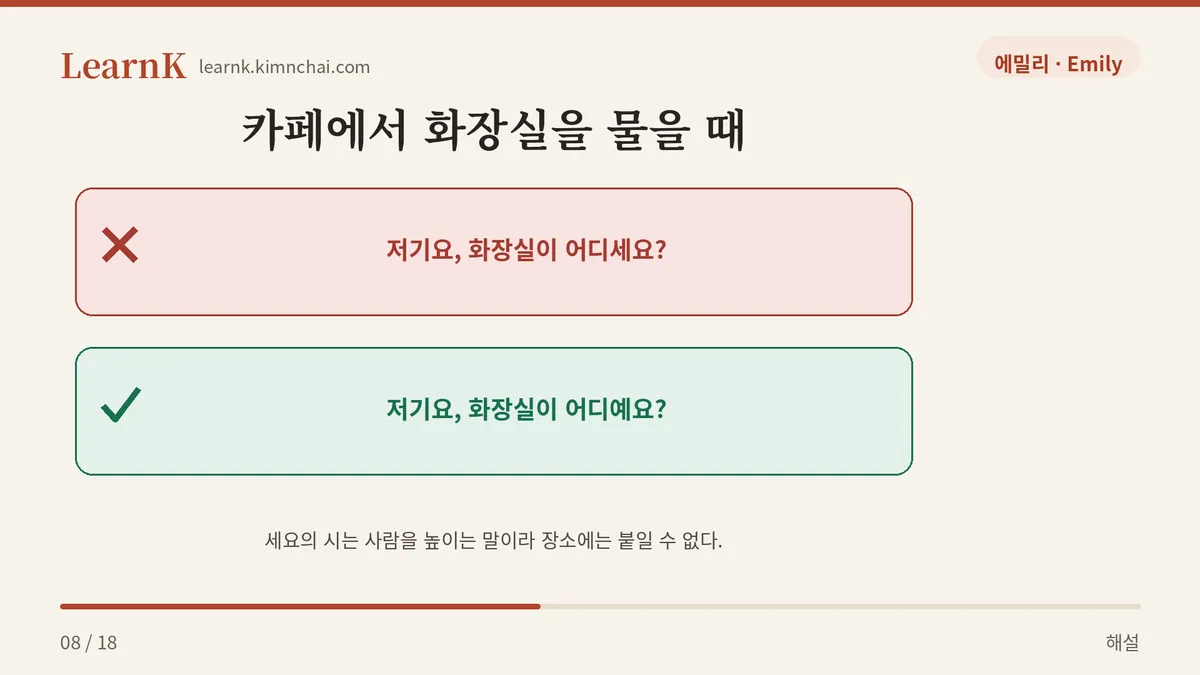
✗ (to a café employee) 저기요, 화장실이 어디세요? (jeogiyo, hwajangsiri eodiseyo?) ✓ (to a café employee) 저기요, 화장실이 어디예요? (jeogiyo, hwajangsiri eodiyeyo?) — Excuse me, where’s the bathroom? → The ‘-시- (-si-)’ inside ‘-세요’ exists to elevate a person. Attach it to a place and you end up honoring the bathroom, which will get a laugh out of whoever you asked. People get 어디세요, things and places get 어디예요.
✗ (calling your manager, who has stepped out of a meeting) 부장님, 어디세요? (bujangnim, eodiseyo?) ✓ (same situation) 부장님, 지금 어디 계세요? (bujangnim, jigeum eodi gyeseyo?) — Sir, where are you right now? → Grammatically both are correct. But ‘어디세요?’ is so short and blunt that, aimed at someone above you, it can come across as pressing them. Use 계시다 (gyesida), the honorific form of 있다 (itda, “to be, to be present”), and 어디 계세요? (eodi gyeseyo?) makes the exact same question far gentler.
Example sentences by situation
1. When you get to the meeting spot first (texting a friend on KakaoTalk)
언니, 지금 어디야? 나 벌써 도착해서 자리 잡았어. (eonni, jigeum eodiya? na beolsseo dochakhaeseo jari jabasseo.) Where are you right now? I already got here and grabbed us a seat.
This is the most typical message from whoever arrived first. Tacking on ‘나 벌써 도착했어 (na beolsseo dochakhaesseo)’ — “I’m already here” — turns it from a nudge into simply sharing where things stand, which is much softer. In Korea it’s also common to just send your live location right afterward.
2. On the phone with a delivery or courier driver
기사님, 지금 어디쯤이세요? 제가 1층으로 내려갈까요? (gisanim, jigeum eodijjeumiseyo? jega ilcheung-euro naeryeogalkkayo?) Roughly where are you right now? Should I come down to the first floor?
You’re speaking with someone for the first time, so polite speech is non-negotiable. The 쯤 (jjeum) in 어디쯤이세요? (eodijjeumiseyo?) means “about, roughly” — you’re not demanding an exact address, you’re closer to asking “are you nearly here?”, which takes the pressure off. In real life you’ll hear this form far more often than a plain ‘어디세요?’.
3. When your parents call
엄마, 나 지금 지하철이야. 30분 뒤에 도착해. (eomma, na jigeum jihacheoriya. samsipbun dwie dochakhae.) Mom, I’m on the subway right now. I’ll be there in 30 minutes.
Plenty of Korean households use casual speech with parents, so answering your mother’s 어디야? in 반말 (banmal) isn’t rude at all. What matters is not hanging up after giving only your location. Location + your estimated arrival time — that’s what actually answers what the question was really asking (when are you coming?).
Polite, casual, and neighboring expressions
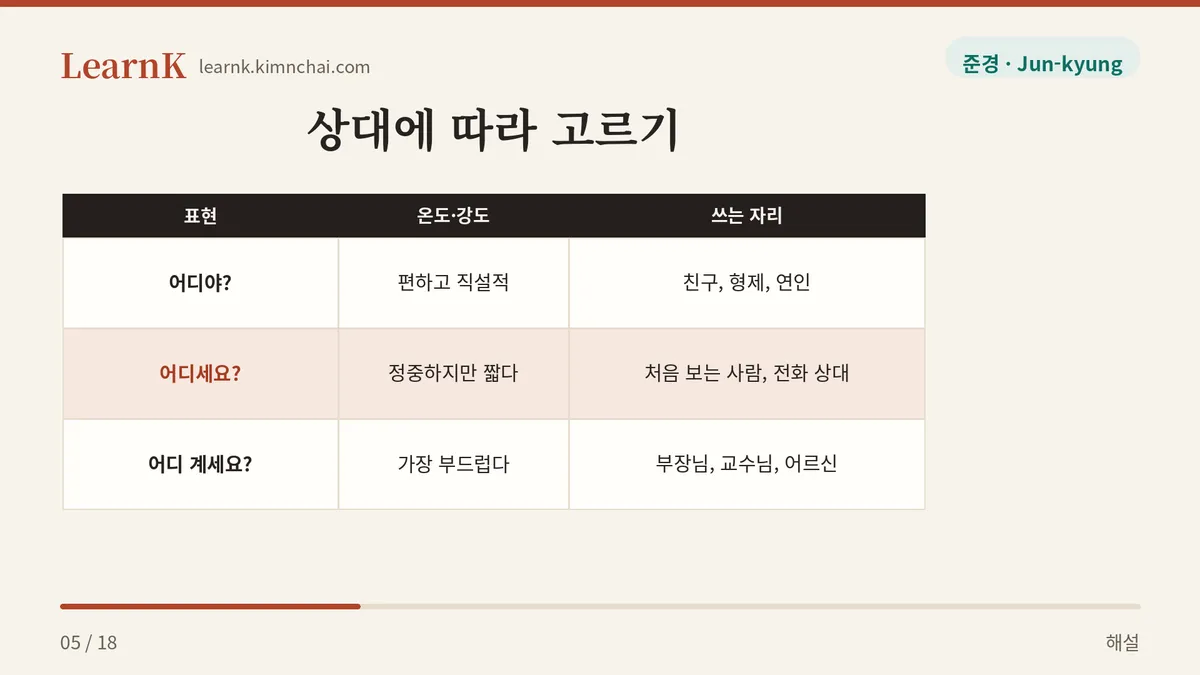
| Expression | Temperature / intensity | Where you use it |
|---|---|---|
| 어디야? (eodiya?) | Relaxed and blunt, sometimes a nudge | Friends, siblings, partners. Never with someone above you |
| 어디예요? (eodiyeyo?) | Neutral, all-purpose polite | Asking about places and things. Slightly businesslike when aimed at a person |
| 어디세요? (eodiseyo?) | Courteous, but short and direct | Someone you’re meeting for the first time, a caller. A bit much for your boss |
| 어디 계세요? (eodi gyeseyo?) | The softest and most respectful | Your manager, your professor, an elder |
| 어디쯤이야? / 어디쯤이세요? | Gently asking when you’ll arrive | While waiting; calls with delivery and courier drivers |
Squeeze that table into one line and it comes out like this. If you need to elevate a person, use ‘-세요’; to elevate them further, ‘계세요’; if you’re asking about a place, ‘예요’; and if you don’t want to sound like you’re rushing anyone, slip in ‘쯤’.
Cultural background — the ten minutes before you meet
There’s a reason 어디야? gets used this much. Subway stations in Seoul routinely have more than ten exits, and the café down the alley has its sign hanging on the second floor. Even when you know the address exactly, the ten minutes right before you meet are still confusing. So in Korea, plans don’t end at “what time, where” — they’re completed by one short call right before you meet. And the first words of that call are almost always 어디야?
In dramas, this line is often used as a device to change the temperature of a scene. The moment a character calls someone who has gone silent and lets out this one phrase, the line stops being a question about location and becomes an emotion: “why did you disappear without a word?” Conversely, in a reunion scene the very same words can be the first thing said in relief. The fact that a three-syllable question can carry worry, hurt, and delight all at once is one of the more interesting — and simultaneously trickier — parts of learning Korean.
The word formation is transparent. 어디 takes the copula, the honorific ‘-시-’ is layered on top, and you get 어디세요. It’s not newly coined slang and it’s not a loanword. As for why ‘어디세요?’ on the phone hardened into a question about someone’s organization, it makes sense once you picture the landline era, when a telephone belonged not to a person but to a house or an office. A way of speaking from the days when phones belonged to places has simply carried straight over into the smartphone age.
Today’s quiz
You want to ask a café employee where the bathroom is. Which one fits the blank?
저기요, 화장실이 ______
① 어디야? ② 어디세요? ③ 어디예요? ④ 어디 계세요?
Answer: ③ 어디예요? (eodiyeyo?)
A bathroom is a place, not a person, so ② and ④ — the ones containing the person-elevating ‘-시-’ — are out. ① is casual speech, so it doesn’t suit an employee you’ve never met. People get 어디세요? (eodiseyo?), places get 어디예요? (eodiyeyo?) — remember that one-syllable difference and you’re already halfway through today’s lesson.
Definitions and example sentences are from the National Institute of Korean Language’s Basic Korean Dictionary (krdict.korean.go.kr); that portion of this post, including our translations, is licensed under CC BY-SA 2.0 KR.