어이없다 (eoieopda) — The First Thing Koreans Say When Something's Absurd
When you watch Korean dramas, you’ll often come across a scene where a character opens their eyes wide, lets out a bewildered little laugh, and mutters, “어이없어… (eoieopseo…).” It’s that curious expression that looks like anger and amusement at the same time. Today we’ll take a deep dive into the phrase Koreans reach for first when something is just too outrageous: 어이없다 (eoieopda).
어이없다
어이없다 (eoieopda) is an adjective that captures the feeling of being so blindsided by something absurd that you’re “speechless” or “dumbfounded.” It doesn’t simply mean you’re angry — it’s closer to being so flabbergasted that a helpless laugh escapes you instead. That’s why, when someone says this, their face usually reads more baffled than furious.
- 어이없어 (eoieopseo) — casual (반말); the most common conversational form of “어이없다”
- 어이없네 (eoieomne) — used when reacting almost to yourself, half-muttering
- 어이없다는 표정 (eoieopdaneun pyojeong) — a dumbfounded expression
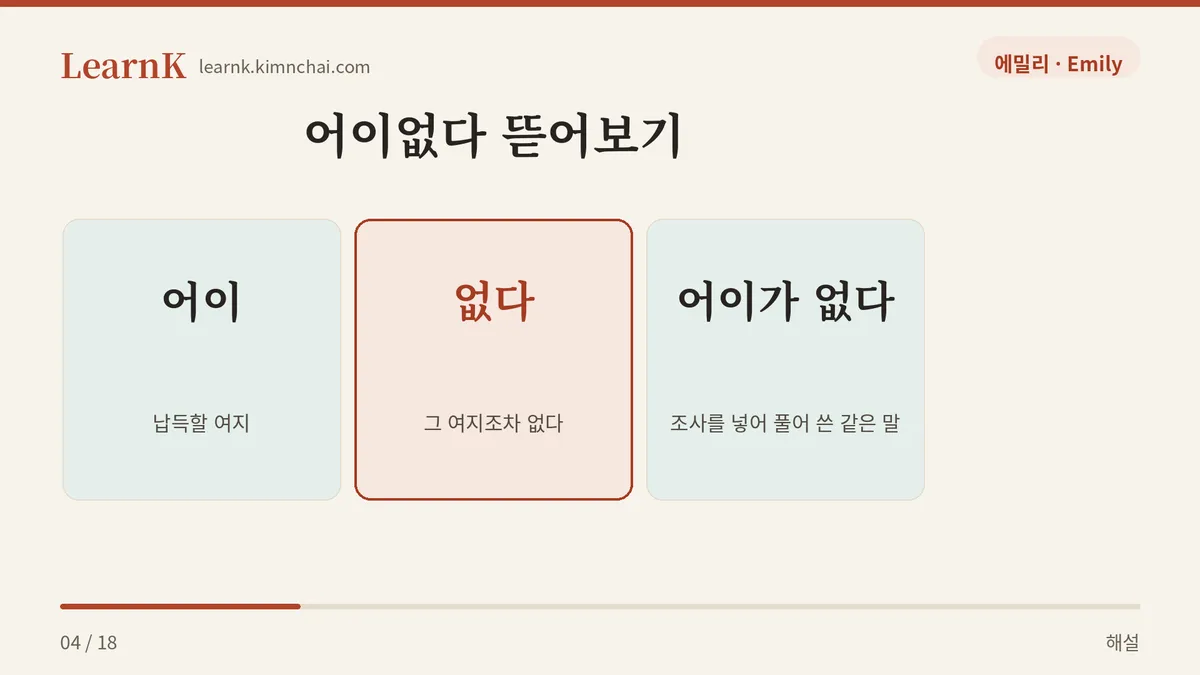
By the way, you’ll also see it written out with the particle ‘가’ as 어이가 없다 (eoiga eopda). The meaning is the same.
Checking the National Institute of Korean Language Dictionary
The National Institute of Korean Language’s Basic Korean Dictionary defines the word like this.
어이없다 (adjective): to feel dumbfounded after encountering something utterly unexpected. [en] absurd; ridiculous; preposterous [ja] あきれる・あっけにとられる・あぜんとする [es] atónito, absurdo, exorbitante [zh] 荒唐,无法理解 — National Institute of Korean Language, Basic Korean Dictionary (krdict.korean.go.kr)
Let’s also look at the real usage examples the dictionary provides.
말이 안 되는 그의 강변에 사람들은 어이없다는 표정을 지었다. — National Institute of Korean Language, Basic Korean Dictionary (krdict.korean.go.kr)
Here, people are left speechless after hearing his nonsensical, forceful argument (강변). Before they can even push back, a “are you seriously saying this?” look comes over their faces first.
학생의 뻔한 거짓말에 선생님은 어이없다는 듯이 고개를 저었다. — National Institute of Korean Language, Basic Korean Dictionary (krdict.korean.go.kr)
This is a scene where, faced with a lie that’s obviously going to be caught, the teacher lets out a bewildered laugh rather than getting angry. It shows nicely how ‘어이없다’ is closer to bewilderment than to anger.
토론을 하겠다는 사람들이 욕설과 비방을 하다니 좀 어이없다. — National Institute of Korean Language, Basic Korean Dictionary (krdict.korean.go.kr)
This is the disappointment-tinged disbelief you feel when you see behavior that’s the exact opposite of what you expected. Adding ‘좀’ in front softens the intensity just a little.
Seeing It in a Real Conversation
Scene: A meetup spot for a secondhand deal. After waiting 40 minutes, the seller has just texted to say he “won’t sell after all.”
준경: 뭐야 이거… 40분을 세워 놓고 이제 와서 안 판다고? What the… he made us wait 40 minutes and now he says he won’t sell?
에밀리: 헐, 진짜 어이없다. 나 이거 사려고 지하철 두 번 갈아탔는데. Wow, this is seriously absurd. I switched subway lines twice just to buy this.
준경: 미안하다는 말도 없어. 그냥 “죄송” 두 글자. Not even a proper apology. Just “sorry,” two little syllables.
에밀리: 어이없어서 웃음밖에 안 나온다, 진짜. It’s so ridiculous all I can do is laugh, honestly.
준경: 야, 우리 그냥 저기서 붕어빵이나 먹고 가자. Hey, let’s just grab some bungeoppang over there and head home.
에밀리: 그래… 시간 아까워서라도 그게 낫겠다. Yeah… at least that way the whole trip won’t be a total waste.
Example Sentences by Situation
1. When someone cuts in line You’ve been standing in line forever, and someone slips in ahead of you — what do you say? “어이없네 (eoieomne), 방금 저 사람 새치기한 거지? (did that person just cut in line?)” It’s that moment, right before your anger boils over, when disbelief pops out first.
2. When you hear a ridiculous excuse When a coworker who showed up late says, “알람이 세 개나 다 안 울렸어요 (all three of my alarms failed to go off),” you think to yourself: “어이가 없어서 (eoiga eopseoseo) 뭐라고 해야 할지 모르겠네 (I’m so dumbfounded I don’t even know what to say).” You don’t feel it’s even worth arguing back.
Formal vs. Casual Speech and Similar Expressions
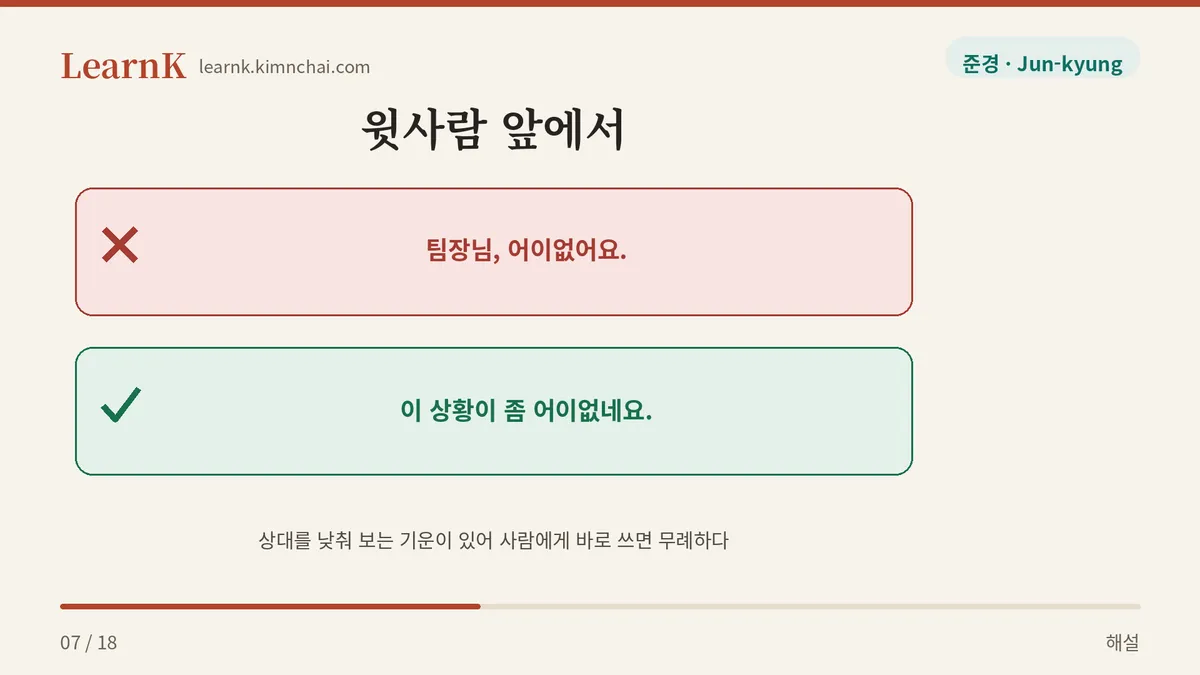
- Casual (반말): 어이없어 (eoieopseo) / exclamatory: 어이없네 (eoieomne)
- Polite (존댓말): 어이없어요 (eoieopseoyo) / 어이없네요 (eoieomneyo)
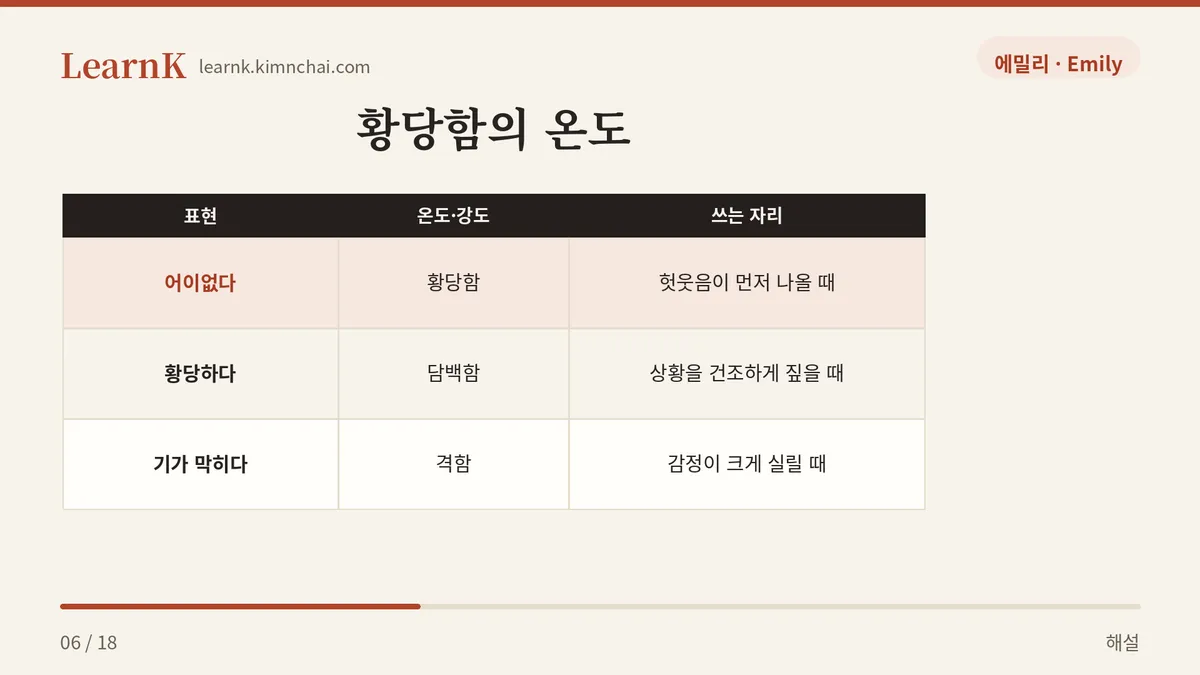
- Similar expressions: 황당하다 (hwangdanghada) — almost the same meaning, but a bit more matter-of-fact / 기가 막히다 (giga makhida) — stronger and more emotional / 어처구니없다 (eocheoguni-eopda) — practically the same as ‘어이없다’
One thing to watch out for: ‘어이없다’ carries a slight nuance of looking down on the other person, so saying “어이없어요 (eoieopseoyo)” directly to someone senior to you can come across as rude. It’s safer to use it about a situation or a third party rather than the person you’re talking to.
Cultural Background

‘어이없다’ is a core reaction word in Korean variety shows and dramas. You’ll often see a cast member staring blankly into the camera in an outrageous situation, with the subtitle “어이없음” (dumbfoundedness) slapped on screen. In the film Veteran (CJ Entertainment, 2015), the emotion audiences feel while watching a spoiled third-generation chaebol behave completely beyond reason is exactly this ‘어이없음.’ Too absurd to get angry at, too outrageous to laugh at — it’s a word that pins down that emotion living somewhere in between.
Closing Quiz
A friend calmly tells you, “라면을 끓이다가 물 대신 우유를 부었다 (while making ramyeon, I poured in milk instead of water).” How would you express a dumbfounded reaction naturally, in casual speech (반말)? (Hint: try using the exclamatory ending ‘-네’.)
Answer: 어이없네 (eoieomne) — “야, 그걸 진짜 했다고? 어이없네! (Hey, you actually did that? That’s unbelievable!)”
Definitions and example sentences are from the National Institute of Korean Language’s Basic Korean Dictionary (krdict.korean.go.kr); that portion of this post, including our translations, is licensed under CC BY-SA 2.0 KR.