어쩐지 (eojjeonji) — Between "I have no idea why" and "Ah, so that's why"
어쩐지
어쩐지 (eojjeonji) means “I don’t know what the reason is, but…” When you can’t point to a cause, yet your heart or your senses have already reacted, this is the word that fills in that unexplained space. You open your eyes in the morning and, with nothing in particular going on, your mood has sunk. You’re seeing someone for the first time, but your eyes keep drifting back to them. All you did was step into an old alleyway, and somehow your chest aches a little. At moments like these, a Korean speaker says 어쩐지 기분이 이상해 (eojjeonji gibuni isanghae) — “Somehow I feel strange.” Ask them to name a reason and they can’t, but the feeling itself is unmistakable.
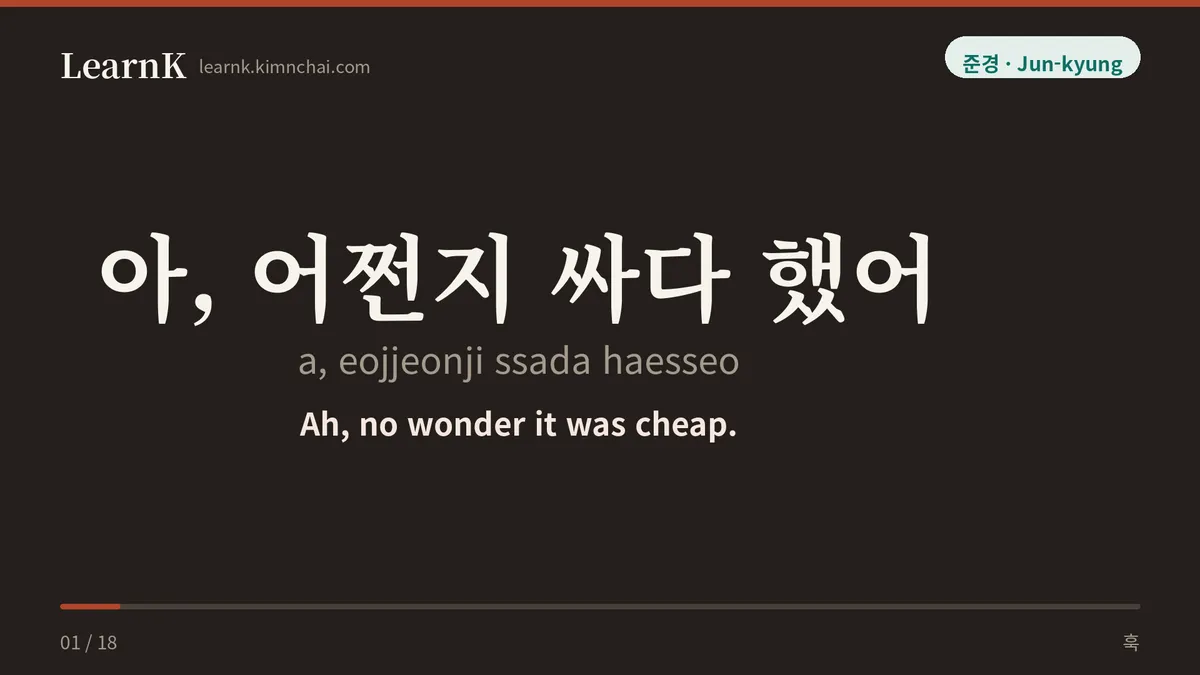
In real conversation, though, the spot where 어쩐지 (eojjeonji) pops out most often is a little different. It’s the moment you suddenly learn a reason you hadn’t known. You’d been sensing that something was off for a while, but you had no idea why. Then the explanation clicks into place. In that moment, Koreans say it short: 아, 어쩐지. (a, eojjeonji.) In English it lands close to “Ah, no wonder” or “That explains it.”
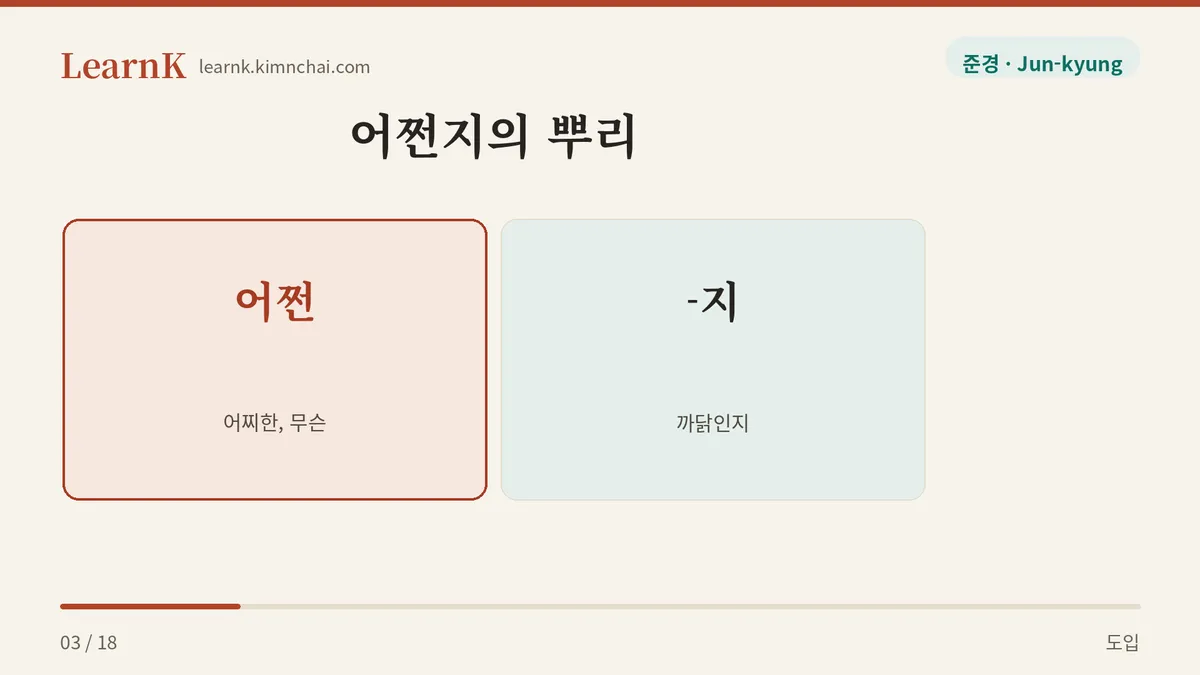
The two uses are really one. The root of 어쩐지 is “for whatever reason.” Say it while you still don’t know that reason and it comes out as “I don’t know why, but…”; say it after you’ve learned the reason, looking back over what already happened, and it comes out as “Ah, so that’s why.” The only difference is whether you’re facing forward or looking back. That’s why, in the second use, a form marking recollection almost always tags along: 어쩐지 춥더라 (eojjeonji chupdeora), 어쩐지 조용하다 했어 (eojjeonji joyonghada haesseo), 어쩐지 이상하더라고요 (eojjeonji isanghadeoragoyo) — it pairs up with -더라 (-deora), -다 했어 (-da haesseo), and -더라고요 (-deoragoyo). Learn these tails together with the word and your mistakes drop sharply.
Checking with the National Institute of Korean Language dictionary
어쩐지 (eojjeonji) 「부사 (adverb)」 어떤 이유인지는 모르겠지만. (Even though one doesn’t know what the reason is.) [en] somehow — Even though one does not know the reason. [ja] なぜか【何故か】。どういうわけか。どうやら。どうも。なんとなく【何となく】 — 如何なる理由か分からないが。 [es] indefiniblemente, inexplicablemente — No saber por cuál razón. [zh] 不知怎的 — 虽然不知道是什么原因。 — National Institute of Korean Language, Basic Korean Dictionary (krdict.korean.go.kr)
A Portuguese translation isn’t listed in this dictionary. For reference, something like “sem saber por quê” would do the job — but we should be clear that this one line is ours, not the dictionary’s.
Now let’s look at real usage examples from the same dictionary. Read only the definition and 어쩐지 looks like it has just one face, “I don’t know why, but…” — but spread the examples out and both of the faces described above appear plainly.
나는 소의 눈을 보면 어쩐지 슬프더라. — National Institute of Korean Language, Basic Korean Dictionary (krdict.korean.go.kr)
(naneun so-ui nuneul bomyeon eojjeonji seulpeudeora.) “When I look at a cow’s eyes, somehow I just feel sad.” There’s no logical way to explain why a cow’s eyes are sad. There’s no reason to feel sad, and yet you do. This is the most typical picture of 어쩐지 standing in front of an emotion.
김 대리는 시키는 일은 잘 해내지만 어쩐지 믿음직스럽지가 못하다. — National Institute of Korean Language, Basic Korean Dictionary (krdict.korean.go.kr)
(Kim daerineun sikineun ireun jal haenaejiman eojjeonji mideumjikseureopjiga motada.) “Assistant Manager Kim does whatever he’s assigned well, but somehow he doesn’t inspire confidence.” He does the work. There’s nothing to fault. And still you don’t quite trust him. When you’re carefully putting forward a judgment you can’t back up with evidence, 어쩐지 acts as a cushion.
어쩐지 죽도를 휘두르는 솜씨가 보통이 아니더군요. — National Institute of Korean Language, Basic Korean Dictionary (krdict.korean.go.kr)
(eojjeonji jukdoreul hwidureuneun somssiga botongi anideogunyo.) “No wonder the way you swung that bamboo sword was no ordinary skill.” From here on we’re in the second face. The speaker has just heard that the other person was a kendo athlete, and having heard it, is now replaying the scene they witnessed earlier. Attached to the polite ending -더군요 (-deogunyo), it’s courteous with a note of admiration mixed in.
어쩐지 내가 시키는 일을 곱게 한다 했어. — National Institute of Korean Language, Basic Korean Dictionary (krdict.korean.go.kr)
(eojjeonji naega sikineun ireul gopge handa haesseo.) “No wonder you were doing everything I asked so nicely.” This is a textbook sentence for the -다 했어 (-da haesseo) pattern. It means: you were being unusually agreeable, which struck me as odd, and now I know why. It even carries the temperature of a favor — or an ulterior motive — about to follow.
정말 그렇군요. 어쩐지 모양이 뒤틀린 물고기가 좀 보이더라고요. — National Institute of Korean Language, Basic Korean Dictionary (krdict.korean.go.kr)
(jeongmal geureokunyo. eojjeonji moyangi dwiteullin mulgogiga jom boideoragoyo.) “You’re absolutely right. No wonder I was seeing some fish with twisted bodies.” Here the speaker hears the other person’s explanation, thinks “ah, so that’s what it was,” and lays their own observation on top as supporting evidence. In real conversation, 어쩐지 very often attaches itself to what someone else has just said.
A real conversation
Scene: Saturday afternoon, in front of an apartment complex. Emily has rolled up with a bike she bought secondhand.
에밀리: 이거 봐, 나 이 자전거 오만 원에 샀어. 대박이지? Look at this — I got this bike for 50,000 won. Amazing, right?
준경: 오만 원? 잠깐만… (브레이크를 잡아 본다) 아, 어쩐지 싸다 했어. 50,000? Hold on… (squeezes the brake) Ah, no wonder it was cheap.
에밀리: 왜? 뭐 이상해? Why? Is something wrong?
준경: 뒷브레이크 다 닳았어. 이거 갈면 이만 원은 더 나와. The rear brake is completely worn. Replacing it’ll run you another 20,000.
에밀리: 헐. 어쩐지 아저씨가 돈만 받고 후딱 가시더라. Ugh. No wonder the guy took the money and rushed off.
준경: 그래도 프레임은 멀쩡하네. 아주 나쁜 거래는 아니야. Still, the frame’s in good shape. Not a terrible deal.
Both times, “the thing that felt off earlier” and “the reason I’ve just discovered” meet inside a single sentence. And both times, the line is close to talking to oneself. 어쩐지 isn’t a word for persuading someone else — it’s closer to the sound of a puzzle clicking together inside your own head, let out loud.
This is where it sounds off
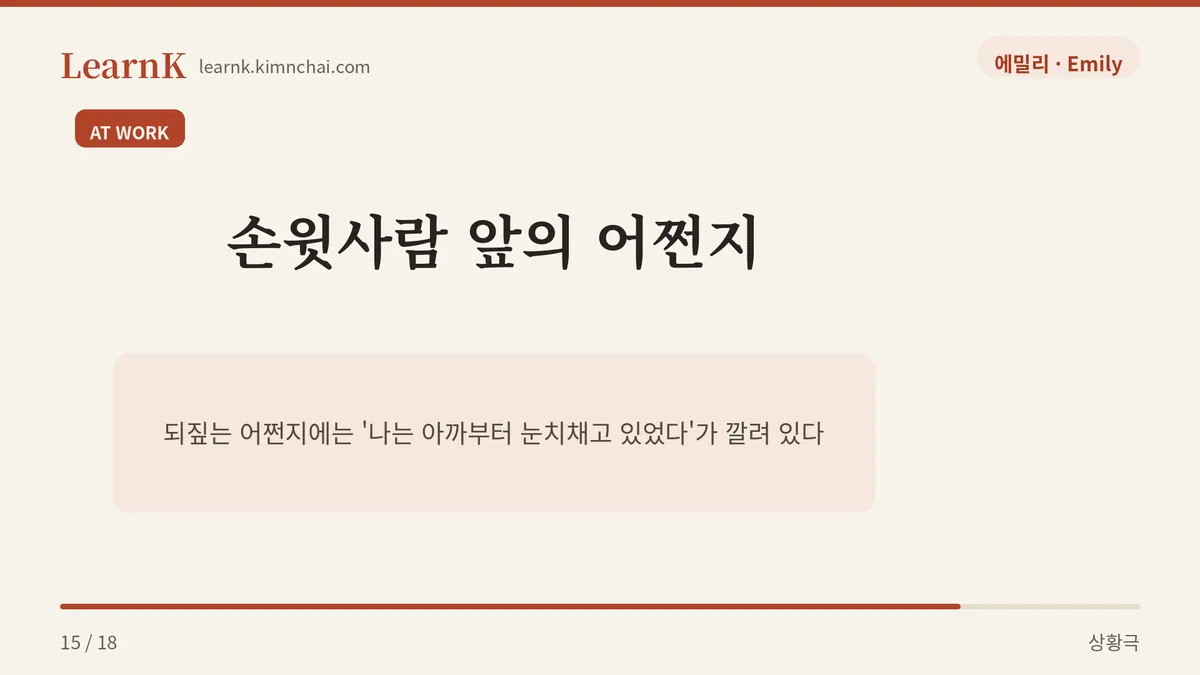
✗ (To your department head) 부장님, 어쩐지 이 자료가 좀 이상하다 했습니다. ✓ (To your department head) 아, 그런 사정이 있었군요. 이제 이해했습니다. → The grammar is fine. The problem is the temperature. The looking-back use of 어쩐지 has an unspoken layer underneath it: “I’d already noticed something was wrong a while ago.” Use it in front of the person who made that document and it sounds like “So you were wrong, just as I suspected.” In front of someone senior — or the person directly involved — it’s safer to steer away from 어쩐지 and toward expressing understanding instead.
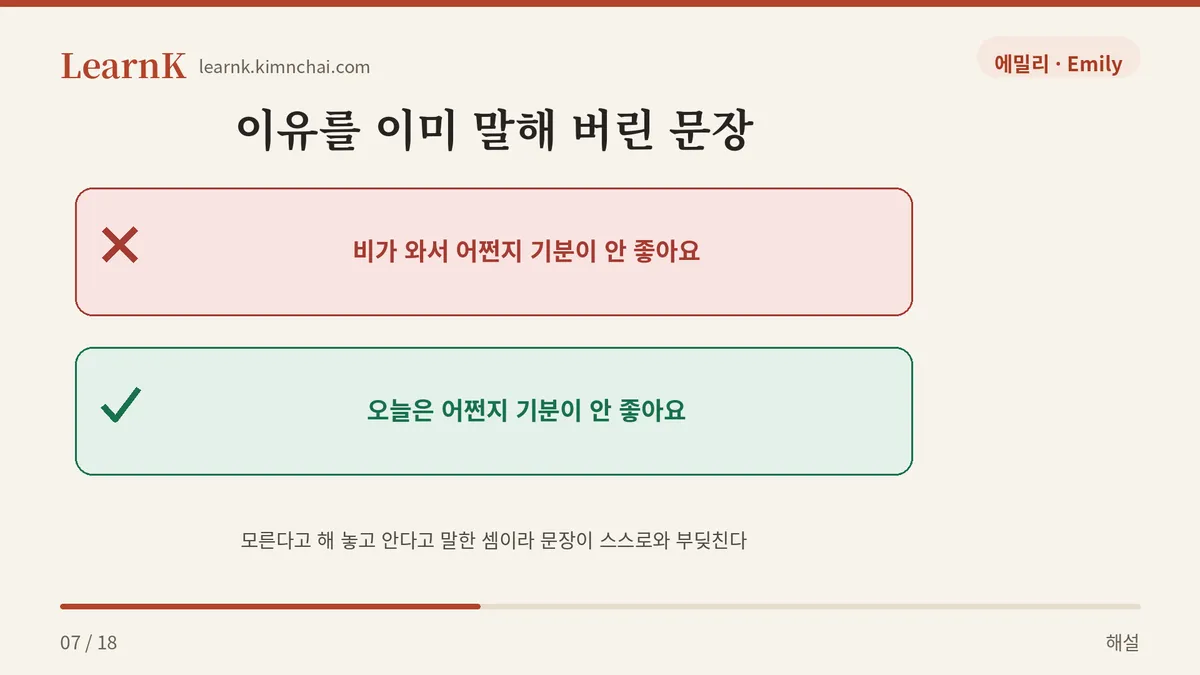
✗ 비가 와서 어쩐지 기분이 안 좋아요. ✓ 오늘은 어쩐지 기분이 안 좋아요. → 어쩐지 means “I don’t know the reason, but…” And yet the first sentence has already given the reason up front: 비가 와서 (bi-ga waseo, “because it’s raining”). You’ve said you don’t know and then said you do, so the sentence collides with itself. When you do know the reason, just drop 어쩐지.
Example sentences by situation
1. Your friend looked rough, and you’ve just heard they pulled an all-nighter
어쩐지 아까부터 계속 하품하더라. 오늘은 일찍 들어가. (eojjeonji akkabuteo gyesok hapumhadeora. oneureun iljjik deureoga.) — No wonder you kept yawning. Go home early today. Instead of saying you’re worried, you say what you observed. In Korean conversation, affection often comes out on a detour like this.
2. The moment a notice pops up saying that your dropping video call was due to server maintenance
아, 어쩐지 아침부터 접속이 자꾸 끊기더라고요. (a, eojjeonji achimbuteo jeopsogi jakku kkeunkideoragoyo.) — Ah, no wonder the connection kept dropping since this morning. In polite speech, -더라고요 (-deoragoyo) follows almost automatically. It isn’t a word that blames anyone — it tidies up the situation — so it lands softly even in a meeting.
3. The first use: when your heart moves for no reason at all
가을만 되면 어쩐지 연락하고 싶은 사람이 생긴다. (gaeulman doemyeon eojjeonji yeollakhago sipeun sarami saenggin da.) — When autumn comes, somehow there’s always someone I want to reach out to. There’s nothing to look back on in this sentence. It’s just how it is. This use is exactly why 어쩐지 turns up so often in personal essays, diary entries, and song titles.
Polite and casual speech, plus similar expressions
어쩐지 is an adverb, so its form never changes. Politeness is decided at the end of the sentence. In casual speech it’s 어쩐지 춥더라 (eojjeonji chupdeora); in polite speech it becomes 어쩐지 춥더라고요 (eojjeonji chupdeoragoyo). That said, tossing out 아, 어쩐지 (a, eojjeonji) on its own has a strong talking-to-yourself quality, so it feels far more natural in casual settings. In front of someone senior, 아, 그래서 그랬군요 (a, geuraeseo geuraetgunyo) is the safer choice.
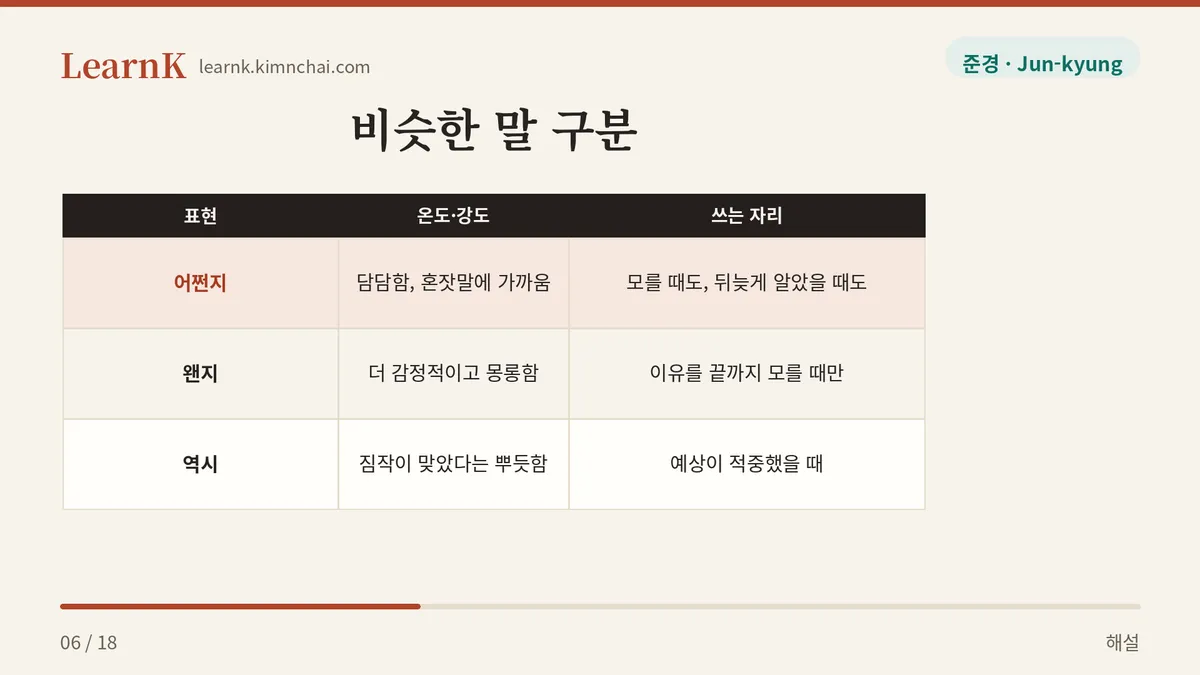
| Expression | Temperature / intensity | Where it’s used |
|---|---|---|
| 어쩐지 (eojjeonji) | Calm, matter-of-fact. Close to talking to yourself | Both when you don’t know the reason and when you’ve just found it out |
| 왠지 (waenji) | More emotional, hazier | Only when you don’t know the reason. Not used for belated realizations |
| 역시 (yeoksi) | Satisfaction at having guessed right | When a prediction lands. Also used as praise |
| 그럴 줄 알았어 (geureol jul arasseo) | Strong. Can sound like showing off | Only among peers. Used on someone’s failure, it stings |
| 어째 (eojjae) | Heavier on suspicion | Casual spoken use with people you’re close to. “어째 좀 이상하더라 (eojjae jom isanghadeora)” |
Plenty of learners mix up 왠지 (waenji) and 어쩐지 (eojjeonji). The distinction is simple. If the reason stays unknown all the way through, either 왠지 or 어쩐지 works — but the slot where you look back on the past after the reason has come to light takes only 어쩐지. Say 왠지 싸다 했어 (waenji ssada haesseo) after checking the bike’s brakes, and to a Korean ear the sentence sounds somehow out of joint.
Cultural background — when 눈치 (nunchi) finally turns into words
The 어쩐 (eojjeon) in 어쩐지 is a shortened form of 어찌한 (eojjihan). Adding -지 (-ji) turned it into “for what reason,” and that whole chunk hardened into an adverb. Once you see this structure, it becomes clear why the two uses live together inside one word. Either way, the word is pointing at a reason — the only difference is whether you don’t know it yet or have just found it out.
There’s a reason this word is used so unusually often in Korean. Korean society runs on 눈치 (nunchi) — a culture of reading the atmosphere first and speaking later. The sense that something is off usually arrives long before any explanation. The air in the office isn’t what it normally is. A friend’s voice sits half a beat lower. Someone is being oddly kind. In the moment, you don’t put that sense into words. Then later, when you learn the circumstances, the discomfort you’d folded away unfolds all at once. 어쩐지 is exactly the sound of that unfolding. So rather than conveying information, this word quietly testifies to one fact: “I’d been feeling it all along.”
In dramas, too, the word shows up right after a twist. You’ve surely seen at least one scene where a character learns a hidden relationship or truth and, instead of delivering some grand line, trails off and leaves behind a single 어쩐지. The line is short, but the effect is large — because viewers immediately start rearranging small moments from earlier episodes in their heads. It’s the same in variety-show subtitles. When a cast member reveals an unexpected talent and “어쩐지…” appears in the corner of the screen, everything that just went by gets read anew.
So when you memorize this word, don’t store only the meaning — store the posture along with it. A person saying 어쩐지 has their eyebrows slightly raised, their gaze aimed not at the other person but at empty space, and their voice is quiet. It’s the face not of someone demanding an explanation, but of someone who has just received one.
Today’s quiz
In which of the following situations is 어쩐지 (eojjeonji) the most natural thing to say?
① You already heard why your friend was late, and you’re passing that reason along to someone else exactly as you heard it ② You’d been feeling that the café was unusually quiet for a while, and you’ve just learned that today is a temporary holiday ③ You’re telling someone your exact test score
The answer is ②. 어쩐지 only gains its power when the state of “I was feeling it, but I didn’t know why” comes first. The moment a reason is laid on top of that state, out comes 아, 어쩐지 오늘 카페가 조용하다 했어 (a, eojjeonji oneul kapega joyonghada haesseo). ① and ③ are situations where you’re delivering information you already know, so there’s no gap for 어쩐지 to slip into.
Definitions and example sentences are from the National Institute of Korean Language’s Basic Korean Dictionary (krdict.korean.go.kr); that portion of this post, including our translations, is licensed under CC BY-SA 2.0 KR.