강릉 (Gangneung) — Two Hours from Seoul, and Why Koreans Just Say "I'm Gangneung Tomorrow"
강릉 (Gangneung)
강릉 (Gangneung) is the name of a city on South Korea’s east coast. Its full administrative name is 강원특별자치도 강릉시 (Gangwon-teukbyeoljachido Gangneung-si), but among Koreans these two syllables work far less like an administrative label and far more like a phrase meaning “the place you go to see the ocean.”
Friday afternoon. Someone in the office picks up their bag and says, ‘나 내일 강릉.’ (na naeil Gangneung.) No verb. No object, no particle. And yet everyone nearby understands, and most of them put on an envious face. You will never find this sentence in a Korean textbook, but in real Korean, a single place name standing in for an entire sentence happens all the time. What we’re covering today isn’t what the word means — it’s what those two syllables actually do inside a Korean conversation.
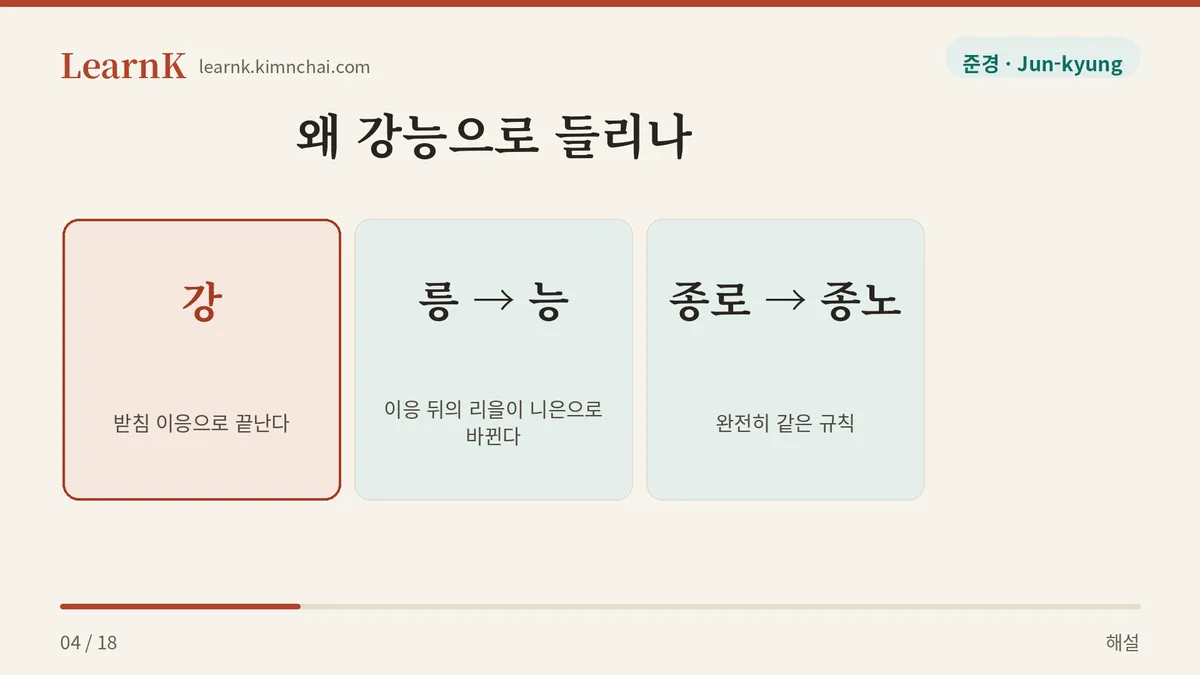
Let’s start with the sound. This is the place name that Korean learners get wrong on the first try close to 100 percent of the time. The letters are 강 and 릉, but the actual pronunciation is [강능] ([gangneung]). The ㄹ that follows the final consonant ㅇ turns into ㄴ — the exact same thing that makes 종로 (Jongno) come out as [종노]. That’s why the romanization is Gangneung and not Gangreung. The romanization isn’t spelled strangely; it’s just faithfully transcribing the real sound.
And why this city, of all places? In 2017, the high-speed rail line connecting Seoul and Gangneung opened, putting the East Sea roughly two hours from Seoul Station. Before that, Gangneung was a place you went only after working yourself up to it. Now it’s a day trip: leave in the morning, look at the sea, eat 순두부 (sundubu, soft tofu stew), drink coffee, and be back by evening. That’s exactly why the short phrase ‘나 내일 강릉’ holds together. Those two syllables already contain all of it — “it’s not far,” “I’m going to rest,” “there’s the ocean.”
Seeing It in a Real Conversation
Situation: Saturday morning in the Seoul Station waiting area. Twenty minutes before departure, two people buy gimbap and head down to the platform.
Jun-kyung: 야, 김밥 두 줄이면 되지? 자리에서 먹게. Hey, two rolls of gimbap is enough, right? We’ll eat at our seats.
Emily: 어. 근데 강릉까지 진짜 두 시간이면 가? Yeah. But does it really only take two hours to get to Gangneung?
Jun-kyung: 응, 기차 생기고 나서는 그래. 예전엔 버스 타고 한참 갔지. Yeah, ever since the train opened. It used to take forever by bus.
Emily: 헐, 그럼 아침에 갔다가 저녁에 와도 되겠네. Whoa, so you could go in the morning and come back at night.
Jun-kyung: 그래서 요즘 강릉은 당일치기로 많이 가. 순두부 먹고 커피만 마시고 와도 남는 장사야. That’s why people do Gangneung as a day trip now. Even just sundubu and coffee is worth the trip.
Emily: 콜. 난 이번엔 바다 앞에서 아무것도 안 할 거야. Deal. This time I’m doing absolutely nothing in front of the ocean.
This Sounds Off
Place names aren’t words you have to tailor to your listener, so there’s no way to be rude with this one. Instead, here are the two misunderstandings that learners run into almost without fail.
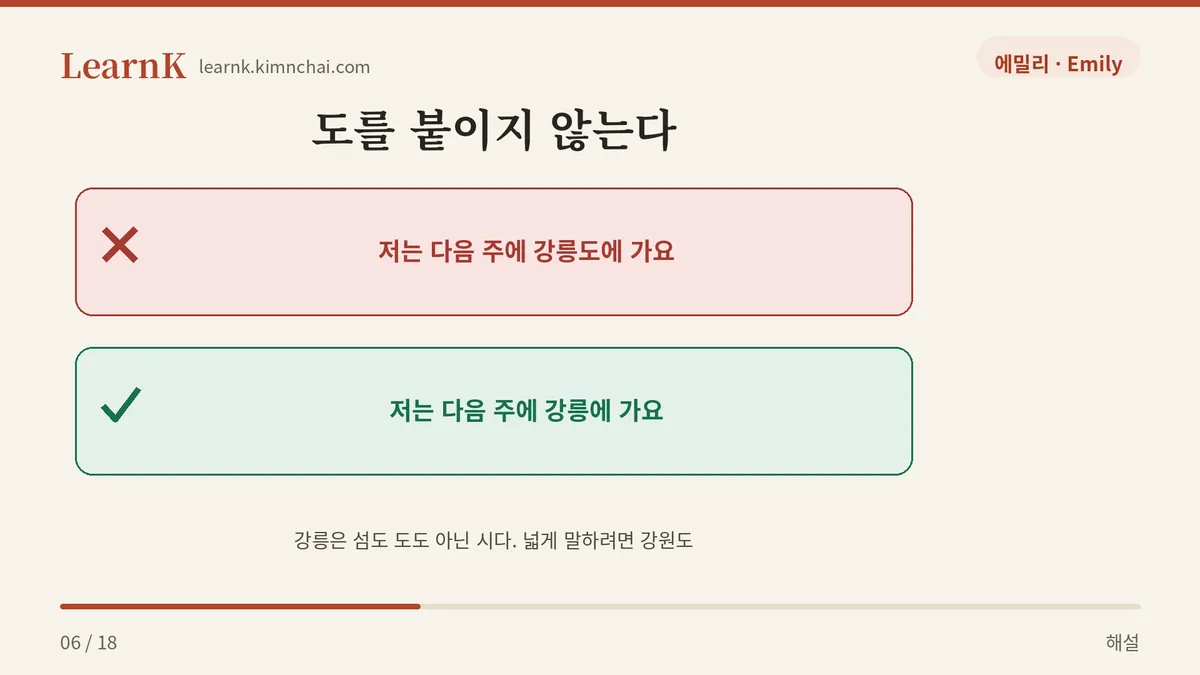
✗ 저는 다음 주에 강릉도에 가요. (jeoneun daeum jue Gangneung-do-e gayo.) ✓ 저는 다음 주에 강릉에 가요. (jeoneun daeum jue Gangneung-e gayo.) → This mistake comes from the habit of attaching ‘-도 (-do)’, the way you do with 제주도 (Jeju-do) and 울릉도 (Ulleung-do). There, 도 means either “island” (島) or “province” (道) — but Gangneung is neither an island nor a province. It’s a city, 시 (si). If you want to speak at the province level, the word is 강원도 (Gangwon-do), and that points to a much wider area that contains Gangneung.
✗ [강·릉]에 가요. (letter by letter: gang-reung) ✓ [강능]에 가요. (Gangneung) → This is a textbook case of a place name where spelling and sound diverge. If you pronounce it letter by letter, Koreans will still understand you, but they’ll immediately register it as a foreign accent. When you’re buying a train ticket or telling a taxi driver where you’re going, saying [강능] dramatically raises your success rate.
Example Sentences by Situation
1. Talking about weekend plans — by far the most common setting
이번 주말에 강릉 가려고요. (ibeon jumare Gangneung garyeogoyo.)
Telling a coworker or friend your weekend plans. In Korean you don’t say something long like ‘강릉에 여행을 갈 예정입니다’ (“I am planning to take a trip to Gangneung”). Dropping even the particle ‘에’ and saying ‘강릉 가려고요’ sounds far more natural. Nine times out of ten, the person hearing this will come right back with ‘바다 보러 가요?’ (bada boreo gayo?) — “Going to see the ocean?”
2. Talking about where you’re from
저 강릉 사람이에요. 바다 앞에서 자랐어요. (jeo Gangneung saramieyo. bada apeseo jarasseoyo.)
Introducing your hometown when meeting someone for the first time. ‘강릉 사람이에요’ is closer to everyday spoken Korean than ‘강릉 출신이에요’. In Korea, saying you’re from a coastal city very often sends the conversation straight toward ‘그럼 회 잘 먹겠네요’ (geureom hoe jal meokgenneyo) — “You must be good with raw fish, then.”
3. Asking about travel time — the most practical one for travelers
서울역에서 강릉까지 얼마나 걸려요? (Seoullyeogeseo Gangneungkkaji eolmana geollyeoyo?)
A sentence for the station or the information desk. ‘~에서 ~까지’ (~eseo ~kkaji) is the basic pair that binds a starting point to a destination, so memorize it whole and you can swap in any place name for the rest of your life. For the record, from Seoul Station the answer that comes back is roughly two hours, give or take.
Polite vs. Casual Speech, and Related Expressions
A place name itself carries no honorific level. The difference between polite and casual speech is decided at the end of the sentence, not by the place name. To someone older or senior, it’s ‘강릉 가세요?’ (Gangneung gaseyo?); to a friend, ‘강릉 가?’ (Gangneung ga?). The two syllables stay exactly the same and only what follows changes — which actually makes this an easy one to learn.
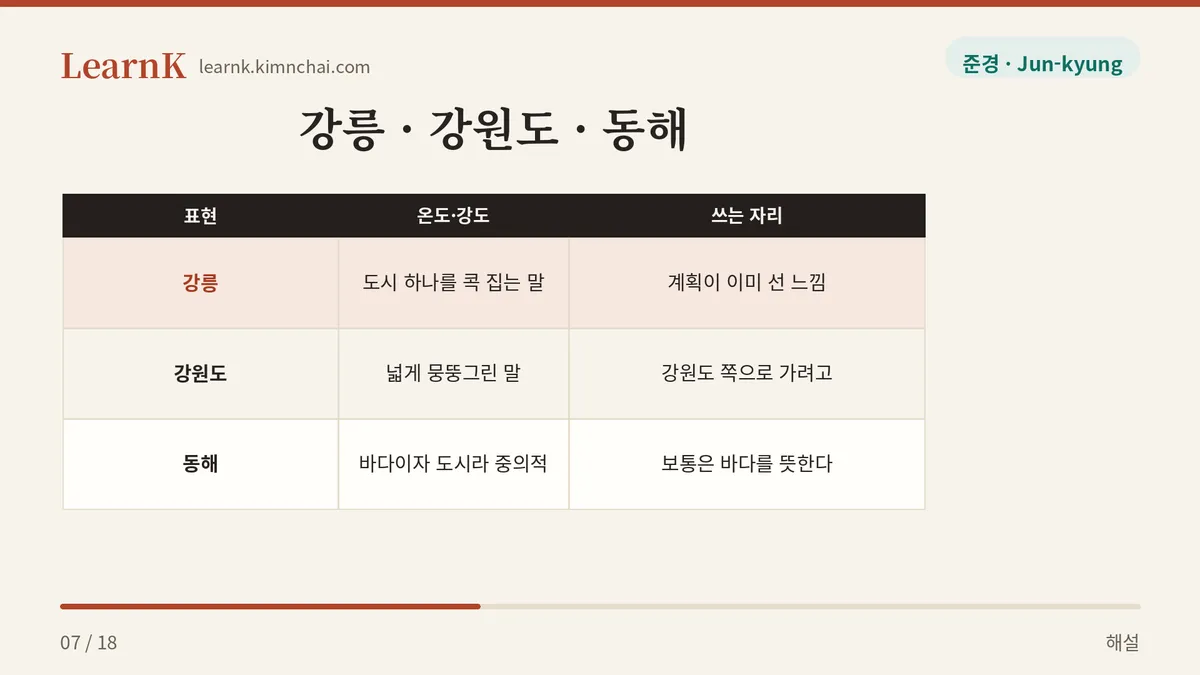
What’s genuinely confusing here isn’t politeness level — it’s scope. The four words below show up side by side all the time in Korean conversation, but each one points to a different size of thing.
| Expression | Feel & scope | Where it’s used |
|---|---|---|
| 강릉 (Gangneung) | Pinpoints one specific city. Sounds like the plan is already set | Anywhere — travel, hometowns, transportation |
| 강원도 (Gangwon-do) | Broad and lumped together. Sounds like nothing’s decided yet | When referring to the whole region. ‘강원도 쪽으로 가려고’ — “I’m thinking of heading Gangwon-do way” |
| 영동 (Yeongdong) | A geographic and meteorological term, so it’s stiff | Weather forecasts and the news. The coastal area east of the Daegwallyeong pass |
| 동해 (Donghae) | Ambiguous — it’s both a sea and a city | Usually means the sea. When you mean the city, say ‘동해시’ (Donghae-si) |
That last row is the real trap. If someone says ‘동해 갈래?’ (Donghae gallae?), they normally mean “want to go to the East Sea?” — not “want to go to the city of Donghae?” And the flagship destination for going to see that East Sea is, of course, Gangneung.
Cultural Background — Between the Sea and the Coffee
The name itself sketches the landscape. In Chinese characters, Gangneung is 江陵 — a river (江) and a hill (陵). It was called 하슬라 (Haseulla) in the Goguryeo era and 명주 (Myeongju) under Unified Silla before settling into its present name during the Goryeo period. That makes it a name over a thousand years old.
Three things, more or less, make Gangneung what it is today. First, coffee. The area around 안목해변 (Anmok Beach) is known as 커피거리 (keopi-geori, “Coffee Street”), a row of cafés facing the ocean, and a coffee festival is held there every year. For Koreans, ‘강릉 커피’ (Gangneung keopi) is practically a proper noun of its own. Second, 초당순두부 (Chodang sundubu). The soft tofu made around the Chodang-dong neighborhood is famously seasoned with seawater instead of salt, and some people set out before dawn specifically to eat it for breakfast. Third, sunrises. 정동진 (Jeongdongjin) gets its name from sitting due east of Gwanghwamun in Seoul, and after it appeared as a setting in the 1995 drama 모래시계 (Moraesigye, “Sandglass”) (SBS, 1995), it became a nationally famous sunrise spot.
While we’re on dramas: that scene on the seaside breakwater where the heroine stands holding buckwheat flowers and the hero suddenly materializes — the one anyone who has watched even a little Korean drama will picture — was also filmed in Gangneung, at Jumunjin. Ever since 도깨비 (Dokkaebi, “Goblin”) (tvN, 2016), that breakwater has been a spot where people line up to take photos. You don’t even have to quote the dialogue; for Koreans, the five syllables ‘주문진 방파제’ (Jumunjin bangpaje) are enough to replay the whole scene.
There are older faces here too. 오죽헌 (Ojukheon) is the house where 신사임당 (Shin Saimdang) lived and where 율곡 이이 (Yulgok Yi I) was born — meaning the figures on both the 50,000-won and the 5,000-won bills came out of this one house. 강릉단오제 (Gangneung Danoje), inscribed on UNESCO’s list of Intangible Cultural Heritage of Humanity, is still held on a grand scale every year. And Gangneung is where the ice events of the 2018 PyeongChang Winter Olympics were held.
Finally, the way people talk. This region, east of the Daegwallyeong pass, has an intonation noticeably different from Seoul speech. Its best-known marker is the sentence ending ‘~드래요 (~deuraeyo)’, which turns up almost without fail whenever a drama or variety show portrays someone from Gangwon-do. If you hear that ending while you’re traveling, that alone means you’ve arrived in Gangneung.
Today’s Quiz
Which of the following is natural Korean?
- 저는 다음 주에 강릉도에 가요. (jeoneun daeum jue Gangneung-do-e gayo.)
- 저는 다음 주에 강릉에 가요. (jeoneun daeum jue Gangneung-e gayo.)
- 저는 다음 주에 강릉시도에 가요. (jeoneun daeum jue Gangneung-si-do-e gayo.)
Answer: 2
Gangneung is not an island (島) or a province (道) — it’s a city (市) — so you don’t attach ‘-도’. This is the single most frequent mistake among learners who’ve gotten used to the 도 in 제주도 (Jeju-do) and 울릉도 (Ulleung-do). If you want to talk about the wider region, ‘강원도에 가요’ (Gangwon-do-e gayo) is correct; if you want to pinpoint one city inside it, it’s ‘강릉에 가요’ (Gangneung-e gayo). And when you read it aloud, don’t forget — it’s [강능].