급발진 (geupbaljin) — The Moment Someone Goes From Perfectly Still to Suddenly Flooring It

급발진 (geupbaljin)
급발진 (geupbaljin) describes what happens when a person who was sitting there perfectly calm suddenly — with zero warning — gets angry or worked up, and their words and actions come shooting out all at once. When a friend who was quietly eating dinner suddenly raises their voice over some throwaway comment, or when someone who was laughing along a second ago suddenly turns serious and pours out everything they’ve been holding in, Koreans nudge the person next to them and say: “쟤 왜 저래, 갑자기 급발진하네. (jyae wae jeorae, gapjagi geupbaljinhane.)” — “What’s with them? They just went zero to a hundred.”
There are two things at the heart of this word. First, there is no warning. The gradual part — the face slowly hardening, the voice dropping — gets skipped entirely. It goes from 0 to 100 in a single jump. Second, the person isn’t in control of it. It’s less that they get angry and more that the anger gets out. That’s why 급발진 (geupbaljin) isn’t so much an accusation as a slightly exasperated tease.
One more thing worth knowing: 급발진 (geupbaljin) doesn’t only attach to anger. The measure isn’t the type of emotion but the speed. A quiet person whose energy suddenly spikes and who grabs the karaoke mic — that’s 급발진 (geupbaljin). Someone at a drinking table who abruptly launches into the story of their crush — 급발진 (geupbaljin). A coworker who pulls out their entire life story mid-meeting when nobody asked — also 급발진 (geupbaljin). That’s exactly what makes this word so useful for Korean learners: it covers “갑자기 화냈어 (gapjagi hwanaesseo, they suddenly got angry),” “갑자기 흥분했어 (gapjagi heungbunhaesseo, they suddenly got worked up),” and “갑자기 오버했어 (gapjagi obeohaesseo, they suddenly went overboard)” all with one word.
The forms are simple. As a noun it’s just 급발진 (geupbaljin); as a verb, 급발진하다 (geupbaljinhada); past tense, 급발진했다 (geupbaljinhaetda). Online and in everyday conversation you’ll also often hear 급발진 오다 (geupbaljin oda), literally “급발진 comes.” You say something like “나 오늘 급발진 왔어 (na oneul geupbaljin wasseo)” — “I had a 급발진 moment today” — as if the emotion rolled in from somewhere outside you. It’s a very Korean way of speaking that makes your own behavior sound a little like somebody else’s doing, leaving yourself some room for an excuse.
Seeing it in a real conversation

Setting: 9 p.m., in front of an apartment building’s main gate. He’s just taken delivery of a monitor he bought secondhand, and the seller has only barely walked away.
Jun-kyung: 아 진짜, 흠집 없다더니 여기 다 긁혀 있잖아. Ugh, seriously. He said no scratches, but look, it’s all scuffed right here.
Emily: 그러게. 근데 아까 네 목소리 좀… 아저씨 좀 놀란 것 같던데? Yeah, it is. But your voice back there… I think you kind of startled him.
Jun-kyung: 내가? 난 그냥 확인한 건데. Me? I was just checking, that’s all.
Emily: 확인은 무슨. 사진 보자마자 급발진했잖아. 나도 깜짝 놀랐어. “Checking,” sure. You went from zero to a hundred the second you saw that photo. Even I jumped.
Jun-kyung: …인정. 요즘 내가 좀 급발진이 잦다. …Fair. I’ve been blowing up over little things a lot lately.
Emily: 응. 다음엔 숨 한 번 쉬고 말해. 그 아저씨 잘못 맞는데 네가 지는 그림 됐잖아. Yeah. Next time take a breath first. He was in the wrong, but you ended up looking like the bad guy.
Using it this way sounds off

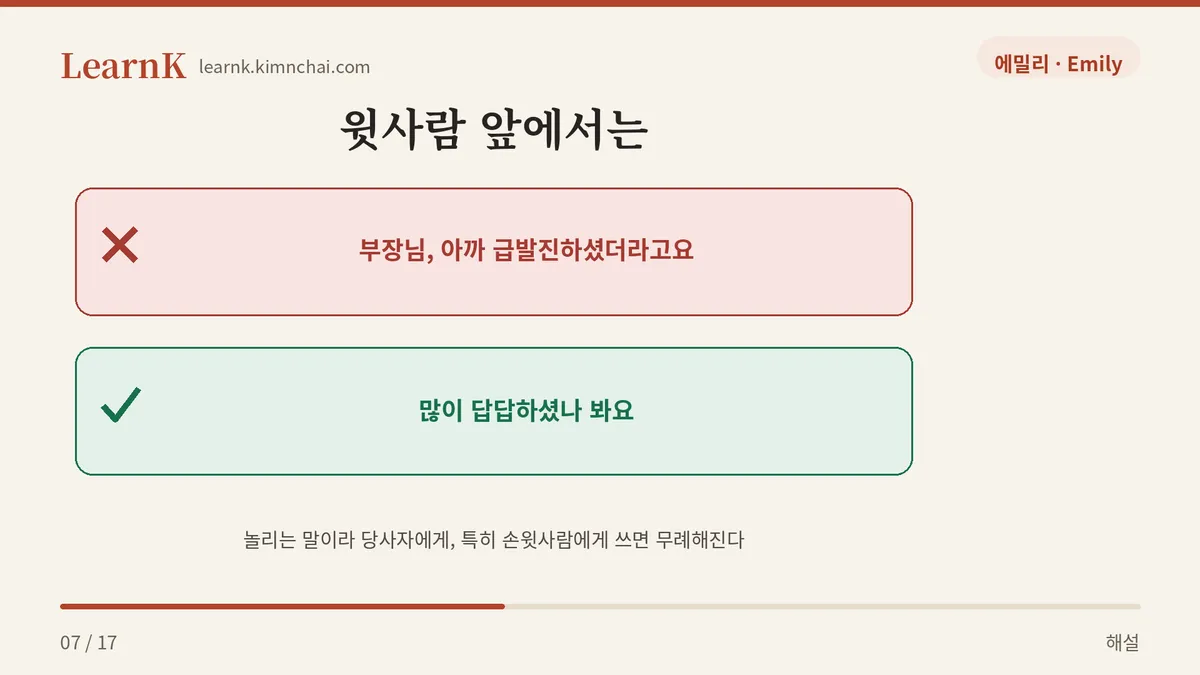
✗ (to your department head) 부장님, 아까 회의 때 급발진하셨더라고요. (bujangnim, akka hoeui ttae geupbaljinhasyeotdeorag oyo.) ✓ (to a coworker) 야, 아까 회의 때 부장님 급발진하신 거 봤어? (ya, akka hoeui ttae bujangnim geupbaljinhasin geo bwasseo?) → 급발진 (geupbaljin) is a teasing word. It’s natural in the third person, said behind someone’s back, but used directly to the person’s face — and to someone senior, no less — it amounts to telling them “you couldn’t control your emotions there” straight to their face. In front of someone above you, it’s safer to soften it into something like “많이 답답하셨나 봐요 (mani dapdaphasyeonna bwayo, you must have been really frustrated).”
✗ (while a friend is crying and opening up about something that genuinely hurt them) 야, 너 지금 급발진이야? (ya, neo jigeum geupbaljiniya?) ✓ (same situation) 무슨 일 있었어? 천천히 얘기해 봐. (museun il isseosseo? cheoncheonhi yaegihae bwa.) → The grammar is fine, but the temperature is all wrong. 급발진 (geupbaljin) carries a built-in verdict — “your reaction is bigger than the situation deserves” — so using it when someone is genuinely hurting and letting it out makes their whole emotion sound trivial. This word is for overreacting to something small, not for reacting big to something big.
Example sentences by situation
1) When a friend suddenly unloads in the group chat
A quiet group chat, and then a friend dumps an eight-line message into it out of nowhere. Another friend eases the mood with this:
야, 왜 갑자기 급발진이야. 무슨 일 있었어? (ya, wae gapjagi geupbaljiniya. museun il isseosseo?) Whoa, why the sudden explosion? Did something happen?
It starts as teasing and ends as concern — a very Korean kind of sentence. It packs “you overreacted a bit there” and “are you okay?” into one breath.
2) When you’re owning up to it yourself
After fighting with your partner over something small yesterday, you apologize the next day like this:
어제는 미안. 내가 좀 급발진했어. (eojeneun mian. naega jom geupbaljinhaesseo.) Sorry about yesterday. I kind of lost it out of nowhere.
It’s much gentler than “내가 화냈어 (naega hwanaesseo, I got angry).” You admit fault, but the word comes with a built-in nuance of “that’s not how I normally am” — which is why it shows up constantly in real apologies.
3) When it’s not anger but energy that spikes
A senior colleague who stayed quiet the entire company dinner suddenly grabs the mic at the karaoke afterparty and belts out three songs back to back.
아까까지 한마디도 안 하시더니 노래방 오니까 급발진하시네. (akkakkaji hanmadido an hasideoni noraebang onikka geupbaljinhasine.) He didn’t say a word all night, and now that we’re at karaoke he’s completely gone off.
There’s no anger here at all. It’s a good demonstration that what triggers 급발진 (geupbaljin) is not the kind of emotion but the speed of the change.
Politeness levels and similar expressions
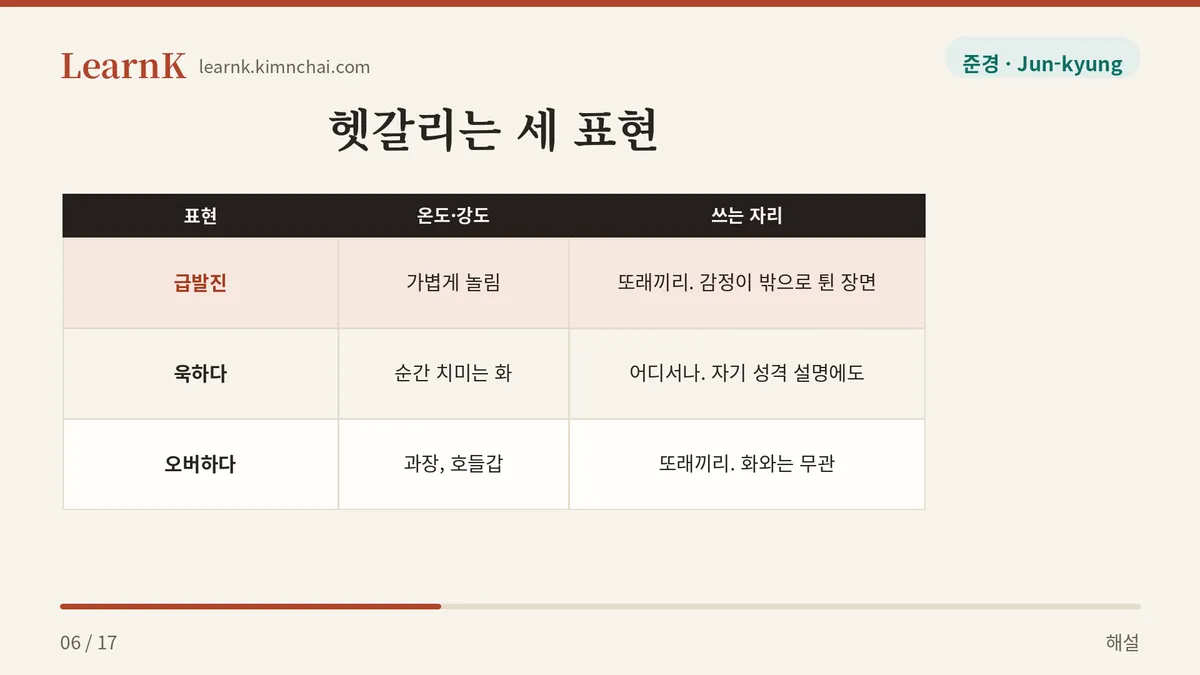
Because 급발진 (geupbaljin) is newly coined slang, it has no polite form. You can technically construct something like “급발진하셨습니다 (geupbaljinhasyeotseumnida),” but nobody actually says it. When someone senior is present, switch to the expressions on the right side of the table below.
| Expression | Tone / intensity | Where it’s used |
|---|---|---|
| 급발진 (geupbaljin) | light teasing, “are you serious right now” | peers, friends, social media. Not used toward seniors |
| 욱하다 (ukhada) | anger that flares up in an instant | anywhere. Also used to describe your own temperament |
| 정색하다 (jeongsaekhada) | the smile drops, the face goes cold | anywhere. Closer to “turning serious” than to anger |
| 오버하다 (obeohada) | exaggerating, making a fuss; unrelated to anger | peers. When a reaction is over the top |
The pair people mix up most is 급발진 (geupbaljin) and 욱하다 (ukhada). 욱하다 (ukhada) refers to the feeling itself, the surge of anger in that instant; 급발진 (geupbaljin) refers to the whole scene of that feeling shooting out into the open. That’s why “나 원래 잘 욱해 (na wonrae jal ukhae, I’ve always had a short fuse)” works as a description of your personality, while “나 원래 잘 급발진해 (na wonrae jal geupbaljinhae)” sounds awkward. Instead you’d frame it as a recent, repeated pattern of incidents: “나 요즘 급발진이 잦아 (na yojeum geupbaljini jaja, I’ve been blowing up a lot lately).”
Cultural background — a word that came from car news
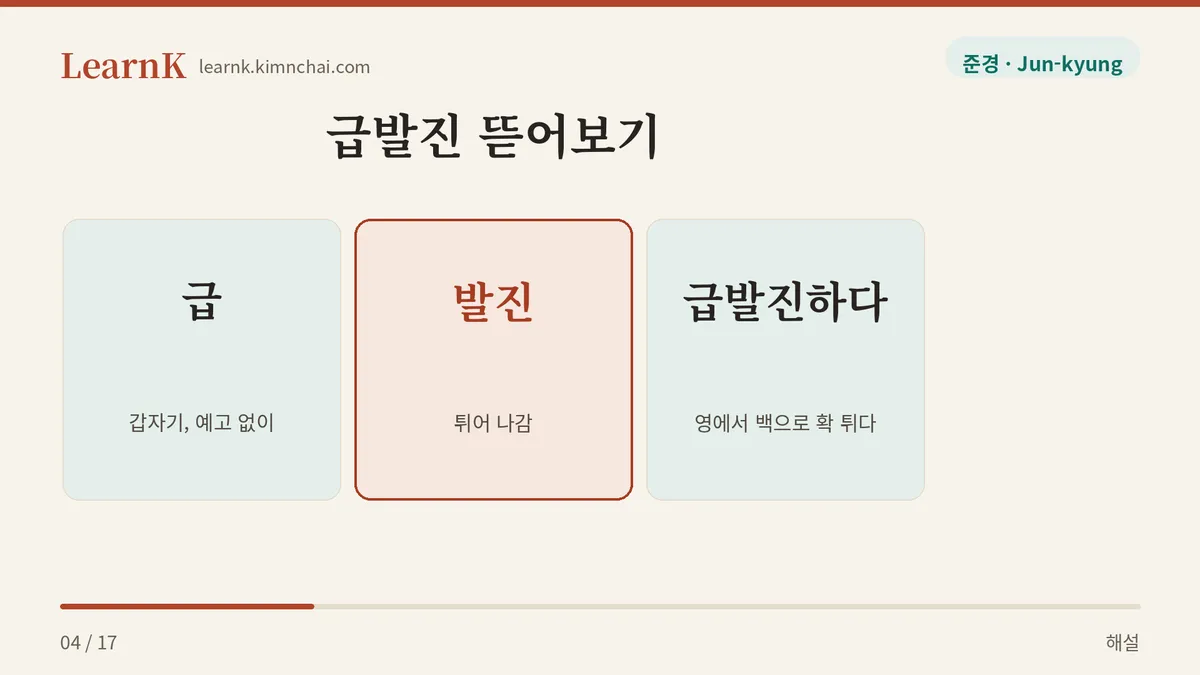
급발진 (geupbaljin) was originally an automotive term. In Chinese characters it’s 急發進, combining 급 (急, sudden) and 발진 (發進, to set off), and it refers to the phenomenon where a car lurches forward on its own even though the driver is pressing the brake. In Korea, a run of news coverage about these accidents through the 2010s made the word familiar to ordinary people.
That image then transferred straight onto people. A car that shoots forward even though the brake is pressed — in other words, the person tried to stop themselves and couldn’t. That’s precisely why the metaphor works so well. Korean has plenty of expressions where responsibility is clear, like “화냈다 (hwanaetda, got angry),” but 급발진 (geupbaljin) quietly shifts the blame over to a mechanical malfunction. Which is why people who get teased with this word usually don’t take it too badly. It’s not “you’re a jerk” — it’s closer to “looks like your brakes gave out for a second.”
Watch enough Korean dramas and you’ll run into the scene itself constantly. The father silently ladling soup at the dinner table who suddenly sets down his spoon and raises his voice. The new hire who has been quietly listening in the meeting room and suddenly stands up and says every single thing on their mind. Subtitles usually render it as “snapped” or “lost it,” but what Korean viewers actually type in the live comments watching that scene is, more often than not, a single line: “급발진 오졌다 (geupbaljin ojyeotda, that was one hell of a 급발진).” Once you know this word, you’ve got one more lens for watching dramas.
Today’s quiz
Which of the following is the most natural situation for using 급발진 (geupbaljin)?
- A friend bursting into tears after hearing their parent is ill
- A normally quiet coworker suddenly raising their voice in the middle of a conversation about what to have for lunch
- A boss making consistently calm, measured criticisms from the start of the meeting to the end
- Greeting someone politely upon meeting them for the first time
Show the answer
Answer: 2
급발진 (geupbaljin) has three conditions: ① no warning, ② over something trivial, ③ a reaction that shoots way up. Number 2 fits exactly — a “normally quiet” person suddenly taking off over the trivial topic of “what to eat for lunch.” Number 1 is a big emotion over a big matter, so using the word there would be rude; number 3 has a constant speed, so it isn’t 급발진 (geupbaljin) at all (if anything, it’s closer to 정색 (jeongsaek)); and number 4 has no emotional spike whatsoever.