괜찮으세요? — One Phrase for "Are You Okay?" and "Would You Mind?"
괜찮으세요?
괜찮으세요? (gwaenchaneuseyo?) is a polite way of asking whether someone is all right — in body or in mind — or of checking that whatever you’re about to do won’t put them out. The subway brakes hard and the person in front of you stumbles; you have to push a meeting back by thirty minutes; you set a very spicy dish down in front of a first-time guest. Three scenes that look nothing alike, and in all three a Korean speaker reaches for the very same phrase. Spend even a few days in Korea and you’ll hear it several times a day — yet in textbooks it tends to show up briefly in Chapter 1 and then disappear.
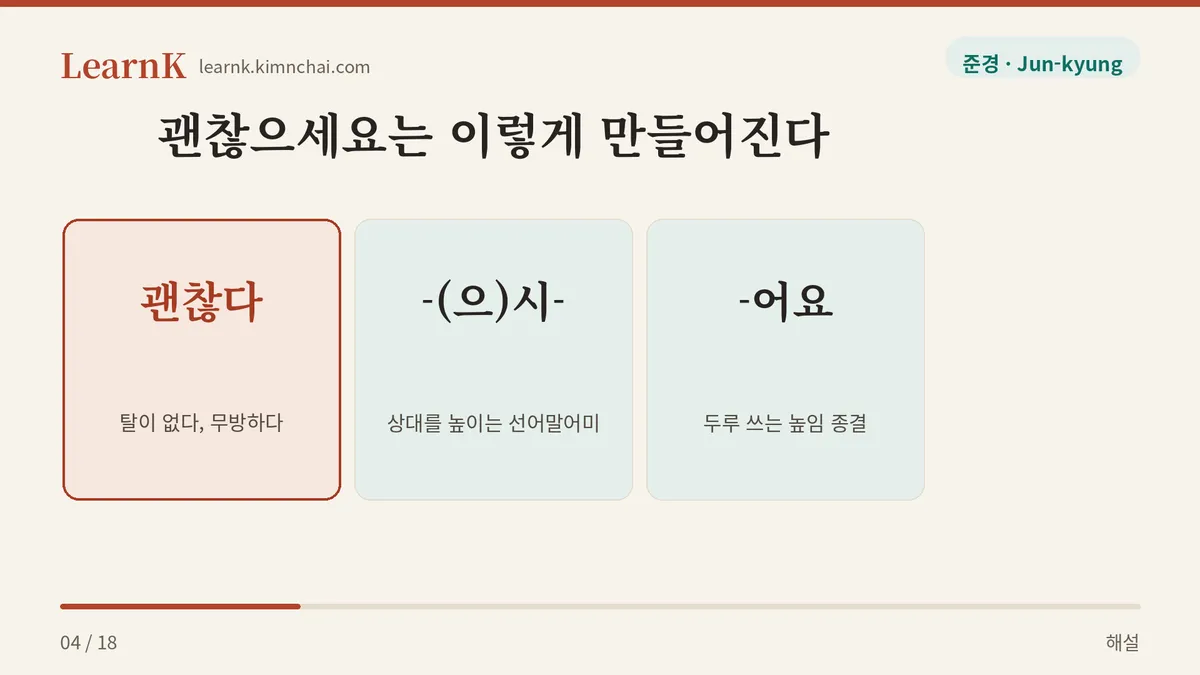
The base form is 괜찮다 (gwaenchanta), and its meaning splits three ways. First, to be unharmed, to be in fine shape. Second, to be permissible — “there’s no problem with doing that.” Third, to be not bad, in fact rather good (그 집 김치찌개 괜찮아 (geu jip gimchijjigae gwaenchana) — “the kimchi stew at that place is pretty good”). Attach the honorific -(으)시- (-(eu)si-) and the all-purpose polite ending -어요 (-eoyo) and you get 괜찮으세요 (gwaenchaneuseyo); lift your pitch at the end and it becomes the question 괜찮으세요?
So this one phrase flies in two directions. Point the arrow at the other person and it’s concern — something you toss to someone who has fallen, someone whose color looks off, someone who has been coughing for a while. Point the arrow back at yourself and it becomes a way of asking permission: may I open the window, may I sit next to you, may we push our plans back? It’s a device for getting the other person’s blessing before you push your own circumstances into the room. Same sentence — what comes in front of it decides which one it is. If “괜찮으세요?” arrives on its own with nothing before it, nine times out of ten it’s concern; if it comes in the shape of ~해도 괜찮으세요? (~haedo gwaenchaneuseyo?), it’s asking permission.
One more thing. When this phrase turns up as an answer rather than a question, the meaning shifts again. If someone asks 더 드릴까요? (deo deurilkkayo?) — “shall I give you some more?” — and you reply 괜찮아요 (gwaenchanayo), that isn’t “yes, please.” It’s “I’m good, thanks — I’ll pass.” Concern when you ask it, refusal when you answer with it: this double life is the point Korean learners stay confused about the longest.
See It in a Real Conversation
Situation: Subway Line 2 on the way home from work. The train brakes suddenly, Emily loses her grip on the strap, and pitches forward.
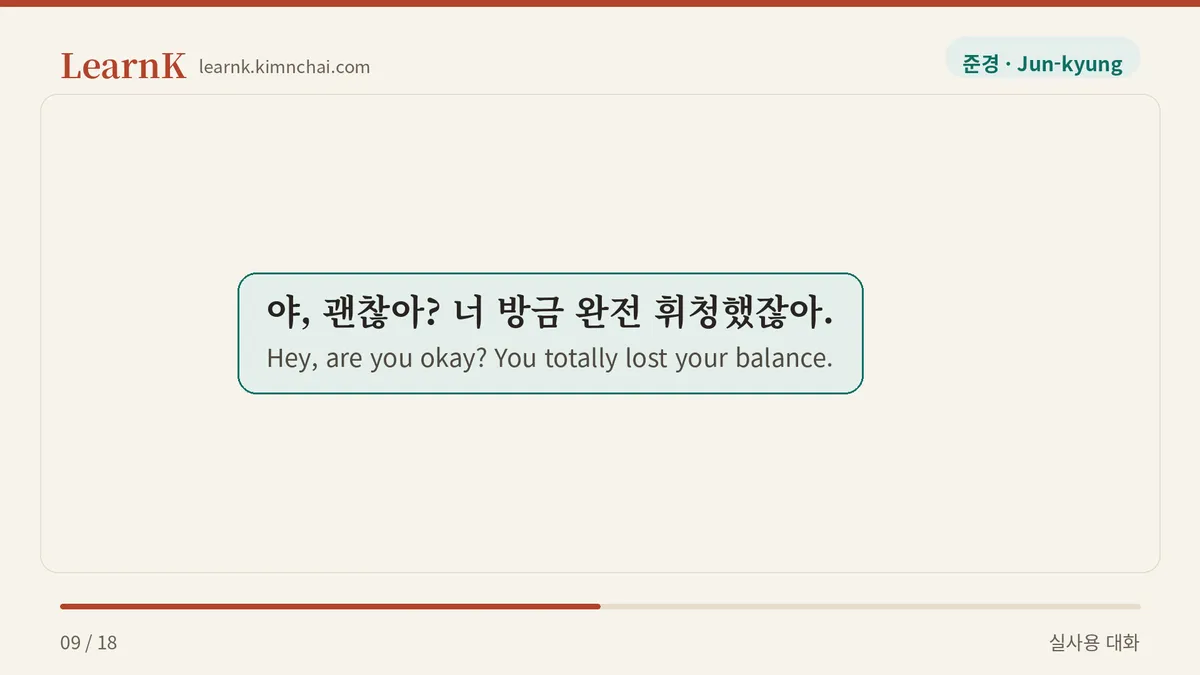
Jun-kyung: 야, 괜찮아? 너 방금 완전 휘청했잖아. Hey, are you okay? You totally lost your balance just now.
Emily: 나보다 저 아저씨… 내가 발을 밟았어. “괜찮으세요?” 했는데 그냥 웃고 마시더라. Forget me — that guy over there. I stepped on his foot. I asked “are you okay?” and he just smiled it off.
Jun-kyung: 그럼 된 거야. 그럴 땐 눈만 마주쳐도 다 통해. Then it’s fine. In situations like that, just making eye contact says everything.
Emily: 근데 나 아직도 헷갈려. 아까 뒤에 계신 아주머니도 나한테 “괜찮으세요?” 하셨거든. But I still get confused. The lady behind me said “gwaenchaneuseyo?” to me too.
Jun-kyung: 아, 그건 걱정 반, “좀 비켜주실래요” 반이야. 상황 봐서 알아들으면 돼. Ah, that’s half concern, half “could you move over a bit.” You just read the situation.
Emily: 하나로 두 개를 하네. 효율 좋다, 한국어. One phrase doing two jobs. Efficient language, Korean.
This Would Sound Awkward
✗ (to the chief mourner at a funeral) 많이 힘드시죠? 괜찮으세요? ✓ (to the chief mourner at a funeral) 얼마나 상심이 크세요 (eolmana sangsimi keuseyo). — “How great your grief must be.” → In the face of real grief, “괜찮으세요?” is a question whose answer is already obvious, so it lands as too light. A house in mourning has its own set greetings, and using them is what courtesy calls for.
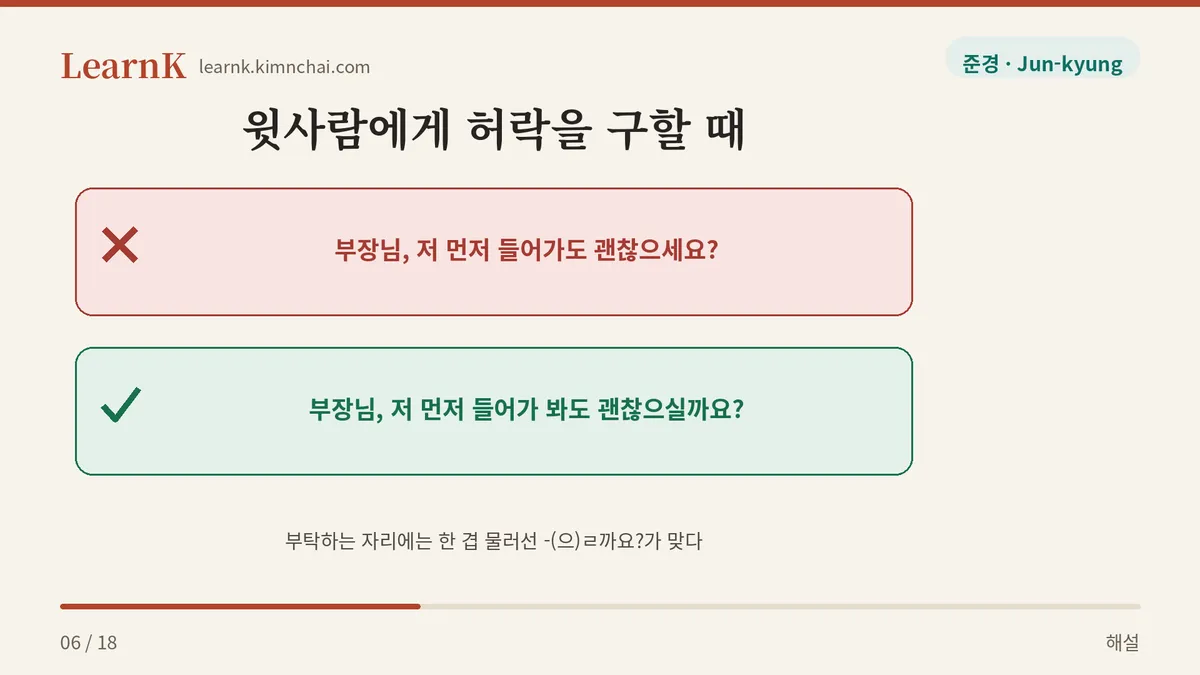
✗ (to your department head) 부장님, 저 먼저 들어가도 괜찮으세요? ✓ (to your department head) 부장님, 저 먼저 들어가 봐도 괜찮으실까요? (gwaenchaneusilkkayo?) → The grammar is correct, but when you’re asking permission from someone senior, “괜찮으세요?” checks their state head-on, which comes off as slightly forward. The one-step-back -(으)ㄹ까요? (-(eu)lkkayo?) fits a request much better.
Example Sentences by Situation
1. Asking to share a table at a café — the place is packed and only one table has a free seat. Instead of just plopping down, you ask first.
여기 앉아도 괜찮으세요? (yeogi anjado gwaenchaneuseyo?) Is it okay if I sit here?
Because ~해도 comes in front, this is the permission side, not the concern side. If the other person says 네, 괜찮아요 (ne, gwaenchanayo), that’s a yes — and if they quietly move their bag aside, that’s a yes too.
2. When you have to change the schedule — the meeting before ran long and you need to push your next appointment back. Rather than leading with an apology, ask about the other person’s circumstances first; that’s what this expression is for.
회의를 30분만 미뤄도 괜찮으세요? (hoeuireul samsip-bunman miryeodo gwaenchaneuseyo?) Would it be all right if we pushed the meeting back by just 30 minutes?
In email or messages, switching to 괜찮으신가요? (gwaenchaneusingayo?) makes it one shade more careful.
3. Putting spicy food in front of a guest — restaurant owners and hosts use this constantly. It’s a spot where concern and permission mix half and half, checking on the other person’s condition in advance.
이거 많이 매운데 괜찮으세요? (igeo mani maeunde gwaenchaneuseyo?) This is quite spicy — will that be okay for you?
Polite and Casual Forms, and Related Expressions
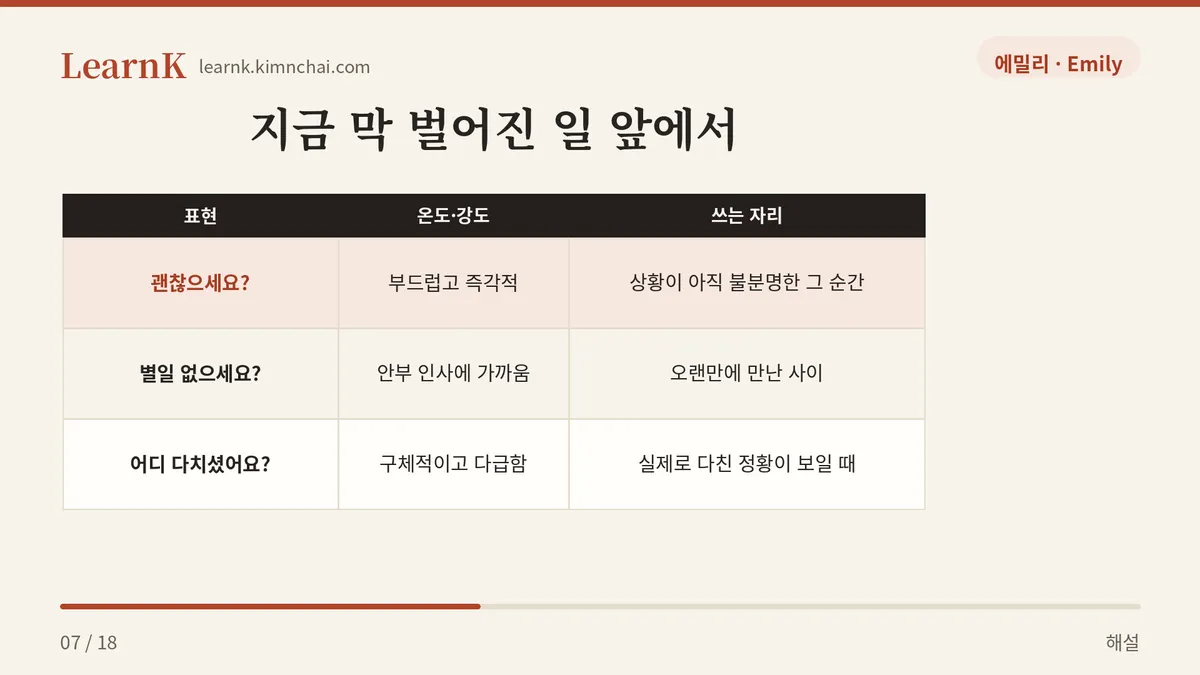
| Expression | Warmth / intensity | Where it fits |
|---|---|---|
| 괜찮으세요? (gwaenchaneuseyo?) | Soft and immediate | Strangers, customers, elders. The most widely used default |
| 괜찮으신가요? (gwaenchaneusingayo?) | A step back, more careful | Texts and email, formal inquiries |
| 괜찮으실까요? (gwaenchaneusilkkayo?) | The most deferential request | Asking permission or indulgence from someone senior |
| 괜찮아요? (gwaenchanayo?) | Light and friendly | Peers or neighbors you can’t quite speak casually with |
| 괜찮아? (gwaenchana?) | Concern that comes right in | Friends, family, partners |
| 별일 없으세요? (byeoril eopseuseyo?) | Closer to a how-are-you | People you haven’t seen in a while. Not for someone who just got hurt |
| 어디 다치셨어요? (eodi dachisyeosseoyo?) | Specific and urgent | When there are visible signs of actual injury |
The two bottom rows are the ones to watch. 별일 없으세요? is a check-in after time has passed, so using it on someone who just fell sounds oddly unhurried, and 어디 다치셨어요? presumes injury has already happened, so using it on someone who’s perfectly fine will alarm them. In that brief moment when the situation still isn’t clear, 괜찮으세요? is the phrase that fills exactly that gap.
Cultural Background — Between a Question and a Polite No
Watch any Korean drama and, in the scene where someone collapses or an accident happens, the first line the lead delivers while running over is almost always this one. Not their name, not “what happened” — first comes “괜찮으세요?” It’s such a fixed reaction that the line barely needs subtitling, and after watching the scene a few dozen times, learners end up memorizing the phrase with their bodies.
What’s interesting is that it’s often not a question meant to get an answer at all. The other person usually just says “아, 네 괜찮아요 (a, ne gwaenchanayo)” and that’s that. The point isn’t to receive a status report; it’s to send a signal that says “I see you.” So the moment you offer the phrase, you’ve already taken a step closer, and reaching out a hand or picking up their bag follows naturally after it. It has a question mark on it, but it’s really closer to a greeting.
On the other side sits 괜찮아요 (gwaenchanayo) as an answer. In Korea this is the softest available form of refusal. When someone holds out a flyer on the street, when a shop offers you a bag, when an elder keeps piling side dishes onto your plate — instead of “싫어요 (sireoyo)” or “안 사요 (an sayo)”, out comes “괜찮아요.” It lets you decline without giving a reason and without costing the other person face. So if a Korean person answers you with “괜찮아요,” chances are good it’s a polite pass, not a status report. Reading the room to decide whether to offer once more — that, too, is part of using this expression properly.
Today’s Quiz
On the subway, the cane of the elderly person sitting next to you clatters to the floor. You quickly pick it up for them. What’s the most natural thing to say as you hand it over?
- 별일 없으세요? (byeoril eopseuseyo?)
- 괜찮으세요? (gwaenchaneuseyo?)
- 어디 다치셨어요? (eodi dachisyeosseoyo?)
Answer: 2. Number 1 is a how-have-you-been greeting for someone you haven’t seen in a while, so it doesn’t fit something that just happened, and number 3 presumes injury, which will startle the person when all that fell was a cane. Number 2 carries concern and a check-in at once without putting any weight on them. Add one more line and it’s complete — 괜찮으세요? 여기 있습니다. (gwaenchaneuseyo? yeogi itseumnida.)
Definitions and example sentences are from the National Institute of Korean Language’s Basic Korean Dictionary (krdict.korean.go.kr); that portion of this post, including our translations, is licensed under CC BY-SA 2.0 KR.