Gyeranjjim — The Bowl That Puffs Up Over the Rim of the Pot
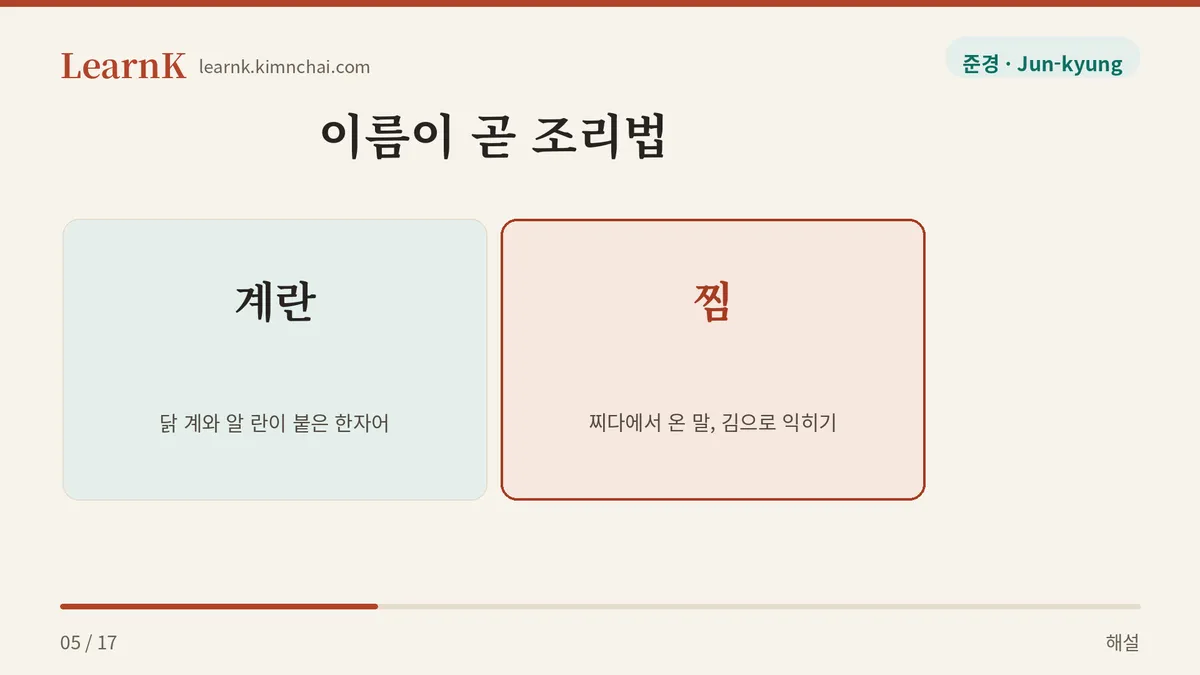
계란찜
계란찜 (gyeranjjim) means a dish made by adding green onions, sesame seeds, and the like to beaten eggs and steaming them. The definition wraps up in a single line, but the places where this word gets used are always a little noisy. At a Korean barbecue place, right about when the grill is heating up, a server carries a earthenware pot across the room — and heads turn at every table. That yellow mass, puffed up like a lid, is gyeranjjim. It shows up on the table of a студент living alone, on the spread of a holiday morning, and beside a child’s lunchbox. For Koreans, gyeranjjim is less a dish you learn to cook than one you simply grow up eating.
So the temperature of this word is low and comfortable. Not the star of the table but the thing beside it — inexpensive, hard to mess up, and liked by just about everyone. At restaurants it arrives in a piping-hot earthenware pot, billowing up like foam; at home it’s steamed in a pot or the microwave and comes out smooth and moist. Knowing in advance that the same name can mean two quite different-looking things will save you from being startled the first time you order.
The word itself carries neither honorific nor humble weight. It’s the name of a thing. What matters instead is the verb that goes with it. Gyeranjjim pairs with 하다 (hada), 만들다 (mandeulda), and 찌다 (jjida). The fact that this is food cooked by steam — not pan-fried or deep-fried — is preserved right there in the verb.
Checking the National Institute of Korean Language dictionary

계란찜 「명사」 달걀 푼 것에 파, 깨 등을 넣고 찐 음식. [en] Steamed eggs; — A food made by adding green onions, sesame seeds, etc. to beaten eggs and steaming them. [ja] ちゃわんむし【茶碗蒸し】 — 卵を溶いたものにネギ、ゴマなどを入れて蒸した料理。 [es] Gyelanjjim, huevos al vapor — Alimento que se elabora añadiendo cebolletas verdes, semillas de sésamo, etc. a huevos batidos y cociéndolos al vapor. [zh] 鸡蛋羹 — 在打散的鸡蛋中加入葱花、芝麻等调料后蒸制而成的一道食品。 — National Institute of Korean Language, Basic Korean Dictionary (krdict.korean.go.kr)
The Portuguese definition isn’t listed in the dictionary, so we translated it ourselves — Gyeranjjim, ovos cozidos no vapor: prato feito adicionando cebolinha, gergelim e outros ingredientes a ovos batidos e cozinhando-os no vapor. (Only that one line is our own translation; the quoted block above is the dictionary’s own text.)
What’s worth noticing in the definition isn’t the ingredients but the cooking method: steaming. There are many ways to cook an egg, and only the steamed version gets called gyeranjjim. It’s also fun that the dictionary specifically names green onions and sesame seeds. The character of this dish — made not from fancy ingredients but from whatever is always in the kitchen — is already baked into the definition.
Let’s also look at the real usage examples in the dictionary.
나는 자취했을 때 쉽고 간편한 계란 프라이나 계란찜을 자주 해 먹었다. — National Institute of Korean Language, Basic Korean Dictionary (krdict.korean.go.kr)
This is someone who lives alone looking back on the past. This one sentence tells you everything about where gyeranjjim sits. It’s placed side by side with a fried egg — meaning it belongs not to culinary skill but to the smallest unit of keeping house.
우리 할머니의 계란찜은 명란젓이 들어가는 것이 특징이다. — National Institute of Korean Language, Basic Korean Dictionary (krdict.korean.go.kr)
This sentence shows that gyeranjjim differs from household to household. Some families add 명란젓 (myeongnanjeot), salted pollock roe; some season it with salted shrimp; some finely dice carrots into it. In Korea, once the subject of gyeranjjim comes up, it tends to turn into bragging about how our family makes it.
계란찜을 하다. — National Institute of Korean Language, Basic Korean Dictionary (krdict.korean.go.kr)
This is the most basic pairing. Gyeranjjim takes 하다. Memorize this short line whole and you’ll never fumble over which verb to use.
나만의 비법이 있지. 계란찜은 시간을 맞추는 게 엄청 중요해. — National Institute of Korean Language, Basic Korean Dictionary (krdict.korean.go.kr)
This is casual spoken Korean in 반말 (banmal). You can hear the slightly show-off tone of talking about cooking with a close friend. And in fact, gyeranjjim really does live or die by how long you leave it on the heat. Undercook it a little and it runs; overcook it a little and it turns tough. So calling it a “secret technique” doesn’t sound like a stretch at all.
A real conversation
Scene: A neighborhood samgyeopsal place on a Friday evening. The meat is just starting to cook when a piping-hot earthenware pot goes past to the next table.
Jun-kyung: 어, 저거 저거. 저기요, 여기 계란찜 하나요! Oh, that thing right there. Excuse me, one gyeranjjim over here!
Emily: 뭐가 그렇게 급해. 나 아직 메뉴판도 다 못 봤는데. What’s the rush? I haven’t even finished looking at the menu.
Jun-kyung: 이건 늦게 시키면 고기 다 먹고 나서 나와. 순서가 생명이야. If you order this late, it comes out after you’ve finished the meat. Timing is everything.
Emily: 아 맞다, 나 한국 와서 처음엔 이걸 계란말이인 줄 알고 시켰다가 깜짝 놀랐잖아. Oh right — when I first came to Korea I ordered this thinking it was rolled omelette, and I was shocked.
Jun-kyung: 부드러운 푸딩 같은 게 나올 줄 알았지? 여기 계란찜은 뚝배기째 위로 부풀어서 나와. You expected something soft like pudding, right? Here the gyeranjjim comes puffed up over the rim of the pot.
Emily: 응, 모자처럼 솟아 있어서 진짜 웃겼어. 근데 그게 제일 맛있더라. Yeah, it stood up like a hat — it was hilarious. But it turned out to be the best part.
These sound unnatural
Since gyeranjjim is the name of a thing, it doesn’t care who you’re talking to or where you are. Instead, here are two misunderstandings learners often trip over.
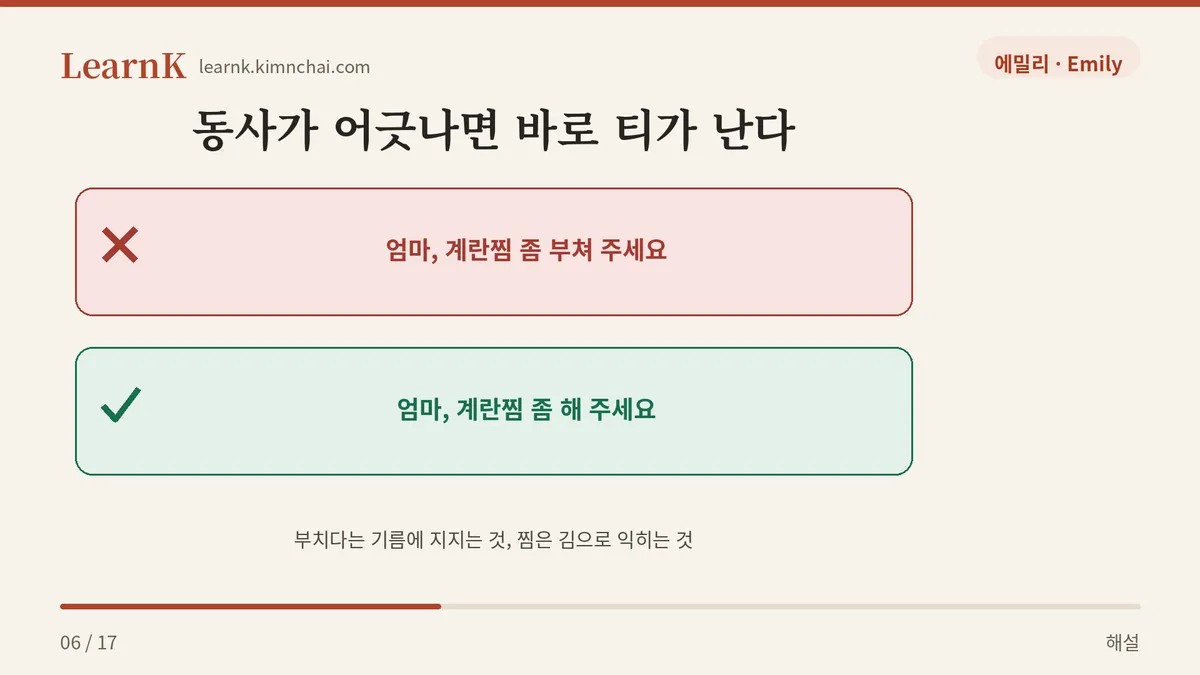
✗ 엄마, 오늘 저녁에 계란찜 좀 부쳐 주세요. ✓ 엄마, 오늘 저녁에 계란찜 좀 해 주세요. → 부치다 (buchida) means to pan-fry something in oil. 찜 (jjim) is cooking by steam, so it only goes with 하다, 만들다, and 찌다. The cooking method is already inside the name, so a mismatched verb stands out immediately.
✗ (At a barbecue place, expecting a soft egg dish) 여기 계란말이 하나 주세요. ✓ (At a barbecue place) 여기 계란찜 하나 주세요. → 계란말이 (gyeranmari) is thinly pan-fried egg rolled up; gyeranjjim is steamed and puffed. The names are similar enough that people mix them up often, but what arrives at your table is completely different.
Example sentences by situation
1. Ordering an extra dish at a restaurant The trick is to order it before the meat arrives. Use 존댓말 (jondaenmal), polite speech, with the server.
사장님, 계란찜 하나 추가할게요. (sajangnim, gyeranjjim hana chugahalgeyo.) Sir, we’ll add one gyeranjjim.
2. Asking for a side dish at home On an evening when there’s nothing decent for a side dish, this is the easiest request to reach for.
반찬 없으면 계란찜이라도 하나 할까? (banchan eopseumyeon gyeranjjimirado hana halkka?) If there’s no side dish, should I at least make a gyeranjjim?
3. Talking about cooking tips Since water quantity and timing are the keys, advice like this gets passed around a lot.
계란찜은 물을 조금 넉넉히 넣어야 부드러워요. (gyeranjjimeun mureul jogeum neokneokhi neoeoya budeureowoyo.) For gyeranjjim, you need to add a bit more water to make it soft.
Polite and casual speech, and similar expressions
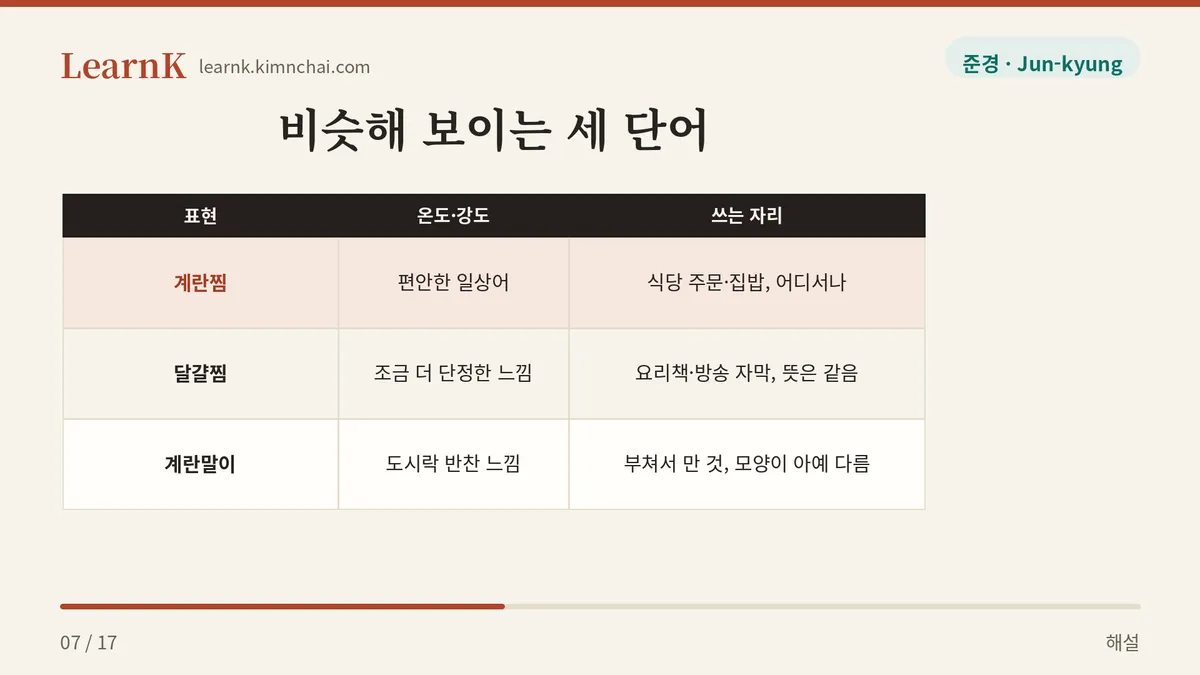
Leave the word 계란찜 as it is and just change the sentence ending, and it fits whatever setting you’re in. At a restaurant it becomes 계란찜 하나 주세요 (gyeranjjim hana juseyo); with a friend it becomes 야, 계란찜 시키자 (ya, gyeranjjim sikija). Below are neighboring words that are easy to confuse.
| Expression | Tone & intensity | Where it’s used |
|---|---|---|
| 계란찜 (gyeranjjim) | Comfortable, everyday | Restaurant orders and home cooking. Anywhere |
| 달걀찜 (dalgyaljjim) | Same dish, a slightly tidier feel | Cookbooks, TV subtitles. No difference in meaning |
| 계란말이 (gyeranmari) | A lunchbox / side-dish feel | Pan-fried and rolled. A completely different shape |
| 계란 프라이 (gyeran peurai) | The simplest, most hurried feel | Breakfast alone, or on top of ramyeon |
Cultural background — between the earthenware pot and the dinner table
The 계란 (gyeran) in gyeranjjim is a Sino-Korean word, made of 鷄 (chicken) and 卵 (egg), and the native Korean word for the same thing is 달걀 (dalgyal). Both are standard, so saying 달걀찜 (dalgyaljjim) isn’t wrong either. The 찜 (jjim) at the end comes from 찌다 (jjida), so the name itself amounts to an explanation: steamed chicken eggs. That plainness — a name that consists of nothing but ingredient and cooking method — suits the character of the dish well.
At Korean restaurants, gyeranjjim is usually cheap or comes free with the meal. The version served in an earthenware pot at a barbecue place is made by pouring in plenty of water and putting it over high heat so it puffs up, foam and all. Because of the way it rises above the rim of the bowl, first-timers reach for their cameras before their spoons. The homemade version, on the other hand, is quiet. You set a bowl inside a pot and steam it in a water bath, or run it in the microwave for a few minutes, and that’s it — which is why it’s the first name that comes to mind on a day with no side dishes.
In dramas, too, this dish always occupies a similar spot. Not a lavish spread, but a meal left out for a family member who came home late, or the cramped kitchen of a student living alone. It’s no accident that living alone and grandmothers both show up in the dictionary’s example sentences. Gyeranjjim isn’t a dish you’re served in honor — it’s a dish that means someone is looking after you. That’s why, for Korean learners, this word isn’t just one more menu item, but a small gauge for measuring the warmth of a Korean table.
Today’s quiz
A friend has come over and there are no side dishes. You want to steam some eggs and make one for them. Which sentence is the most natural?
- 반찬이 없네. 계란찜 하나 부쳐 줄게.
- 반찬이 없네. 계란찜 하나 해 줄게.
- 반찬이 없네. 계란찜 하나 튀겨 줄게.
The answer is 2. Gyeranjjim goes with 하다, 만들다, and 찌다. The 부치다 in 1 is the verb for gyeranmari or savory pancakes, and the 튀기다 in 3 means cooking in oil — the opposite direction from steaming. Just remember that the cooking method is already contained in the name and you won’t go wrong.
Definitions and example sentences are from the National Institute of Korean Language’s Basic Korean Dictionary (krdict.korean.go.kr); that portion of this post, including our translations, is licensed under CC BY-SA 2.0 KR.