계산해 주세요 (gyesanhae juseyo) — The Phrase You'll Use at Least Once a Day in a Korean Restaurant
계산해 주세요
계산해 주세요 (gyesanhae juseyo) is what you say to a server or shop clerk to ask, “I’m ready to pay now, so please add up what I owe.” If you’ve ever eaten out in Korea, this is a sentence you hear or say at least once a day. It’s one of the first expressions a Korean learner memorizes in week one — and one you’ll still be using daily after fifteen years in the country. Standing up full and happy at a barbecue place, pulling out your wallet after ordering coffee at a café, getting up from the chair after your haircut is done — the settings differ, but the words are the same.
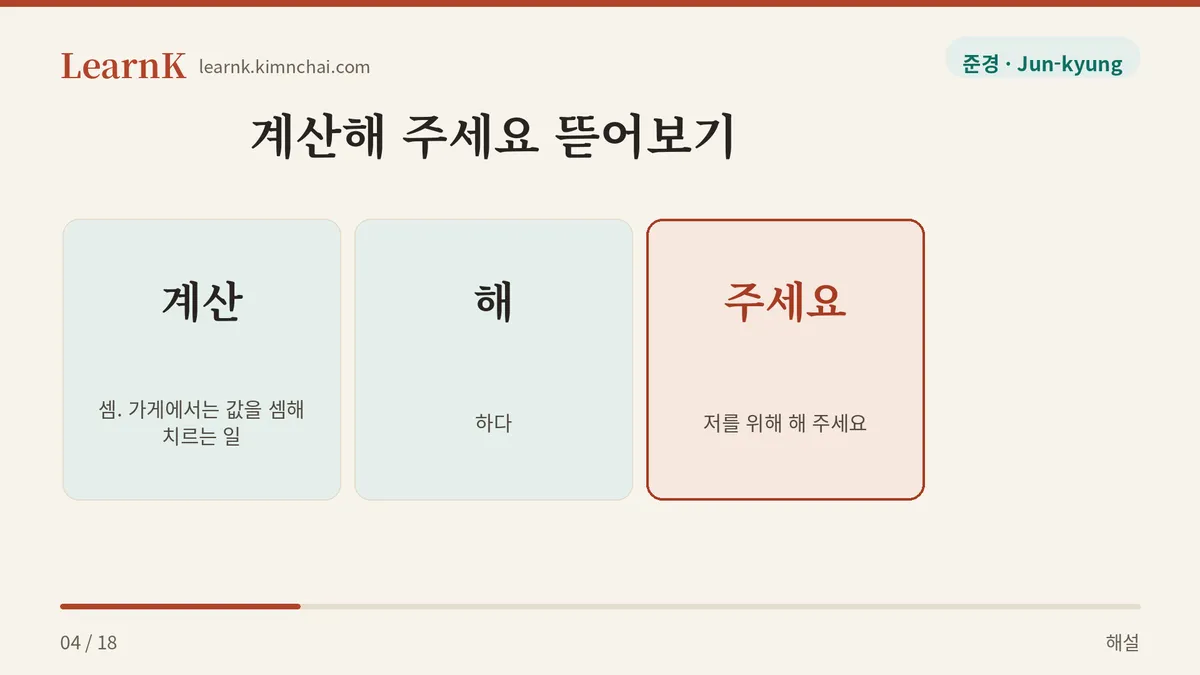
계산 (計算, gyesan) is a Sino-Korean word that originally means “calculation, doing the math.” In a shop, though, the meaning goes one step further and has hardened into “to add up and settle the price of what you ate or bought.” Attach -아/어 주세요 (-a/eo juseyo), the ending used to make a request, and literally you get “please do the math” — but what actually passes between the two of you is “the check, please” and “I’ll pay now” bundled into a single phrase. That’s why these few words also carry the signal, “We’ve finished eating, we’re getting up now.” Say it in a Korean restaurant and the staff won’t just tell you the total — they’ll start getting ready to clear the table.
The temperature is polite, but not especially formal. It isn’t rude to use with a clerk you’ve never met, and it isn’t stiff to use at a place you go to every week — it’s the safest basic form there is. If you want to be a bit more deferential, say 계산 부탁드립니다 (gyesan butakdeurimnida); if you’re in a noisy restaurant calling the owner from across the room, shorten it to 여기 계산이요 (yeogi gyesaniyo). Remember one thing in advance, though. This phrase is for the people who work at the shop, and no one else. Use it on someone you just ate with and the meaning flips completely — we’ll come back to that below.
See It in a Real Conversation
Situation: A neighborhood samgyeopsal place on a Friday night. They’re about to get up after finishing the meal, when both of them reach for their wallets at the same time.
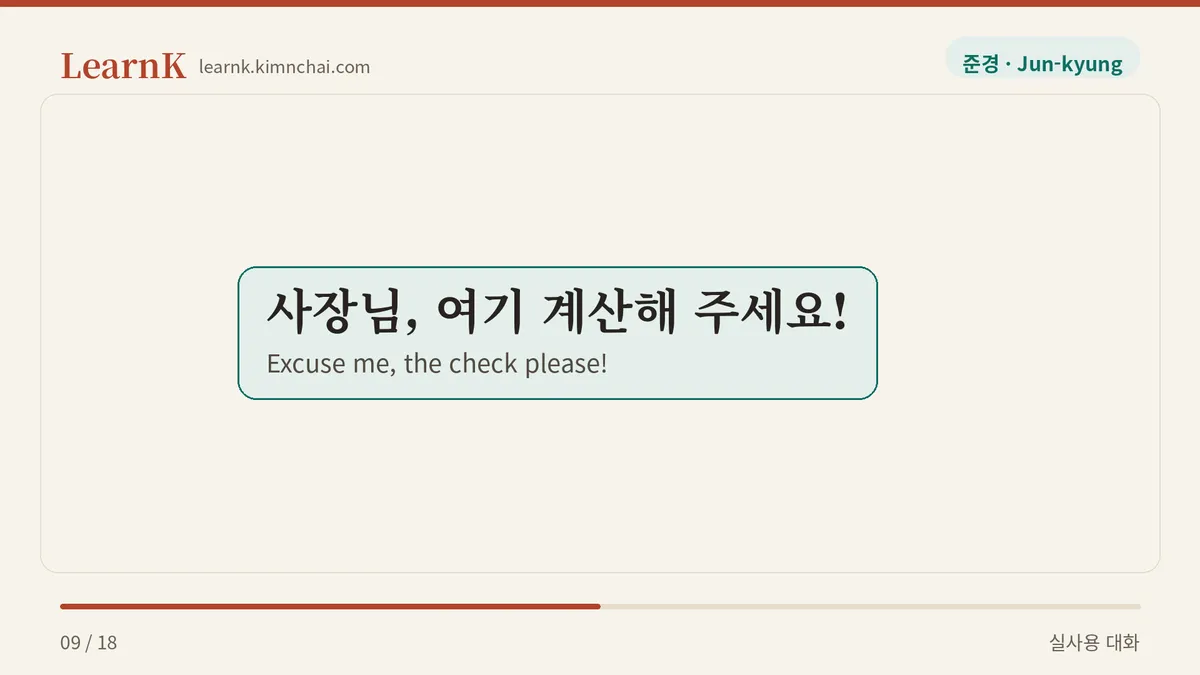
Jun-kyung: (손 들며) 사장님, 여기 계산해 주세요! (raising his hand) Excuse me, the check please!
Emily: 야, 왜 네 맘대로 불러. 오늘 내가 산다고 했잖아. Hey, why are you calling them on your own? I said I’m buying today.
Jun-kyung: 지난달 냉면집도 네가 냈어. 오늘은 그냥 얻어먹어. You paid at the naengmyeon place last month too. Just let me get it today.
Emily: 아, 됐고. 사장님, 따로 계산해 주세요! 카드 두 장이요. Nope, forget it. Excuse me, please ring us up separately! Two cards.
Jun-kyung: 야, 진짜 너 못 이기겠다. Man, I really can’t win against you.
Emily: 대신 커피는 네가 사. 콜? Then coffee’s on you. Deal?
Where It Sounds Off
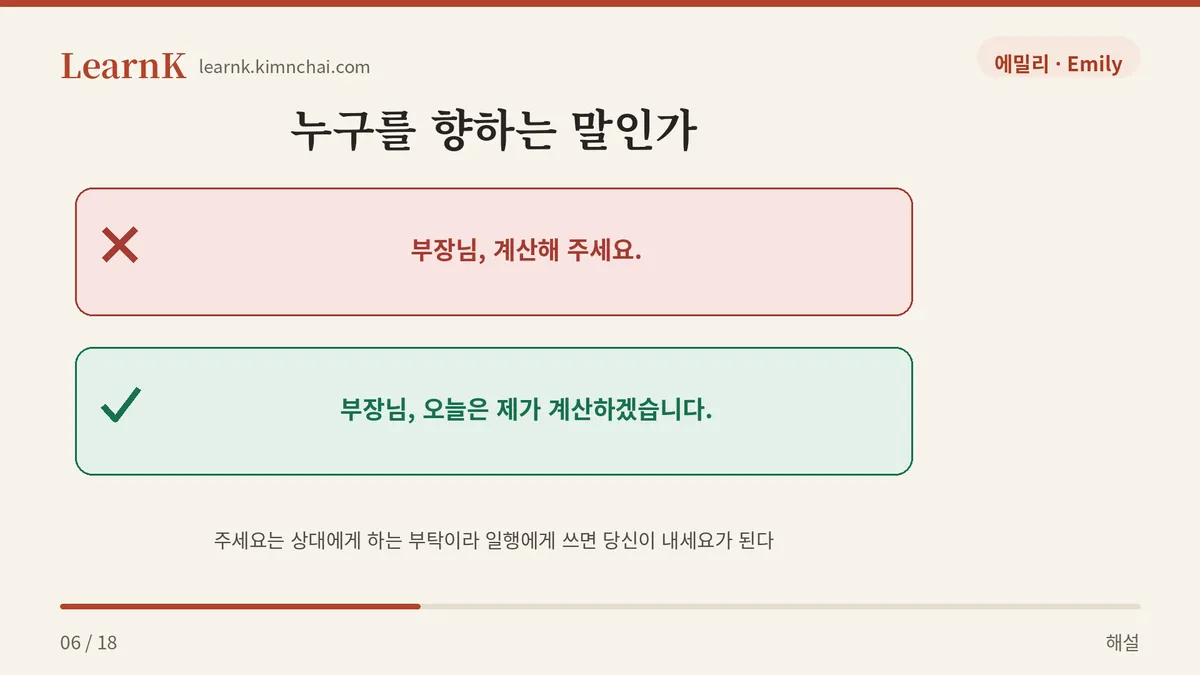
✗ (at the register, to your department head) 부장님, 계산해 주세요. ✓ (to the clerk) 여기 계산해 주세요. / (to your department head) 부장님, 오늘은 제가 계산하겠습니다. → -아/어 주세요 is a request asking the other person to perform the action. So if you use it on someone who ate with you, it turns into “You pay.” A request to settle the bill is always aimed at the people working there.
✗ (after eating a meal a friend cooked for you at home) 잘 먹었어. 계산할게. ✓ 잘 먹었어. 다음엔 내가 살게. → 계산 (gyesan) belongs only where a price has been set. Put a price tag on a home-cooked meal and gratitude turns into a transaction — unless it’s clearly a joke, it comes across as cold.
Example Sentences by Situation
① Paying separately at the café counter You’ve gone out for coffee with a coworker and agreed to pay for your own. After ordering, you hold out your card and say:
따로 계산해 주세요. (Ttaro gyesanhae juseyo.) — Please ring us up separately. When one person is covering it all instead, you say 같이 계산해 주세요 (gachi gyesanhae juseyo). These two sentences fly back and forth hundreds of times a day in Korean cafés and restaurants.
② Calling out while still seated The barbecue place is loud and the server hasn’t looked your way. You raise a hand and call out, short:
저기요, 여기 계산이요! (Jeogiyo, yeogi gyesaniyo!) This is the form where you cut the sentence off at “계산이요” instead of finishing it. It isn’t rude — it’s a practical shortening for places where the distance is long and the room is loud. Standing at a quiet café counter, you wouldn’t clip it this far; you’d say “계산해 주세요.”
③ Stepping up to pay at the end of a work dinner The team dinner is over and everyone is gathering their coats, but tonight it’s on you. Here it’s not a request but a declaration, so the ending changes.
오늘은 제가 계산하겠습니다. (Oneureun jega gyesanhagetseumnida.) Among friends, it’s 오늘은 내가 계산할게 (oneureun naega gyesanhalge). Same word, but -해 주세요 points at the other person, while -할게요 / -하겠습니다 points at you.
Polite vs. Casual, and Related Expressions
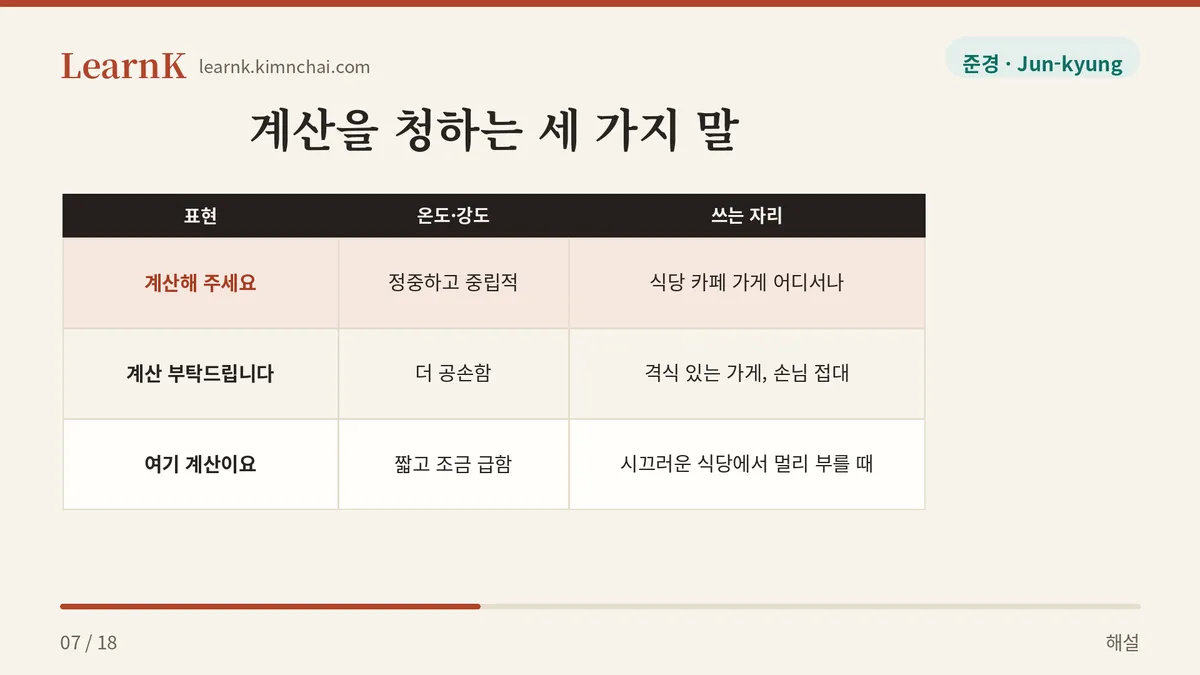
| Expression | Temperature & Force | Where It’s Used |
|---|---|---|
| 계산해 주세요 (gyesanhae juseyo) | Polite and neutral | The basic form, good in any restaurant, café, or shop |
| 계산 부탁드립니다 (gyesan butakdeurimnida) | More deferential, more careful | Formal establishments, or when you’re hosting guests |
| 여기 계산이요 (yeogi gyesaniyo) | Short, casual, slightly hurried | Calling from a distance in a noisy restaurant |
| 계산할게요 (gyesanhalgeyo) | A declaration that you’re paying | When you’re the one settling up — works in front of the clerk or your companions |
| 얼마예요? (eolmayeyo) | Neutral, just asking the price | When you don’t know the price. Not a request to settle the bill |
| 결제해 주세요 (gyeoljehae juseyo) | Businesslike and stiff | Card counters and online checkouts. Sounds odd at a restaurant |
In casual speech among peers, you’d say things like “계산하자” or “계산 좀 하고 가자.” But that’s language between the people in your own party — no matter how much of a regular you are, you don’t use casual speech with the staff. In Korea, the default between customer and clerk is polite speech in both directions, regardless of age.
Cultural Background — The Standoff at the Register
In Korean restaurants, paying usually happens not at the table but at the register by the door. Plenty of places leave the slip face-down on your table and you carry it up on your way out. So “계산해 주세요” is both a phrase you call out with a raised hand from your seat, and a phrase you say while pulling out your wallet at the counter.
That spot in front of the register is also a place Korean dramas love. Two people shoving their cards at the clerk, going “I’m paying,” “No, I’m paying,” until one of them sneaks off and pays first — it shows up so often you can picture the scene without anyone quoting a line. That’s because for a long time in Korea, the natural pattern was for one person to cover the whole bill and someone else to cover the next one. Instead of splitting that day’s cost, you split the relationship across a longer stretch of time. These days going Dutch (각자내기 / 더치페이) is spreading fast, and “따로 계산해 주세요” has become the more common line — but where there’s an age gap, or where someone is treating a guest, the current where the elder or the person who did the inviting pays is still very much there.
So using this expression well isn’t a matter of memorizing a sentence. Who you aim it at and when you bring it out says everything about where you stand at that table. If you’re the one being treated, “잘 먹었습니다” comes first; if you’re the one doing the treating, the Korean way is to quietly walk to the register before the other person can reach for their wallet.
Today’s Quiz
A senior colleague has offered to buy you a meal, so you’ve come to a restaurant together. You’ve finished eating and you’re standing at the register. What’s the most natural thing to say to them?
- 선배님, 계산해 주세요.
- 선배님, 잘 먹었습니다. 다음엔 제가 살게요.
- 선배님, 여기 계산이요.
Answer: 2
Both 1 and 3 are ways of asking shop staff to settle the bill, so directed at the senior colleague who just ate with you, they land as “You pay” — a nudge to hurry up and cough up. When you’re the one being treated, saying thank you first and promising the next round is the most natural way to close things out in Korea. “계산해 주세요” only lands the way you mean it when it’s aimed across the counter.