~해 주시겠어요? — The Temperature at Which a Request Lands: Korean's Most Careful Way to Ask
~해 주시겠어요?
~해 주시겠어요? (~hae jusigesseoyo?) means making a request by first asking about the other person’s willingness — “would you be willing to do that for me?” — and it is the most careful, most deferential way to ask for something in Korean. The first request expression most Korean learners memorize is usually ~해 주세요 (~hae juseyo). There’s nothing wrong with it. But if it’s the only one you ever use, sooner or later you’ll run into a strange moment: you were clearly being polite, and yet the other person’s face stiffens, just slightly.
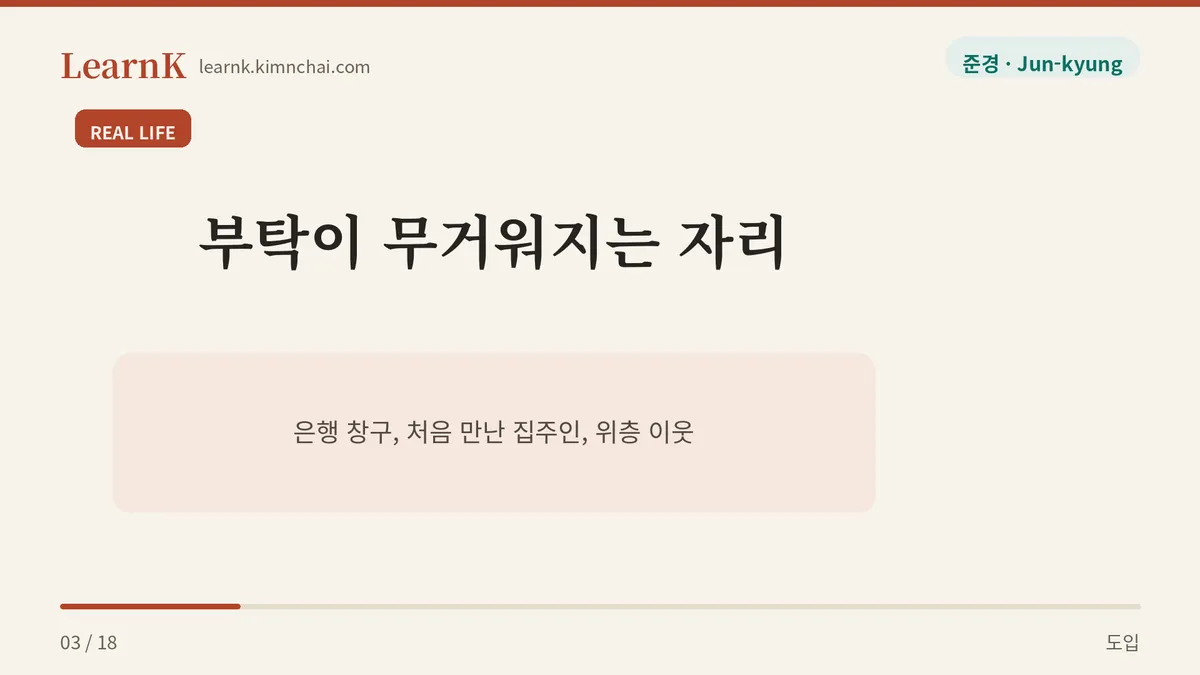
A bank counter, the civil affairs desk at a district office, a landlord you’re meeting for the first time, a phone call with your child’s homeroom teacher, asking a delivery driver to leave the package by the door — anywhere the weight of a request gets even a little heavier, Koreans quietly swap ~해 주세요 for ~해 주시겠어요?. The difference is exactly one thing. The first one delivers my need; the second one hands the decision over to the other person. In Korean, politeness is often decided less by how many honorific words you know than by how much room you leave the other person to say “no.”
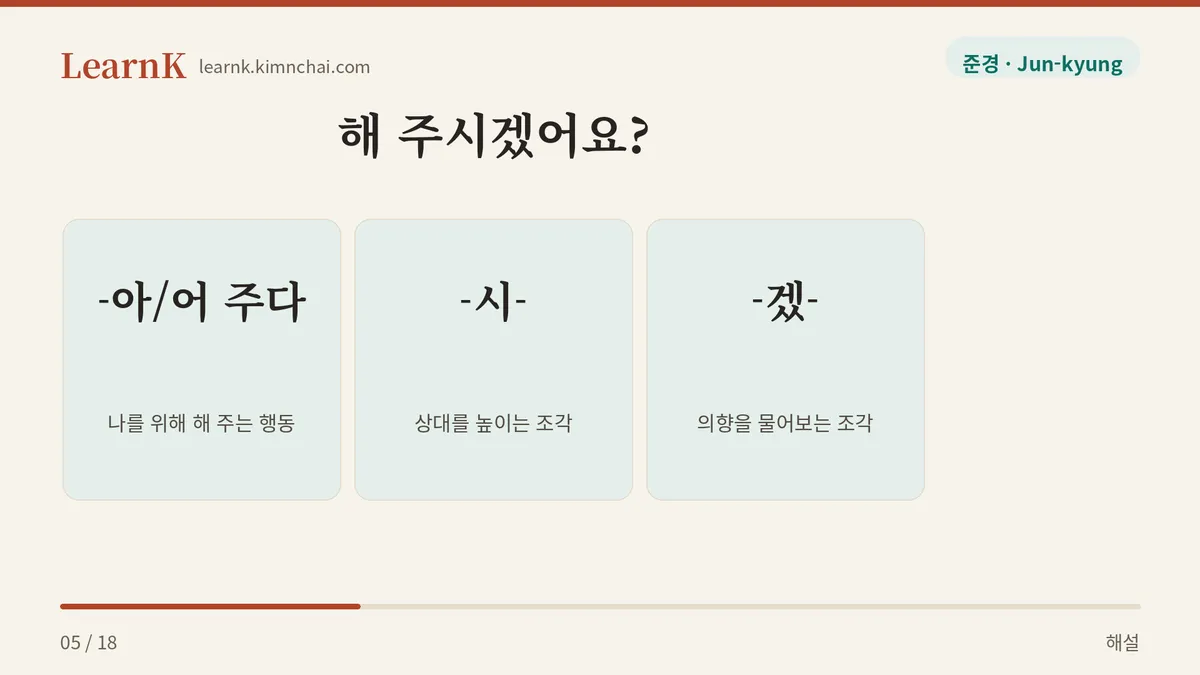
This expression is four pieces layered on top of each other. First, -아/어 주다 (-a/eo juda) attaches, marking the action as something done for me. On top of that sits -시- (-si-), which elevates the listener. Then -겠- (-gess-) is added, gently asking about their intention. Finally, the sentence closes not with a command but with the question ending -어요? (-eoyo?). So a literal rendering comes out close to “would you have it in you to do that for me?” The content of the request hasn’t changed at all, but the structure of the sentence itself seats the other person in the decision-maker’s chair.
Koreans often put 혹시 (hoksi) in front of it. 혹시 창문 좀 닫아 주시겠어요? (hoksi changmun jom dada jusigesseoyo?) — 혹시 creates a little breathing room that means “or never mind,” so the bigger the burden of the request, the more often it shows up alongside. In writing or in formal settings, it climbs one more step to ~해 주시겠습니까? (~hae jusigesseumnikka?).
See It in a Real Conversation
Scene: Saturday afternoon, in front of the main gate of an apartment complex — the meeting spot for a secondhand sale. Emily has come to pick up the chair she bought, but the seller hasn’t come out yet. Jun-kyung drove over with her.
Emily (on the phone): 안녕하세요, 의자 사러 온 사람인데요. 혹시 몇 동 앞으로 가면 되는지 알려 주시겠어요? Hi, I’m the one who came to buy the chair. Could you please tell me which building to go to?
Jun-kyung: 야, 너 전화 예절 진짜 한국 사람 다 됐다. Wow, your phone manners are totally Korean now.
Emily: 이거 쓰면 사람들이 갑자기 친절해져. 신기해, 진짜. When I use this, people suddenly get nice. It’s honestly amazing.
Jun-kyung: 맞아. 그냥 ‘어디예요?’ 하면 좀 따지는 것처럼 들리거든. Right. If you just say “Where are you?” it can sound like you’re complaining.
Emily: 아 참, 이따 짐 내릴 때 너도 좀 도와 주시겠어요? Oh right, would you please help me unload it later?
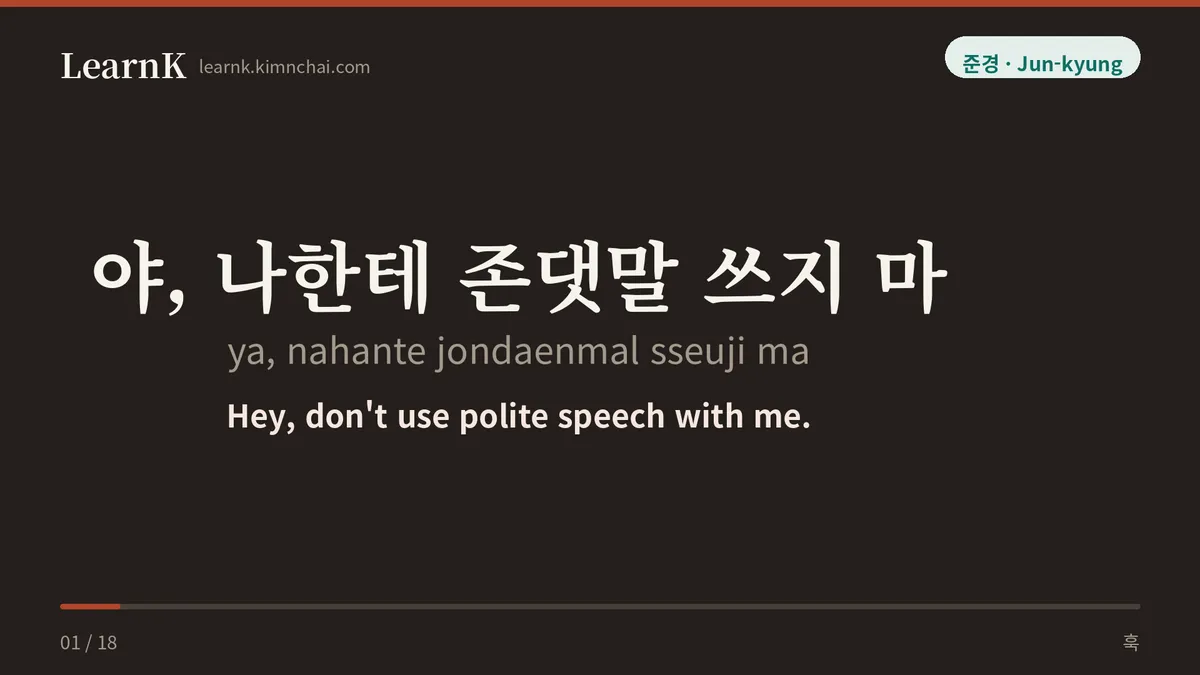
Jun-kyung: 야, 나한테 존댓말 쓰지 마. 그거 완전 놀리는 거잖아. Hey, don’t use polite speech with me. That’s straight-up teasing.
This Is Where It Sounds Off
✗ (to a friend of ten years) 야, 물 좀 갖다 주시겠어요? (ya, mul jom gatda jusigesseoyo?) ✓ (to a friend of ten years) 야, 물 좀 갖다줘. (ya, mul jom gatdajwo.) → The grammar is flawless. The problem is the temperature. When this expression suddenly pops out between two people who speak casually to each other, a Korean will hear it one of two ways: either you’re angry and deliberately putting distance between you, or you’re teasing. That is exactly why Jun-kyung bristled in the conversation above.
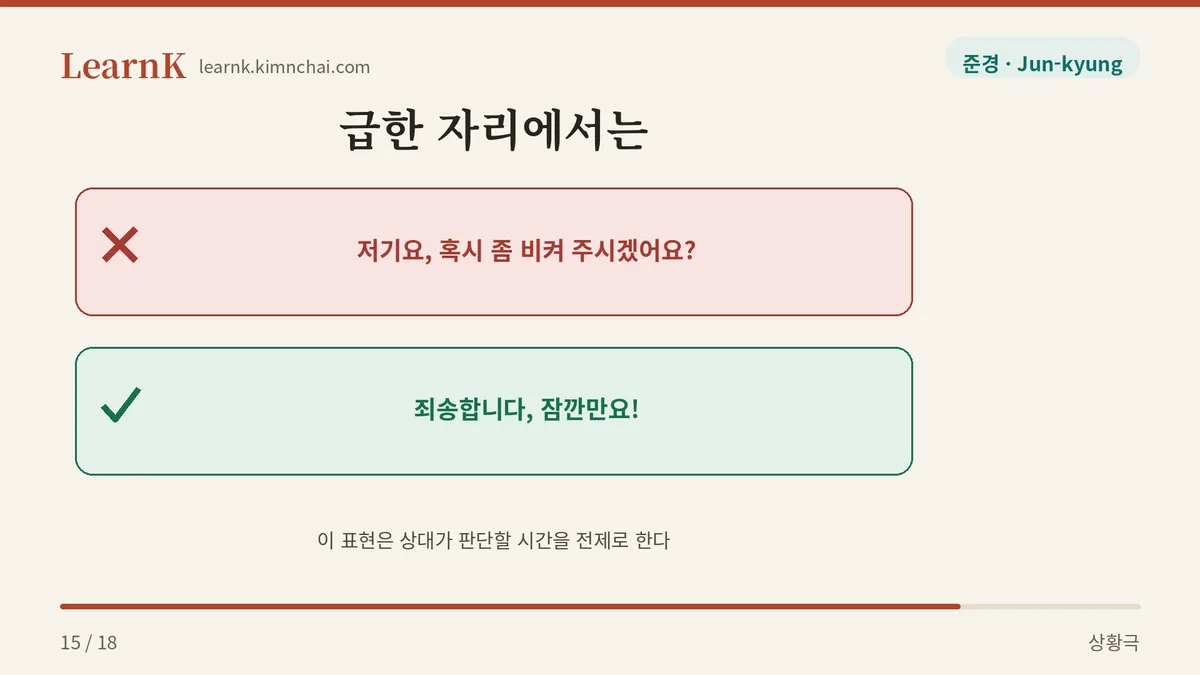
✗ (right before the subway doors close, when you need to get off and the way is blocked) 저기요, 혹시 좀 비켜 주시겠어요? (jeogiyo, hoksi jom bikyeo jusigesseoyo?) ✓ (same situation) 죄송합니다, 잠깐만요! (joesonghamnida, jamkkanmanyo!) → This expression assumes the other person has time to think and decide. In a spot where someone has to move within three seconds, that leisurely space actually gets in the way. When they’re in a hurry, Koreans compress politeness not into length but into a single 죄송합니다 (joesonghamnida).
Example Sentences by Situation
① At the hair salon, asking for one more small adjustment after the cut is already finished
저, 앞머리만 조금 더 짧게 잘라 주시겠어요? jeo, apmeorimman jogeum deo jjalpge jalla jusigesseoyo?
The hair salon is one of the places this expression gets used most. You’re asking someone to redo work that’s already finished, which means asking for extra labor — and 잘라 주세요 (jalla juseyo) turns it into a demand, while 잘라 주시겠어요? (jalla jusigesseoyo?) turns it into a request. The 저 (jeo) at the front is a meaningless sound of hesitation, but in Korean that hesitation itself reads as courtesy.
② At a government office or bank, asking someone to double-check a document
죄송한데, 이 부분 한 번만 다시 확인해 주시겠어요? joesonghande, i bubun han beonman dasi hwaginhae jusigesseoyo?
This is a situation where the mistake may well be theirs. Here, 다시 확인해 주세요 (dasi hwaginhae juseyo) slips easily into the nuance of “you got it wrong, so fix it.” Opening it up as a question turns the sentence into asking for help rather than pointing out a fault, so the person on the other side of the counter doesn’t stiffen up defensively. 한 번만 (han beonman) comes along as a signal meaning “just this once, so please don’t feel put upon.”
③ Asking an upstairs neighbor about noise at night
혹시 밤 열한 시 이후에만 조금 조용히 해 주시겠어요? hoksi bam yeolhan si ihue man jogeum joyonghi hae jusigesseoyo?
In Korean apartments, noise between floors is the point where a neighborly relationship can collapse in an instant. One turn of phrase here can decide the next several years. If it sounds like a demand, the other person goes straight into defense; but if you shape it as a request and even narrow it down to a specific hour, what usually comes back first is an apology. This is where the expression earns its keep more than anywhere else.
Similar Expressions Across 존댓말 (jondaenmal) and 반말 (banmal)
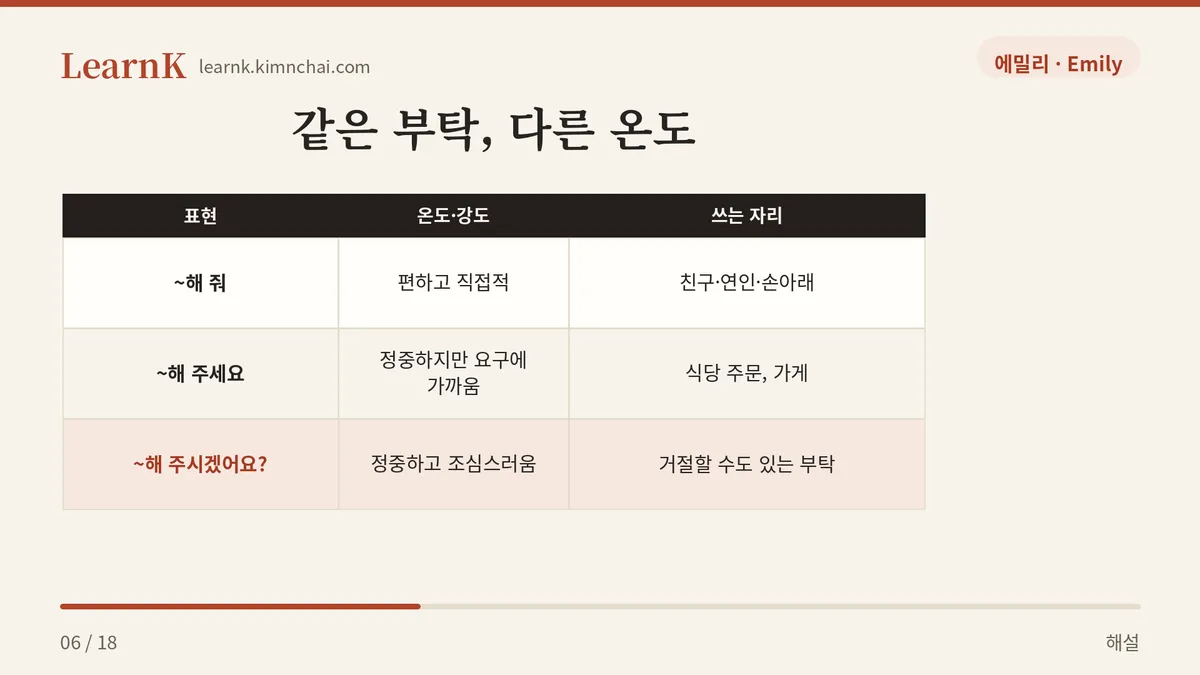
| Expression | Temperature / Force | Where It’s Used |
|---|---|---|
| ~해 줘 (~hae jwo) | Casual and direct | Friends, partners, people younger than you. Never with someone above you |
| ~해 주세요 (~hae juseyo) | Polite, but close to a demand | Ordering at a restaurant, in shops, requesting a service that’s already agreed on |
| ~해 주시겠어요? (~hae jusigesseoyo?) | Polite and careful | Requests the other person could refuse. People you’re meeting for the first time |
| ~해 주실 수 있나요? (~hae jusil su innayo?) | Polite + checking feasibility | Requests that hinge on time or ability. Coordinating schedules |
| ~해 주시면 감사하겠습니다 (~hae jusimyeon gamsahagetseumnida) | The most formal and weighty | Email, official documents, a boss or a business client |
For the same request, the further down the table you go, the easier it becomes for the other person to say “no.” The principle running through this table is that the more room there is for refusal, the more polite it is. That said, further down isn’t automatically better. If you use the bottom expression to ask a café to hold the ice, it’s so heavy that it comes out awkward instead.
Cultural Background — the Habit of Turning Requests into Questions
Korean has developed an unusually rich set of devices for softening a request by turning it into a question, and -겠- (-gess-) sits at the center of them. This piece originally expresses conjecture or intention, but dropped into a request, it converts the flat assertion of “do this for me” into the question “would you be inclined to do this for me?” The reason -겠- feels hard to Korean learners isn’t that its meaning is complicated — it’s that this little piece carries attitude rather than meaning.
If you watch closely for where this expression shows up in Korean dramas, an interesting rule emerges. There’s almost never a scene where the lead uses it with the person they love. Instead, it comes out toward strangers, or toward someone the character has fallen out with. That’s exactly why a long-together couple suddenly making requests of each other in polite speech after a fight is such a staple of Korean drama direction. The line itself is courteous, yet the viewer instantly registers that the relationship has grown distant. Korean shows you, in a single sentence, that politeness is distance.
The same holds in real life. When a team leader at a company says to a team member, 이거 오늘까지 정리해 주시겠어요? (igeo oneulkkaji jeongnihae jusigesseoyo?), that is an instruction wearing the clothes of a request. Few people in a Korean workplace hear that sentence and actually refuse. The reason this form is used anyway is that handing over an order dressed as a favor is how both sides keep face. Here’s the sense learners need: this expression doesn’t always mean real choice is being offered — but even the gesture of offering a choice makes the relationship far smoother.
Today’s Quiz
The day after moving in, you go upstairs to introduce yourself. You want to bring up the footsteps you’ve been hearing late at night for several days now. This is someone you’ll have as a neighbor for years to come. What’s the most appropriate thing to say?
① 밤에 좀 조용히 해. (bame jom joyonghi hae.) ② 밤에는 조용히 해 주세요. (bameneun joyonghi hae juseyo.) ③ 혹시 밤 열한 시 이후에만 조금 조용히 해 주시겠어요? (hoksi bam yeolhan si ihue man jogeum joyonghi hae jusigesseoyo?)
Answer: ③
① is 반말 (banmal), so it’s out of the question with a neighbor you’re meeting for the first time. ② is grammatically polite, but it lands close to a demand, giving the impression that you’ve come to file a complaint at your very first meeting. ③ does three things at once: 혹시 lightens the burden, 열한 시 이후 (yeolhan si ihu) narrows the scope of what you’re asking for, and ~해 주시겠어요? hands the decision to the other person. The power of today’s expression isn’t in making your sentence longer — it’s in creating a space where the other person can comfortably answer “yes.”
Definitions and example sentences are from the National Institute of Korean Language’s Basic Korean Dictionary (krdict.korean.go.kr); that portion of this post, including our translations, is licensed under CC BY-SA 2.0 KR.