훈훈하다 (hunhunhada) — Why Korean Calls the Warmth of a Room and the Warmth of a Heart by the Same Name
훈훈하다
On a winter evening, there’s that moment when you step through someone else’s front door and your glasses instantly fog up white. 훈훈하다 (hunhunhada) means warm in just the right, easy-to-bear way — and, one step further, having a warmth that gently melts the heart. When Koreans reach for this word, it’s usually in one of two places: a room they’ve just walked into from the cold outside, or the moment right after seeing someone’s small act of kindness.
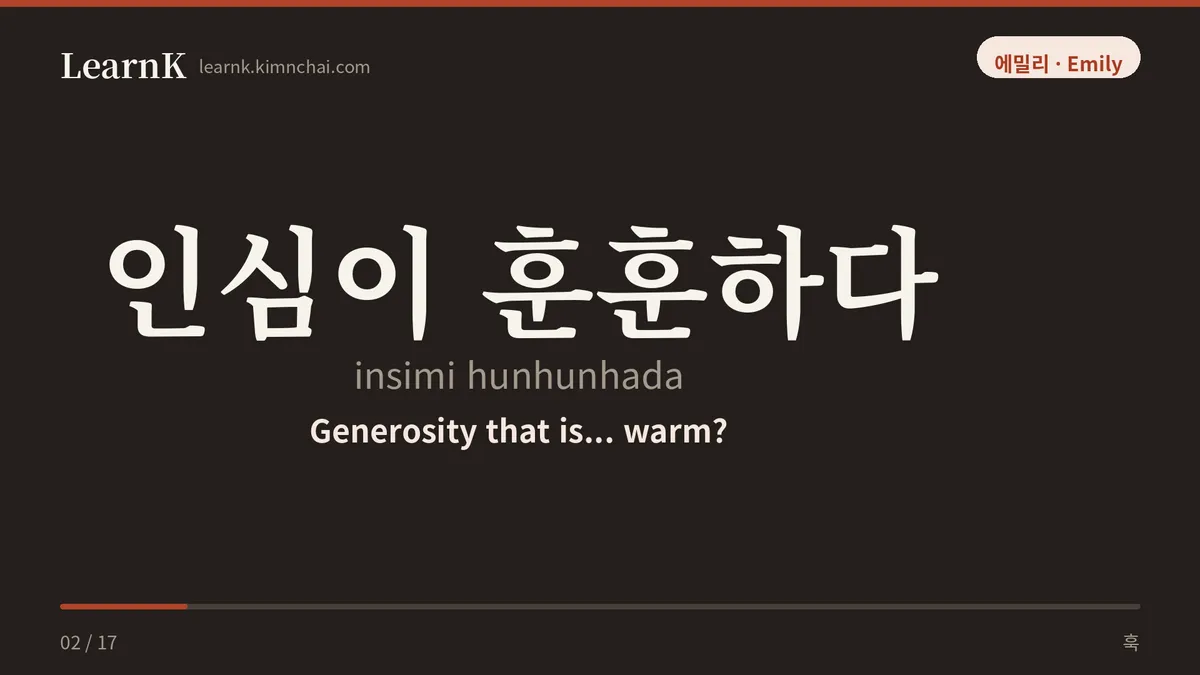
What’s interesting is that in Korean these two places run into each other without a break. A word for the temperature of a room gets used, unchanged, for the temperature of a person’s heart. That’s why even a learner hearing 인심이 훈훈하다 (insimi hunhunhada) for the first time can guess about half of what it means. People have an ideal temperature between them too, and this says that temperature came out just right.
When it’s about temperature, 훈훈하다 has a clear ceiling. A sauna isn’t 훈훈하다, it’s 뜨겁다 (tteugeopda); a midsummer afternoon isn’t 훈훈하다, it’s 덥다 (deopda). What 훈훈하다 points to is the temperature of “the spot the cold has just left.” So the word sticks well to winter, and to enclosed spaces — a room, an interior, the inside of a car left idling: places where the air sits still.
When it’s about the heart, the intensity is low as well. The kind of feeling that makes tears spill over belongs to 뭉클하다 (mungkeulhada). 훈훈하다 sits a notch below that: the corners of your mouth quietly lift, and the feeling lingers for a while afterward. And it’s usually spoken from the seat of someone watching something happen to other people.
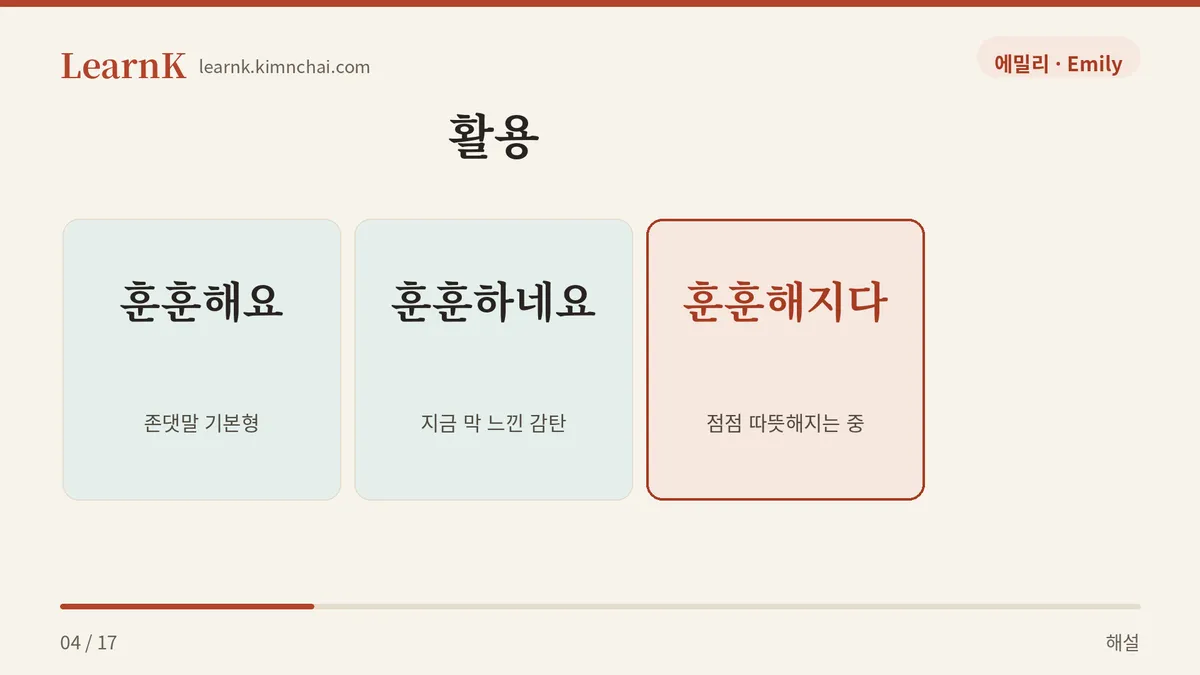
Since it’s an adjective, it conjugates like this. Casual: 훈훈해 (hunhunhae). Polite: 훈훈해요 (hunhunhaeyo). Formal: 훈훈합니다 (hunhunhamnida). For something you’re struck by right this moment, 훈훈하네요 (hunhunhaneyo); for the past, 훈훈했다 (hunhunhaetda); and when the state is in the middle of changing, 훈훈해지다 (hunhunhaejida).
Checking It in the National Institute of Korean Language Dictionary
훈훈하다 〔adjective〕
- 날씨나 온도가 견디기 좋을 만큼 따뜻하다. (The weather or temperature is warm enough to be comfortable to bear.) [en] warm — The weather or temperature being bearably warm. [ja] ぽかぽかする — 気温や温度が丁度良く、暖かい。 [es] cálido — Dicho del clima o la temperatura, que está tolerablemente caliente. [zh] 暖和,暖烘烘 — 天气或温度达到让人舒适的温暖。
- 마음을 부드럽게 녹여 주는 따뜻함이 있다. (Having a warmth that softly melts the heart.) [en] warm; warm-hearted — Having warmth that softens the heart. [ja] なごやかだ【和やかだ】。ほのぼのする — 心暖まる温かみがある。 [es] caliente, de buen corazón — Que tiene una calidez que ablanda el corazón. [zh] 暖洋洋,温暖 — 有让人内心融化的暖暖的东西。
- 냄새가 서려 있다. (A smell hangs in the air.) [en] filled with; covered with — A smell filling the air, etc. [ja] ほのかににおう【ほのかに匂う】 — 匂いが漂うさま。 [es] impregnado de olor — Que está impregnado de algún olor. [zh] 散发出味道。 — National Institute of Korean Language, Basic Korean Dictionary (krdict.korean.go.kr)
The Portuguese definitions are not carried in the dictionary. What follows is not a dictionary quotation but our own translation: ① agradavelmente morno ② caloroso, de bom coração ③ impregnado de um cheiro.
Here are the actual usage examples listed in the dictionary.
향내가 훈훈하다. 인심이 훈훈하다. 심성이 훈훈하다. 집이 훈훈하다. 실내가 훈훈하다. 방이 훈훈하다. — National Institute of Korean Language, Basic Korean Dictionary (krdict.korean.go.kr)
Line these six up side by side and you can see the map of the word at a glance.
- 인심이 훈훈하다 (insimi hunhunhada) — This is what comes out when a vendor at the market throws in a little extra, or when the neighbors bring rice cakes around to a family that has just moved in. It describes the atmosphere of a whole neighborhood or a whole shop, not one person’s personality.
- 심성이 훈훈하다 (simseongi hunhunhada) — This one is about an individual’s innate grain of heart. It’s a judgment you make after knowing someone for a long time, so it isn’t really used about someone you’ve just met.
- 집이 훈훈하다 (jibi hunhunhada) — This is close to a greeting you make as you step into someone’s home in winter. It’s talk about temperature, but it also lands as “I see you’re doing well.”
- 실내가 훈훈하다 (sillaega hunhunhada) — Used for the air in public places: cafés, the subway, hospital waiting rooms. It also sounds natural in written language, like notices and news articles.
- 향내가 훈훈하다 (hyangnaega hunhunhada) — This is sense 3. It’s used for scenes where incense has soaked into a space, like a temple or a memorial-rite table, and these days you’ll see it in writing more than in everyday conversation. As a learner, it’s plenty to start with just senses 1 and 2.
See It in a Real Conversation
Situation: A December night, in front of an apartment complex. Emily has bought a used electric heater secondhand, and Jun-kyung has come out to help her carry it in.
Jun-kyung: 다 받았어? 판매자분 벌써 가셨네. Did you get everything? The seller already left.
Emily: 응, 근데 이거 봐. 리모컨이랑 여분 필터까지 챙겨 주셨어. Yeah, but look at this. She threw in the remote and a spare filter too.
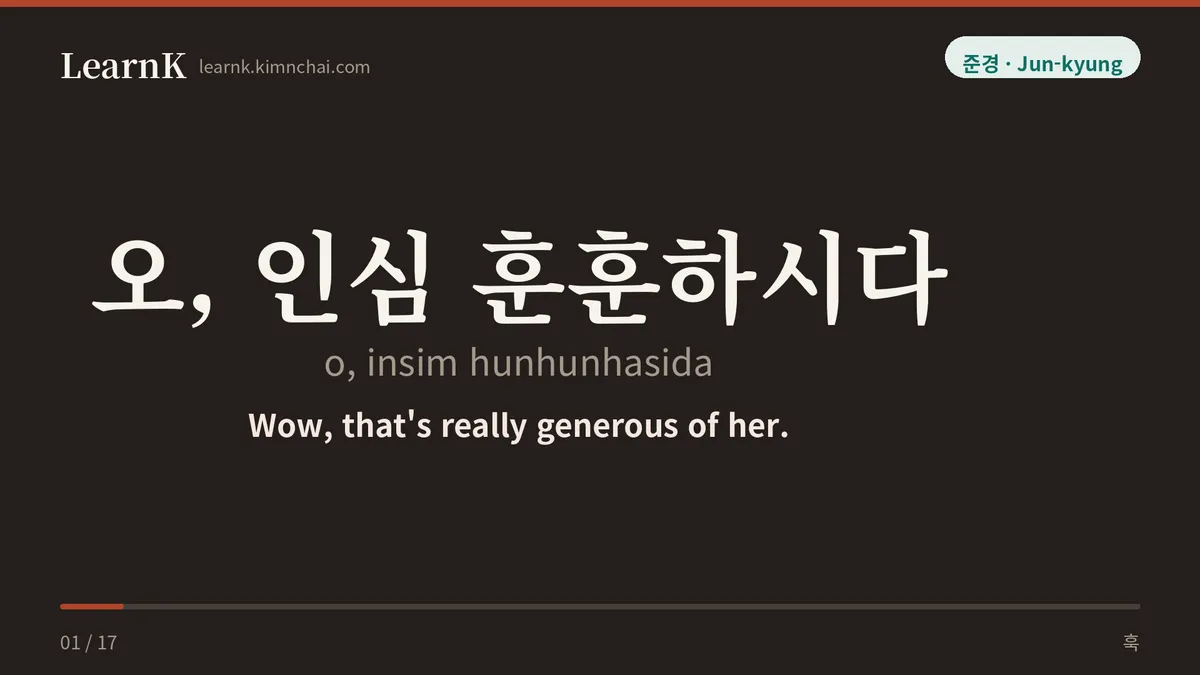
Jun-kyung: 오, 인심 훈훈하시다. 요즘 그런 분 잘 없는데. Wow, that’s really generous of her. You don’t meet people like that these days.
Emily: 그치? 값도 오천 원 깎아 주시고, 조심히 가라고 세 번이나 말씀하셨어. Right? She knocked five thousand won off too, and told me three times to get home safe.
Jun-kyung: 야, 얼른 들어가자. 손 얼겠다. Hey, let’s hurry inside. My hands are freezing.
Emily: 이거 켜면 우리 집도 십 분이면 훈훈해질 거야. Once I turn this on, my place will be nice and warm in ten minutes.
This Is Where It Sounds Off
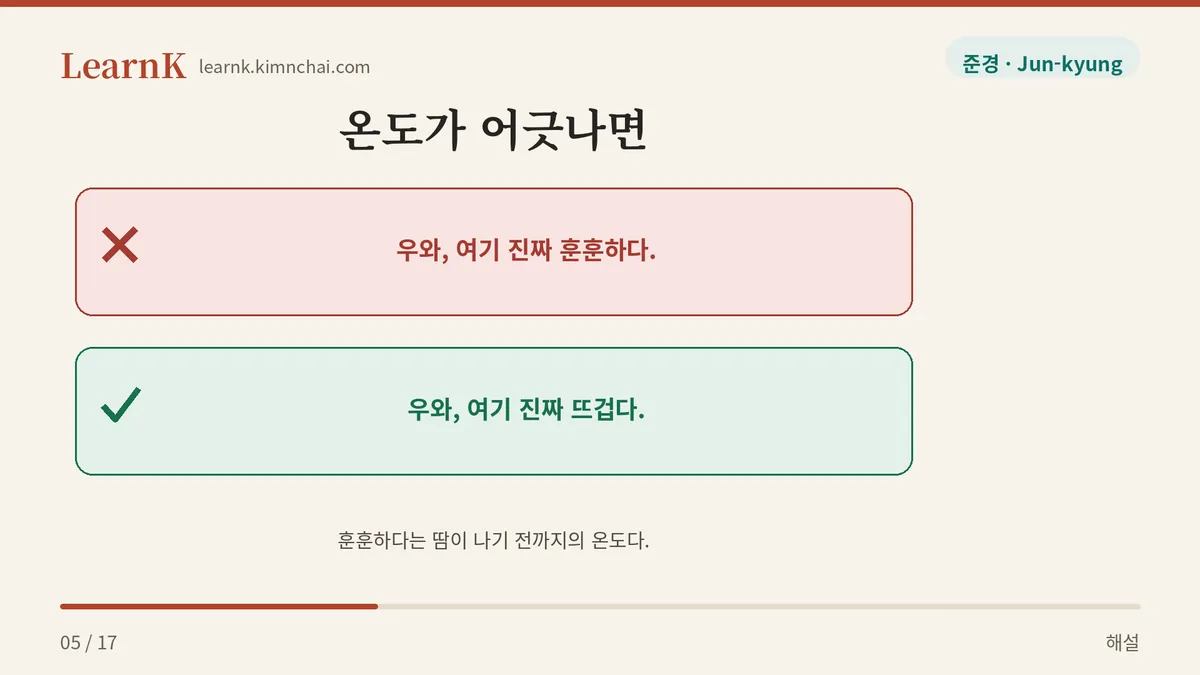
✗ (walking into a sauna) 우와, 여기 진짜 훈훈하다. ✓ (walking into a sauna) 우와, 여기 진짜 뜨겁다. → 훈훈하다 is the temperature of a place the cold has only just left. Use it somewhere hot enough to make you sweat and the temperature is off by too much, so your listener ends up wondering whether you’re joking.
✗ (talking about yourself) 제가 어제 할머니 짐을 들어 드렸거든요. 참 훈훈했죠? ✓ (talking about someone else) 어떤 학생이 할머니 짐을 들어 드리더라고요. 보는 내내 훈훈했어요. → 훈훈하다 is a word that comes from the observer’s seat. Attach it to your own good deed and it looks like you’re billing someone for a compliment, which makes the person listening uncomfortable.
Example Sentences by Situation
① At a holiday meal, watching Grandma keep putting side dishes on her grandson’s plate
할머니가 손주 밥 챙기시는 거 보니까 보기만 해도 훈훈하네요. (halmeoniga sonju bap chaenggisineun geo bonikka bogiman haedo hunhunhaneyo.) Watching Grandma keep filling her grandson’s plate — it warms you up just to see it.
Paired with “보기만 해도 (bogiman haedo),” sense 2 becomes unmistakable, because it signals that this isn’t something you went through yourself but something you watched from beside it.
② On a day that’s ten below, taking your coat off as you come into a café
밖은 영하 십 도인데 안은 훈훈하네요. 여기 앉아도 될까요? (bakkeun yeongha sip doinde aneun hunhunhaneyo. yeogi anjado doelkkayo?) It’s minus ten outside but it’s lovely and warm in here. May I sit here?
훈훈하다 comes most alive when you mention the temperature gap between outside and inside in the same breath. This word is a sensation born out of contrast in the first place.
③ Reading the comments on a news article and sending a friend the link
오랜만에 훈훈한 소식이라 아침부터 기분이 좋았어. (oraenmane hunhunhan sosigira achimbuteo gibuni joasseo.) It was the first heartwarming news in a while, so I’ve been in a good mood all morning.
훈훈한 소식 (hunhunhan sosik) is close to a set phrase. On the Korean internet, 훈훈 works almost like a tag for the good news that slips in between the accident-and-incident headlines.
Polite and Casual Forms, and Similar Expressions
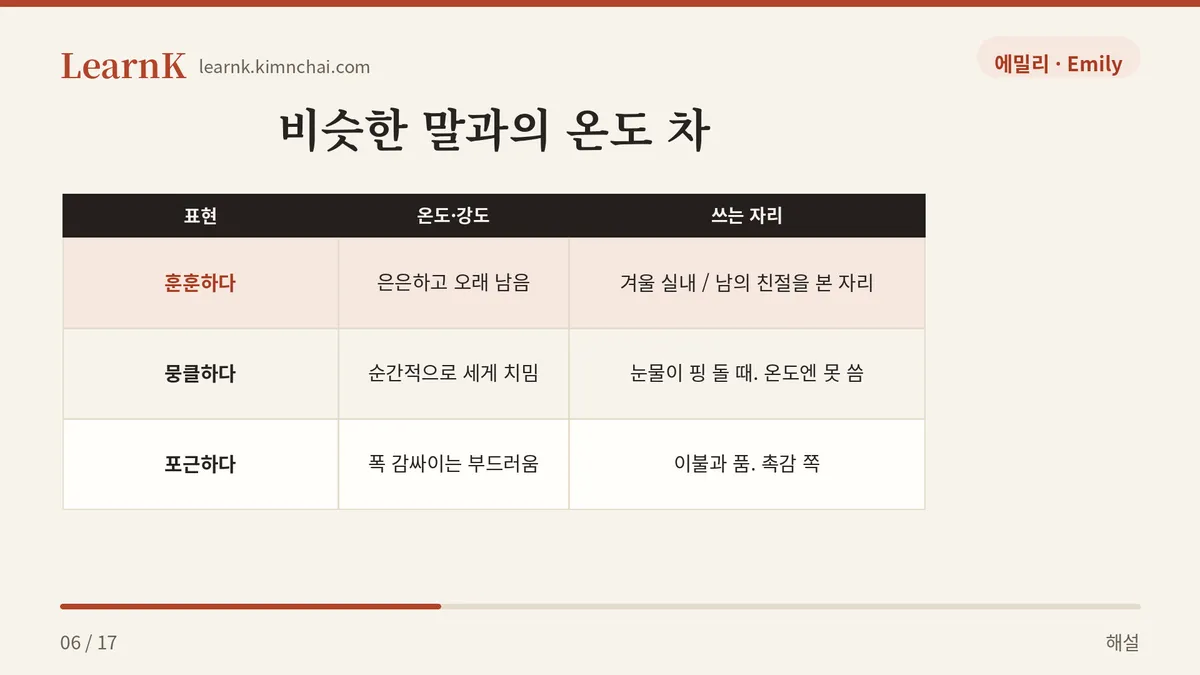
With a friend it’s “집 훈훈하다,” to someone older it’s “집이 훈훈하네요,” and in a presentation or a public notice it becomes “실내가 훈훈합니다.” When you’re speaking respectfully about a person’s heart, you slip in -시- as in 훈훈하시다 (hunhunhasida). The “인심 훈훈하시다” in the conversation above is exactly that case.
| Expression | Temperature / Intensity | Where it’s used |
|---|---|---|
| 훈훈하다 (hunhunhada) | Softly warm, and it lingers | Winter indoor air / having watched someone else’s kindness |
| 따뜻하다 (ttatteutada) | Neutral, with the widest range | Temperature, people, tone of voice — anywhere. The safe default |
| 포근하다 (pogeunhada) | The softness of being wrapped up | Blankets, arms, atmosphere. More about touch than about air |
| 뭉클하다 (mungkeulhada) | A feeling that surges up hard in an instant | When your chest tightens. Can’t be used for temperature |
| 흐뭇하다 (heumutada) | Contented satisfaction | Mostly when watching someone younger do well |
When you’re torn, the test is simple. If it’s the feel at your fingertips, it’s 포근하다. If your eyes prickle with tears, it’s 뭉클하다. If the person you’re fondly watching is younger than you, it’s 흐뭇하다. And if it’s somewhere in between, with the air quietly warming up, that’s 훈훈하다.
Cultural Background — Ondol Rooms and 훈남
Most Korean homes use floor heating. Instead of hot air pouring down from above, heat rises slowly from the floor and pools through the whole room. What 훈훈하다 pictures is exactly this state: a room where the air isn’t moving hard, just quietly warmed. That’s why in Korean this word is stuck closer to the 아랫목 (araetmok), the warmest spot on the heated floor, than to an air conditioner or a heater.
The internet word 훈남 (hunnam), which appeared in the 2000s, came out of here too. Short for 훈훈한 남자 (hunhunhan namja), “a warm guy,” it points less to someone dazzlingly handsome than to someone whose look puts you in a good mood. A word for the temperature of the heart spread all the way to impressions of appearance. That said, this usage is new slang, so it isn’t included in the definitions in the National Institute of Korean Language’s Basic Korean Dictionary. For exams or formal writing, it’s safer to stay with senses 1 and 2 as listed.
The places 훈훈하다 turns up in dramas are mostly set, too: the scene where a family that fought badly gathers back at the table without a word, or the one where a gruff character secretly helps out and slips away. Episodes like that get articles titled “훈훈한 엔딩 (hunhunhan ending)” the next day. In Korean, this word doesn’t take charge of the emotional peak — it takes charge of the afterglow once the peak has passed.
Today’s Quiz
Which of the following situations best suits 훈훈하다?
- An August afternoon, with heat rising off the asphalt.
- The convenience store owner gave an extra rice ball to a student studying late.
- Someone stepped on your foot on the subway and you didn’t even get an apology.
Show the answer
The answer is 2. It’s a situation where you watched a small kindness from beside it, so “인심이 훈훈하네요” is natural. For 1 it isn’t 훈훈하다 but 덥다 or 뜨겁다 that you need, and 3 is the exact opposite temperature, so the word can’t be used in any of its senses.
Definitions and example sentences are from the National Institute of Korean Language’s Basic Korean Dictionary (krdict.korean.go.kr); that portion of this post, including our translations, is licensed under CC BY-SA 2.0 KR.