훈남 (hunnam) — The Word That Praises Warmth Over Good Looks
훈남
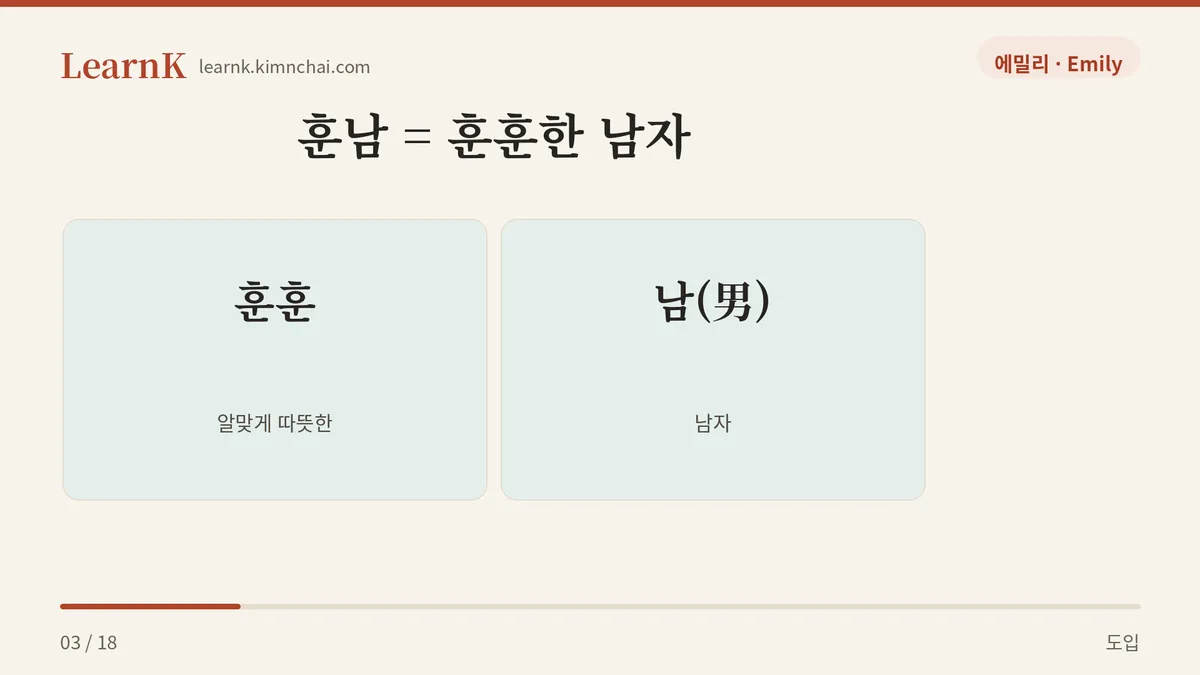
훈남 (hunnam) is short for 훈훈한 남자 (hunhunhan namja), and it describes a man whose features aren’t so much chiseled as they are warm — someone whose presence is so comfortable that just looking at him leaves you feeling a little warmer inside. If you’ve ever watched a Korean drama, you’ve probably seen the live comment feed flood with these two syllables the moment the male lead walks on screen. It’s usually the first line posted in a friend group chat the morning after a blind date, and it’s what comes out in the evening after you watch someone help carry a stroller up the subway stairs. It sounds like a word about looks, but it isn’t only about looks — which is exactly why it’s a classic case of learners knowing the definition and still having no feel for who it actually describes.
The key is in 훈훈하다 (hunhunhada). It’s originally an adjective about temperature. When you come in from the cold in midwinter and the room is warm — not hot, not chilly, just right — you say 방이 훈훈하다 (“the room is 훈훈하다”). 훈남 is that sense of temperature transferred onto a person. So 훈남 isn’t really a measure of “how handsome is he,” but closer to “how many degrees does my mood rise when he’s next to me.”
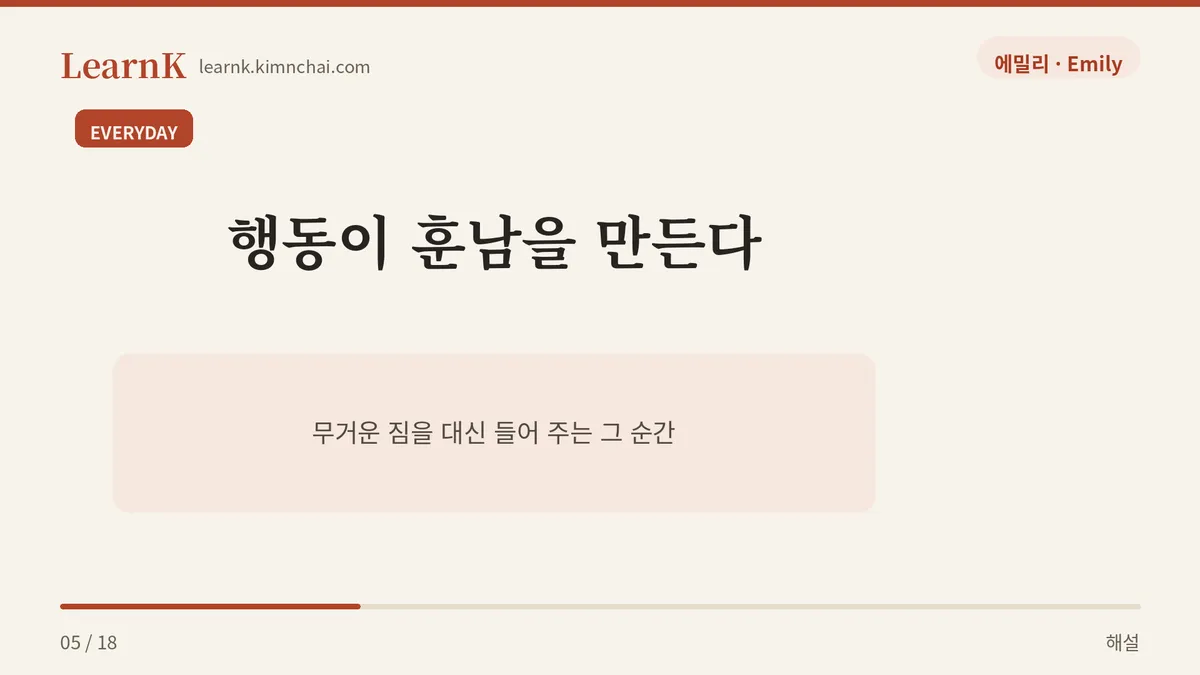
Because of this, 훈남 has one quality that other compliments about appearance don’t. You can become a 훈남 through your actions. His face is exactly the same as it was yesterday, but the moment he carries a heavy bag for someone, holds the convenience-store door for the person behind him, or crouches down to meet a child at eye level to talk to them, Koreans will call him a 훈남. On the flip side, no matter how good-looking a man is, if his attitude is cold and rude, the word 훈남 will never stick to him. Half of this word is appearance; the other half is attitude.
The intensity isn’t top-tier. If 완전 잘생겼다 (“he’s seriously handsome”) is an exclamation, 훈남 is a signal of mild affection. It’s a noun, so you use it as 훈남이다, 훈남 스타일, 훈남 미소, and the matching term for women is 훈녀 (hunnyeo). And one very important feature — 훈남 is mostly a word used when the person isn’t there. Miss this point and your compliment turns into a faux pas.
See It in a Real Conversation
Scene: Saturday afternoon, in front of an apartment complex. Emily rolls up pushing a secondhand bike.
Emily: 나 이거 오만 원에 샀어. 근데 판매자가 완전 훈남이었어. I got this for 50,000 won. And the seller was a total hunnam.
Jun-kyung: 오, 잘생겼어? Oh, was he good-looking?
Emily: 그게 아니라, 브레이크까지 조여 주고 바람도 넣어 줬어. 웃는 게 딱 훈남이야. Not that — he tightened the brakes and even pumped the tires. That smile, total hunnam.
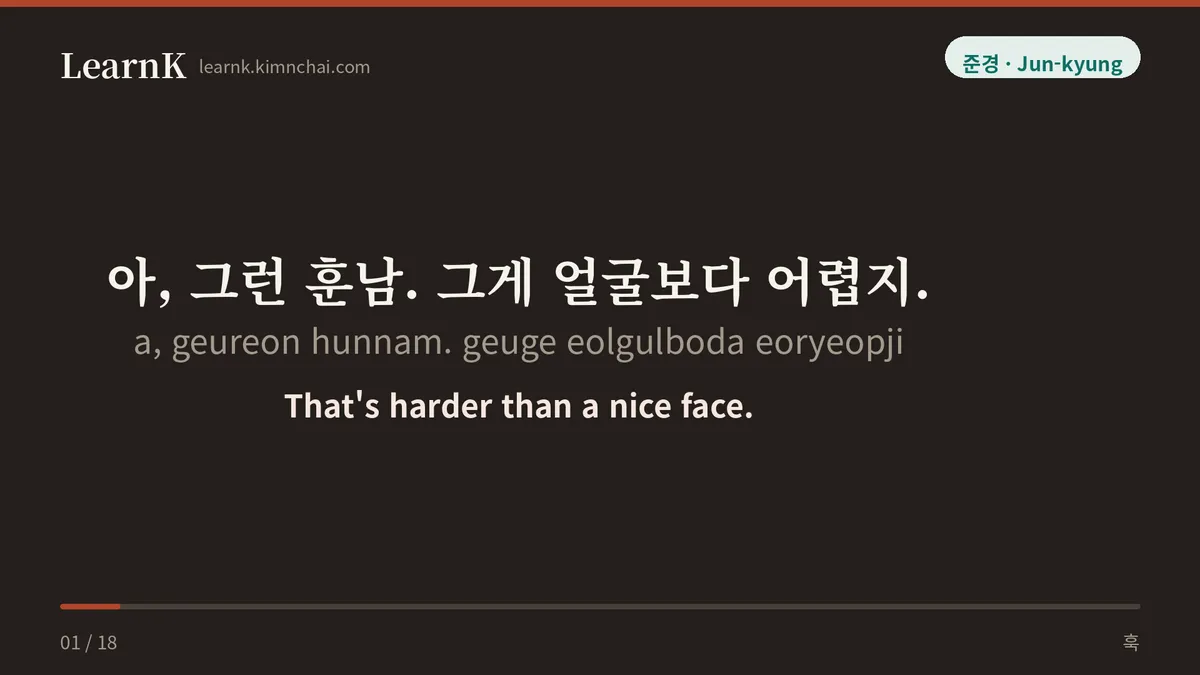
Jun-kyung: 아, 그런 훈남. 그게 얼굴보다 어렵지. Ah, that kind of hunnam. That’s harder than a nice face.
Emily: 야, 너도 나 이사할 때 냉장고 옮겨 줬잖아. 그날은 좀 훈남이었어. Hey, you moved my fridge when I moved in. You were kind of a hunnam that day.
Jun-kyung: 좀? 나 그날 허리 나갔는데 겨우 ‘좀’이야? “Kind of”? I threw my back out that day and all I get is “kind of”?
When It Sounds Off
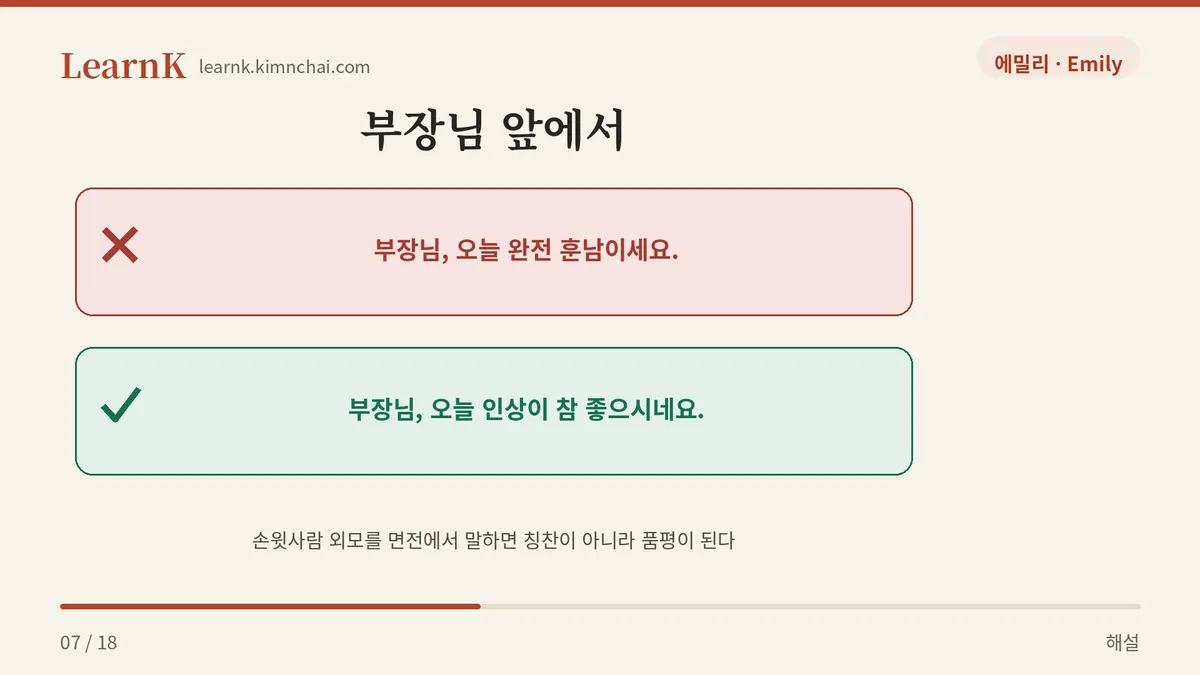
✗ (To your manager, face to face) 부장님, 오늘 완전 훈남이세요. ✓ (To your manager, face to face) 부장님, 오늘 인상이 참 좋으시네요. — “You look really lovely today, sir.” → 훈남 is a piece of slang that peers toss back and forth casually. Said to someone senior to you — and to their face, no less — it doesn’t land as a compliment; it lands as an appraisal.
✗ (To a client contact you’re meeting for the first time) 실물이 훨씬 훈남이시네요. — “You’re much more of a hunnam in person.” ✓ (To a coworker after you’ve left the meeting) 아까 그분 훈남이더라. — “That guy earlier was a real hunnam.” → 훈남 is a word that gets passed around when the person isn’t present. Commenting on the appearance of someone you’ve met for work, right to their face, doesn’t read as friendliness — it reads as pressure. The grammar is perfectly fine; the setting is wrong.
Example Sentences by Situation
1. Giving a friend the rundown the day after a blind date
This is where you describe someone whose first impression was ordinary but who got better the more you talked. 훈남 pairs especially well with this kind of “slowly rising” appeal, rather than love at first sight.
완전 훈남은 아닌데, 만날수록 훈남이더라. wanjeon hunnameun anninde, mannalsurok hunnamideora He’s not a knockout, but the more I met him the more of a hunnam he became.
2. Dropping a line in the group chat while watching a drama
This is the reaction that comes right around the scene where the male lead quietly holds an umbrella over someone. Here, 훈남 points not to the actor’s face but to the character’s actions.
이번 드라마 남자 주인공, 딱 요즘 말하는 훈남이야. ibeon deurama namja juingong, ttak yojeum malhaneun hunnamiya The male lead in this drama is exactly what people mean by hunnam these days.
3. Seeing a younger relative after a long time
In Korea, this comes up often around the holiday dinner table. Telling a grown nephew or younger cousin 잘생겼다 (“you’re handsome”) is a bit direct, but 훈남 can be handed over with a smile, like a joke, so it’s easy to say.
우리 사촌동생 군대 갔다 오더니 훈남 다 됐네. uri sachondongsaeng gundae gatda odeoni hunnam da dwaenne My cousin came back from the military a full-on hunnam.
Politeness Levels and Similar Expressions
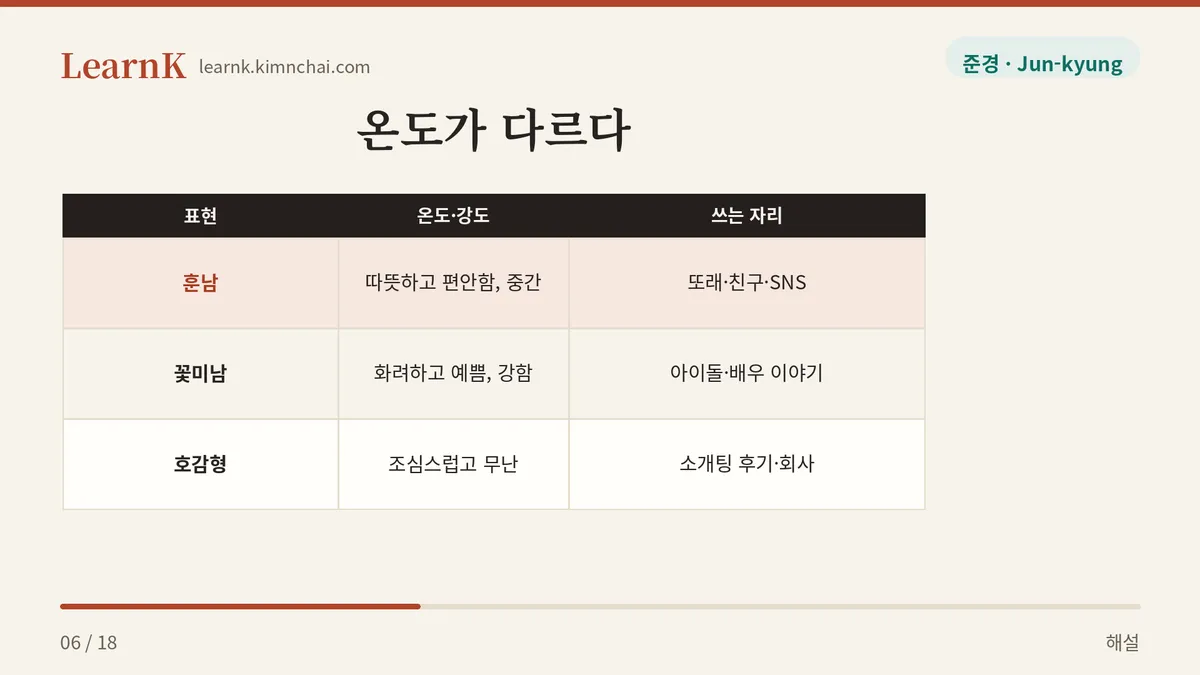
훈남 has no formal register of its own. You can say 훈남이십니다, but it’s just a piece of slang with a polite ending tacked on, so instead of sounding respectful it only sounds more awkward. In situations that call for formality, you have to swap the word out entirely.
| Expression | Warmth / Intensity | Where it’s used |
|---|---|---|
| 훈남 (hunnam) | Warm and easygoing; medium intensity | Peers, friends, social media — mostly when the person isn’t around |
| 꽃미남 (kkonminam) | Flashy and pretty; strong | Talking about idols and actors; over-the-top for an ordinary acquaintance |
| 미남 (minam) | Neutral, somewhat formal | Anywhere — though it feels literary, or like something an older person would say |
| 호감형 (hogamhyeong) | Cautious and safe | Blind-date debriefs, the office — places where judgments have to be handled carefully |
| 훈훈하다 (hunhunhada) | The warmth of an entire scene | Used for situations and moods, not just people |
That last row is worth a closer look. 훈남 attaches only to people, while 훈훈하다 attaches to scenes. Watching a father and son walk side by side, you can say 저 장면 참 훈훈하다 (“what a heartwarming scene”), but you would never say 저 장면 훈남이다.
Cultural Background — A Compliment That Doesn’t Rank
The word formation is simple. Take the 훈 from 훈훈하다 and attach 남(男), meaning “man.” It spread through internet message boards in the mid-2000s, and 훈녀, built the same way, followed close behind.
What’s interesting is placing it next to the buzzword of the generation right before it. 얼짱 (eoljjang) joins 얼굴 (“face”) with 짱, meaning “the best,” and it came out of a culture of posting photos and ranking who came out on top. 훈남 doesn’t rank anyone. There’s no problem at all with five 훈남 in a single classroom. It’s easiest to understand this way: after a word that treated looks as a competition had its run, 훈남 was born out of the fatigue that followed.
It also overlaps with a shift in dramas. There was a time when the male lead in a Korean drama was typically cold, wealthy, and rough in the way he spoke. As viewers began giving their hearts, for longer, to characters who were kind and considerate, a name was needed for that whole type of role — and 훈남 filled the spot. Even now, the word almost never goes missing from an article introducing the male lead of a Korean drama. So there’s one more reason for Hallyu fans to learn it: these two syllables keep showing up when you read show synopses and viewer reactions.
One thing to add: this word is a compliment, but at the end of the day it’s a remark about someone’s outward appearance. Using it lightly among close friends is natural, but at work or when meeting someone for the first time, not bringing up anyone’s looks at all — whoever they are — is what fits the current sensibility in Korea.
Today’s Quiz
Which of the following uses 훈남 (hunnam) most naturally?
- Directly to your manager after a meeting ends — “부장님, 오늘 훈남이세요.”
- Sitting with a friend at a café, watching a stranger who just gave up his seat to an elderly person at the next table — “저 사람 훈남이다.”
- In the personal statement on your résumé — “저는 성실하고 훈남입니다.”
See the answer
Answer: 2
It’s between peers, said where the person in question can’t hear it, and prompted not by his looks but by an action just witnessed. This is the seat where 훈남 sits most comfortably.
Number 1 amounts to appraising a senior colleague’s appearance to his face, which is rude. It should be swapped for 인상이 참 좋으시네요. Number 3 is awkward twice over: it puts slang in an official document, and it calls the writer himself a 훈남.